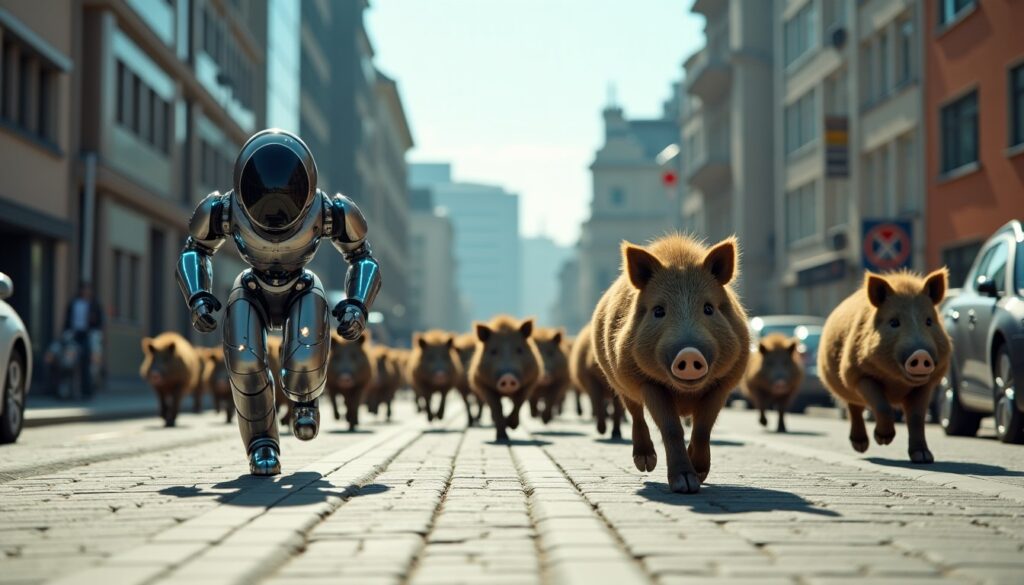
In an era where technology is increasingly infiltrating our daily lives, a spectacular scene unfolded in the heart of the Polish capital, Warsaw. On April 12th, a video showing a robot named Edward in the middle of a chase with a pack of wild boars immediately went viral across international social networks. Far from being mere entertainment, this technological intervention illustrates a new frontier between robotics and urban wildlife management. Located in a busy parking lot, Edward calmly and determinedly follows a group of wild animals, driving them away from the city and back toward the nearby forest. This humanoid robot, developed to operate in complex urban environments, embodies not only a technological breakthrough but also a compelling example of peaceful coexistence between urban areas and nature. The video loops endlessly, fascinates millions of internet users, and raises questions about the potential role similar machines could play in managing public spaces undergoing ecological transition.
Through this extraordinary chase, the Polish capital offers a true lesson in innovation in the use of robots. Edward does not hunt; he gently guides, acting as a mediator between city dwellers and sometimes disruptive urban wildlife. As the wild boars invade several neighborhoods in Warsaw, searching for food in trash bins and creating anxiety-inducing situations, this robot offers an alternative to controversial traditional methods such as hunting or traps. This technological choice would reduce risks for residents while respecting animal presence. The use of Edward also serves as a case study to reflect on future uses of robotics in protecting public safety in urban settings. But this viral success raises certain challenges: how far should we entrust such sensitive missions to robots? Does Edward’s popularity, now a true social media star, mask the real issues of his deployment?
- 1 The robot Edward in action: an unexpected chase in the heart of Warsaw
- 2 A robot unlike any other: characteristics and design of Edward for urban wildlife management
- 3 The difficult coexistence: wild boars and city dwellers, a growing challenge in Warsaw
- 4 Edward, social media star: an unusual influencer robot
- 5 The reasons for a technological adoption: why favor a robot to drive away wild boars?
- 6 Social and ethical implications of the use of urban robots facing wildlife
- 7 The future of robotics in cities: between wildlife regulation and smart urban management
The robot Edward in action: an unexpected chase in the heart of Warsaw
The viral video of Edward, the robot chasing a pack of wild boars through the streets of Warsaw, offers a spectacle both surprising and revealing of the challenges posed by wild animals in a rapidly expanding urban setting. This robot, a Unitree G1 humanoid measuring 1.32 meters, was specially designed to operate in complex environments, able to navigate easily over varied terrains such as narrow sidewalks, concrete parking lots, and green spaces among buildings.
In the parking lot where the situation became critical, Edward approaches the wild boars with great gentleness, avoiding any sudden movements liable to cause panic among the animals. The robot’s ability to follow the herd over a significant distance without excessively frightening the wild boars is the key to its success. It thus acts as a calming mediator, accompanying the boars out of inhabited areas toward the forest, a place better suited to their wild life.
This intervention represents a respectful alternative to the use of weapons or traps, which are generally necessary to manage these animals when they invade urban neighborhoods. By avoiding violence, Edward shows that it is possible to solve a complex problem through intelligent technologies adapted to their environment.
A robot unlike any other: characteristics and design of Edward for urban wildlife management
To understand this feat, we must first examine Edward’s technical specifications and design. This humanoid robot, a Unitree G1 model, measures about 1.32 meters tall, making it large enough to attract animals’ attention but with a moderate stature, sufficiently reassuring so as not to provoke aggression. It is equipped with a backpack housing a set of advanced sensors to continuously analyze its surroundings.
The software driving Edward was carefully developed, incorporating recognition and artificial intelligence algorithms allowing the robot to react in real time to the movements and behaviors of the wild boars. This adaptability explains its effectiveness during this urban chase: it does not act arbitrarily but follows a precise protocol learned during intensive training sessions carried out in China at the end of 2025.
Another key advantage: its mobility. Edward can move effortlessly over different types of surfaces, from concrete slabs in parking lots to muddy forest paths. Its balance and reception of environmental data allow it to adjust its speed to never surpass that of the wild boars, which is crucial to avoid unnecessarily frightening these wild animals. Its smooth, controlled gait combines robustness and gentleness, in perfect harmony with the urban and natural landscape.
| Characteristic | Description | Advantage in the intervention |
|---|---|---|
| Size | 1.32 meters | Sufficient dimension to impress without provoking aggression |
| Mobility | Multi-terrain (parking lots, sidewalks, green spaces) | Adaptability to complex and varied urban environments |
| Sensors | Real-time object recognition and animal behavior | Reactivity and movement adapted to animals |
| AI Software | Non-violent distancing protocol | Contactless management and minimal stress for wildlife |
| Training | Intensive sessions in China late 2025 | Mission-specific learning for urban deployment |
The difficult coexistence: wild boars and city dwellers, a growing challenge in Warsaw
The recurring presence of wild boars in several Warsaw neighborhoods has raised major safety and well-being concerns for residents over several years. These animals, attracted by easily accessible food in waste containers, can cause property damage and pose dangers, particularly when in groups, like the pack seen in the video with Edward.
Reported incidents notably include attacks on passersby, garden vandalism, and general disruption of urban comfort. Resident reactions range from fear and fascination to sometimes rejection. The complexity of managing these animals in an urban context explains the gradual emergence of innovative solutions, such as using robots like Edward.
This fragile balance between wildlife and urban life highlights a significant environmental challenge: how to respect animals while ensuring the safety of human populations? Edward’s intervention offers a response that goes beyond the classic opposition between tolerance and regulation, proposing a peaceful and non-invasive interaction with the wild boars.
Since his spectacular live appearance, Edward has become a true celebrity on social networks. His wild boar chase videos now total over 500 million views on various platforms such as TikTok, Instagram, and X. This meteoric popularity far exceeds a simple local news piece and has propelled this robot to the status of a modern icon between technology and urban ecology.
Edward does not just push back wild boars; he also interacts with pedestrians, enriching his presence in urban settings and humanizing his machine figure. This unifying image has led to appearances on television shows and even in the Polish Parliament, symbolizing a new form of technological and social influence.
Edward’s success illustrates a contemporary trend: influencer robots capable of raising awareness about environmental or safety issues while entertaining the public. Nevertheless, this media exposure raises several questions. Is Edward merely entertainment or a genuine public interest tool? Does this digital star hide concrete limits in his operational capabilities?
The reasons for a technological adoption: why favor a robot to drive away wild boars?
The decision to introduce a robot in the management of urban wild boars responds to strong criticisms leveled against traditional methods. Hunting and traps remain classic solutions but deeply divide public opinion. Such interventions often lead to tension, both ethically and in terms of public safety. Turning to Edward offers a more harmonious alternative, adapted to the evolution of contemporary cities.
By driving away wild boars without direct contact, the robot minimizes risks for residents while reducing the animals’ stress. The absence of violence sends a strong message in a context where society increasingly demands regulations more respectful of biodiversity. Moreover, Edward operates predictably and controllably, which limits hazards related to wildlife.
Finally, this technology also symbolizes robotics’ entry into the civilian sphere with a clear and pragmatic use. The Polish experience could pave the way for innovative management of interspecies interactions, particularly in metropolises where urban pressure on natural habitats intensifies.
| Traditional method | Advantages | Limitations |
|---|---|---|
| Hunting | Quick eradication of unwanted animals | Divides public opinion, risks for humans and animals |
| Trap | Selective method | Often perceived as cruel, high animal stress |
| Robot Edward | Non-violent, safe, and respectful | Still experimental technology, high cost |
Social and ethical implications of the use of urban robots facing wildlife
The deployment of Edward raises fundamental questions about the integration of robots in our daily environment. From a social perspective, the presence of a robot chasing animals in a public space profoundly modifies the relationship between humans, animals, and machines. Robotics becomes a key player in ecological regulation, inviting us to rethink our relationship with living beings and technology.
From an ethical standpoint, using a robot to drive away wild boars avoids direct conflicts and physical violence. But this approach also raises the question of technological intervention limits: at what point should the machine yield to nature? This dilemma is crucial to preserve a balance between efficiency and respect for animal integrity.
Moreover, Edward’s media coverage impacts public perception. While some see him as undeniable progress, others question the growing dependence on robots and possible dehumanization of shared spaces. This discussion remains open, especially in an urban context where the diversity of expectations is broad.
The future of robotics in cities: between wildlife regulation and smart urban management
The case of Edward in Warsaw could represent a turning point in how future cities manage not only wildlife but also other aspects of urban life. In 2026, metropolises are increasingly confronted with the need to integrate technological solutions to improve safety, cleanliness, traffic, and coexistence between humans and animals.
Robots capable of intervening in contexts as varied as wild boar presence demonstrate a major advance toward smarter and more sustainable cities. They can participate, for example, in the preventive detection of animals, guidance, monitoring of green spaces, and ecological mediation actions. These uses could multiply to improve residents’ comfort while promoting local biodiversity.
However, the deployment of such machines must imperatively be accompanied by precise regulatory frameworks. Transparency about their use, safety of interactions with humans and animals, as well as environmental ethics will be at the heart of debates. Urban robotics must be conceived as a lever for responsible innovation.
Thus, Edward is not just a technological dream or a simple viral gadget. He illustrates a futuristic intervention model that could well become the norm in the near future, contributing to harmonious coexistence between the city, technology, and nature.