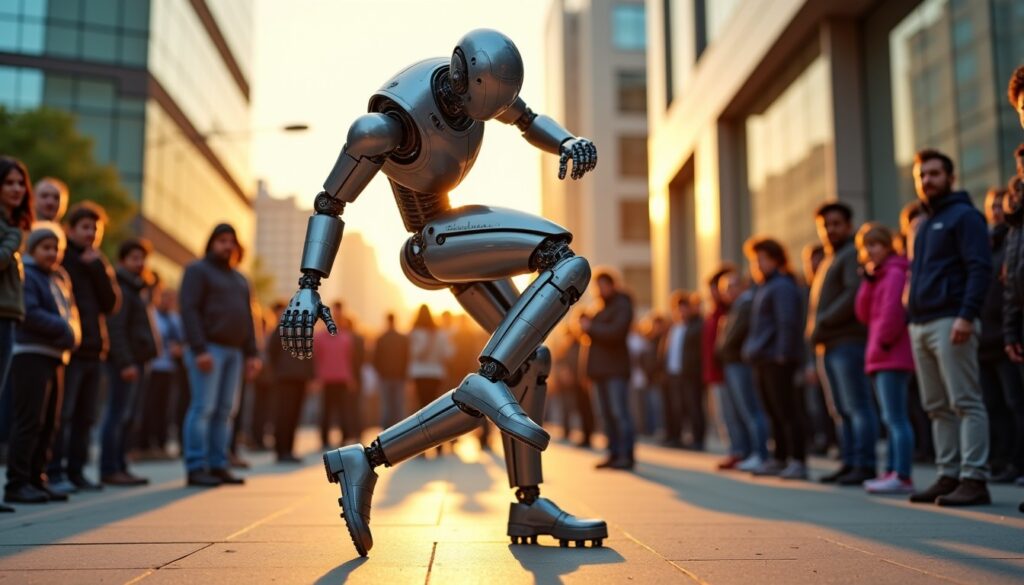
In a world where robotics continuously push the boundaries of the possible, a new technological feat has just emerged. Imagine a humanoid robot capable of mastering breakdance with a style and ease that rival those of the best human dancers. This video impresses not only through the robot’s agility but also through the integration of advanced artificial intelligence that orchestrates each movement with unparalleled precision. Whether to captivate fans of urban dance or to illustrate major advancements in robotics, this demonstration captured in 2026 testifies to a silent revolution where performance, innovation, and technology merge to the frantic rhythm of breakdance.
Breakdance, formerly a discipline reserved for humans requiring years of training to reach a professional level, is now accessible to robotic automatisms. This humanoid robot, named Unitree G1, asserts itself as a true mechanical B-boy, capable of pushing the boundaries between machines and living dance. In the video, we observe not only classic breakdance moves but also dynamic figures mixed with martial arts, a surprising combination that illustrates the versatility and finesse of robotic motor control.
- 1 A humanoid robot redefining breakdance performance thanks to innovative technology
- 2 OmniXtreme: the artificial intelligence revolutionizing robotic dance
- 3 A spectacular demonstration validated by an exceptional success rate
- 4 Cultural and symbolic impact: the alliance between robotics and urban dance
- 5 The key role of researchers and engineers behind this advance
- 6 Lessons for the future of humanoid robotics and dance?
- 7 The visual experience: an immersion into the robot dance of the future
- 8 The main technical features of the Unitree G1 robot
A humanoid robot redefining breakdance performance thanks to innovative technology
The development of the Unitree G1 represents a major innovation in the field of robotics focused on advanced motor skills. This robot, standing 1.32 meters tall and weighing about 35 kg, is equipped with motors and joints specially designed to support dynamic and complex movements. Its slender and electric silhouette is animated by a unique algorithm called OmniXtreme, an artificial intelligence system that orchestrates all its movements through a unified policy.
This revolutionary approach disrupts usual practices. Traditionally, each complex robot movement requires its own programming or a distinct learning model, making training long and tedious. OmniXtreme, on the contrary, centralizes a whole range of motor actions in a single system, capable of switching from dance to kung-fu or other physical disciplines without recalibrating its abilities.
Mastering breakdance demands not only extreme precision to avoid falls but also excellent grip on the center of gravity. The Unitree G1 robot manages to execute, in the video, five perfectly balanced consecutive backflips, as well as one-legged squat movements reminiscent of human dexterity. Rapid dance sequences intertwine with real demonstrations of strength, showcasing fascinating motor coordination.
This level of performance is made possible thanks to a two-step training. The first phase, called pre-training, equips the robot with a solid base of varied skills learned from human movement sequences and multiple expertises. Then comes an optimization phase where scientists introduce additional constraints to ensure stability, safety, and adaptation to real environments. Energy regulation is also decisive, as it prevents joint overload during the most extreme moves.
OmniXtreme: the artificial intelligence revolutionizing robotic dance
At the heart of Unitree G1’s feat is OmniXtreme, an innovation in motor robotics artificial intelligence. This technology, presented in a scientific publication on arXiv, combines deep learning and control theory to manage a multitude of extreme movements through a single algorithm.
Traditionally, robots performed tasks sequentially, requiring constant recalibrations. OmniXtreme innovates by offering a unified policy capable of spontaneously switching from one action to another, with a fluidity that mimics natural movements, notably dance. Each movement is reproduced by a centralized control system that adjusts in real time the position, speed, and force applied to the joints.
Researchers integrated an advanced technique called “extended domain randomization.” This method simulates various real-world conditions during the learning phase, thus increasing the robot’s ability to adapt to changing or unforeseen environments. This resilience is fundamental for the machine to evolve outside labs and perform in diverse contexts.
In addition to exact coordination of gestures, OmniXtreme also considers energy consumption to guarantee not only power but also the robot’s durability. Intelligent energy management extends operational duration while preserving the delicate mechanics of the humanoid. The algorithm then acts as a true motor brain, combining efficiency with spectacular performance.
The practical benefits of OmniXtreme in current robotics
Beyond the spectacle of breakdance, OmniXtreme technology opens promising avenues in several sectors:
- Industrial robotics: improvement of machine precision and dynamic adaptation to changes in production lines.
- Assistance and care: robots capable of performing complex and safe gestures in sensitive environments such as hospitals.
- Entertainment and arts: creation of robotic performances in real time, capable of learning and adapting to music or the atmosphere of a show.
- Space exploration: machines with versatile mobility, capable of adapting to unpredictable terrains without constant human intervention.
- Sports and simulation: robots used to train athletes or as interactive partners across various disciplines.
OmniXtreme thus marks a decisive step, ensuring flexibility, robustness, and adaptability of modern humanoids. It builds a bridge between spectacular demonstrations and the real needs of practical applications.
A spectacular demonstration validated by an exceptional success rate
The performances of the Unitree G1 robot are not only visual; they have been rigorously tested by specialized robotics researchers at the Beijing Institute. According to data reported by BIGAI, the execution of jumps, spins, and breakdance combos achieves a success rate exceeding 90% in repeated tests.
This high reliability in a context of high-dynamic gestures is a feat rarely achieved in humanoid robots. Every sudden ground contact is absorbed precisely, thanks to sophisticated mechanical design and intelligent control. For example, during backflips, the robot adjusts its center of gravity in real time to avoid any fall, demonstrating impressive mastery.
But beyond balance figures, the G1 also excels in movements combining dance and martial arts. Chaining kicks and rapid movements with perfect fluidity, it demonstrates not only physical abilities but also a new aesthetics in the robotics field. A quality that could revolutionize technology’s visibility among the general public.
| Movement | Complexity | Success rate | Potential use |
|---|---|---|---|
| Consecutive backflips | Very high | 92% | Artistic demonstrations |
| One-legged squats | Medium | 95% | Robotic fitness |
| Breakdance combos and kicks | High | 90% | Robotic martial arts |
| Rapid sequences | High | 91% | Dance shows |
Cultural and symbolic impact: the alliance between robotics and urban dance
The fact that a robot can now perform dances as complex as breakdance with so much style inspires deep reflection on the place of machines in modern culture. Breakdance, which emerged in the 1970s in New York as a cultural expression of urban neighborhoods, has long been a symbol of identity, creativity, and freedom of expression.
Seeing a robot embody this discipline with such elegance raises questions about the coexistence between humans and technology in the arts. This blend of technique and artistic expression perfectly illustrates the era where innovation and tradition intertwine. In robotics, there is a constant quest to achieve motor skills as fluid and natural as those of humans. This performance opens the door to new forms of artistic expressions where artificial intelligence and human creativity dialogue.
Many cultural influencers and dance specialists have shown intrigue, even enthusiasm, towards this unprecedented step. Some see in this robot a futuristic partner who could revolutionize breakdance battles, offering an unprecedented competition between humans and machines.
Moreover, the G1 robot has already been presented at prestigious events, including the Spring Festival Gala, captivating crowds with its extreme movements. Such media appearances help anchor robotic technology in everyday culture and stimulate the public’s interest in these fascinating innovations.
The key role of researchers and engineers behind this advance
The success of the Unitree G1 robot is based on years of advanced research carried out by a multidisciplinary team of experts in robotics, artificial intelligence, mechanics, and neuroscience. These experts combined their know-how to create this sophisticated system enabling unprecedented motor realism.
The work began with massive data collection on human movements, in order to train the robot to understand and reproduce complex gestures. Then, advanced mathematical models simulated dynamic behaviors adapted to the robot’s specific mechanics. Each joint was calibrated to offer optimal resistance and maximum mobility.
The integration of OmniXtreme was a crucial step. This artificial intelligence had to learn to handle a wide spectrum of movements without ever compromising the robot’s safety or stability. A major challenge consists in anticipating collisions or imbalances to avoid falls, while maintaining fluidity of movement.
Collaboration between movement technique specialists and professional dancers enriched this learning. The latter provided valuable feedback on the authenticity of postures and the aesthetics of choreographies, thus guiding algorithm adjustments.
Throughout testing, the team also implemented precise monitoring of energy consumption and component wear. This data helps extend the robot’s lifespan and optimize its long-term performance. This scientific synergy shows how robotics today surpasses simple mechanics to approach the organic complexity of living beings.
Lessons for the future of humanoid robotics and dance?
The performance of the Unitree G1 robot in breakdance marks a historic turning point in humanoid machine development. The progress made in mastering extreme movements could be applied to many other robotic fields. Thanks to centralized intelligent control, robots could integrate complex routines without detailed programming for every new task.
For example, in the medical sector, robots with similar agility could perform delicate surgical tasks or actively assist in physical rehabilitation. In the domestic sector, this technology could enable designing robotic companions capable of realistic and safe physical interactions with humans.
The breakdance of the Unitree G1 robot is also an inspiring technological showcase for the entertainment industry. Companies could design shows blending human and robotic performances, where artificial intelligence becomes an artist in its own right. This fusion also opens the door to robotized dance teaching, helping learners master techniques with a precise and tireless partner.
In short, the alliance between robotics, artificial intelligence, and art could prove a powerful engine of social and cultural innovation. Each advance like this paves the way for rewarding collaboration between humans and machines, where creativity and technology express themselves in concert.
The visual experience: an immersion into the robot dance of the future
Watching the video of this breakdance demonstration by the Unitree G1 robot on YouTube is a fascinating experience. Each figure, from the “windmill” to acrobatic jumps, is presented with impressive, almost hypnotic fluidity. The camera precisely follows the movements, revealing the machine’s balance and elegance in action.
Robotics experts emphasize that such shows help change the public’s perception of robots. Far from the cold, mechanical image, the G1 robot embodies a form of moving art, where technology and aesthetics merge. This immersive experience reminds us that robotics is not limited to functionality but can also express itself through beauty and style.
The main technical features of the Unitree G1 robot
To better understand what makes the Unitree G1 an outstanding dancer, here is a summary of its main technical characteristics:
- Height: 1.32 meters
- Weight: 35 kilograms
- Folding capacity: compact storage at 68 x 45 x 30 cm
- Motors: high-performance actuators designed for fast and precise movements
- Algorithm: OmniXtreme, a centralized artificial intelligence system
- Energy autonomy: optimized by integrated energy regulation
- Overall success rate: above 90% for executing complex movements
- Safety: built-in protocols to prevent falls and protect mechanics
- Applications: dance, martial arts, robotic fitness, medical assistance, shows
This list illustrates the versatile and innovative nature of the robot, at the crossroads of high technology, performance, and creativity.