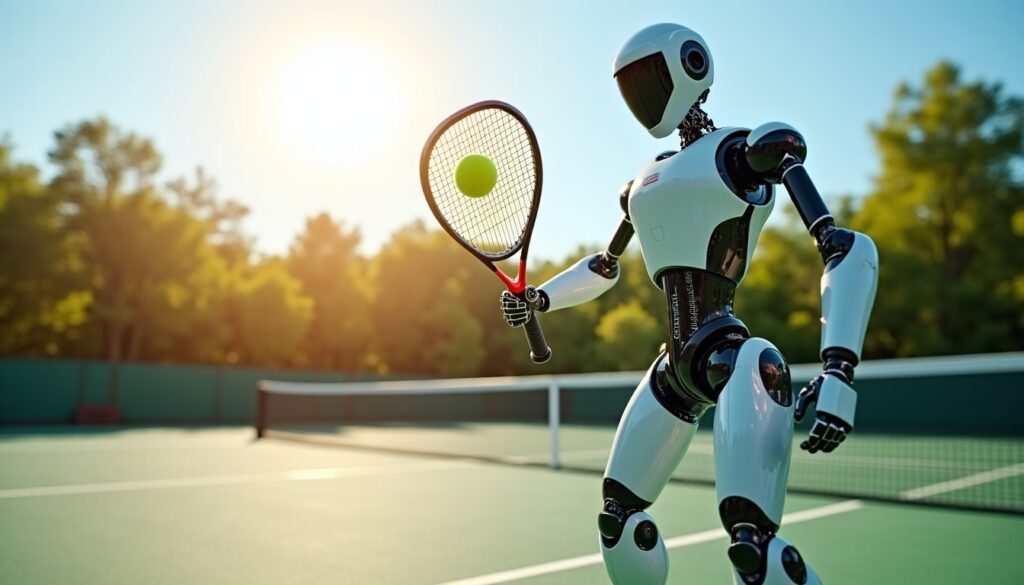
In a world where technology is advancing at a breakneck speed, robotics and artificial intelligence are infiltrating fields previously reserved for humans. In 2026, a major milestone is reached in sports, with the mastery of tennis by a humanoid robot in just five hours of learning. Imagine Djoko, the undisputed star of human tennis, finding himself overwhelmed by a futuristic opponent capable of returning the ball with astonishing precision and agility. This phenomenon raises questions not only about physical performance but also about the very nature of rapid learning in a technological environment.
The G1 robot, developed by Unitree and powered by the artificial intelligence system called LATENT, demonstrates that the boundary between human and machine is blurring. This robot, 1.30 meters tall and weighing only 35 kilograms, capable of sustaining rallies and adapting its movements in real time, revolutionizes the very concept of athletic performance. Through a series of tests and training sessions, it has succeeded in assimilating the complex skills of traditional tennis in less time than a human beginner would take to reach a basic level. The challenge goes far beyond the game: this breakthrough highlights the power of learning based on imperfect data, the continuous evolution of robotic capabilities, and the future of machines in sports and industries previously accessible only to humans.
- 1 How a humanoid robot like G1 revolutionizes rapid tennis learning
- 2 The key technology behind the performance: the LATENT system developed at Tsinghua University
- 3 Analyzing G1 robot results: performance and limits in the sports context
- 4 Potential applications of robots’ rapid learning in sports and beyond
- 5 How sports robotics redefines the notion of sporting performance in 2026
- 6 Humanoid robots and sports competition: a controversial but promising alliance
- 7 The future of sports robots: towards a synergy between humans and machines
- 8 The technical features of G1 that ensure its mastery of tennis in five hours
How a humanoid robot like G1 revolutionizes rapid tennis learning
Tennis is a sport known for the demanding combination of reflexes, strength, agility, and precision. Usually, humans require months, even years, of intensive training to reach a level allowing them to sustain rallies in real game situations. Yet, the G1 robot has proven that these skills can be assimilated in just five hours, thanks to differentiated and innovative learning.
The secret lies in the methodical approach employed by the LATENT artificial intelligence system. Rather than trying to teach the robot complete sequences or perfect gestures, researchers chose a segmented learning method. By isolating specific fragments of movements — such as forehands, footwork, or body adjustments — the robot imitates and integrates the essential tennis fundamentals more quickly. This technique allows superior flexibility because the robot does not confine itself to a rigid protocol but learns to adapt and improvise according to the situations.
Through reinforcement learning, G1 can continuously correct its errors, even when working from imperfect or incomplete data. This multidimensional self-adjustment capability represents a turning point in sports robotics. It is no longer enough to have large amounts of perfect data for the machine to acquire complex skills; it is the quality and diversity of fragments that feed its effective progression. Thus, rapid training is no longer limited to repeating a precise gesture but relies on intelligence capable of analyzing and interpreting raw information.
This paradigm has not only allowed G1 to master standard shots but also to react effectively in dynamic conditions, foreshadowing a future where robotics no longer simply execute programmed commands but become truly autonomous on the court, anticipating ball trajectories and modulating responses in real time.
The key technology behind the performance: the LATENT system developed at Tsinghua University
The LATENT project, led by researchers from the prestigious Tsinghua University, symbolizes the alliance between robotics and innovation in artificial intelligence in the sports field. Unlike traditional approaches that require massive and perfectly calibrated datasets, LATENT exploits the richness of imperfect data to accelerate and make robot learning more efficient. This innovation helped take the Unitree G1 humanoid from a clumsy apprentice stage to a promising player in record time.
The method used involves training the robot with sessions based on capturing human movements by fragmenting the complexity of gestures. Researchers record limited sequences from motion capture, sometimes even imprecise, then the machine learns to reconstruct these movements and extract their essence to apply them effectively.
This approach presents a double advantage: it drastically reduces real data training time and allows the robot not to get stuck facing common errors or inaccuracies in human gestures. The system uses a hybrid force-position control complemented by dual encoders to guarantee near-human precision in executing movements, even when it comes to demanding tasks such as quickly adjusting posture while moving a racket.
But LATENT does not stop at mere gesture imitation: a second level of artificial intelligence intervenes in real time to analyze the game situation. The robot does not mechanically repeat a learned movement; it evaluates the ball’s trajectory and speed to choose and then adapt the most appropriate gesture.
This adaptive intelligence mechanism is a major breakthrough as it brings robotics closer to a fully natural human behavior on a tennis court. The robot’s agility, its ability to maintain balance, jump, and continuously reposition during rallies illustrate LATENT’s sophistication, already considered a disruptive technology in the landscape of robotics applied to sport.
Analyzing G1 robot results: performance and limits in the sports context
G1’s on-court performances surprised with their precision and fluidity, but it is the way these results fit into a broader logic that intrigues. Technically, the robot succeeds in about 90.9% of its forehands and 77.8% of its backhands depending on targeted zones. It can also return balls reaching speeds of 15 meters per second, which is a respectable pace compared to human standards.
These figures highlight the effectiveness of the LATENT system and AI’s potential to quickly gain competence on complex tasks. By simulating more than 10,000 attempts, researchers refined the algorithms to maximize the robot’s precision and responsiveness, establishing models capable of adapting to variations in courts and ball bounces.
However, it is essential to remember that conditions remain controlled. G1 is not yet a complete tennis player: it does not manage complex strategies, the psychological pressure of matches, nor prolonged physical endurance. It operates on punctual and clearly defined tasks, without yet competing with the best humans in the diversity and depth of the game.
These limits illustrate that even with advanced artificial intelligence and rapid training, robotics has not yet achieved an integrated and hybrid form of play comparable to that of a professional athlete. The incredible performance achieved remains a targeted feat, but already it opens the way to industrial and sporting applications where robotics can effectively intervene in situations requiring precision and agile adaptation.
Potential applications of robots’ rapid learning in sports and beyond
The case of G1 transcends the simple sporting feat. The ability of a humanoid robot to quickly assimilate complex gestures from imperfect data is a promising path for many sectors. In the coming years, one can imagine machines able to train quickly and well on new tasks, adopting flexibility and autonomy previously inaccessible.
In sports, this technology could serve as training assistants, adaptive virtual partners, or even coaches capable of analyzing and instantly correcting gestures. It could also contribute to the rehabilitation of injured athletes through personalized robotic learning programs.
Beyond sports, many industries would benefit from this approach. Whether in fine handling, robotic medicine, or automated services, the development of robots capable of rapid and adaptive learning will transform operational prospects and reduce costs linked to long programming or training phases.
Robotics and artificial intelligence thus find themselves at the heart of a dynamic where performance is no longer measured only by brute strength but by intelligent, economical, and reproducible adaptation capacity in original and unpredictable environments.
How sports robotics redefines the notion of sporting performance in 2026
The G1 robot, with its lightning-fast learning, casts new light on the criteria of sporting performance. Until now, mastering tennis required an accumulation of hours, intensity of effort, and long refinement, where endurance and repetition dominated.
This new reality shows that with technology and sophisticated artificial intelligence, skill acquisition can be swift, questioning the supremacy of physical strength and years of training. This is a case where rapid learning, based on precise robotics, can both match and, in some cases, surpass raw human performance.
However, this does not exclude the value of psychological, strategic, and emotional skills typical of human players. A match against a robot could, in a few years, resemble a duel between an execution machine and a player of tactical intelligence. The debate on the role of machines in sports competitions would then be more topical than ever.
For amateurs and professionals alike, this technology also opens the door to highly advanced analyses of gestures, positions, and strategies, enriching the very experience of the game with real-time data and tailored adjustments.
Humanoid robots and sports competition: a controversial but promising alliance
The appearance of robots such as G1 on tennis courts fuels debates about the integration of artificial intelligences into sports competitions. If these machines can learn quickly and achieve impressive precision, the question of their place in a traditional sports environment divides opinion.
Some see these innovations as a natural extension of technology serving sport: they raise training levels, help diagnose technique, or even create hybrid competitions where humans and machines compete under specific rules.
Others, however, fear a dilution of human values, where authentic sporting performance would be eclipsed by mechanical or programmed capabilities. This concern prompts reflection on ethical and regulatory standards that will have to frame this future.
In 2026, initiatives are already underway to organize robotic tennis competitions, as well as exhibitions where humans and robots share the stage. This coexistence, though young, reveals enormous potential to redefine the very nature of sport and its founding acts.
The future of sports robots: towards a synergy between humans and machines
The path laid out by the G1 robot is only a starting point towards a future where the human-machine alliance will be omnipresent in sports, industrial, and everyday activities. Rapid learning, capitalized in the tennis context, could be transposed to other complex disciplines like basketball, football, or gymnastics.
This collaboration could push individual limits while promoting enriching interaction, where technology amplifies human intuition and skills. One can thus imagine robot training assistants able to adapt in real time or automated analysis systems offering instant feedback on performance.
Robotics in 2026 no longer aims merely for strict automation but aspires to complementarity with humans: learning together, improving mutually, taking on shared challenges. This model opens unprecedented perspectives in training, competition, and exchanges.
The best innovations often arise from the meeting of disciplines: here, the convergence between robotics, artificial intelligence, and sport pushes the boundaries of what seemed possible while raising essential philosophical and practical questions for the future.
The technical features of G1 that ensure its mastery of tennis in five hours
To understand the speed and precision of G1’s learning, it is necessary to analyze its mechanical and electronic assets. Weighing only 35 kg for 1.30 m, G1 integrates a complex system of sensors, motors, and algorithms that allow it to move fluidly, execute precise gestures, and maintain balance in dynamic contexts.
Here are the main features that explain its performance:
- Hybrid force-position control: This system used on its arms combines optimal force and precise positioning, allowing adapted and flexible strikes.
- Dual encoders: These devices provide fine measurement of joint movements, essential for fluid coordination.
- Lifting capacity: Each arm can lift up to 3 kg, sufficient to handle the racket and quickly adjust posture.
- Agility: G1 can jump, fold, and balance in real time, which is crucial in a sport as dynamic as tennis.
- Imitation and reinforcement learning system: Its algorithms allow the robot to learn from each rally and adapt accordingly.
- Sim-to-real simulation: Before each real test, G1 trains in a virtual environment with random parameters to strengthen its robustness against unforeseen events.
| Feature | Description | Impact on sports performance |
|---|---|---|
| Height | 1.30 m | Allows good mobility on the court |
| Weight | 35 kg | Ensures a balance between stability and speed |
| Force per arm | 3 kg | Precise racket handling and fast gestures |
| Movement precision | Dual encoders + hybrid control | Fluid execution and gestures adjusted to the game phase |
| Learning | Imitation + AI reinforcement | Quick adaptability and real-time corrections |
These technical innovations allow G1 to quickly solve tennis-specific challenges: anticipating the ball’s trajectory, precisely adjusting its position, and hitting effectively despite the game’s dynamics. It is an example of modern robotics combined with artificial intelligence serving performance.