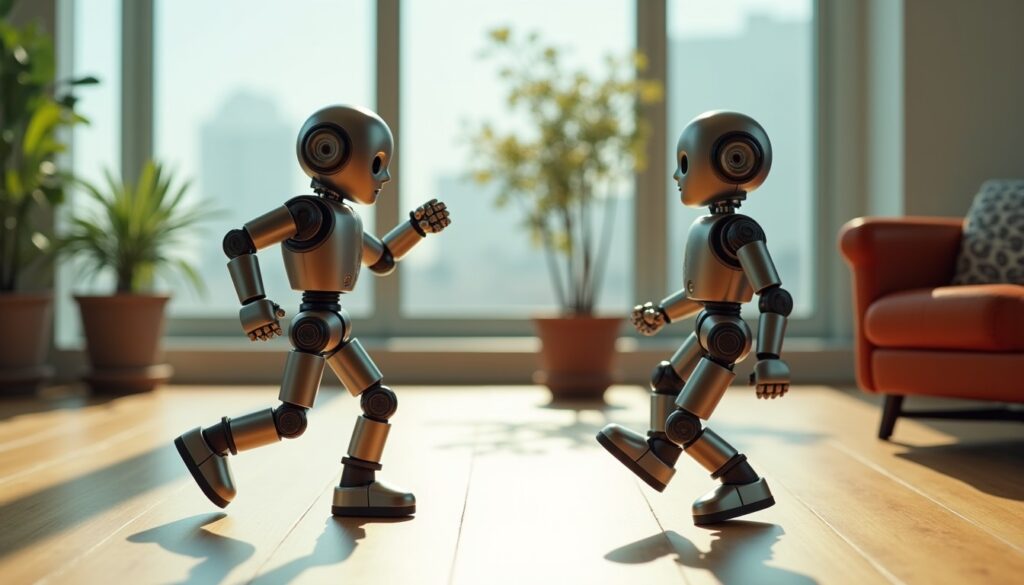
In the fascinating world of robotics and technological feats, the illusion of perfection is often present, especially when a humanoid robot attempts iconic moves like Michael Jackson’s moonwalk. This legendary dance, popularized in the 1980s thanks to choreography of astonishing fluidity, has become a universal cultural reference. The recent video of a robot trying to reproduce this legendary move to the famous song Billie Jean quickly captured the attention of internet users. The initially promising show quickly turned into a comical and unexpected scene, raising profound questions about the current limits of robotics. Between fascination and bursts of laughter, this demonstration highlights the still persistent gap between the raw technicality of machines and their ability to adapt to the unpredictability of the real world.
Fascination with dancing robots is not new. Many researchers invest years in designing machines capable of closely imitating human movements, integrating balance, speed, and coordination. The moonwalk, with its apparent simplicity and delicate execution, represents a major challenge: it requires not only precise control of the lower limbs but also the ability to manage a surprising visual offset. In this viral video, broadcast on social media in 2026, the humanoid begins with confidence and synchronization, managing to reproduce a few rhythmic steps with a certain mechanical elegance. However, a simple detail – a step on the stage – disrupts the whole and triggers a spectacular fall that made the rounds on the internet.
Beyond mere humorous distraction, this mishap raises a crucial point in the development of robotic technologies: the management of the unexpected. While the initial performance seems to indicate that we are on the dawn of a new era where the distinction between human and machine in artistic terms could blur, the unexpected fall reveals how rigid and preprogrammed these systems still are. The video thus offers us a blend of hope and limits, revealing that despite impressive advances, robotics still has many steps to overcome to achieve true autonomy and adaptability worthy of the best human dancers.
- 1 The technical challenges for a robot imitating Michael Jackson’s moonwalk
- 2 The humorous failure, a revealing sign of robotics limits in 2026
- 3 The viral video: driver of robotics popularization among the general public
- 4 The challenges of humanoid robots adapting to the unexpected
- 5 How robotics progresses despite these mishaps on stage
- 6 Ethical and cultural issues raised by robotics in dance
- 7 The importance of planning and preparation in robotic demonstrations
- 8 Future perspectives for robotics in dance and live performance
The technical challenges for a robot imitating Michael Jackson’s moonwalk
Reproducing the moonwalk, Michael Jackson’s signature movement, is a precision feat that combines motor finesse and sense of rhythm. For a robot, executing this dance step relies on several complex parameters. First of all, dynamic balance control is absolutely essential. When a human dancer slides backward while giving the impression of walking forward, their brain constantly adjusts forces and posture. For a robot, programming this gait requires a sophisticated algorithm capable of simultaneously directing the motors of the legs and feet in complete synchronization.
Sensors also play a crucial role. Modern robots are equipped with numerous sensors (gyroscopes, accelerometers, pressure sensors) that allow detecting the exact position of each joint and measuring stability. Yet, automatic balance recovery when an obstacle appears—like a stage step—remains a true challenge. The viral video clearly illustrates this: the robot notices the step only after hitting it, reacts awkwardly the first time, then completely fails to adapt during the second encounter. This complexity illustrates the difficulty robotic systems have in anticipating or improvising when facing simple hazards for a human dancer.
Moreover, advanced robotics involves simultaneous and fluid coordination among several body segments to avoid breaking the illusion of dance. The arms, for example, must naturally accompany the leg movements while respecting the music’s tempo. In this video, despite the robot swinging its arms with some regularity, the movements still lack naturalness. This absence of suppleness is likely due to the limitations of current motors and software that remain focused on predefined trajectories, without real possibility of dynamic adaptation.
To emphasize this aspect, it is interesting to compare dancing robots to other robotic creatures designed for specific tasks. For instance, current quadruped robots—used notably for industrial inspections—show a better ability to manage uneven terrain thanks to real-time adaptation algorithms. This highlights that “artistic” robotics must combine motor precision and environmental sensitivity, which remains a still vague technological frontier.
The humorous failure, a revealing sign of robotics limits in 2026
Despite decades of research and impressive progress, this scene of a robot awkwardly slipping and falling on stage in front of an audience underlines that humor and imitation comedy hold an important place in robotics. The error, far from going unnoticed, becomes a truly viral moment and draws attention to the machines’ still glaring imperfections. Consequently, this failure becomes a form of involuntary humor that defuses futuristic ambitions and allows the public to identify more closely with these machines while still not mistaking them entirely.
The spectators present witnessed a kind of two-level performance, where the show blends wonder and situational comedy. Some even thought they were observing a simulated technical feat, a kind of staging where the fall would be planned. Yet, this is not the case. This video exposes the robot’s vulnerability to the unexpected. Humor, in this context, is not only a narrative gadget but a mirror on technical reality: great leaps forward exist, but the humanity of the gesture, the ability to anticipate or improvise in case of a problem, are far from being achieved.
We can even go further by pointing out that this failure illustrates a central paradox of artistic robotics: trying to imitate human perfection often reveals the gap that still separates us from the machine. It also feeds a broader discourse on the relationship between humans and robots, where human imperfection remains a precious quality, a signature of authenticity and creativity.
This viral video, with its impact on social platforms such as TikTok or X, has helped energize the debate on what robotic dance will be in the future. Between the emergence of artificial intelligence capable of creativity and mechanical rigidity, this burlesque fall raises many questions about the evolution of the field.
In a world saturated with images and content, the video of a robot failing to reproduce the moonwalk becomes a true viral phenomenon able to reach millions of people. This highlights how social media transform the most cutting-edge technological events into accessible and often playful collective experiences. This viral success is all the more remarkable because few users understand the underlying technical mechanisms of this demonstration. But the power of the image prevails.
Viral videos play a key role in disseminating technological innovations, often by reducing their complexity to a strong, shocking, or funny moment that is easily shareable. Here, the “dancing” robot, with its memorable failure, becomes a popular icon and an entry point for the general public to take an interest in robotics advances. This media success has a dual effect: it arouses both wonder at progress and a critical, sometimes mocking, look that pushes to question the current limits.
Content creators, whether researchers, startups, or artists, know that virality grants significant influence, and many try to replicate this type of impact with other demonstrations. However, the case of the failed moonwalk reminds us that spectacular shows are often built on meticulous preparations, and that in real conditions, technology is still fragile.
| Advantages of viral videos in robotics | Limits revealed by live failures |
|---|---|
| Rapid popularization of innovations | Exposure of major technical errors |
| Facilitated public access to technology | Risk of negative perception regarding reliability |
| Stimulates interest in research and development | Limits credibility of simplified demonstrations |
| Encourages discussions on ethics and sense of progress | Can reinforce stereotypes about robots |
The virality of a video can thus be a tremendous lever for robotics, provided not to forget the complexity behind spectacular images.
The challenges of humanoid robots adapting to the unexpected
The most critical point in the robot’s failure trying the moonwalk lies in its disastrous handling of a simple obstacle: a step on the stage. This apparently trivial detail reveals a fundamental challenge for current robotics: real-time adaptability. Unlike humans, who instinctively integrate their environment, constantly analyzing the ground, distances, and obstacles, robots remain largely prisoners of pre-programmed routines.
In this demonstration, the robot hits the step the first time, wobbles but manages to straighten up, intriguing the audience. Some even thought they were witnessing a moment of technical improvisation. Unfortunately, the robot falls into the same trap just after, without managing to analyze the situation differently. The automatic correction mechanism appears defective, a clear proof of limits in recognizing and handling the unexpected.
This is a widespread issue in humanoid robotics. Locomotion algorithms work perfectly in controlled environments but struggle as soon as unprogrammed elements appear. This rigidity greatly constrains their use in daily contexts, where an infinite variety of unexpected situations can occur. For example, a domestic robot tasked with tidying a living room will have to face scattered objects, uneven rugs, or moving people, which is today beyond the reach of most machines performing well in standardized environments.
This adaptability challenge is at the heart of research in embedded artificial intelligence. For humanoid robots to truly integrate into everyday life, they must learn to perceive, anticipate, and react to unplanned events, relying on flexible databases and deep learning capabilities in real time.
How robotics progresses despite these mishaps on stage
This spectacular failure must not overshadow the rapid advances in artistic robotics and in the sector as a whole. Technology evolves at an impressive speed, and each year sees the emergence of more intelligent, faster, and more capable machines. The field of robotic dance is one of the most visible laboratories where advanced hardware, artificial intelligence, and sensory recognition mingle.
The latest generations of humanoid robots in 2026 have sophisticated motorized systems, capable of very precise movements and integrating machine learning algorithms that continuously improve their moves in relation to music and the environment. Many research projects aim to integrate more sensitive sensors, more powerful processors, and above all software capable of making real-time decisions, paving the way for increasingly natural performances.
However, the complexity of human locomotion, the need to reconcile balance, fluidity, and creativity pose challenges engineers strive to resolve step by step. Demonstrations are regularly organized, proving that the robot can perform complex choreographies under ideal conditions, but the real technological breakthrough will come when they can improvise and adapt like human artists.
It is also interesting to note the role of interactive shows where the robot evolves in collaboration with humans, integrating non-verbal signals to adjust its behavior. These experiments reveal that the convergence between AI, robotics, and art is a promising path to gradually overcome traditional mechanical limits.
Ethical and cultural issues raised by robotics in dance
The show of a robot trying to copy Michael Jackson does not only raise technical questions but also stimulates a wider debate on the cultural impact of robots in the arts. Dance is a deeply human form of expression, imbued with emotion, history, and social interaction. The robotization of artistic gestures invites reflection on the consequences of this transition.
On the one hand, the rise of dancing robots offers new artistic perspectives, opening the possibility of choreographies impossible to perform by human bodies, thanks to movements of extreme precision and unmatched endurance capacities. On the other hand, it questions the authenticity and emotional value of a performance that lacks soul, even if it is ultra-technically sophisticated.
Debates in 2026 increasingly focus on the role machines will play in artistic creation: simple execution tools, creative partners, or direct competitors? The viral video and its involuntary humor also remind us that the public likes to see “human” robots but remains sensitive to their mistakes, which give them a kind of unexpected charm and realism.
- Emotional authenticity versus mechanical perfection
- Impacts on the profession of human dancers
- Social interactions and robotization of performances
- The role of creativity in artificial intelligence
- Questions of intellectual property and cultural imitation
The importance of planning and preparation in robotic demonstrations
Robots shown in viral videos, like this robot trying the moonwalk, often give the impression of a spontaneous feat. However, these shows are the result of rigorous preparations. Choreographies are largely predetermined, environments are designed to limit the unexpected, and every movement is carefully tested. This planning is essential to create an illusion close to perfection.
The management of technical sequences, anticipation of errors, and minimization of fall risks are crucial steps. For example, during the preparation of the demonstration, a team of engineers and programmers must calibrate sensors for each expected action, configure motors, and provide backup mechanisms in case of incidents. When the unexpected step on the stage caused the robot’s fall, it highlighted the importance of taking every parameter into account—even the most insignificant—to avoid a potential fiasco.
The table below illustrates the key steps in preparing a successful robotic demonstration, showing the level of requirement needed:
| Step | Description | Objective |
|---|---|---|
| Choreography design | Development of movements adapted to the robot’s capabilities | Align programming with physical limits |
| Motor programming | Precise calibration of actuators and motors | Ensure fluidity and synchronization |
| Training in a controlled environment | Performance rehearsal in a setting without hazards | Optimize success and limit failure |
| Simulation of the unexpected | Testing reactions to obstacles or errors | Better manage unplanned situations |
| Adaptation and readjustment | Modification of algorithms based on results | Improve performance robustness |
These steps show that the stage demonstration is far from a simple instant feat, but the result of long-term work.
Future perspectives for robotics in dance and live performance
Despite current setbacks, robotics continues its rise in the artistic universe with ambitious perspectives for the coming years. The marriage between technology and human expression opens the way to unprecedented experiences, where human dancers and robots could co-create interactive performances. Advances in artificial intelligence, flexible materials, and embedded electronics should enable robots to gain fluidity, expressiveness, and autonomy.
Several laboratories and artistic companies are already working on hybrid choreography projects integrating robots and humans sharing a stage space. These projects explore new forms of interaction, where the robot would no longer be a simple imitator but a partner capable of reacting to a dancer’s improvisations or audience reactions. These innovations also promise to increase dance accessibility for people with disabilities, through the creation of adapted robotic aids.
The challenge for 2030 will be to overcome the current limits observed in videos like this one and make robots intelligent enough to adapt not only to space but also to artistic and emotional unpredictability. Robotic dance could then establish itself as an art form in its own right, both fascinating and moving, capable of pushing the boundaries of human creativity.