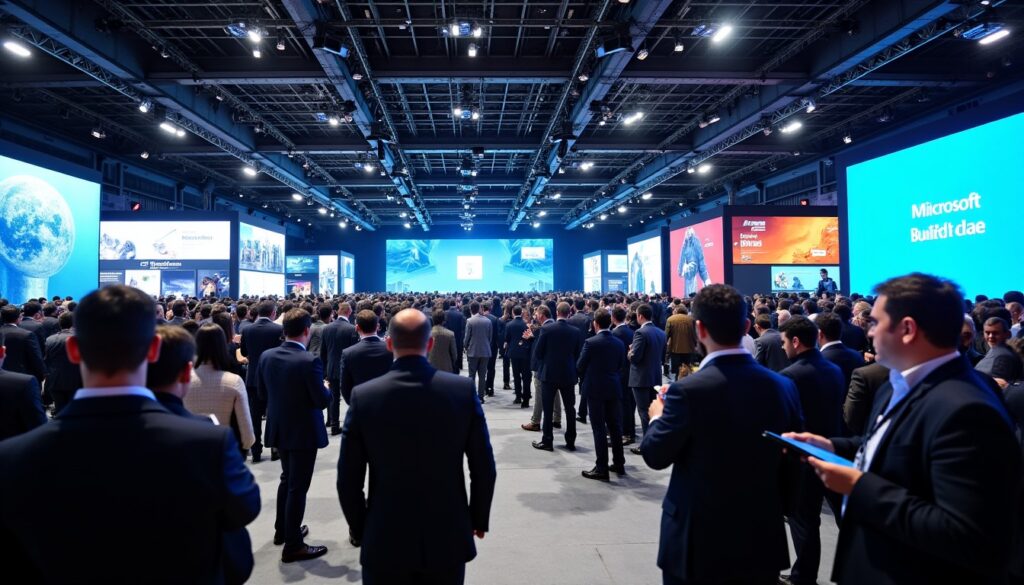
The Microsoft Build 2026 conference, which will take place in early June in San Francisco, is already sparking excitement and curiosity among developers and technology enthusiasts. In addition to being a must-attend event for announcements related to software development, this edition promises a deeper immersion into the world of artificial intelligence, with a focus on intelligent agents and a more interactive experience. With the venue moving from Seattle to the Fort Mason Center, Microsoft aims to offer a more intimate setting conducive to deep learning and enhanced collaboration among participants. However, despite the anticipation, it should be kept in mind that Build 2026 may not unveil major hardware revolutions or the imminent arrival of a supposed Windows 12. This positioning might disappoint some, but it highlights Microsoft’s strategy, which seems to prioritize consolidation and optimization of existing tools, notably around cloud computing, new AI features, and the Azure ecosystem.
This year, technological innovations mainly revolve around the rise of so-called “agentic” artificial intelligence agents, designed to act autonomously and coordinate various complex tasks within the operating system and business applications. These advances are expected to profoundly transform the developer experience by providing more efficient, intelligent programming tools capable of better integrating production into everyday work environments such as Excel, Teams, or Outlook. In parallel, GitHub Copilot will evolve toward greater autonomy, with significant improvements in debugging, testing, and project management, thus constituting a key driver for developer productivity.
Yet, this digital transformation also raises questions about the limits and risks associated with overly rapid or poorly controlled automation. The challenge will be not to fall for typical marketing fog, where promises of unlimited AI capabilities obscure concrete challenges such as operational errors or deployment costs. In this context, announcements around Azure AI Foundry and Windows AI Foundry will take on strategic importance: they aim to facilitate the integration of AI solutions both in the cloud and locally on users’ machines, ensuring speed, privacy, and flexibility.
Ultimately, Microsoft Build 2026 is shaping up as a pivotal moment where the company bets on a pragmatic and technical approach more than spectacular demonstrations. By understanding this framework, development stakeholders and observers will better know what to expect and how to avoid disappointments, focusing on the essentials: tools that truly enhance developers’ capabilities and creativity while anticipating upcoming technological market evolutions.
- 1 Decoding AI Agents at the Heart of Microsoft Build 2026 Innovations
- 2 GitHub Copilot 2026 News: Towards an Autonomous and Proactive Development Assistant
- 3 Azure AI Foundry and Windows AI Foundry: Foundations for the Next Wave of AI Innovations
- 4 Windows 12 and Managing Expectations at Microsoft Build 2026
- 5 Developer Experience at Microsoft Build 2026: Richer Tools for Intelligent Applications
- 6 Cloud Computing Perspectives: Azure’s Strategic Role in Microsoft Build 2026
- 7 What Disappointments to Avoid at Microsoft Build 2026 to Not Spoil the Event?
- 8 What’s New on the Xbox and Surface Side at Microsoft Build 2026? A Key Point of Attention
- 9 Microsoft Build 2026 by the Numbers: Between Sobriety and Focus on the Essential
Decoding AI Agents at the Heart of Microsoft Build 2026 Innovations
The notion of “agentic,” which will hold a central place at Microsoft Build 2026, embodies a major evolution in the field of artificial intelligence. Unlike traditional systems that often only provide responses or recommendations, these AI agents are designed to act autonomously in various contexts, orchestrating multiple complex operations simultaneously. This multidimensionality allows envisioning capable digital assistants able, for example, to automatically book rooms, schedule meetings, correct code, or even test different scenarios in predictive mode.
One of the major challenges is to avoid errors that can occur when artificial intelligences multiply actions without rigorous supervision. It is known that early agent prototypes can sometimes perform inappropriate actions, such as deleting important files, moving calendar events at the wrong time, or offering erroneous recommendations. To overcome these pitfalls, Microsoft must rely on a solid technical foundation: Azure AI Foundry is positioned as the base of a platform capable of managing these agents in a coordinated, secure, and scalable manner.
This cloud infrastructure aims not only to provide the models needed for these agents but also to simplify their deployment across different systems, as well as their integration into consumer and professional applications. For example, Microsoft 365 suites like Teams and Outlook should benefit from these agents to automate and streamline collaborative work, thus delivering real added value to everyday users.
The concept of agentic also raises ethical and control questions. It is necessary to clearly define the limits of action for these agents and implement supervision mechanisms to prevent IA initiatives from harming human work or leading to cognitive overload due to intrusive automation. Moreover, the technical challenge of orchestrating multiple agents interacting with one another to accomplish chained tasks without conflicts is fertile ground for innovation in software development.
List of expected benefits from AI agents according to Microsoft Build 2026 announcements:
- Advanced automation of repetitive tasks within business applications
- Ability to act proactively rather than reactively
- Multi-agent orchestration to manage complex workflows
- Seamless integration into the Microsoft 365 ecosystem
- Improved productivity with intelligent assistance during planning and execution phases
- Customization possibilities according to the specific needs of developers and businesses
This transformation of AI agents, beyond simple textual interaction, therefore marks a turning point in their role and impact on daily work. Microsoft Build 2026 should deepen these aspects by unveiling concrete prototypes and more in-depth business applications, while clarifying use cases that will allow fully leveraging this agentic ecosystem without falling into the usual traps.
GitHub Copilot 2026 News: Towards an Autonomous and Proactive Development Assistant
GitHub Copilot, which has revolutionized software development over recent years, is expected to take a new step at Microsoft Build 2026. This intelligent code assistance service gains autonomy and intelligence, which opens the door to advanced capabilities in managing development projects. It will no longer be just about basic code suggestions but tools capable of debugging, testing, profiling, and correcting software at an integrated and smooth level.
According to sources reported by Reuters, Microsoft is concurrently working on developing new in-house AI models specifically dedicated to coding. This promises to increase Copilot’s suggestion accuracy and relevance while reducing errors and common code smells in complex projects.
Copilot’s improvements aren’t limited to better syntactic analysis. In 2026, this intelligent assistant aims to become a true “augmented developer.” Imagine a tool that proposes, tests, and validates patches automatically, or anticipates potential bugs before they occur. This type of automation offers considerable time savings for teams, especially in environments where delivery quality and speed are key.
In parallel, special attention is paid to collaboration. Copilot will better integrate with project management platforms and team workflows to facilitate coordination and code review. This includes real-time collaborative analysis tools, where each developer can benefit from active AI assistance without losing control of their project.
As with any technological progress, this advancement raises questions about the trust placed in the assistant, especially in cases where Copilot could quickly generate errors. Microsoft will have to provide solid guarantees, for example via auditing or human supervision systems, in order to prevent this assistant from becoming a source of frustration rather than productivity.
Comparative table of GitHub Copilot features before and after Microsoft Build 2026:
| Features | Current version | Expected post-Build 2026 version |
|---|---|---|
| Basic code suggestions | Present | Improved, more contextualized |
| Automatic debugging | Limited | Autonomous, with detailed diagnostics |
| Testing and profiling | Not supported | Automated, integrated into workflows |
| Proactive corrections | Manual, assisted | Automatic, contextual suggestions |
| Team collaboration | Basic | Integrated and improved in real time |
This new generation of Copilot promises to profoundly change developers’ daily lives, reducing cognitive load related to repetitive tasks and increasing delivery reliability, while maintaining a smooth interface for development teams. Microsoft Build 2026 will spotlight these innovations, thus laying the foundation for more efficient practices in software development.
Azure AI Foundry and Windows AI Foundry: Foundations for the Next Wave of AI Innovations
The Azure cloud infrastructure remains a central pillar of Microsoft’s artificial intelligence offering, notably thanks to Azure AI Foundry, a set of tools and services that allows training, deploying, and orchestrating AI models optimally and economically. At Microsoft Build 2026, the focus will be on improvements around multi-model management and on the efficient transition from prototypes to large-scale production.
Thanks to these advances, companies will be able to better control costs associated with computing resources, manage AI response latency, and maximize the efficiency of development teams. The challenge is also to guarantee the scalability of complex architectures that integrate multiple models simultaneously, a growing demand in many sectors.
In parallel, Microsoft has developed Windows AI Foundry, a complementary platform aiming to bring AI capabilities directly to local machines. This hybrid approach enables running certain AI models on the NPU (Neural Processing Unit), GPU, or even CPU of PCs without systematically relying on the cloud. This feature is crucial for reasons of privacy, speed, and service continuity in case of network unavailability.
The combination of these two foundations – Azure AI Foundry in the cloud and Windows AI Foundry locally – forms a powerful ecosystem for developers. It offers them a dual capacity: to create high-performance intelligent applications and to dynamically adapt deployment based on usage contexts, whether in large cloud infrastructures or on connected devices.
Key expected benefits of the Azure and Windows AI Foundry hybrid approach:
- Reduction of operational costs through optimized AI model training
- Improved latency for more instantaneous responses
- Enhanced guarantees on sensitive data protection thanks to local processing
- Ability to operate offline in constrained environments
- Greater flexibility for developers in designing hybrid applications
Microsoft Build 2026 will certainly highlight several concrete demonstrations integrating these technologies, confirming their key role in Microsoft’s AI innovation strategy. This hybrid approach responds both to growing performance needs and concerns linked to data security and sovereignty in an increasingly connected digital world.
Windows 12 and Managing Expectations at Microsoft Build 2026
Despite many speculations, Microsoft Build 2026 will not be the setting for a surprise announcement of a brand-new Windows 12. This decision illustrates a conscious strategy to avoid excessive expectations and thus potential disappointments, while focusing attention on more pragmatic and concrete advancements.
Users accustomed to Microsoft conferences often expect a fresh look at the flagship operating system. However, Microsoft leadership now insists that Windows growth and transformation happen in stages, with incremental evolutions rather than sudden revolutions. This is especially true in the current context, where artificial intelligence is deeply integrated into system features without necessarily radically changing the interface or overall software structure.
This approach avoids two major pitfalls: on the one hand, an overload of new features difficult for users to assimilate quickly; on the other hand, the risk of disappointment due to overly high expectations. Instead, Microsoft bets on a user experience that gains in fluidity and performance thanks to AI tools such as Windows Agent Framework and Windows Agent Store, central to this edition’s announcements.
This highlights Microsoft’s intent to reposition Windows not only as an operating system but as an intelligent platform capable of integrating native AI agents. This orientation transforms the traditional perception of Windows and promises to renew its role within collaborative work and software development environments.
Developers and users can thus anticipate better integration of cloud and local services, optimized task management via autonomous agents, as well as a richer ecosystem with features adapted to current needs without waiting for a disruptive major version.
In summary, Microsoft Build 2026 invites a gradual renewal of Windows, where sobriety in announcements hides a strong ambition to embed artificial intelligence at the core of the system.
Developer Experience at Microsoft Build 2026: Richer Tools for Intelligent Applications
Technical conferences like Microsoft Build are primarily platforms to develop the ecosystem and make developers more productive. This year is no exception. The developer experience will be central to the discourse, with enriched programming tools to leverage various artificial intelligence-related innovations.
The challenge is to enable application creators to design more performant, interactive solutions adapted to the real needs of end users. This involves easier integration of AI agents into development workflows, providing more robust and flexible APIs, expanded documentation, and new testing environments.
A key focus will be simplifying the transition between AI prototypes and operational deployment, notably thanks to Azure AI Foundry. Developers will thus be able to leverage their innovations without being hindered by scaling issues, cloud resource management, or model compatibility.
Moreover, Microsoft will highlight new features in classic programming tools like Visual Studio to make coding more intuitive and faster via intelligent suggestions, automatic code quality analyses, and better integration of Copilot. This synergy between intelligent tools and shared work environments aims to boost creativity and responsiveness of development teams.
Main areas of improvement in the developer experience announced for Microsoft Build 2026:
- Advanced implementation of AI agents in workflows and IDEs
- API optimization to facilitate multi-model management
- Improvement of intelligent debugging and profiling tools
- Simplified deployment of AI applications from prototype to production
- Strengthening team collaboration through shared and synchronized tools
These improvements are intended to reduce the learning curve and democratize the use of advanced technologies while maintaining professional quality essential in ambitious projects. Ultimately, Microsoft Build 2026 appears as a springboard for developers seeking to master the new technological paradigms linked to AI and the cloud.
Cloud Computing Perspectives: Azure’s Strategic Role in Microsoft Build 2026
Cloud computing remains a fundamental pillar of Microsoft’s strategies, and the 2026 edition of Build will put this theme front and center. Azure, as a cloud platform, lies at the heart of technical innovations aiming to make AI models more accessible, more efficient, and better integrated into business processes.
Microsoft is focusing on how to provide developers with the best conditions to train and orchestrate multiple models simultaneously without degrading performance or increasing energy or financial costs. This is a major issue in a context where AI is omnipresent and expectations for agility are high.
Announcements might include new services, resource management optimizations, and tools to facilitate migration from prototypes to large-scale production. This dimension is crucial for companies seeking to quickly integrate AI applications into their business processes while controlling costs.
Azure will also serve as a relay for distributing AI agents, making their large-scale deployment possible in a variety of professional environments. The balance between cloud performances and local processing (via Windows AI Foundry) creates a coherent and promising hybrid ecosystem, offering technical and operational guarantees.
Synthetic table of Azure improvement areas for Microsoft Build 2026:
| Category | Objective | Expected Impact |
|---|---|---|
| Multi-model training | Optimize resource management | Cost reduction and reduced latency |
| AI orchestration | Facilitate simultaneous management of multiple agents | Better process coordination |
| Prototype-to-production transition | Simplify scaling of AI projects | Faster and more reliable deployments |
| Developer support | Provide robust and documented tools | Improved productivity |
In the current environment, these innovations should strengthen Azure’s positioning as the platform of choice for developing large-scale AI applications, responding to the needs of ambitious companies and innovative startups.
What Disappointments to Avoid at Microsoft Build 2026 to Not Spoil the Event?
While Microsoft Build 2026 raises significant expectations, it is crucial to adopt a clear-eyed view to avoid being swept away by unrealistic optimism. Certain points deserve close monitoring to prevent the event from disappointing participants or giving a distorted image of progress made.
The first disappointment could come from marketing hype around AI agents without clear demonstrations or tangible use cases. Promises of automation and augmented intelligence must imperatively rely on functional prototypes and sincere feedback, thus avoiding the classic hype effect that erodes developers’ trust.
Another potential source of dissatisfaction lies in the absence of major hardware innovations, notably no new Surface hardware or surprise Xbox console launches. Those expecting hardware highlights will therefore need to revise their ambitions: Microsoft favors a measured approach this year, oriented towards software and the cloud ecosystem.
Finally, the growing complexity of AI tools, even if they bring real functional gains, can also represent a barrier if their integration is not accompanied by a significant effort to simplify their handling. A confusing or overly fragmented developer experience risks slowing adoption of proposed innovations, which would be regrettable given the stakes.
Recommendations for fully enjoying Microsoft Build 2026 without disappointment:
- Keep realistic expectations about announcements, favoring concrete novelties over grand abstract promises
- Focus on tools and features that provide real gains in software development
- Closely follow practical demonstrations and use cases shared during technical conferences
- Ignore unconfirmed rumors about hardware launches to better appreciate software content
- Invest time in gradually mastering new tools to assess their relevance before industrial deployment
By exercising discernment, participants and observers alike can make the most of Microsoft Build 2026, enriching their understanding of upcoming innovations without falling into the pitfalls of poorly controlled enthusiasm.
What’s New on the Xbox and Surface Side at Microsoft Build 2026? A Key Point of Attention
Contrary to expectations on AI and cloud services, the hardware segment specific to Xbox and Surface lines appears to take a back seat for Microsoft Build 2026. No major hardware announcements are expected, confirming Microsoft’s desire to prioritize this event towards software innovations and developer tools.
This orientation does not imply neglect of these sectors but rather a strategic distribution of announcements: Xbox novelties are now more dispersed over dedicated gaming events, while the Surface line focuses on more discreet updates throughout the year.
However, this absence of major announcements should not overshadow the fact that foundations built around Windows AI Foundry and the software ecosystem indirectly fuel these products, improving their integration with cloud services, support for embedded AI, and the overall fluidity of uses.
Users and developers are thus invited to patience and vigilance, as these technical sublayers will eventually announce significant improvements even in physical products, for example in terms of battery optimization, intelligent performance, or advanced customization.
In short, Microsoft Build 2026 fits within a maturity perspective where the hardware-software convergence is built gradually, without spectacular announcements but with more solid foundations for future innovation cycles.
Microsoft Build 2026 by the Numbers: Between Sobriety and Focus on the Essential
The very organization of Microsoft Build 2026 reflects the desire to return to an experience centered on quality rather than quantity. Limited to two days, the event takes place at the Fort Mason Center in San Francisco, a cultural and event venue offering a more intimate setting conducive to deep exchanges, with approximately 2,500 participants expected.
This significant reduction compared to previous editions (3,000 to 5,000 people) reflects a will announced by Microsoft to favor more targeted interactions, adapted to a public of engaged developers rather than a broad general audience. Free online access also helps democratize participation while preserving the richness of technical content.
In terms of content, the conference is mainly structured around innovations in artificial intelligence, cloud computing, software development, and associated tools, as reflected by the key themes addressed in keynotes and workshops. Sobriety in programming corresponds to a general trend in the tech industry to concentrate energies on tangible announcements quickly applicable.
Synthetic table of key Microsoft Build 2026 data:
| Characteristic | Detail | Impact |
|---|---|---|
| Event dates | June 2–3 | Short and concentrated format |
| Venue | Fort Mason Center, San Francisco | Intimate setting conducive to collaboration |
| Number of participants | Approximately 2,500 registered | More targeted interactive experience |
| Access | In-person + free online streaming | Wide content distribution |
| Main themes | AI, intelligent agents, cloud computing, software development | Focus on practical tools and new features |
This format favors a better quality of experience for participants, as well as a concentration of announcements around concrete and pragmatic projects, while avoiding the often observed hype in other major professional technology events.