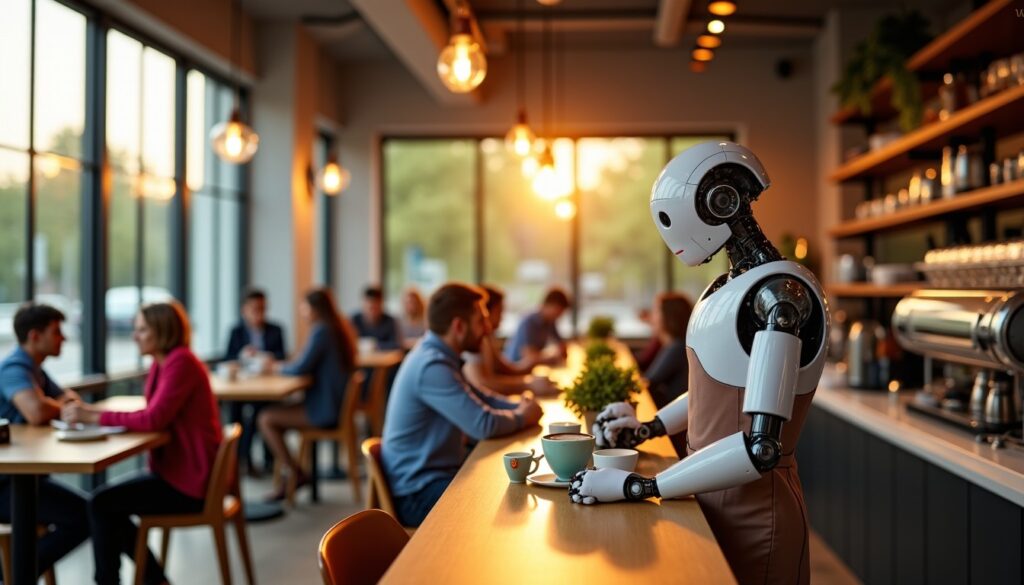
In a world where automation is increasingly infiltrating the heart of our daily activities, the coffee sector is no exception. Since 2021, a major player in this field has been shaking up the traditional barista service codes: Jarvis, a robot developed by the American company Artly. Designed to guide coffee lovers towards an experience where precision, consistency, and innovation come together, Jarvis does not just prepare a simple cup. It reproduces with exceptional meticulousness the gestures of a latte art champion, thus offering a coffee that is both aesthetic and flavorful. This barista robot far exceeds the image of an impersonal automatic machine, embodying a true digital craftsman capable of serving without ever taking a break or making mistakes influenced by stress or fatigue. Thanks to advanced artificial intelligence combined with precision robotics and computer vision, Jarvis transforms the way coffee is served, ensuring consistent quality while customizing each preparation down to the last millimeter. This technological feat already captivates the curiosity of coffee specialists and consumers, announcing a revolution in a historic sector that has often remained faithful to human traditions.
At a time when demand for sophisticated caffeinated beverages continues to rise in the most dynamic metropolises, the integration of Jarvis also reflects a paradigm shift in the relationship between man and machine in social spaces. This robot does not just replace the barista; it complements and perfects them. It analyzes in real time the foam, extraction, and temperature to instantly adjust its movements. Furthermore, Jarvis eliminates the uncertainties linked to human errors, guaranteeing a perfect drink regardless of the order volume. This advanced automation nevertheless raises questions about the place of humans in the profession, whose traditional skills seem progressively challenged by mechanical partners of a new kind. From high-end cafes in Portland to innovative concept stores in New York or Tokyo, Jarvis has become a fascinating symbol of a future where robotic technology and gustatory authenticity coexist to push the limits of what is possible in coffee preparation.
- 1 The origins of Jarvis: an ambitious project in robotics and coffee
- 2 The precise operation of Jarvis: between artificial intelligence and fine robotics
- 3 The key advantages of automation with Jarvis in coffee service
- 4 Current limitations of Jarvis and technical challenges of the barista robot
- 5 How Jarvis influences the perception of coffee in the contemporary world
- 6 Development prospects and future applications of the Jarvis robot
- 7 The societal and economic impact of Jarvis in the coffee world
- 8 Robotics at the service of barista art: a promising human-machine collaboration
The origins of Jarvis: an ambitious project in robotics and coffee
The development of Jarvis is not limited to a simple robotic arm aimed at the automatic command of a coffee machine. Behind this technological feat lies a clear ambition to faithfully reproduce the artistic gestures of an expert barista. It is Artly, an American company at the forefront of robotics and computer vision, that initiated this revolutionary project. The primary objective was not only to automate coffee preparation but above all to infuse it with the precision and elegance of industry professionals, such as latte art champion Joe Yang.
The idea was born from a simple observation: traditional coffee machines cannot recreate the finesse and aesthetics of certain drinks made by a human barista. Automated coffee often had the reputation of being practical but rarely memorable. To overcome this limitation, Artly relied on close collaboration with Joe Yang, whose movements were captured using sensors placed on his arms. Each precise gesture, whether the pouring of milk into a cup or the subtle rotations needed to draw a leaf or a heart in latte art, could thus be reproduced almost identically by the robot.
Beyond simple motor reproduction, Jarvis was designed thanks to a machine learning system. The integrated artificial intelligence records real-time results from high-definition cameras that monitor foam, texture, and the fidelity of the designs made. When the foam does not meet the expected quality, the robot automatically adjusts its next movements. This continuous learning loop grants it a unique status: that of a robotic barista capable of self-correction, making each cup better than the last and allowing consistent performance regardless of workload.
Jarvis does not merely simulate the precision of human movements; it also implements rigorous control of ingredient quantities. Artly claims that its robot controls the dose to the nearest tenth of a gram, an error margin impossible to reach for most humans during a rush in a busy café. The water temperature, pressure exerted on the coffee, extraction time, and milk emulsion are thus finely calibrated. Undoubtedly, Jarvis marks a new era in the preparation of caffeinated drinks, brilliantly combining engineering, robotics, and coffeeology.
The precise operation of Jarvis: between artificial intelligence and fine robotics
At the heart of Jarvis lies an exceptional alliance between cutting-edge robotics and sophisticated artificial intelligence. The system combines a robotic arm with multiple degrees of freedom with a set of visual and tactile sensors capable of analyzing each step of coffee preparation. This barista robot is a perfect example of intelligent automation where the machine does not merely repeat a movement but learns and adapts continuously.
The first phase of the process begins with receiving an order, often through a digital interface where the customer selects their favorite coffee. Once the order is recorded, Jarvis activates the La Marzocco coffee machine specially configured to optimize extraction quality. This synchronized collaboration between robot and coffee machine ensures an espresso made from freshly ground, perfectly dosed coffee.
Next, Jarvis moves to the most delicate step: preparing the milk foam. Thanks to sensors installed in the steam wands, the robot controls the temperature and texture of the foam in real time. The foam must be airy but dense enough to support latte art designs. Here, artificial intelligence plays a key role. It oversees foam quality through visual analysis, detecting defects and adjusting pressure and milk flow on the fly.
The final step, often the most remarkable for enthusiasts, is the pouring and artistic creation on the coffee’s surface. Using data recorded during collaboration with Joe Yang, Jarvis performs precise movements, controlling the speed, angle, and position of the robotic arm to draw motifs such as leaves, flowers, or hearts. This mechanical feat offers near-millimetric precision, impossible to achieve with the human hand.
Jarvis is also equipped with a permanent visual feedback system. Three high-definition cameras simultaneously analyze the aesthetic aspect and foam texture of each cup. If the result shows a defect, the system analyzes it and adjusts parameters for subsequent preparations. A real automated quality control, an innovation that transforms the way coffee is served.
This looped operation allows the service to remain smooth without any compromise on quality, even during peak hours. Jarvis can thus efficiently serve about thirty consecutive customers without any break, which represents a major asset in terms of automation and profitability for establishments.
List of main components and functions of Jarvis:
- Robotic arm with multiple degrees of freedom: capable of executing precise and complex gestures.
- Integrated visual and tactile sensors: to adjust foam and temperature in real time.
- Artificial intelligence system: learns from mistakes and adapts gestures for each preparation.
- Digital user interface: smooth and personalized order taking.
- Modified La Marzocco coffee machine: synchronized with the robotic arm for a perfect espresso.
- Real-time quality control system: analyzes the texture and final appearance of each cup.
The key advantages of automation with Jarvis in coffee service
The barista robot Jarvis represents a true revolution in the coffee universe, blending high technology and gastronomic expertise. Its presence in service establishments presents a multitude of benefits that far exceed mere practicality. This automation notably results in remarkable consistency in the quality of drinks served, a major challenge given the complexity of personalized orders in a fast-paced urban context.
One of the greatest benefits lies in impeccable regularity management. Jarvis offers coffee calibrated to the nearest tenth of a gram, whether in the amount of ground beans, water temperature, or foam fineness. In urban environments where cafes can be crowded and demands pressing, this automatic precision avoids human errors often linked to fatigue or workload overload. The robot serves each customer with the same rigor, maintaining a high level of excellence at all times.
Beyond quality control, Jarvis also improves service efficiency. It is capable of working for long hours without breaks, significantly reducing customer wait times and increasing order throughput. This uninterrupted continuity makes a difference in high-traffic establishments where every second counts. Furthermore, Jarvis eliminates the risk of errors or inconsistencies in coffee preparation, optimizing satisfaction among loyal or demanding consumers.
In addition to these technical aspects, Jarvis offers a fascinating mechanical spectacle, attracting a curious and technophile clientele. This attractiveness contributes to the commercial valorization of cafes that integrate it, strengthening their innovative image while offering a new and immersive experience. Jarvis’s perfect precision in latte art also generates positive word-of-mouth and social media shares, contributing to the brand’s virality.
Finally, automation with Jarvis helps ensure better traceability of consumption and performance. All data related to each drink is recorded and can be used to adjust offerings, manage stocks, or analyze customer preferences. This level of analysis opens the door to more personalized and effective marketing strategies in the coffee sector.
Comparative table between human barista and Jarvis robot in this context:
| Criteria | Human Barista | Jarvis Robot |
|---|---|---|
| Dose accuracy | ± 0.5 gram | ± 0.1 gram |
| Quality consistency | Variable depending on fatigue and volume | High, consistent all day |
| Service capacity without break | Limited (necessary breaks) | Unlimited |
| Creative personalization | Very high | Programmed and evolving |
| Customer interaction | Direct and warm | Limited, assisted by synthetic voice |
Current limitations of Jarvis and technical challenges of the barista robot
Despite its impressive advances, the Jarvis robot is not without constraints and limitations inherent to current technology. Its dependence on human support still proves necessary in several areas. Indeed, even if Jarvis is fully autonomous in preparation, it requires employees to regularly supply the milk and coffee bean reservoirs, transmit orders, and perform periodic cleaning of various equipment.
This necessity implies that Jarvis is not yet capable of complete autonomy, especially in environments with reduced teams. Moreover, drinks based on unusual ingredients, such as certain plant-based milks with more complex textures, can constitute a specific challenge for the robot, which must adapt its settings with greater caution. The richness of requests in some bars thus sometimes requires additional manual interventions to avoid failures.
From a technical point of view, the complexity of the robotics involved implies a high acquisition and maintenance cost. Robotic arms require regular maintenance and constant software updates to remain efficient. These constraints still hinder massive adoption since independent cafes or small businesses struggle to make such significant investments.
Finally, the question of human interaction remains a cultural issue. Many customers still appreciate the contact and warmth of a human barista, capable of chatting, advising, and personalizing the order with a touch of empathy absent in the machine. The mechanical repetitiveness of Jarvis, even if advanced, cannot fully replace the sensory and social experience of a traditional café.
Nevertheless, these limits are expected to recede rapidly with progress in artificial intelligence, robotics, and sensory integration, making it conceivable that Jarvis and its successors could gain in autonomy, versatility, and more natural interaction capabilities.
How Jarvis influences the perception of coffee in the contemporary world
The arrival of Jarvis in cafes has not only transformed the way coffee is prepared but also deeply redefines the culture around this millenary beverage. Coffee, long seen as a craft art linked to the presence and know-how of the barista, now opens up to a new technological symbiosis between machine and human.
For many consumers, Jarvis embodies the promise of a perfect coffee, served quickly and consistently, with no compromise on aesthetics or flavor. This product reliability serves to reassure in a universe where quality is a determining criterion and where expectations grow with the rise of specialty coffee concepts. Jarvis thus plays a key role in democratizing quality drinks, making coffees worthy of the most prestigious competitions accessible to a broader audience.
This technological evolution also raises questions about the value and attributes associated with the barista profession. The robot does not completely replace the human, but it forces a rethinking of the skills required to offer an innovative service, where human intervention is more focused on customer relations, management, and creativity beyond standardization.
Finally, Jarvis participates in a certain contemporary fascination for the alliance between science and art in coffee. Its capacity to execute fine latte art patterns, coupled with instant analysis of deviations, testifies to an unprecedented dialogue between intelligent software and virtual manual mastery. This new balance opens new avenues for robotic culinary experimentation and increasingly personalized and spectacular coffee experiences.
Development prospects and future applications of the Jarvis robot
Artly does not stop at coffee. Their barista robot Jarvis is a precursor of a new generation of robotic automatisms capable of making complex preparations in various environments. The company is already working on variants capable of preparing cocktails, smoothies, and other sophisticated drinks, applying the same principles of precision and learning from human specialists and sensory feedback.
Beyond the beverage sector, this intelligent technology also has potential applications in industrial fields far removed from coffee. Automation of production lines, handling of liquids or delicate substances, these robots could become efficient allies in professions where repetition and precision are vital. Jarvis thus paves the way for versatile assistive robotics, supporting human activities in multiple sectors.
Moreover, the development of increasingly advanced artificial intelligence will soon enable the robot to better understand individual taste preferences and adapt not only its movements but also recipes in real time. This advanced personalization promises a truly tailor-made consumption experience, where each cup is unique and optimized.
More broadly, the growing integration of barista robots like Jarvis in cafes could revolutionize the sector, redefining standards of quality, speed, and innovation. With cost reductions and increased autonomy capacities, one can imagine that these robots will become an essential element of establishments in the future, alongside human baristas.
The societal and economic impact of Jarvis in the coffee world
The deployment of barista robots like Jarvis also brings profound social and economic transformations. Economically, investing in this type of technology represents a high initial cost but opens the door to significant long-term savings. Indeed, reducing labor needs for preparation, consistent quality, and increased productivity are powerful arguments for operators.
On the other hand, this evolution raises employment-related questions. Integrating Jarvis can modify the role of staff within cafes, shifting the focus from manual tasks to positions more oriented towards management, technical cleaning, or customer relations. Some fear that robotization will lead to the loss of traditional jobs, while others see it as an opportunity for professional development and skill growth.
Sociologically, Jarvis also participates in transforming our social and cultural spaces. The café, a place of conviviality and exchange, sees the emergence of a new mechanical actor who, even if not fully replacing humans, redefines interactions and customer expectations. The robot’s presence can create curiosity but also raises questions about the authenticity of service.
Moreover, the collection and use of data generated by Jarvis allow managers to refine their offerings and organization. This augmented intelligence promotes personalization and efficiency but also raises debates about privacy and customer information use. The challenge is thus to guarantee an ethical framework for this digital and robotic transformation.
Robotics at the service of barista art: a promising human-machine collaboration
The evolution of Jarvis proves that robotics should not be seen as a threat to baristas, but rather as a new tool capable of amplifying their know-how. This barista robot is the perfect illustration of a human-machine collaboration where artificial intelligence and mechanical precision are put at the service of uncompromising quality. This symbiosis opens new creative paths in coffeeology, promising unprecedented gustatory and visual explorations.
Human baristas, freed from repetitive tasks thanks to Jarvis, can focus more on welcoming, personalized advice, or creating original recipes. Together, they form a complementary duo where human creativity is supported by technological efficiency. For example, in some high-end cafes equipped with Jarvis, baristas use the robot to test complex latte art variations while remaining available to experiment with unique blends or meet specific customer expectations.
This collaboration also promises advances in training. By analyzing the robot’s gestures and corrections, apprentice baristas can better understand technical subtleties, thus accelerating their skill development. The integrated artificial intelligence can also act as a virtual coach, offering instant and precise feedback on human performance.
In summary, Jarvis illustrates a future where robotics does not replace humans but enriches their profession, creating a dynamic of innovation and precision unprecedented in the art of coffee. This alliance is an inspiring model for other fields where artisanal know-how and advanced technology must coexist.