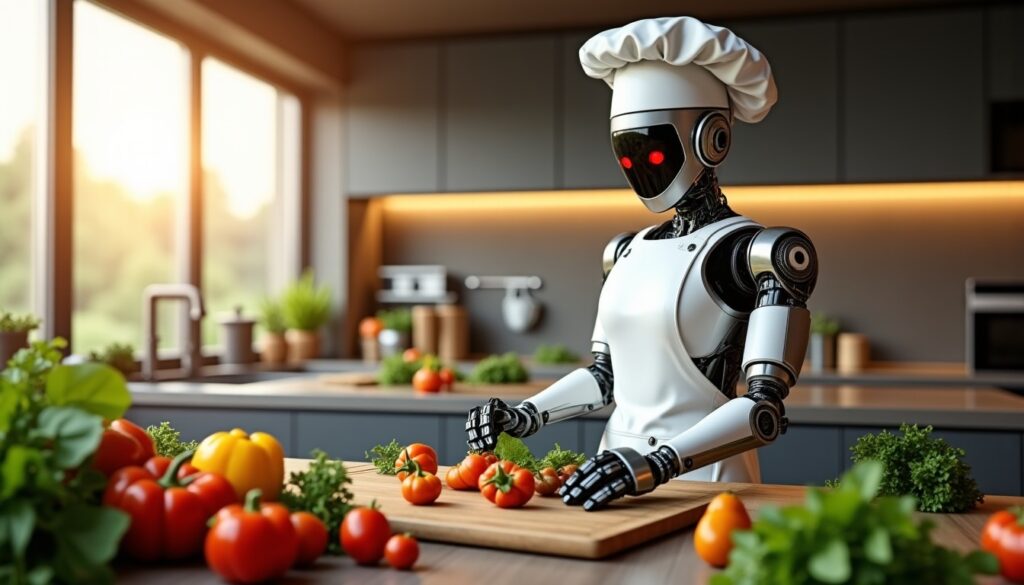
In a world where technology pushes the boundaries of innovation every day, a new type of intelligent robot is making its entry into the domestic sphere. Imagine an assistant capable of mastering the culinary art with a skill surpassing even that of a seasoned amateur cook, and all this from a simple video source. This impressive feat is now within reach thanks to the artificial intelligence model π0.7, developed by the startup Physical Intelligence based in San Francisco. With a unique and rapid learning approach, this robot transcends classical robotic training methods, marking a revolutionary step in automation and robotics applied to gastronomy. In a context where adapting to daily tasks remains a major challenge, this innovation promises not only to change our relationship with cooking but also to reinvent how robots interact with their environment, with unprecedented mastery brought by learning from a simple video.
Until now, robotic mastery of cooking required massive volumes of data and titanic training sessions, often impossible to reproduce in the field. The approach adopted by π0.7, isolating the essentials from a few rare examples and verbal instructions, paves the way for autonomous and easily adaptable artificial intelligence. From handling utensils, to precise management of complex devices, to executing precise gastronomic recipes, the paradigm is shifting towards machines capable of reusing their knowledge in new contexts. This innovation resonates strongly with both the domestic robotics universe and culinary enthusiasts, who already see the potential of a revolutionary culinary assistant that is fluid, intuitive, and personalized.
- 1 How this robot revolutionizes cooking learning through a video
- 2 The technical challenges of autonomous learning in culinary robotics
- 3 The specific operation of π0.7: a revolutionary AI for extraordinary culinary mastery
- 4 Impact on daily life: how this robot changes the culinary experience
- 5 The technological implications of this innovation in kitchen robotics
- 6 The future of culinary robots thanks to video learning and AI
- 7 Complementary innovations associated with robotic learning in the kitchen
- 8 Towards accessible and personalized culinary robotics for all
How this robot revolutionizes cooking learning through a video
Currently, most of the most advanced kitchen robots rely on colossal databases containing millions of hours of videos to learn to perform various tasks. This method, though powerful, is resource-intensive and inflexible when it comes to addressing new or unforeseen contexts. The true breakthrough introduced by the π0.7 model is its ability to segment and integrate diverse knowledge from an extremely limited number of examples, without requiring full training or massive collection of specific data.
The startup Physical Intelligence demonstrated in a striking experiment that their robot could use a brand-new air fryer, an object it barely knew. This surprising result occurred from only two video sequences available in its data: one where a robot was closing an air fryer and another from an open-source database showing the handling of a plastic bottle. The AI π0.7 succeeded in combining these fragmentary details with more general data sourced from the web to understand the complete functioning of a novel device, then cook a sweet potato to perfection.
This skill is all the more impressive as managing daily cooking, with its many objects and varied tasks, requires a finesse of gestures that is hard to program mechanically. The vision of a robot capable of extending its cooking skills based on a simple video and a few instructions symbolizes a major advance in robotic mastery of daily tasks. Rather than mechanically repeating programmed gestures, the robot deeply adapts its understanding and execution of tasks, heralding significant progress in terms of autonomy and flexibility.
The technical challenges of autonomous learning in culinary robotics
The world of robotics, especially applied to cooking, presents very complex technical requirements that often limit the success of automatons. One of the major problems is the diversity and fragility of the objects handled: each food item or utensil demands precise gestures and real-time adaptation to variations. It is not simply about executing a series of mechanical commands, but about understanding and adjusting the action according to the context.
Within this framework, a robot must master several aspects:
- Fine sensory perception: being able to identify objects, their textures, fragility, and their position in space.
- Advanced motor coordination: performing delicate movements ranging from peeling to handling ingredients without damaging them.
- Real-time adaptation: recognizing and correcting errors or reacting to unforeseen events (misplaced object, uneven cooking, etc.).
Added to these imperatives is the complexity of the kitchen environment itself, which combines the use of various appliances, innovative equipment, and an infinite number of recipes. Most traditional robotic systems rely on rigid technical programming that restricts their ability to manage these variables. This is precisely what AI π0.7 manages to overcome thanks to its learning model based on incremental and contextual information gain.
For example, when handling the air fryer, it had to not only operate the opening and closing but also understand the cooking mechanism, which the robot was able to accomplish by intelligently combining independently acquired information. Oral language recognition — verbal instructions — further strengthens this adaptability and provides a form of fluid human interaction that enriches real-time learning.
The specific operation of π0.7: a revolutionary AI for extraordinary culinary mastery
The secret behind the robot’s performance lies in the very nature of the artificial intelligence model π0.7. Unlike classical models, which rely heavily on volumes of specific data grouped in a context, this system uses a so-called “transfer learning” approach. This means it draws on knowledge acquired in various contexts, then assembles these elements to perform an unprecedented task.
This process is comparable to how a human learns to transfer skills between disciplines: for example, a person who masters tool handling can quickly understand how to manipulate new instruments based on their existing knowledge. Similarly, the AI combines observed gestures on a plastic bottle and the closing of an air fryer to achieve a relevant execution on a still unknown device.
Sergey Levine, co-founder of Physical Intelligence, emphasizes this fundamental aspect: “The model does not simply execute, it reinvents its action sequence by recomposing knowledge that at first seems disparate.” This ability to continuously relearn, to readapt on the field with vocal instructions, is a true innovation that could change the game in the development of autonomous robots.
To make this possible, π0.7 was designed using algorithms of contextual fusion and incremental learning. Rather than waiting hours for recalibration or a new full training, it improves live, based on feedback and received instructions. This flexibility significantly reduces the costs and integration time of robots in varied environments, especially domestic ones.
Impact on daily life: how this robot changes the culinary experience
The arrival of this type of intelligent robot in our kitchens goes beyond mere task automation. It invites a complete rethinking of how technology can participate in daily gastronomy by combining technical mastery and culinary inventiveness. For many, the main obstacle to home cooking is time, technicality, and the stress related to preparation; this robot promises to remove these barriers.
Concretely, several benefits are already anticipated:
- Time saving: thanks to precise and rapid automation of preparation, this model significantly reduces tedious phases.
- Reliability and consistency: cooking a dish perfectly every time, without errors or inaccuracies.
- Personalized learning: the robot can adapt to individual preferences, learn new recipes in moments, and offer innovative variations.
- Support for beginners: novices benefit from real-time guidance thanks to voice instructions, making gastronomy accessible to all.
For example, in home testing, the robot not only managed to cook a simple sweet potato but also adjusted the cooking parameters based on its size and composition. This pedagogical autonomy demonstrates how technology combined with artificial intelligence can become a valuable culinary partner.
A robot serving gastronomic creativity
Beyond technical aspects, the integration of this robot in kitchens opens exciting prospects for culinary creativity. By combining perfect mastery of gestures with the ability to process a wide range of culinary data, it can suggest unprecedented recipes, optimize textures, or propose subtle pairings depending on the available ingredients.
Some examples of what such a system could offer:
- Adaptive menu creation based on individual tastes and dietary regimes.
- Recommendations for ingredient substitutions in case of shortages or allergies.
- Optimization of cooking times to maximize flavor and nutritional value.
- Proposal of original and personalized seasonings or presentations.
This role as a culinary co-pilot does not replace the human touch but enhances it, allowing amateurs as well as professionals to fully exploit their creative potential while delegating repetitive tasks to advanced technology.
The technological implications of this innovation in kitchen robotics
The success of π0.7 in rapid learning from a single video is a turning point in the development of multifunction robots intended for cooking. It highlights several major technological advances that redefine current standards:
- Intelligent automation: robots no longer just execute fixed programs but become learning entities capable of improving in real time.
- Enhanced human-machine interaction: voice commands simplify communication and allow unprecedented reactivity.
- Modularity and adaptability: the ability to understand and master new appliances or utensils without long learning processes.
- Resource reduction: lowering the need for massive data and computing power thanks to targeted and efficient learning.
A comparative table clearly illustrates this evolution between classical techniques and the π0.7 model:
| Aspect | Traditional robots | AI model π0.7 |
|---|---|---|
| Volume of data required | Millions of hours of video | A few video sequences + general knowledge |
| Adaptation time | Long, several weeks/months | A few minutes/hours |
| Flexibility with a new device | Limited, often impossible | Very high, recomposition of skills |
| Real-time learning | Almost nonexistent | Yes, with vocal instructions |
| Energy cost | Very high | Optimized |
The future of culinary robots thanks to video learning and AI
As artificial intelligence continues to evolve the technological landscape, culinary robots with rapid and autonomous learning capabilities will reshape our daily lives. Experts anticipate an ecosystem where kitchen appliances will no longer be mere tools but genuine intelligent partners capable of mastering new gestures, learning gastronomic innovations, and even collaborating in culinary creation.
Possible scenarios in the near future:
- Robots capable of instantly learning during online cooking demonstrations or from a downloaded video.
- Multifunction devices communicating among themselves to coordinate preparation stages.
- Integrated systems enabling users to provide oral or gestural instructions facilitating contextual learning.
- Advanced personalization to meet nutritional requirements and dietary preferences diverse across households.
This promising horizon mobilizes both robotics professionals and gastronomy enthusiasts, heralding an era where culinary mastery would be accessible to all, powered by technology and artificial intelligence.
Complementary innovations associated with robotic learning in the kitchen
The emergence of the π0.7 robot takes place in a context shaped by other key advances in culinary robotics and intelligent automation. For example, humanoid robots like Atom, developed by Dobot Robotics, combine incredible precision and the capacity to adapt to unexpected situations. Atom masters gestures as simple as perfectly toasted bread, or as delicate as handling lettuce or cherries, demonstrating the diversity of possible applications.
In this domain, AI integration fosters synergies across multiple technological disciplines:
- Computer vision: detailed analysis of foods and surfaces to avoid errors.
- Sophisticated motor control: real-time adjustments of pressures and action angles.
- Natural communication: voice dialogue and intuitive interaction with the user.
- Collaborative learning: sharing data and strategies among robots to accelerate collective progress.
This convergence sparks a permanent innovation dynamic, where each advance in machine learning or mechanical robotics directly improves the quality and diversity of prepared dishes. These technologies promote the democratization of high-quality gastronomy, whose mastery no longer depends solely on human know-how but also on intuitive and intelligent automation.
Towards accessible and personalized culinary robotics for all
The integration of culinary robots based on artificial intelligences like π0.7 is not limited to technical sophistication. One of the major challenges for their widespread adoption remains making them available in an accessible, easy-to-use form and at the best price for the general public.
For this, several factors are essential:
- Intuitive ergonomics: interfaces and voice commands designed to facilitate every interaction.
- Adaptation capability: rapid learning of new domestic appliances or specific utensils.
- Detailed personalization: adjustment to eating habits and preferences of each user.
- Controlled cost: development of energy-efficient and resource-saving solutions.
This approach aims to democratize access to culinary robotics, gradually transforming the kitchen into a space where technology supports creativity, speed, and precision in preparation. It notably promises a true daily asset for seniors, people with reduced mobility, or overloaded professionals.