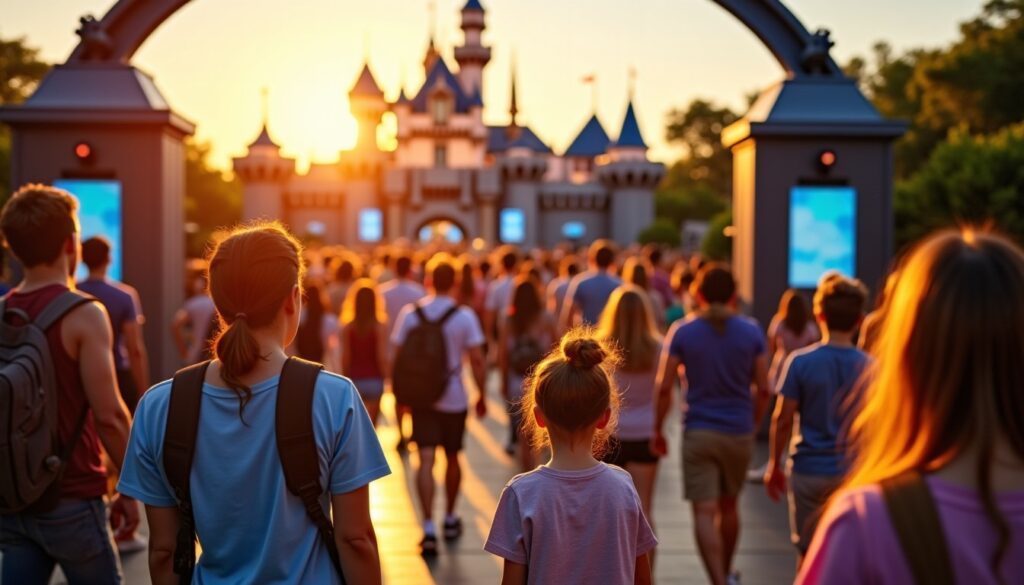
At the heart of the technological and societal news of 2026, Disneyland, the iconic Californian park, is making headlines by adopting facial recognition at its entrance gates. This initiative, presented by the Walt Disney Company as a step forward to enhance security and ease visitor flow, also raises serious concerns related to surveillance and privacy protection. Under the watchful eyes of biometric cameras, each face becomes a digital key, giving the park an unprecedented Big Brother feel. Surrounded by passionate debates and controversies, this rise of facial recognition technology profoundly questions our relationship with control and immersion in entertainment spaces.
For several weeks, Disneyland visitors have been subject to this new form of control, marking a turning point in the customer experience. While Disney assures that this system mainly aims to limit ticket fraud and the abusive sharing of annual passes, some already mention a drift towards increased surveillance. However, the park offers visitors the possibility to bypass these biometric lines by favoring classic entrances with an identity document. This dual path shows the delicate balance between security innovation and respect for individual freedoms, in a context where facial recognition is the subject of intense debates in the United States and worldwide.
- 1 Facial recognition technology at Disneyland: operation and security objectives
- 2 The weight of surveillance and the Big Brother specter at the entrance gates
- 3 Privacy and individual freedoms: crucial issues facing facial recognition
- 4 Risks of errors and discrimination linked to biometric systems
- 5 International comparison: Disneyland and biometric practices in amusement parks
- 6 Security measures and data protection implemented by Disneyland
- 7 Future prospects: towards increased control or an improved user experience?
Facial recognition technology at Disneyland: operation and security objectives
The implementation of facial recognition at Disneyland relies on a sophisticated system of cameras placed at the entrance gates. These devices automatically photograph visitors, transforming these images into unique digital biometric data. The main goal advanced by the Walt Disney Company is twofold: on the one hand, to prevent ticket fraud and stop the illegal transfer of annual passes; on the other hand, to facilitate and speed up visitor flow by making entrance management smoother.
This process relies on artificial intelligence algorithms that compare the captured image to those recorded in the Disney database. If a match is detected, it helps validate the visitor’s identity and verify their access rights. For example, a person who has already used a ticket could have their admission confirmed more quickly, while those attempting to enter by sharing or falsifying tickets could be spotted and excluded.
Beyond control, this technology also promises an improvement in overall security: by detecting suspicious behavior or unauthorized individuals, the park hopes to prevent potential incidents. However, this system does not operate completely without visitors’ knowledge. Visitors can choose an entrance line without facial recognition by presenting an identity document, which marks an effort by the park to leave some freedom space.
However, the system’s accuracy and speed required several years of testing, notably at Magic Kingdom in Orlando from 2021, then a new phase at Disneyland in 2024 before a larger deployment in 2026. These stages allowed refining the technology and better meeting operational constraints while respecting legal frameworks.
In summary, facial recognition at Disneyland aims to be an effective security tool while offering a smoother user experience, but it sparks passionate debate about its human and legal implications.
The weight of surveillance and the Big Brother specter at the entrance gates
The introduction of facial recognition at Disneyland echoes the image of a nearly tangible Big Brother at the entrance gates, where each face becomes an object of digital collection and analysis. This technological immersion, while officially aimed at securing the space, strongly questions the very nature of surveillance and the boundaries that should not be crossed in a park supposed to be a place of relaxation and escape.
The metaphor of Big Brother, popularized by George Orwell’s novel, perfectly illustrates the mistrust felt towards a system where cameras can control, identify, and monitor the presence of millions of visitors daily. The park becomes a space where every gesture is subject to massive data processing, potentially stored or shared. This reality particularly worries privacy advocates who fear a drift towards generalized surveillance and the multiplication of possible abuses.
Indeed, facial recognition technology proves to be a double-edged tool: while it allows efficient management and increased control, it also opens the door to the creation of massive biometric databases, with risks to confidentiality. These tensions are critically pronounced in California, where public debate regularly opposes security pressure to the protection of individual rights.
Another raised issue concerns the lack of precise information about the retention period of images and collected data. The question of the governance of data stored by Disney remains central, especially since the company acknowledges that, despite technical and administrative measures, no security system is completely inviolable. Visitors, though implicitly consenting by passing under these cameras, do not always have full transparency on the exact use and purpose of the data.
This fierce controversy thus fuels a feeling of deep immersion where the boundary between security and surveillance becomes porous. For many, by adopting facial recognition, Disneyland embarks on a path that goes beyond simple flow management to embody one of the emblematic cases of the ethical challenge posed by these new technologies.
Privacy and individual freedoms: crucial issues facing facial recognition
In the digital age, the use of facial recognition brings back a fundamental debate: that of privacy and individual freedoms. Disneyland, as an iconic place welcoming millions of visitors, illustrates these heightened stakes.
The use of invasive biometric technology in an amusement park raises questions that must be answered with transparency and rigor. How can we ensure that visitors’ personal data is used ethically and securely? What information is given to visitors at the moment their faces are scanned? Disney has formalized the possibility for visitors to refuse this biometric examination, however, this requires using a specific queue where identity must be proven otherwise. We are thus confronted with a compromise between innovation and respect for individual freedom.
Facial recognition is a technology that goes beyond just taking an image. It represents a sprinkling of information which, once gathered, forms a kind of detailed profile, sometimes exploited for commercial purposes or to refine marketing behaviors. Thus, several ethical questions arise:
- Informed consent: Do visitors truly grasp the extent of what they consent to by passing through these gates?
- Data usage: Can this information be used for purposes other than access control, such as profiling or targeted advertising?
- Sharing and security: Who has access to this data and how is it protected against hacking or internal abuse?
- Retention period: What is the duration of biometric data storage and when is it destroyed?
In this context, Californian legislation imposes certain guarantees, but current events demonstrate that these laws are often put to the test. At the American level, the adoption of the system raises debate in a country where facial recognition is already used in more sensitive contexts such as immigration or law enforcement. These usages are regularly challenged due to identification errors, racial biases, and disproportionate impacts on certain populations.
Disneyland is thus under fire, notably from organizations such as the American Civil Liberties Union (ACLU), which warns against unchecked use and a worrying normalization of these technologies in public entertainment venues.
Ultimately, the question of privacy in the face of facial recognition in a universe like Disneyland remains a precarious balance where security, convenience, and respect for fundamental rights intermingle.
Risks of errors and discrimination linked to biometric systems
Despite announced promises, facial recognition is not free from major flaws, notably the risk of identification errors that can lead to serious consequences. These errors raise not only practical problems but also heavy ethical issues, especially in places like Disneyland where enjoyment and security must coexist harmoniously.
Facial recognition algorithms rely on photographic databases large enough to ensure a good match. However, independent studies have shown that these systems can display higher error rates for certain population categories, particularly people of color or women, due to biases in training data.
In a park as crowded as Disneyland, an error could lead to an unjustified expulsion of a visitor, a denial of entry, or prolonged waiting times, negatively affecting customer experience and damaging the park’s reputation. These risks are all the more worrying as facial recognition is also used by law enforcement in more serious contexts, where consequences can be dramatic, such as wrongful arrests.
Disney has acknowledged these limits and states that the system is designed to minimize errors, but no biometric device can be totally infallible. To mitigate these risks, Disneyland offers an alternative with the possibility of not going through facial recognition, which remains a minimal but necessary measure.
Here is a list of risks related to facial recognition errors:
- Misidentification: Confusion between two individuals with similar features potentially leading to unjustified entry refusal.
- Indirect discrimination: Disproportionate impact on certain populations due to algorithmic biases.
- Attacks on dignity: Stress or humiliation in case of unjustified intervention.
- Legal consequences: Possibility of legal sanctions or damages claims.
Managing these risks is an ongoing challenge for operators, especially in a large and tourist environment like Disneyland where customer experience must remain a central priority. The debate on limiting algorithmic biases and improving systems is at the heart of current technological discussions.
International comparison: Disneyland and biometric practices in amusement parks
While Disneyland California comes under the spotlight in 2026 with the adoption of facial recognition, this technology is far from isolated in the entertainment world. Indeed, several major parks and sports venues integrate biometric systems aiming to secure locations and optimize visitor experience.
In the United States itself, some Major League Baseball stadiums have deployed facial recognition to allow ticket holders quick entry after submitting a selfie via a dedicated app. This practice has demonstrated increased entry fluidity while limiting fraud.
Internationally, feedback varies:
| Amusement park | Country | Technology used | Main objective | Public reaction |
|---|---|---|---|---|
| Disneyland Paris | France | Facial recognition (optional) | Fight against fraud and subscription control | Reservations and complaints, possibility of refusal by classic identification |
| Magic Kingdom Orlando | United States | Facial recognition (tests since 2021) | Entrance flow smoothing and security | Progressive tests accepted by some visitors |
| Universal Studios Singapore | Singapore | Associated biometric recognition | Enhanced security | High acceptance, favorable local context |
| Yankee Stadium | United States | Facial recognition via selfie | Quick access and fight against fraud resale | Polarization of opinion, privacy debates |
This diversification shows that amusement parks and leisure venues are gradually adopting biometrics to meet common challenges: security, fluidity, and fraud prevention. However, societal and legal responses vary depending on cultures and levels of privacy demands.
Disneyland Paris still allows customers to avoid facial recognition by presenting an identity document, a choice that is not very consensual but reflects a real consideration of reluctances. This type of balance seems more difficult to achieve in some other contexts abroad.
Security measures and data protection implemented by Disneyland
To meet the challenge of protecting visitors in this context of biometric surveillance, Disney has deployed a set of technical, administrative, and physical measures designed to secure data collected by facial recognition at the entrance gates.
Technically, the captured images are immediately encrypted and stored on servers internal to the park, limiting exposure to hacking risks. Access to these databases is strictly controlled and subject to rigorous monitoring. The park also uses auditing systems aimed at detecting any suspicious activity or intrusion attempts. These precautions aim to provide a maximum security framework for visitors’ personal data.
On the administrative side, Disney has established data management protocols involving storage minimization: only images concerned by suspected fraud are retained, while others are quickly deleted. This limitation principle helps meet legal obligations and ease fears related to indefinite data retention. Moreover, employees in charge of the system receive specific training on confidentiality and responsible data management principles.
Finally, physically, technological installations are placed in secured areas, while devices capturing images are visible to ensure transparency to visitors. Disney also informs its clients through signs and announcements about the existence of these devices, reinforcing the notion of informed consent.
Despite these efforts, the company acknowledges that biometric technology is never completely inviolable, which requires maintaining continuous monitoring and reacting quickly in case a vulnerability is detected. This stance reflects the complexity of reconciling innovation and respect for individual rights.
Future prospects: towards increased control or an improved user experience?
The adoption of facial recognition at Disneyland fits into a broader dynamic of integrating biometric technologies into public and entertainment spaces. This evolution raises the question of the future of interactions between visitors and technological devices in an increasingly connected environment.
Given the potentials and constraints, parks like Disneyland could develop even more sophisticated systems, combining artificial intelligence and automation, to offer a fully immersive experience where the visitor would be recognized in real-time, their preferences analyzed, and their routes optimized. This is an appealing prospect to smooth flows and personalize services.
However, this technological advance must constantly be balanced with the need to preserve freedoms and privacy. The future could see stricter regulatory frameworks emerging to regulate biometric usage in public places, imposing clear limits on data collection, storage, and use.
Furthermore, visitor reactions will inevitably influence managers’ choices: if a majority remains wary of this technology, classic alternatives could be strengthened and popularized. Conversely, growing acceptance could pave the way for a gradual generalization of facial recognition in visitor pathways, as already envisioned by other tech giants, for example Meta with its connected glasses.
In summary, the impact of facial recognition at Disneyland represents a case study of the challenges and opportunities offered by biometric recognition: between improved security and technological immersion, the line remains narrow and will depend as much on technical advances as on future societal choices.