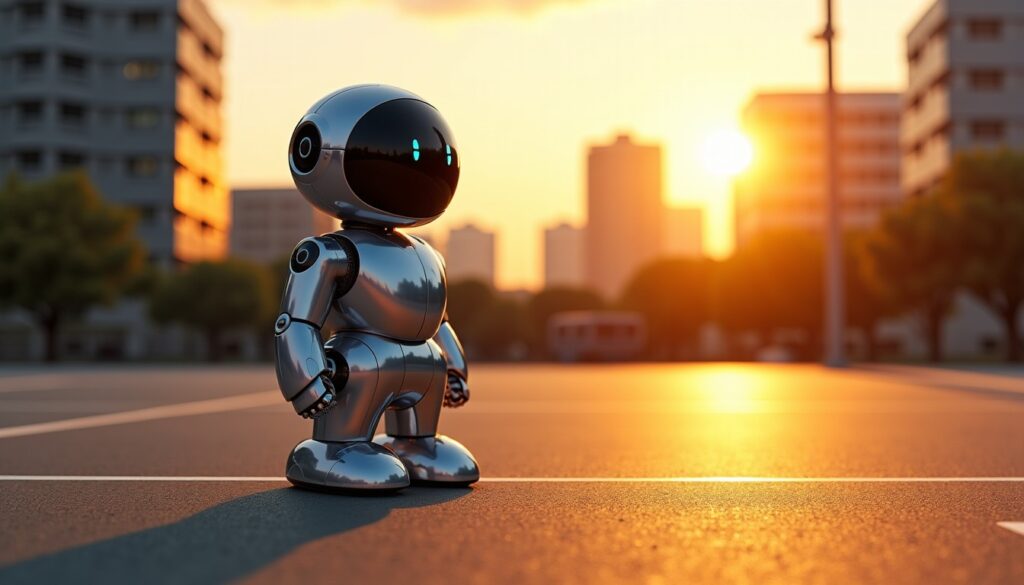
At the heart of the most impressive technological innovations, Toyota has made a big splash with its basketball-playing robot CUE7, a machine that, in 2026, pushes the limits of precision in basketball. This remarkable evolution illustrates the fusion between advanced robotics and sport, where a 2.19 m humanoid robot capable of rivaling the precision of a professional player such as LeBron James reveals a major breakthrough. Beyond the spectacle offered during demonstrations, CUE7 embodies a technical feat combining artificial intelligence, motor control, and visual analysis, taking technology to new heights. Having become capable of dribbling, running, and shooting while adapting to their environment, these robots can now execute long-distance shots with a consistency long inaccessible to machines.
The trajectory of the CUE7 project reflects Toyota’s deep desire to explore what is called “embodied AI”: an artificial intelligence that does not operate solely in the virtual but interacts and learns in the physical world. Every shot by CUE7 results from meticulous attention paid to analyzing distance, angle, and force to apply, which requires the robot to maintain constant stability and adjustment. Through this approach, the Japanese manufacturer opens a new chapter for robotics, announcing a future where the boundary between human performance and automation is increasingly fine. CUE7’s ability to learn from its mistakes like an athlete, adapt in real time, and deliver near-millimeter precision invites reflection on the implications of these technologies in sports and far beyond.
- 1 The complexity of basketball: an ideal challenge to test technological innovations
- 2 From passion to ambition: the emergence of the Toyota CUE7 basketball robot
- 3 Millimetric precision at the heart of CUE7’s technological feat
- 4 Machine learning and reinforcement: the key to the basketball robot’s agility and maturation
- 5 Future implications of sports robotics: a step toward the fusion of AI and competitive sport
- 6 CUE7, a stable and mobile robot: morphology designed for high performance on the court
- 7 Key technological aspects integrated into the Toyota CUE7 basketball robot
- 8 The CUE7 basketball robot facing human competition: a new era for basketball?
The complexity of basketball: an ideal challenge to test technological innovations
Basketball, a team sport combining agility, precision, and instant decision-making, offers an ideal framework to evaluate advances in robotics and artificial intelligence. More than just a game, it requires a fine synthesis of several technical faculties that Toyota’s CUE7 robot manages to integrate. Identifying the target (the hoop), assessing distance, adjusting posture and force are all steps that each robot must chain together with astonishing fluidity.
This sport imposes several simultaneous challenges pushing technology to its limits. Shooting a basket is not limited to a mechanical movement: it requires real-time visual analysis, anticipation of movements, adaptation to external forces (like wind or vibrations), as well as precise motor control converting this data into a mastered gesture. To illustrate, imagine a shot at 25 meters, a distance where the margin of error is minimal. The robot must calculate the ideal trajectory, weigh the angle, launch speed, and ball rotation, variables constantly influenced by its environment.
The fact that CUE7 integrates these dimensions by combining advanced artificial vision and dynamic movement planning places it at the forefront of innovations. This basketball robot does not follow a rigid program but adjusts every shot according to analyses captured by its sensors, which humans do instinctively without thinking. This flexibility is the key to success in precision. Every shot becomes an opportunity for learning and improvement.
Beyond athletic performance, this complexity also shows how basketball, through its multidimensionality, now plays the role of a large-scale laboratory for systems capable of handling multiple cognitive and mechanical processes simultaneously. This context explains why Toyota has taken the bet to create a robot able to evolve in this demanding universe. CUE7 thus illustrates a key transition toward broader applications where robotics and artificial intelligence can interact with our daily lives.
From passion to ambition: the emergence of the Toyota CUE7 basketball robot
What began as an internal project led by a team of enthusiastic engineers quickly turned into a high-level technological challenge. Initially, Toyota’s ambition was not simply to build a basketball robot but to create an experimental platform testing embodied physical intelligence, that is, systems that do not limit themselves to virtual calculations but interact concretely with their environment.
The first versions of CUE date back several years, where the robot was already approaching game reality through programmed sequences. However, it was with the sixth generation that Toyota attracted international attention: CUE6 set a Guinness World Record by successfully making a long-distance shot without a miss, a performance marking the entrance of sports robotics into a new era.
With CUE7, progress is clear. The robot stands at an imposing height of 2.19 meters and weighs only 74 kg, thus optimizing its mobility. This version marks a strategic turning point: it abandons the mere execution of predefined programs to incorporate reinforcement learning, allowing it to learn from its mistakes and improve its performance with each shot.
This change is essential to overcome the rigidity of classical robots. CUE7 therefore becomes a machine capable of real-time adaptation, changing its parameters to adjust to current conditions. This ability significantly increases its precision, even rivaling professional athletes like LeBron James, highlighting the major issue at stake. Toyota no longer designs merely a robot capable of performing gestures but a true electronic basketball player mastering the subtleties of the game.
Millimetric precision at the heart of CUE7’s technological feat
The precision of the basketball robot CUE7 is what impresses observers the most. The ability to string together shots in an almost perfect manner is based on a complex orchestration between its morphology, sensors, and artificial intelligence algorithms. Every detail has been conceived to restore the consistency of a high-level athlete.
This precision first results from an ingenious morphology that reduces the robot’s weight while increasing its stability thanks to a two-inverted-wheel design. This configuration improves mobility, allowing CUE7 to position itself quickly and correctly relative to the basket before each shot, providing optimal balance to master the gesture.
Then, the embedded vision system analyzes in real time the distance to the basket using multiple cameras. It is not just about perceiving the target but also learning to evaluate it precisely in order to continuously adapt the ball’s trajectory. This capacity is coupled with precise motor control that adjusts the power and angle of the shot down to the minute detail.
To better grasp the system’s effectiveness, one can compare CUE7 to a professional basketball player in a high-pressure competition. Where a human manages variable parameters with intuition, the robot uses a combination of machine learning and instant feedback to reproduce optimal conditions. Toyota thus developed a hybrid device combining classical artificial intelligence, inherited from control algorithms, and reinforcement learning, simulating the training process of a human athlete.
Comparative Table: Long-Distance Shooting Precision – CUE7 vs Professional Players
| Performer | Shot Distance (meters) | Success Rate (%) | Adaptation Capability | Execution Speed |
|---|---|---|---|---|
| CUE7 (Toyota robot) | 25 | 92 | Real-time analysis, autonomous learning | 0.8 sec (positioning + shot) |
| LeBron James (pro player) | 25 | ~85 | Instinctive analysis, human motor adaptation | 0.7 sec (positioning + shot) |
These performances reveal that CUE7 often exceeds human standards in consistency, especially in long-distance shots where every millimeter counts. This is a significant leap that heralds unprecedented prospects for the use of robots in complex environments.
Machine learning and reinforcement: the key to the basketball robot’s agility and maturation
The qualitative leap between the first two generations and the seventh mainly lies in autonomous learning capability. Whereas previous versions followed programmed series of gestures, CUE7 combines a reinforcement learning system with predictive control algorithms. This marriage ensures continuous progression.
Reinforcement learning requires the robot to repeat shots, analyze results, and correct its parameters. This process directly evokes that of an athlete refining their shot through thousands of hours of training. Toyota has succeeded in transposing this dynamic into a digital system, allowing CUE7 to better calibrate its throw, adjust force, or correct posture.
This method gives the robot two major advantages: it can adapt in real time to unexpected situations such as a slight displacement of the basket or a variation in the court, and it improves its precision exponentially over sessions. CUE7’s agility expresses itself both in its movements and in its ability to dribble and reposition before shooting, a feat that truly brings it closer to a genuine basketball player.
Looking back, CUE3 already demonstrated impressive endurance with more than 2,000 consecutive free throws made. Today, CUE7 brings a degree of freedom far beyond mechanical execution; it becomes an actor capable of interacting autonomously with its environment.
Future implications of sports robotics: a step toward the fusion of AI and competitive sport
The rise of Toyota’s basketball robot reveals a broader trend in competitive sports: intelligent robotics finds a prime place to push human boundaries. On one side, it offers professionals new training methods with robotic partners capable of repeating precise gestures and providing in-depth analysis data. On the other, it sparks passionate debates around the very nature of sport and competition.
With machines like CUE7 able to deal cards with precision superior to that of an elite player like LeBron, scenarios arise where human performances could be reassessed or surpassed. This observation leads to envisioning the emergence of new categories of competitions mixing humans and robots, or even leagues in which robots themselves compete against each other.
Moreover, technologies developed for these robots have potentially revolutionary applications in other sectors: mobility assistance for people with disabilities, industrial robotics, or interventions in complex environments. Basketball thus becomes a key testing ground to accelerate the maturity of these technologies.
CUE7, a stable and mobile robot: morphology designed for high performance on the court
CUE7’s design combines lightness with exceptionally agile movement capability. Dropping from an initial weight of 120 kg to 74 kg, Toyota has created a faster and better-balanced robot. This mass reduction not only facilitates mobility but also decreases the risk of imbalance during shots.
The double inverted wheel chassis gives the robot dynamic stability, capable of continuously compensating for position variations. This is crucial in a sport like basketball where every millisecond counts to reposition before shooting, dribbling, or evading an opponent. CUE7 thus performs fluid maneuvers, enabling natural sequences comparable to those of a human player.
This innovative morphology also relies on precise electric motors and a closed-loop control system to ensure each movement is executed with the required accuracy. The mechanical and logical interaction results in a gesture as consistent as possible, where the slightest imbalance could compromise shot success.
Key technological aspects integrated into the Toyota CUE7 basketball robot
CUE7 is more than just a simple robot: it is part of the effort to democratize technological advances in applied artificial intelligence. Here are the flagship technologies that distinguish it:
- Advanced artificial vision: multi-camera sensors and image processing algorithms enabling precise and dynamic analysis of basket and ball positions.
- Reinforcement learning: an autonomous training method allowing the robot to learn from its mistakes and continuously optimize its gestures.
- Predictive motor control: real-time movement adjustment to ensure the stability and precision necessary for each shot.
- Optimized morphology: lightweight design and two-inverted-wheel chassis to guarantee mobility and balance on the court.
- Hybrid algorithms: fusion of classical artificial intelligence and machine learning for better adaptability.
These innovations are the result of constant dialogue between robotics engineers, AI experts, and sports specialists. This collaborative work shows how basketball becomes a source of inspiration for solutions that are both technological and interactive.
The CUE7 basketball robot facing human competition: a new era for basketball?
CUE7 has already shown it can compete with human stars such as LeBron in shooting precision, raising the question of what sports competition might become in the future. If a robot can shoot with over 90% success at 25 meters, capable of adapting its play and learning, how can the same level of interest be maintained in traditional competitions?
This could open the way to a major evolution: the official integration of robots in sports challenges. For example, mixed competitions could be envisioned where humans and machines compete to push the limits of possibility, or leagues dedicated exclusively to robots developing their own play strategies based on sophisticated artificial intelligence algorithms.
LeBron himself has commented on these advances by highlighting the wonder inspired by CUE7’s precision, but also the interest it represents for player preparation. Robots could serve as training partners, capable of endlessly repeating precise sequences and providing immediate feedback on performance.
If this dual dynamic between robotics and sport is confirmed, 2026 marks a turning point: the beginning of a new era where technology shapes the very definition of basketball. The debate about the spirit of the game and what competition means then takes on an unprecedented technological dimension.