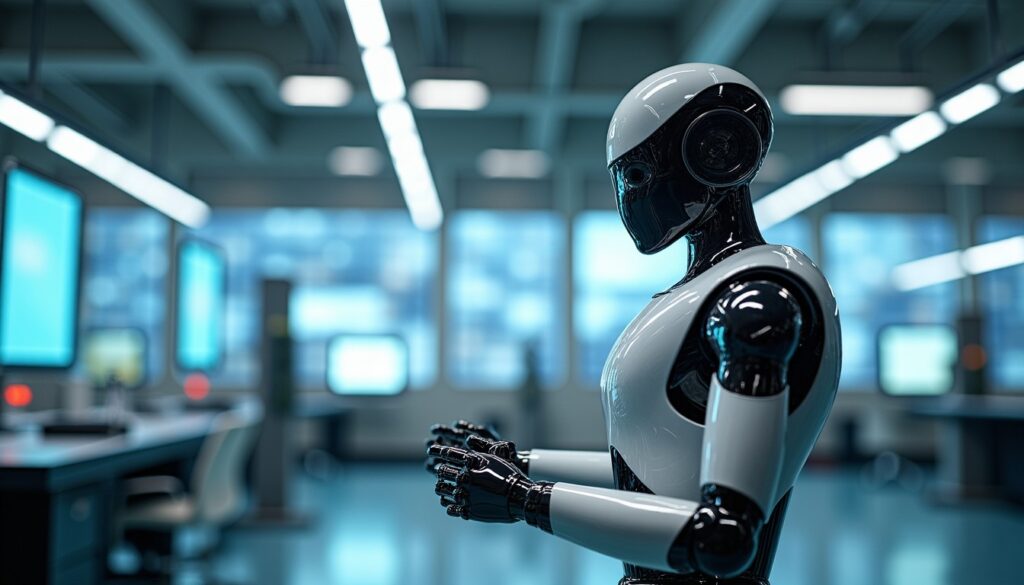
In a world where automation rhymes with performance and innovation, Tesla strikes hard with the unveiling of Optimus Gen 3, a humanoid robot equipped with extraordinary hands capable of learning your movements. At the AWE 2026 trade show in Shanghai, Elon Musk’s company unveiled this technological prodigy that promises to revolutionize industrial and domestic robotics. Designed to interact with objects thought for humans, this robot goes far beyond simple mechanical repetition: thanks to advanced artificial intelligence capable of learning by imitation, Optimus 3 observes and instantly reproduces human gestures with unprecedented precision. This major evolution reflects Tesla’s bold ambition to transform the industrial landscape with a versatile machine, operating efficiently in sometimes very complex environments. This new model, marked by enhanced bipedal locomotion and hands of unprecedented complexity, opens a new era in robotics, combining finesse of execution and adaptive learning.
In a context where humanoid robotics raises as many hopes as challenges, Optimus Gen 3 embodies a major technical advance driven by an architecture redesigned according to the first principles method. This philosophical approach led Tesla to completely rethink the design of the hands, now featuring 22 degrees of freedom per hand, double that of the previous generation. The ambition is clear: to enable the robot to perform delicate gestures ranging from handling standard tools to carrying out precise actions in workshops or assembly lines. By integrating an embedded AI5 chip and advanced local AI, Optimus 3 is capable of unprecedented autonomy and adaptability. This feat, made possible by a perfect symbiosis between hardware and artificial intelligence, triggers a true upheaval in how robots can be deployed on a large scale from this summer.
- 1 The extraordinary hands of Optimus 3, a technical feat for robotics
- 2 Learning by imitation: how Optimus 3 assimilates your movements
- 3 Optimus 3 and improved bipedal locomotion: toward more natural movement
- 4 Industrial production of Optimus 3: a major strategic shift for Tesla
- 5 The potential impact of Optimus 3 on industry and society
- 6 Technical and ethical challenges related to Optimus 3
- 7 The global competition in humanoid robots in 2026
- 8 Toward a new era: Optimus 3, the convergence of technology and intelligence
The extraordinary hands of Optimus 3, a technical feat for robotics
Manipulating complex and varied objects with precision is one of the greatest challenges in humanoid robotics. Tesla fully understood this by completely redesigning the hands of the Optimus Gen 3 robot, a true centerpiece of this innovation. Compared to previous versions which had around 11 degrees of freedom per hand, this third generation doubles this capability to 22 degrees of freedom. This means that each finger benefits from multiple joints, allowing fine, fast, and perfectly controlled movements. This spectacular increase in dexterity opens a still unexplored field of applications.
The first principles method adopted by Tesla relies on a thorough analysis of the fundamental laws of physics. Rather than improving an existing mechanical scheme, the engineers tackled the problem at its source, reinventing the hand’s architecture to optimize strength, sensitivity, and flexibility at the same time. This radical approach allowed the combination of ultra-light materials with miniature and fast actuators, while integrating advanced tactile sensors. The result: an unparalleled ability to grasp, manipulate, and interact with a variety of objects, from fragile tools to industrial assembly parts, without risk of damage.
This technical feat is demonstrated in impressive showcases: Optimus 3 can hold a screwdriver, assemble electronic components, handle delicate objects such as fruits, or even perform complex gestures involving standard tools. These skills make Optimus a versatile robot, capable of adopting multiple roles, unlike industrial robots specialized in a single task.
The hands playing a central role in this revolution, Tesla does not only improve the hardware. They are paired with a powerful artificial intelligence capable of interpreting sensor sensations and adjusting movements in real time. This combination ensures reactivity and precision never seen before on a humanoid robot.
- 22 degrees of freedom: one joint per finger doubling that of previous generations
- Complex tactile sensors: for sensitivity close to the human hand
- Advanced materials: light and durable ensuring speed and endurance
- Miniaturized actuators: enabling exceptional speed and finesse of execution
- Extreme versatility: from handling to electronic precision
This evolution of Optimus 3’s hands ahead of competitors like Boston Dynamics or Figure AI, positioning Tesla as the undisputed leader in humanoid robotics oriented towards industry and daily life.
Learning by imitation: how Optimus 3 assimilates your movements
Besides its extraordinary hands, what truly distinguishes Optimus 3 is its revolutionary artificial intelligence capable of learning by simple observation. Unlike classic robots which require rigorous programming for each movement, Optimus 3 can watch a human and instantly mimic their gestures. This method of learning by imitation is a major turning point for automation and interaction with human environments.
The principle is simple to understand: the AI integrates advanced vision technology, coupled with a neural network analyzing movements captured in real time. This analysis allows reproducing with fidelity both large-scale actions and subtle gestures, such as the precise positioning of fingers on a tool or a delicate manipulation. This ability is not limited to a simple mechanical copy, it includes a contextual understanding that allows Optimus to adapt its movements according to encountered constraints, which is revolutionary.
This functionality opens immense possibilities both industrially and domestically. Now an operator just needs to perform a task for the robot to learn it automatically, without additional code. For example, in an industrial environment, a worker can show how to assemble a component, and Optimus will instantly reproduce this gesture, even in a changing environment.
Moreover, learning by imitation is integrated into a closed-loop system where Optimus continuously improves its performance by correcting errors based on its attempts. This accelerated training system guarantees that robots quickly become operational on multiple types of tasks.
This innovation makes robotics more accessible and adaptable, significantly reducing integration costs and delays in factories or household chores, where variability is the norm.
Tesla envisions scenarios where Optimus 3 could assist workers on assembly lines, learn new processes, or even operate autonomously in unforeseen situations. The robot then becomes a true collaborator capable of interacting harmoniously with humans.
Optimus 3 and improved bipedal locomotion: toward more natural movement
Mobility is a major challenge for all humanoid robots. Optimus Gen 3 introduces significantly enhanced bipedal locomotion, allowing much smoother and more natural movement. This improvement plays a crucial role since it enables the robot to operate in human environments not adapted to traditional machines.
Surface instability, presence of obstacles, or elevation changes present major obstacles for robots. Tesla therefore integrated a new mechanical architecture and advanced motor control algorithms that ensure better stability and a more human gait. The robot can now walk at variable speeds, lean, crouch, or even regain its balance after a disturbance.
This quality of movement is also essential to maximize the effectiveness of Optimus’s extraordinary hands. Precision in handling requires a stable base. Thus, the synergy between locomotion and dexterity results in a machine able to perform complex tasks requiring mobility and finesse simultaneously.
In industrial applications, this means robots can fetch parts from warehouses, handle tools at height, or navigate cluttered areas without human assistance. In domestic contexts, this mobility guarantees deployment in varied homes, with furniture and objects arranged unpredictably.
Optimus 3’s bipedal locomotion also stands out by its ability to adapt to various types of ground, whether flat surfaces, rough terrain, or stairs. These skills pave the way for massive deployment in sectors where a classic robot would be unusable.
Industrial production of Optimus 3: a major strategic shift for Tesla
With the unveiling of Optimus Gen 3, Tesla reveals for the first time a model designed for mass production. The ambitious goal is to manufacture up to one million robots per year to support industrial and social transformation. This strategic shift profoundly affects the company, which is reorganizing its production lines to make intelligent robotics a central priority.
Elon Musk confirmed that production of certain car models, notably the Model S and Model X, would be stopped to free up space and resources necessary for manufacturing Optimus. This choice highlights the strategic priority given to robotics and artificial intelligence in Tesla’s future vision, now focused on a convergence between the automotive and robotics sectors.
The Gigafactories will be the first to benefit from this integration, using Optimus for tasks ranging from handling to complex operations. The goal is to improve productivity while reducing the hardship of repetitive tasks. Ultimately, these robots could also be offered to other industries, or even the general public, in a technology democratization scheme.
Setting up a large-scale production line requires full mastery of embedded robotics, quality control, and artificial intelligence systems. Tesla is currently working to optimize these processes to ensure large-scale production with an excellent quality/price ratio.
| Features | Optimus Gen 3 | Previous Generations |
|---|---|---|
| Degrees of freedom per hand | 22 | 11 |
| Bipedal locomotion | Increased fluidity and stability | Less fluid, less stable |
| Type of AI | Learning by imitation with embedded AI5 | Manual programming |
| Production | Planned for large-scale industrial production | Prototypes or small batches |
This bold, albeit ambitious strategy, relies on Tesla’s mastered artificial intelligence and capacity to invest massively in robot industrialization. This upheaval could well redefine the face of the company and, more broadly, that of the global industrial sector.
The potential impact of Optimus 3 on industry and society
Optimus Gen 3 embodies a major technological advance whose repercussions could extend far beyond manufacturing industry. By integrating a robot endowed with exceptional mobility and dexterity coupled with autonomous artificial intelligence, Tesla is paving the way for a revolution in automation of human tasks.
In factories, Optimus could take charge of logistic work, handling delicate parts, and assembling complex elements, improving productivity while reducing risks for workers. This human-machine collaboration, facilitated by learning by imitation, promises rapid adaptation to technological evolutions and customization of assembly lines.
On the social level, the arrival of humanoid robots capable of performing domestic tasks, personal assistance, or even technical maintenance raises ethical and societal questions. This new mode of robotic assistance could notably lighten the burden on caregivers and transform the daily life of dependent or elderly people.
This transformation, however, requires adapting regulatory frameworks, requalifying jobs, and deep reflection on the coexistence between humans and robots. Tesla, through its technological leadership, highlights the need for a managed transition where innovation rhymes with responsibility.
Despite spectacular advances, Optimus Gen 3 still faces several important challenges. On the technical side, the complexity of the hands and artificial intelligence requires increased robustness for intensive industrial use. Energy autonomy, preventive maintenance, and ability to adapt to unpredictable environments remain major issues.
The learning by imitation process, although promising, must guarantee absolute safety, especially in sensitive contexts where the slightest mistake could cause material or human damage. Cybersecurity and personal data protection are also at the heart of concerns.
On the ethical front, the massive deployment of humanoid robots raises questions about employment, privacy, and liability in case of failure. Tesla will need to collaborate closely with authorities, unions, and social stakeholders to anticipate these impacts and propose balanced solutions.
- Ensure durability of mechanical components under intensive use
- Optimize energy autonomy for prolonged operations
- Guarantee safety through rigorous risk management protocols
- Establish clear ethical standards for employment and liability
- Collaborate with lawmakers to regulate use in society
These challenges, although complex, are the necessary steps to fully integrate Optimus 3 into our industrial and human daily life.
The global competition in humanoid robots in 2026
The launch of Optimus Gen 3 occurs in an extremely dynamic global robotics landscape, where innovations accelerate at a rapid pace. Alongside Tesla, several major players such as Boston Dynamics in the United States, Figure AI, as well as pioneering Chinese companies, compete ingeniously to develop the most performant humanoids.
China, in particular, was already in 2026 one of the largest markets and innovation centers. Tesla chose to unveil Optimus in Shanghai at the AWE trade show to establish itself in this highly competitive context, where requirements regarding reliability, versatility, and cost are high.
The quality of Optimus’s hands, as well as its learning by imitation system, distinguishes it in this leading pack, but the battle is only beginning. The race for intelligent robotization already influences industrial strategies, public policies, and long-term economic prospects.
In this quest for robotic excellence, leadership is earned through a balanced alliance of technological innovation, large-scale production, and integration capacity.
Toward a new era: Optimus 3, the convergence of technology and intelligence
The evolution of Optimus Gen 3 perfectly illustrates the future of robotics: a convergence between ultra-sophisticated hardware and embedded artificial intelligence. This symbiosis allows reaching a level of autonomy, task complexity, and interaction with the human world never seen before.
The robot with extraordinary hands, capable of learning your movements, embodies this ambition. It paves the way for smarter industrialization, unprecedented assistance services, and tailored automation. Tesla thus makes a bold bet: to transform how we work and live by integrating a technology that adapts and improves through human contact.
This new era will undoubtedly provoke profound economic and societal mutations, requiring open and continuous dialogue among researchers, industrialists, users, and decision-makers.