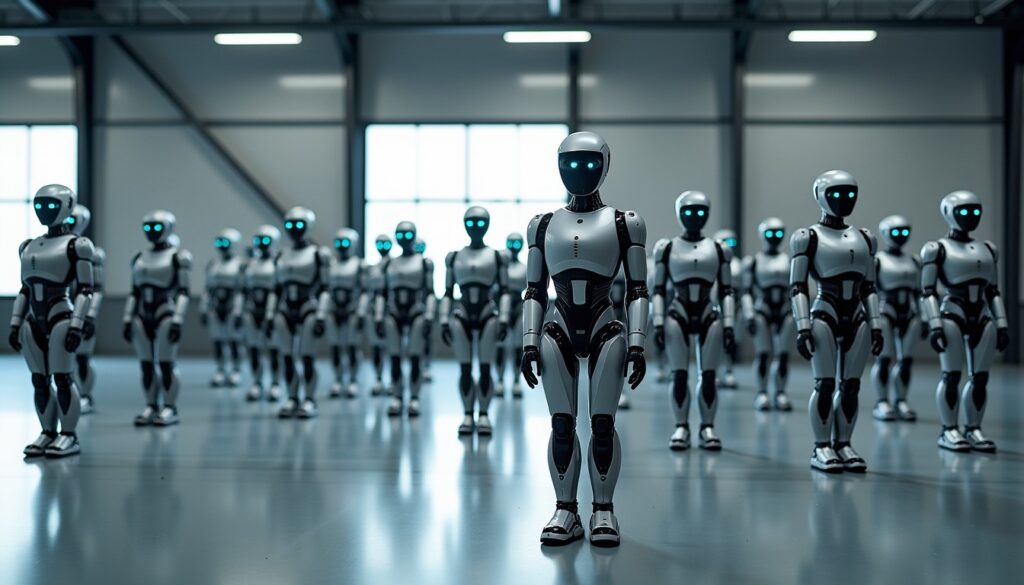
Humanoid robotics reaches a new milestone in 2026 with the spectacular advancement of Figure AI, an American company that managed to produce 55 humanoid robots in the span of just one week. This phenomenal acceleration in industrial production marks an unprecedented turning point in the field, arousing as much admiration as questions about the challenges related to this massive deployment. As robotic technology gains maturity, the question of the impact of this “incredible progression” on the market, society, and security becomes central. In this context, Figure AI positions itself not only as a pioneer of intelligent automation but also as a case study to watch closely. This rapid deployment demonstrates a company’s ability to combine technical innovation with exemplary industrial organization to meet the growing demand in various industrial sectors.
Behind this production record lies a unique factory, named BotQ, where more than 150 interconnected workstations are managed by robust artificial intelligence. This infrastructure has allowed the manufacturing rate to multiply by eight in just a few months, going from one robot built per day to one robot per hour. This transition illustrates the rapid adaptation of the industrial chain to the demands of large-scale production while maintaining a rigorous quality level with more than 50 qualitative control points and a battery success rate higher than 99%. Furthermore, each robot undergoes intensive functional tests to ensure its reliability in real-world usages, such as squatting, jogging, and the ability to move over different terrains.
However, this rapid rise does not only inspire dreams. It also raises major concerns regarding social, ethical, and security repercussions. The massive deployment of these robots raises questions about the role of humans in work, dependency on technology, as well as the ability to oversee increasingly autonomous artificial intelligence. The implications of such innovation are multiple, juxtaposing economic progress with increased vigilance. Yet, Figure AI is not limited to production: the company has designed an intelligent system called Helix, whose strength grows with each robot produced and deployed, thereby enhancing collective performance through autonomous and continuous learning across the entire fleet.
- 1 A major industrial transformation: how Figure AI multiplied its humanoid robot production by eight
- 2 BotQ, the beating heart of production: organization and technological innovations
- 3 Advanced functional tests: ensuring robot reliability despite acceleration
- 4 Helix: the embedded artificial intelligence that transforms each robot into a data source
- 5 Economic impacts: what consequences for industry and employment?
- 6 Security and ethical aspects: a deployment that raises questions
- 7 The technological challenges behind Figure AI’s incredible progression
- 8 Towards a future of omnipresent automation: Figure AI’s next steps
A major industrial transformation: how Figure AI multiplied its humanoid robot production by eight
In the robotics industry, the ability to move from a functional prototype to large-scale industrial production often represents an insurmountable challenge. Yet, Figure AI succeeded in this feat by completely reinventing its production line and equipping itself with a cutting-edge factory: BotQ. This industrial platform is a true model of convergence between robotics, artificial intelligence, and advanced operations management.
The secret to this transformation lies in meticulous organization. With more than 150 workstations supervised by proprietary software, each manufacturing step is automated, controlled, and optimized. The company has implemented more than 50 quality control points, ensuring that each component is compliant before entering the final assembly. This systematic approach has stabilized production despite the rapid volume increase.
Going from one robot produced per day to one robot per hour is equivalent to multiplying the rate by 24 over a period of 120 days. This is a record that few startups in the robotics sector can claim. This leap forward has not only increased industrial capacity but also enhanced the reliability of finished products. From the assembly line, over 80% of robots meet optimal functioning criteria, with exceptional reliability on batteries and mechanical components.
To illustrate this success, here is a comparative table of production performances over recent months:
| Month | Robots produced per day | Success rate (%) | Functional tests performed |
|---|---|---|---|
| January 2026 | 1 | 75 | 50 |
| February 2026 | 5 | 78 | 60 |
| March 2026 | 20 | 80 | 70 |
| April 2026 | 35 | 83 | 75 |
| May 2026 | 55 | 85 | 80 |
The rise of Figure AI also relies on massive investment in industrial robotics and artificial intelligence to ensure better flow management and advantageous predictive maintenance. These industrial innovations have achieved a balance between quantity and quality, which is crucial to establish customer trust and pave the way for massive deployment.
BotQ, the beating heart of production: organization and technological innovations
BotQ, Figure AI’s flagship production site, illustrates the synergy between advanced automation, artificial intelligence, and cutting-edge engineering to revolutionize the manufacturing of humanoid robots. This unique industrial site has been the subject of numerous innovations, notably in connectivity and quality control.
Each station on the line is connected in real time to internal management software, enabling precise and continuous monitoring of the manufacturing process. The adoption of this advanced digital structure has resulted in a significant reduction of human errors and production-related defects. The software also ensures dynamic allocation of resources to avoid bottlenecks.
To support the increased production rate, Figure AI has also developed around ten autonomous stock and logistics flow management systems, thus reducing delays between each stage and perfectly synchronizing supplies. This rigor in organization is the key to meeting growing demand and maintaining consistent performance.
One of the most remarkable elements is the establishment of a rigorous control chain. Each robot produced goes through more than 50 control points and undergoes over 80 functional tests before being approved for delivery. These tests assess several systems: mobility, resistance, battery autonomy, adaptability to different environments, etc.
The BotQ site illustrates how the convergence of technology and organization can be a driver of large-scale industrial innovation. It is what allowed Figure AI to set an unprecedented production pace of humanoid robots worldwide.
Advanced functional tests: ensuring robot reliability despite acceleration
The massive increase in production must imperatively be accompanied by maintenance or even improvement of quality standards. At Figure AI, post-production tests are thorough and ensure that every humanoid robot will be capable of operating under difficult real-world conditions.
A comprehensive battery of tests is applied, including simulations of complex human movements such as squatting, jogging, and stair climbing. These exercises aim to guarantee that robots can perform daily tasks without major failure, and especially without external human intervention.
The control protocol also includes tests on material resistance, intensive usage cycles, as well as checks on embedded systems, with particular attention paid to batteries that achieve a success rate of 99.3%, a remarkable score in autonomous robotics.
The results of these checks translate into a machine yield rate exceeding 80% right from their first factory exit. This balance between fast production and reliability ensures that Figure AI’s rapid expansion does not sacrifice the robustness and functional safety of the robots.
Here is a list of the main functional tests performed on each robot:
- Simulation of varied movements (walking, jogging, stairs)
- Repetition of dynamic motions (squats, twists)
- Precise control of mechanical actuators
- Battery autonomy and recharge test
- Evaluation of visual perception sensors
- Impact resistance analyses of different types
- Statistical control via AI for defect detection
Many engineers participate in developing adapted protocols to ensure that each robot can evolve fully autonomously and react quickly in case of unforeseen events on the field. These methods guarantee a successful transition from prototype phase to reliable industrial production.
Helix: the embedded artificial intelligence that transforms each robot into a data source
At the heart of this “incredible progression” technology, artificial intelligence plays a central role thanks to Helix, the proprietary platform developed by Figure AI to coordinate and optimize the performance of its humanoid robots. This embedded AI does not merely pilot the machines; it continuously evolves them.
Helix operates like a continuous learning system, receiving real-time data collected by each deployed unit. Thanks to this permanent flow, the AI improves body control algorithms, environment recognition via cameras, and autonomous decision-making.
The Helix architecture relies on multi-camera perception that allows robots to reconstruct a 3D model of their environment. This advanced visualization grants them unprecedented adaptability, notably on uneven terrains or complex spaces, without requiring manual intervention or specific recalibration.
This revolutionary technology opens new perspectives for industrial and domestic applications. The robot is no longer a static machine but becomes an intelligent actor capable of anticipating its movements and reacting to unforeseen events. This increased autonomy is a key factor in the large-scale deployment desired by Figure AI.
Another innovative aspect of the system is its capacity for remote maintenance and updates. Helix continuously analyzes the robots’ status and instantly detects breakdowns or anomalies. This data is relayed within minutes to technical teams who then deploy the necessary patches, significantly reducing machine downtime.
Economic impacts: what consequences for industry and employment?
This rapid deployment capacity of humanoid robots by Figure AI radically transforms economic dynamics in several industrial sectors. Intensive automation paves the way for optimizing production lines, reducing labor costs, and significantly increasing productivity.
For manufacturing, this revolution means delegating repetitive or dangerous tasks to robots equipped with sophisticated autonomy. Robots improve operation quality and reduce human errors, thus contributing to better competitiveness on global markets while accelerating production timelines.
However, this shift also raises strong concerns regarding the future of employment. The replacement of workers by robots raises the question of necessary retraining for many operators. Society faces a crucial choice: support this transition through massive training programs or face increased unemployment and social tensions.
Here is a list of economic advantages and risks linked to the massive deployment of robots:
- Advantages: increased productivity, long-term cost reduction, better precision, improved safety.
- Risks: loss of unskilled jobs, challenges in employee training, exacerbated social inequalities, increased technological dependency.
In the long run, the successful integration of these technologies in companies will depend on the ability of governments and economic actors to implement appropriate policies that promote coexistence between humans and robots.
Security and ethical aspects: a deployment that raises questions
The rapid progress of Figure AI, although fascinating, also raises a series of ethical and security questions that must be addressed. By multiplying autonomous robots, the challenge is to ensure that these machines do not become a risk factor, both physically and in terms of privacy and society.
Humanoid robots, equipped with increasingly sophisticated artificial intelligence, can potentially operate in sensitive contexts ranging from public security to handling dangerous objects. It therefore becomes essential to implement strict protocols to ensure their behavior remains controlled and that their data is protected from any abusive use.
Another crucial point concerns liability in case of an incident. Who is responsible? The manufacturer, the operator, or the AI itself? Legislation is still nascent in this field, and civil society calls for clear and anticipatory regulation.
Ethical concerns also include the human dimension, with fears that the omnipresence of robots could permanently alter social interactions, work, and even the perception of humans as distinct beings in society.
The technological challenges behind Figure AI’s incredible progression
Reaching such a production pace was no easy task. Behind the impressive figures, Figure AI had to overcome numerous technological and logistical obstacles. The harmonious integration of complex mechanical systems, embedded artificial intelligence, and demanding quality control required massive R&D investments, as well as unprecedented multidisciplinary expertise.
The challenges include notably the miniaturization of components, thermal management, joint robustness, and actuator synchronization. These are areas where each improvement directly impacts the overall performance and reliability of the robot.
Moreover, ensuring that robots can operate in varied environments without loss of autonomy or adaptability required developing sophisticated algorithms for perception and control. This technical complexity explains the thoroughness of post-production tests and the use of machine learning to optimize behaviors.
Towards a future of omnipresent automation: Figure AI’s next steps
Building on this “incredible industrial progression,” Figure AI now aims to deploy more than 100,000 humanoid robots within a few years, aiming to revolutionize the logistics, manufacturing, and domestic industries alike. This outlook promises a future where automation and artificial intelligence merge to assist humans in their daily tasks.
The company is working on several innovation avenues, notably diversifying models adapted to different sectors, improving energy autonomy, and enhancing the cognitive capacities of robots. The goal is to offer not only a robotic assistant but a true companion capable of intuitively interacting with its environment and users.
This trajectory also assumes strengthening the ecosystem around robots, with infrastructures for remote maintenance, continuous software updates, and instant diagnostics. The focus is on human-machine cooperation, to combine the benefits of technology with controlled human oversight.