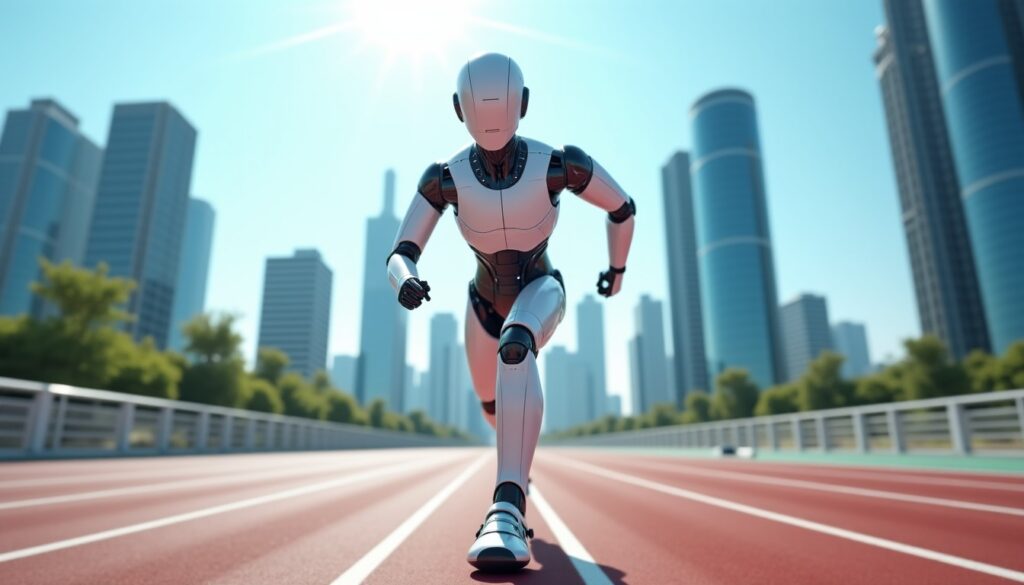
In a constantly evolving field, the robotics sector is today crossing a new impressive threshold. Imagine a bipedal machine that not only walks but sprints at a speed rivaling that of elite human athletes. The Chinese start-up Unitree Robotics recently unveiled a sensational video where their H1 model reaches a top speed of 10.1 meters per second, about 36 km/h. This technical feat, filmed on an athletics track, illustrates the major breakthrough achieved in the mobility of humanoid robots thanks to the synergy between artificial intelligence, technology, and meticulous biomechanical engineering. Watching this sprinting robot, experts and enthusiasts question the future implications of this innovation, both in the industrial field and daily life.
This performance challenges the perceived limits of robotic mobility. Indeed, the H1, with an architecture closely resembling the human body, reaches a speed close to that of world-class runners such as Usain Bolt. The revolutionary speed of this humanoid robot is not a simple isolated feat: it represents a strategic advance that will impact the development of robots serving rapid intervention, logistics, or even rescue in hostile environments. Discover through this article the different aspects of this technological achievement and its short- and medium-term consequences, as well as a dive into the mechanical intelligence driving these new sprinters made of steel and electronics.
- 1 A giant leap in robotics: when a humanoid robot sprints at 10 m/s
- 2 The biomechanical secrets of the H1 humanoid robot for sprinting
- 3 Comparison between human performances and humanoid robot in sprinting
- 4 Technology serving enhanced human mobility in robots
- 5 Potential applications of these sprinting humanoid robots
- 6 Technical and ethical challenges surrounding sprinting humanoid robots
- 7 Towards a new era: the humanoid robots’ half-marathon, an event to follow
- 8 The societal impact of high-performance humanoid robotics
A giant leap in robotics: when a humanoid robot sprints at 10 m/s
The speed recently achieved by Unitree’s H1 robot is simply exceptional. To put things in context, 10.1 meters per second equals about 36 kilometers per hour. This level of performance is close to the human record for 100 meters, set by Usain Bolt at 9.58 seconds, which is a similar average speed. This revolutionary speed was not achieved on a track designed for machines but on a classic athletics track, which further emphasizes the quality of the robot’s mobility.
The H1 robot, weighing 62 kilograms, demonstrates that current robotics can today reproduce, or even surpass, certain human motor abilities. The synchronization of joints, driven by high-precision motors and advanced artificial intelligence, is at the origin of this fluidity of movement. Unlike many previous bipedal machines, the H1 maintains remarkable balance, which is crucial to avoid falls and loss of speed. The technical feat of Unitree Robotics is based on the harmonious integration of several scientific and technological disciplines.
The challenge of running at 10 m/s does not lie solely in the raw capacity for movement but in the complete dynamics of the mechanical body: managing impact forces, absorbing vibrations, real-time adjustment of stability, and anticipating terrain variations. All these elements require hundreds of hours of testing and faithful reproduction of human biological behavior.
The video published by Unitree Robotics is making rounds worldwide and sparks amazement. It attests not only to an unprecedented innovation but also to a future where these humanoid robots could integrate into our daily lives, ranging from express delivery to surveillance of risk areas, while offering speeds never before seen in machines of this size.
The biomechanical secrets of the H1 humanoid robot for sprinting
The architecture of the H1 robot is closely inspired by human morphology, and this aspect plays a fundamental role in achieving such impressive performances. The robot has a leg length of about 80 centimeters, with a total weight close to 62 kilos, recalling the proportions of an average athlete. This careful biomimetics allows the robot to reproduce the natural movements of the human body during running.
Each leg is equipped with joints driven by precision motors that react in milliseconds to adjust and maintain the overall balance of the system. Coordination between the different parts of the body is orchestrated by advanced artificial intelligence that analyzes in real time the ground contacts, forces exerted, and trajectory to follow.
Dynamic motor control is complemented by sophisticated sensors that continuously inform about the position and speed of each segment. Thanks to this data, the robot can adjust its stride, modulate propulsion power, and effectively absorb shocks related to high-speed running. This biomechanical synchronization ensures a smooth, fast, and stable stride. The main technical challenge was to anticipate oscillation effects and balance vulnerabilities so that the robot can maintain speed without wobbling or falling.
This system can be compared to an expert athlete who constantly adjusts their posture and rhythm during a race. Intelligent robotics thus simulates these adaptation capacities specific to humans, demonstrating the successful interconnection between mechanics, electronics, and sophisticated algorithms. Each step taken by the H1 is therefore a demonstration of innovation and cutting-edge technological mastery.
This biomechanical approach is on track to revolutionize the world of humanoid robots by offering multiple possibilities, such as applications in complex urban environments where mobility and speed are major assets.
The key components that ensure the H1’s rapid performance
- High-reactivity motorized joints: ensure precise control of every movement.
- Pressure and position sensors: allow immediate posture adjustment.
- Advanced artificial intelligence algorithms: manage race dynamics in real time.
- Lightweight and robust structure: composite materials combining strength and lightness.
- Intelligent energy management: optimizes autonomy during intense effort.
Comparison between human performances and humanoid robot in sprinting
The speed thresholds achieved today by humanoid robots invite a fine analysis of differences and similarities with human performances. In this field, two essential aspects must be taken into account: body mechanics and decision-making intelligence.
Physically, the robot and humans share certain parameters. For example, the H1 at 62 kg and its legs measuring 0.80 m are analogous to the average morphology of a sprinter of standard size. Despite this parallel, the repetition of movements and the quality of impulses differ radically. A human relies on muscle fibers, tendons, and a natural physiological adaptability that is difficult to simulate mechanically.
Moreover, what most distinguishes the robot from the human runner is its ability to maintain perfect regularity in strides, without fatigue or degradation of coordination. In contrast, endurance and physical recovery limit human performances after a certain time. The robot can thus accumulate effort and offer appreciable consistency.
To better understand these differences, here is a simplified comparative table:
| Criterion | Humanoid Robot H1 | Elite Human Athlete |
|---|---|---|
| Weight | 62 kg | 60-85 kg |
| Leg length | 80 cm | 75-85 cm |
| Maximum recorded speed | 10.1 m/s (36 km/h) | 12.42 m/s (44.7 km/h, Usain Bolt) |
| Endurance | Limited by battery, consistent performance | Variable, affected by fatigue |
| High-speed stability | Very high thanks to real-time AI | Excellent but variable |
If robots like the H1 approach the speed of human runners, technical dimensions continue to evolve rapidly, suggesting that eventually the gap may narrow even further. The question then arises: could these robots, in the near future, sustainably surpass human limits in sprinting?
Technology serving enhanced human mobility in robots
The H1 robot’s ability to sprint is not a simple technological accident. It results from advanced research work that combines several innovative fields, notably robotics, intelligent sensors, high-performance motors, and above all, integrated artificial intelligence to pilot the entire system in real time.
Enhanced human mobility in robots refers to the capacity to reproduce and surpass human motor movements and functions in terms of efficiency and fluidity. The H1 perfectly illustrates this concept thanks to:
- Decision-making intelligence capable of continuously evaluating and correcting movements to stay on the optimal trajectory.
- Adaptation to external conditions, such as surface irregularities or unexpected deviations.
- Energy optimization allowing management of the power used to maximize sprint duration.
- Consideration of biomechanics to reduce shocks and mechanical wear, thus ensuring the robot’s durability.
The combination of these technologies produces a robot that reacts faster, with immediate responsiveness, far beyond human physical capacities in terms of precision. This innovation paves the way for humanoid robots capable of moving freely in diverse environments, whether urban, industrial, or even wild.
Potential applications of these sprinting humanoid robots
This revolution in the mobility of humanoid robots goes beyond visual spectacle. Behind this technical feat lie very promising concrete applications in various sectors. Here are some areas where a fast humanoid can make a radical difference:
- Emergency interventions and rescue: in natural disasters or accidents, a sprinting robot can quickly reach victims, transmit information, or provide immediate assistance.
- Logistics and delivery: fast mobility optimizes timelines and flow management, whether for urban last-mile delivery or hard-to-access environments.
- Security patrols: fast robots can efficiently monitor large perimeters, prevent intrusions or incidents, while promptly reacting to abnormal situations.
- Exploration and maintenance: in industrial, mining, or hostile environments such as space or deep underwater, these machines can intervene with agility and precision.
- Humanoid companions: in supporting elderly or disabled persons, better mobility opens unprecedented perspectives by offering dynamic and adaptable support.
Of course, speed is not everything. It must be accompanied by adaptability and sufficient robustness to withstand shocks and unforeseen events. These conditions are at the heart of current research accompanying these mobility innovations.
Technical and ethical challenges surrounding sprinting humanoid robots
Every major advance in robotic technology comes with crucial questions, both technical and ethical. The development of robots capable of sprinting at speeds close to humans raises several issues:
1. Safety management: a fast robot must imperatively integrate safety mechanisms to avoid accidents, collisions, or injuries, whether to nearby humans or the machine itself.
2. Energy autonomy: maintaining such speed requires significant energy consumption. Finding an optimal balance between power and autonomy is an ongoing challenge that still hinders large-scale deployment.
3. Control and supervision: algorithms must be robust enough to react to all variables, including unforeseen events, without causing potentially dangerous errors.
4. Ethical questions: how far should speed and power of robots be allowed in public spaces? What are the implications for privacy, employment, or increased potential surveillance?
Discussions are underway in scientific and legislative circles to regulate these technologies, to ensure responsible and beneficial deployment for society.
Beyond performance, a global reflection is required to manage the benefits and risks of sprinting humanoids in our living spaces. Innovation must then combine with a strong ethical sense, bringing together engineers, policymakers, and citizens.
Towards a new era: the humanoid robots’ half-marathon, an event to follow
On April 19th, the second edition of the half-marathon reserved for humanoid robots will take place. This unprecedented sporting event illustrates the rise of a competition where technology, research, and performance intertwine. Several models are expected to line up in this race, highlighting not only speed but also endurance and coordination capacity over more than 21 kilometers.
This half-marathon marks an important milestone for several reasons:
- Increased visibility: the event attracts media and public attention, stimulating interest and investments in this sector.
- Technological confrontation: different manufacturers showcase their innovations, promoting exchange and collective progress.
- Full-scale test: running a long distance with stability and performance is a challenge beyond a simple sprint, revealing the maturity of robotic systems.
- A step towards practical applications: the robustness and mobility offered during this race open avenues for multiple industrial and civil uses.
The results of this half-marathon will undoubtedly fuel debates on the future of humanoid robotics, especially in terms of speed, endurance, and autonomy. Technology and performance enthusiasts are already eager to discover this extraordinary competition.
The societal impact of high-performance humanoid robotics
The emergence of humanoid robots capable of sprinting at impressive speeds goes far beyond a simple technical feat. It profoundly influences our relationship to technology, mobility, and human-machine collaboration. This advance opens the way to strengthened cooperation between humans and robots, where complementarity benefits productivity, safety, and comfort.
However, this rapid revolution also disrupts some traditional practices and raises questions about the future of work. Sprinting robots could change the professional landscape in several sectors, replacing or assisting humans for tasks requiring speed and precision.
The gradual integration of these robots into daily life calls for cultural, economic, and social adjustment. It becomes essential to support this transition with education, training, and suitable regulation to harmonize innovation and the common good.
In short, performance and technology are only the beginning of a paradigm shift in humanoid mobility, set to reshape our modes of interaction, industries, and habits.