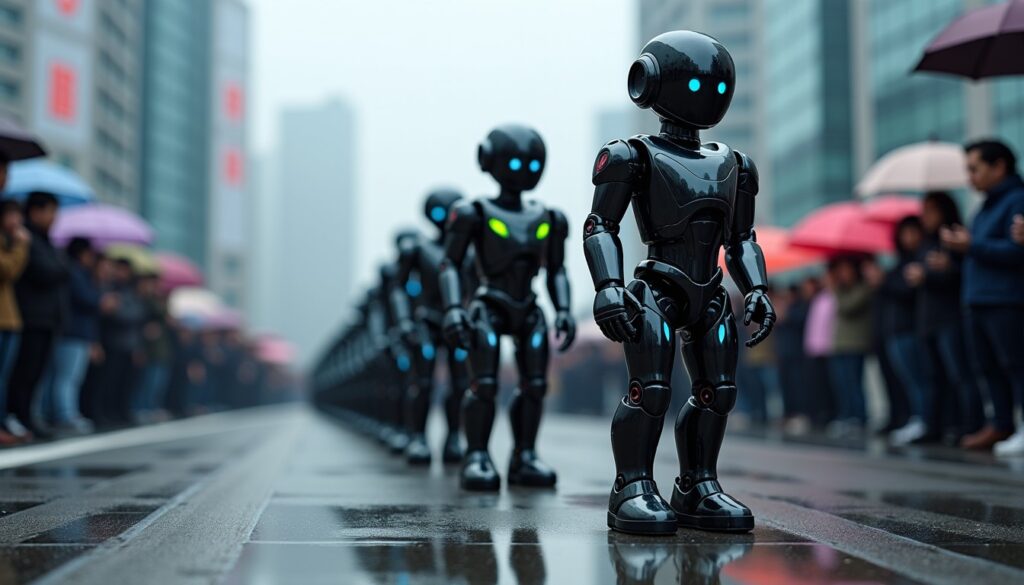
At the dawn of the second edition of the humanoid robot half-marathon, the city of Beijing is preparing to host a competition that is both fascinating and emblematic of current technological evolution. Around 70 teams from all corners of China have sharpened their prototypes to face a 21-kilometer course, challenging not only their endurance but also the human ingenuity that brought them to life. This unique event not only showcases the prowess of robots: it poses the profound question of the place of robotics in our immediate future, both in sports and in industrial and social applications. Through this race, innovation is put to the test in real conditions, and every kilometer given to these machines is a crucial lesson for engineers. This competition thus represents a full-scale laboratory where technology and endurance unite to push the limits of mechanical autonomy.
Since the inaugural edition, this competition has experienced spectacular growth. In 2025, about twenty teams confronted this first real-life test. One year later, nearly 70 teams participated, nearly quintupling the initial number, demonstrating a new passion for these robotic events that combine science, the art of movement, and endurance. This enthusiasm reflects the growing importance the country places on robotics research and innovation, especially in fields rarely associated with technology until now. The current context sees mechanical advances, algorithm mastery, and artificial intelligence combining, a cocktail propelling humanoids beyond being mere gadgets for athletes. This race reflects a race for progress that serves as a model to follow on the international scene.
- 1 A true technological challenge: a half-marathon put to the test by humanoid robots in China
- 2 The challenges of endurance and stability in humanoid robotics
- 3 A competition that generates growing enthusiasm in China
- 4 The scientific and educational dimension of the robotics race in China
- 5 Team strategies and technological innovations in the competition
- 6 The future prospects of humanoid robotics through the Chinese half-marathon
- 7 Nocturnal races to test the resistance and autonomy of robots
A true technological challenge: a half-marathon put to the test by humanoid robots in China
Organizing a half-marathon for humanoid robots is not simply a question of speed. In this competition, the main challenge is to ensure the robots’ ability to maintain performance and stability over a long distance, which requires major innovations in mechanics, dynamic balance, and control systems. The 21 kilometers thus act as a real bridge between sports racing and robotic experimentation, a test that demands machines evolve in a semi-controlled urban environment but faced with unexpected terrain elements such as slopes, varied angles, and different surfaces.
These conditions make the race unique and particularly demanding. Indeed, to cover such a distance, each robot must combine autonomous or semi-autonomous navigation, as well as efficient management of its balance and energy consumption. This is why nearly 40% of the participants exploit this full autonomy, a bold bet that pushes the limits of current technology. The goal is not only the ability of robots to accelerate but to maintain a trajectory and sufficient stability to cover the kilometers without falling or sustaining serious mechanical damage.
The importance of this competition goes beyond the sporting aspect. The data collected during the course provides valuable feedback for improving learning algorithms, sensors, and motor mechanisms. Every fall, every trajectory correction is analyzed to boost the next generation of robots. For example, during the nighttime trial preceding the official race, several technical incidents highlighted significant areas of improvement such as adapting to slippery surfaces and managing cornering angles.
The challenges of endurance and stability in humanoid robotics
Distance holding is the first challenge these robots must face. Unlike a sprint race, a half-marathon represents a test of endurance and reliability, where every detail counts. The machines must be equipped with batteries or energy systems capable of sustaining prolonged effort while efficiently managing their power. This creates a tough dilemma between weight, energy autonomy, and mechanical robustness, often difficult to balance.
Stability is another crucial component. The dynamic balance of humanoid robots is complex to achieve, especially on a course combining different ground textures. A robot that falls often suffers damage compromising not only the competition but also the training and improvement cycle. Some teams have thus focused on innovation in gyroscopic sensors and artificial intelligence to predict and compensate for stability losses.
A list of technological innovations at the heart of the race:
- Advanced balance sensors allowing near-instantaneous regulation.
- Optimized propulsion systems for smooth movement and energy efficiency.
- Machine learning algorithms capable of adapting to track hazards in real-time.
- High energy density batteries offering extended autonomy without overloading the structure.
- Multi-sensor coordination for better environmental perception.
These technical feats explain why the half-marathon has become a symbol for competitive robotics. Each robot is a concentrated blend of brainpower and mechanical expertise fully expressed during the race. Endurance helps distinguish prototypes capable of later evolving into long-duration applications such as mobility assistance or rescue in complex environments.
Table: comparison of key performance figures of participating robots
| Team | Autonomy (in % autonomous race) | Average speed (km/h) | Stability (number of falls) | Race duration (hours:mm) |
|---|---|---|---|---|
| Alpha Robotics | 85% | 8.2 | 0 | 2:34 |
| Beijing Tech | 60% | 7.5 | 1 | 2:48 |
| Shenzhen Innovate | 40% | 7.9 | 2 | 2:45 |
| Tsinghua Robotics | 90% | 8.5 | 0 | 2:30 |
A competition that generates growing enthusiasm in China
The organization of this second edition has benefited from increased interest both among engineers and a curious, passionate public. The growth in the number of participants—from around twenty in 2025 to nearly 70 teams in 2026—attests to a true explosion of popularity. But beyond the numbers, it is the spirit of competition and the willingness to experiment that mark this race.
This edition now offers diversified rewards, focused on endurance and the ability to cross the finish line, rather than purely raw speed. This inspired change reflects the organizers’ desire to prioritize the durability and reliability of robots, essential criteria for these technologies to find concrete application in the real world. For example, a university team took a bold bet by building its robot the very day before the race, highlighting the experimental aspect and strong innovation dynamic among participants.
This phenomenon is all the more remarkable as several teams now operate fully autonomous navigation. These complex algorithms are still fragile but embody the future of robotic intelligence. The technical capital generated by this competition is then used to refine coordination systems, mechanical resilience, and emergency management, thus laying the foundation for a future multi-faceted profession where robotics, logistics, and sport could come together.
The scientific and educational dimension of the robotics race in China
Beyond the competition, this half-marathon is also a remarkable educational platform in the field of robotics. Many university laboratories and Chinese research centers participate, using this race as a true field for experimentation and data exchange. Results obtained during the half-marathon then feed research cycles aimed at solving challenges in mobility, autonomous perception, and robot safety.
Within this framework, the event has fostered the creation of collaborative networks among engineers, researchers, and students. For example, some university teams have developed protocols to test their robots under specific conditions like unstable cobblestones or steep curb crossings. These conditions are not only technical obstacles but also unique opportunities to enrich embedded intelligence.
From an educational perspective, failures and successes in the field serve as a continuous source of improvement, stimulating innovation through direct experience. This dynamic is comparable to a living laboratory where artificial intelligences learn through real interactions with their environment, much more efficiently than in computer simulations.
Team strategies and technological innovations in the competition
Each team arrives with its own strategy to optimize performance over the 21 kilometers of the half-marathon. Some prioritize lightweight robots to reduce energy consumption, others rely on redundant systems to improve reliability. These different approaches reflect the diversity of research in robotics.
Two main trends are especially observed:
- Full autonomy, with machines capable of making real-time decisions without human intervention. These robots analyze track conditions, correct their trajectory, and adapt to spontaneous challenges posed by the terrain.
- Human-machine cooperation, where remote supervision intervenes only in case of detected risk or imminent failure. This hybrid model has proven its relevance for managing complex situations while promoting the machine learning of robots.
This strategic duality results in highly variable performances but fuels a tremendous scientific emulation. Engineers reinvest these experiences to develop next-generation robots that are more agile and robust. The challenges are no longer limited to urban or sports circuits; the refined robotic technology can be deployed in fields such as logistics, industry, or surveillance.
The future prospects of humanoid robotics through the Chinese half-marathon
This half-marathon is part of a global momentum where China positions itself as a leader in modern robotics. Competitions of this type rank among the preferred testing grounds for integrating advances in artificial intelligence, machine learning, and mechatronics. Through this challenge, notable progress is anticipated in several crucial areas:
- Improvement of autonomous mobility, a challenge still open with robots able to operate in complex environments without supervision.
- Material robustness, with mechanical systems designed to withstand prolonged efforts and technical hazards.
- Energy endurance, developing lighter and more durable batteries or integrated energy recovery systems.
- Collaborative intelligence, enabling robots to communicate and adapt collectively during races or multiple missions.
All these research areas ultimately promote practical applications, such as assisting the elderly, disaster zone rescue, or industrial maintenance in hazardous zones. The humanoid half-marathon, beyond its spectacular aspect, is thus a vector of innovation with significant societal impact.
Nocturnal races to test the resistance and autonomy of robots
Preparation for this half-marathon included a nighttime test trial in the streets of Beijing, a first full-scale field test that allowed teams to fine-tune their machines. Running in the dark adds an extra difficulty: robots must indeed rely on their sensors and artificial intelligence algorithms to navigate without natural visibility.
This nighttime race clearly illustrates the technical challenges related to real-time data management and instantaneous response to unforeseen situations such as moving obstacles, changes in relief, or GPS positioning errors. Engineers thus gathered valuable information on energy management and robots’ ability to maintain their balance despite the absence of external visual references.
The observed incidents, such as spectacular falls or synchronization losses, became occasions to adjust systems. This experimental phase, remarkable for its realism, perfectly prepares the ground for the official race scheduled for April 19, 2026, and shows that Chinese robotics continuously raises its standards in the field of innovation and technology.