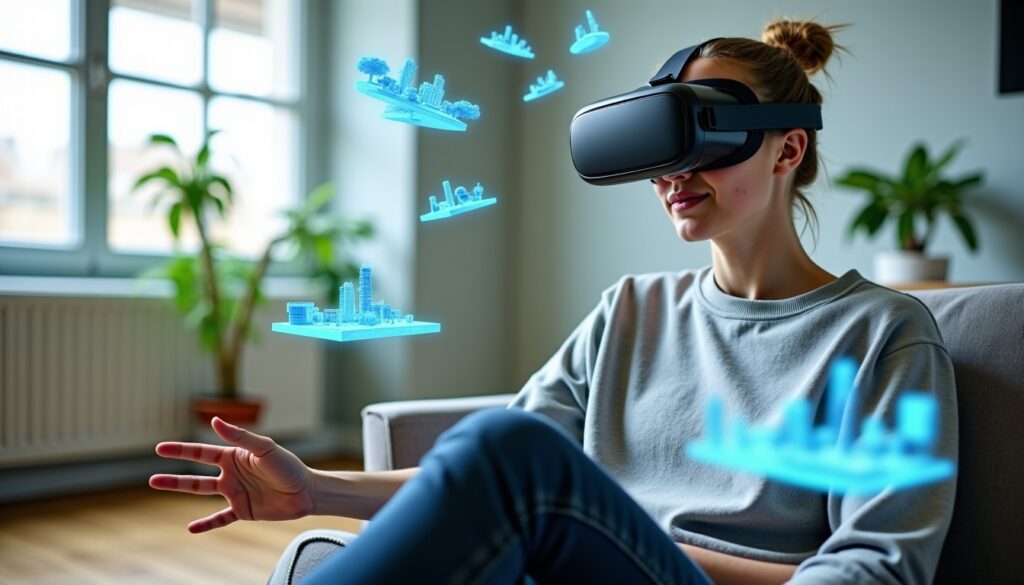
In a world where technology evolves at a breathtaking pace, the way we learn and interact with information is profoundly changing. Gemini, the latest innovation by Google, offers a whole new experience: turning your questions into interactive 3D experiences. This revolutionary advancement immerses the user in a universe where knowledge becomes tangible, immersive, and highly customizable. Imagine being able to manipulate complex simulations in real time, such as the trajectory of the Moon around the Earth or the oscillations of a double pendulum, without leaving your conversation. This concept of user interaction redefines digital education thanks to immersive technology that places visualization and manipulation at the heart of learning.
Farewell to long tedious readings and static diagrams that often leave one perplexed. With Gemini, access to information is now through dynamic 3D experiences, where every element is adjustable at will. Adjust variables, observe the immediate reactions of models, rotate objects, zoom in to analyze the smallest detail, or pause the simulation to deepen your observations. This approach promotes not only better understanding but also accelerated memorization, particularly beneficial for students and enthusiasts of science, engineering, or art.
The digital revolution driven by Gemini is grounded in a commitment to accessibility: all users can access these experiences simply by activating the “Pro” mode in the prompt bar. This strategy by Google avoids any barrier and invites a smooth immersion, without interruption, directly at the heart of the dialogue with AI. While competitors like Anthropic or OpenAI are also developing visual representation tools, Gemini stands out by the richness and fluidity of its interactions, offering a genuine virtual laboratory accessible with a single click.
- 1 Gemini: transforming interactive questions into immersive 3D experiences
- 2 Immersive technology serving pedagogy: concrete examples and applications
- 3 How Gemini redefines user interaction in digital environments
- 4 Gemini versus the competition: a unique immersive revolution in 2026
- 5 Sectors transformed by Gemini’s immersive technology
- 6 A smooth and intuitive interface at the heart of the Gemini immersive experience
- 7 Impacts of Gemini on learning methods and memorization
- 8 Future possibilities for Gemini: towards full integration in virtual reality
Gemini: transforming interactive questions into immersive 3D experiences
Gemini’s ability to create interactive 3D models from a simple query represents a major breakthrough in immersive technology. By deciphering complex questions, the algorithm generates realistic and fully manipulable simulations, facilitating deep understanding in real time. For example, a curious user wanting to visualize the Doppler effect can immediately see the corresponding simulation, adjust frequency or speed parameters, and watch the changes unfold before their eyes thanks to an intuitive interface.
This user interaction reproduces an almost physical contact with concepts, making learning more concrete. Unlike simple illustrations or explanatory videos, Gemini invites direct manipulation, opening the door to multiple explorations. The user can play with the simulation, go back, change initial conditions, and experiment freely, thus creating an active learning environment.
The system integrates a pause button and various sliders so that everyone can control the pace and deepen analysis. This fluidity in the immersive experience ensures better mastery of concepts, whatever the interlocutor’s level. Additionally, the customization of visualizations offers flexibility rarely seen in online education platforms, thus strengthening Gemini’s educational potential.
Immersive technology serving pedagogy: concrete examples and applications
Gemini is not limited to spectacular demonstrations: its pedagogical impact is tangible. Take the example of a physics student who must understand the behavior of a double pendulum, a topic known to be difficult because of its chaotic movements. Instead of studying static diagrams or abstract explanations, they can directly interact with a 3D simulation thanks to Gemini.
By varying the length of the arms, the mass of the weights, or the initial amplitude via sliders, they observe in real time how the system reacts, how the trajectory evolves, and what conditions cause more complex movements. This experiential understanding promotes faster and longer-lasting assimilation by combining sight, touch, and even reflection simultaneously.
Another use case concerns the lunar orbit simulation mentioned in Google’s presentation. Here, the dynamic 3D model shows not only the Moon’s rotation around the Earth but also allows exploration of complementary elements, such as the gravitational field or phenomena like tides, by hiding or displaying certain details. This modularity enriches each session, making teaching richer and more fun, and invites users to formulate their own hypotheses and tests.
Immersive technology also enters artistic and historical fields. A digital artist, for example, can visualize in 3D the lighting effects on a virtual sculpture they freely manipulate. Likewise, a history enthusiast can virtually relive the construction of a monument by exploring each step through interactive scenarios.
List of tangible benefits of Gemini in immersive pedagogy:
- Active approach that stimulates curiosity and creativity.
- Clear visualization of complex concepts through touch and manipulation.
- Adaptability to all learning profiles.
- Acceleration of memorization thanks to multisensory integration.
- Accessibility without costly equipment, via a simple web interface.
How Gemini redefines user interaction in digital environments
Gemini marks a turning point in how users interact with digital content. Beyond simple passive consultation, it offers an interactive platform where every question becomes an opportunity for experimentation. This digital revolution energizes the conversation between human and machine.
Practically, the user remains in their usual conversational environment, but each response can contain integrated 3D experiences. This direct integration in the chat facilitates use, eliminating the need for third-party platforms or separate applications. The instant switch from question to immersive manipulation saves time and energy, while making the experience more natural.
Thanks to options such as the “Pro” mode activatable in the prompt bar, Gemini offers exclusive access to these advanced visualizations, guaranteeing both personalization and data security. These settings ensure users a smooth experience, without overload or interruptions, while adjusting the complexity of simulations according to mastery level or interest.
This smooth user interaction offers unprecedented possibilities. Imagine a medical student adjusting in real time the parameters of a 3D human heart model to observe blood flow and the effects of pathologies. This precision in virtual experimentation changes the game for knowledge professions, bringing theoretical learning closer to a concrete experience close to reality.
Gemini versus the competition: a unique immersive revolution in 2026
The artificial intelligence sector has offered visualization functions for several years now. Anthropic, for example, already integrates certain forms of interactive graphics and diagrams with its assistant Claude. Similarly, OpenAI enriches ChatGPT with visual representations, notably in the scientific field. Yet, Gemini clearly stands out for the depth of its immersion and its level of interaction.
Gemini’s ability to generate complete 3D experiences, manipulable within the chat itself, goes beyond simple illustration. Where others offer static images or limited animations, Google bets on real-time interaction, customizable and scalable. This approach is much more than a mere technical innovation: it creates a new standard for the future of digital learning.
Moreover, the strategic choice of direct integration in the Gemini chatbot minimizes friction. The user does not have to leave the conversation or open multiple applications, which strengthens the coherence of the experience and adherence to the Google ecosystem. This fluidity is a major step forward at a time when users seek both simplicity and efficiency in their knowledge journey.
| Criterion | Google Gemini | Anthropic Claude | OpenAI ChatGPT |
|---|---|---|---|
| Interactive 3D models | Yes, in real time | No | Partially (diagrams) |
| Variable customization | Yes, adjustable live | Limited | Limited |
| Integration in chat | Direct and fluid | Yes | Yes |
| Accessibility | Open to all Pro users | Restricted | Broad |
| Immersion and interaction | Complete immersive experience | Basic graphics | Simple visualizations |
Sectors transformed by Gemini’s immersive technology
The use of Gemini’s interactive 3D experiences is not limited to traditional education. Many industrial, scientific and creative sectors benefit from this immersive technology to revolutionize their processes.
In engineering, for example, professionals can simulate mechanical prototypes in real time, adjusting constraints and visualizing the consequences of modifications. This accelerates design cycles and reduces the need for costly physical models. Medicine also greatly benefits from this innovation, allowing practitioners and students to experiment with the functioning of complex organs and systems without operating room training.
The professional training sector uses this approach to offer more attractive and effective interactive sessions. Virtual reality integrated with Gemini amplifies this immersion, providing fully sensory learning. Even digital artists adopt these tools to directly model their creations in 3D, with the possibility to test lighting and material effects.
Finally, marketing and communication also benefit from these immersive experiences to create more impactful content, captivating audiences further through direct interaction with the products or concepts presented.
A smooth and intuitive interface at the heart of the Gemini immersive experience
One of Gemini’s great strengths lies in the simplicity and ergonomics of its interface, which facilitates creation and manipulation of these interactive 3D experiences. The prompt bar and “Pro” mode provide access to a space where users feel in control, without excessive technical complexity.
The controls are clear: rotation, zoom, parameter modification via sliders, pause, hiding elements… This clarity maximizes ease of use, even for beginners. Gemini offers a genuine virtual laboratory where each experience perfectly adapts to the posed question, thus smoothing the human-machine dialogue.
This interface fits within a strategy considered by Google, which focuses on eliminating obstacles and reducing downtime, key factors in user engagement. The possibility to stay within the conversation window while exploring 3D objects further reinforces this sense of seamless immersion.
Impacts of Gemini on learning methods and memorization
The tactile and visual interaction offered by Gemini transforms the passive reception of information into a true immersive sensory experience. This method, based on direct manipulation of 3D models, promotes better cognitive understanding and enhanced memorization. Recent studies show that kinesthetic learning activated by this type of tool significantly improves knowledge retention.
For instance, retaining the physical phenomenon of the Doppler effect becomes more intuitive when one can directly modify an object’s speed and perceive changes in sound frequencies through the simulation. This active immersion deeply fixes concepts because the brain links learning and physical experience. This goes far beyond the limits of classic readings or passive videos by stimulating several brain areas simultaneously.
More broadly, Gemini fits within a pedagogical innovation movement towards interactive and multisensory education. Within this framework, immersive technology strengthens learners’ motivation, who become actors in their knowledge, which helps reduce boredom and increase engagement during educational sessions.
Future possibilities for Gemini: towards full integration in virtual reality
Current experiments are only a step in a longer-term project: making Gemini a fully immersive platform compatible with virtual reality (VR). Imagine diving deep into your questions via a VR headset, where 3D experiences would no longer be limited to a screen but would completely surround the user.
This evolution would further enhance the immersive aspect by transforming how we explore and understand complex concepts. The dialogue with Gemini would become a true exchange in virtual space, where interactions would be natural and intuitive, simulating physical presence remotely in a scientific or artistic environment.
In 2026, several advanced prototypes of this integration are already in development, signaling a future where the blend between AI and virtual reality will disrupt education, training, and research standards. Gemini will then be able to offer collaborative multi-user experiences, fostering collective learning and co-creation in a shared space, beyond geographical boundaries.
How to activate 3D experiences in Gemini?
To access interactive 3D experiences, simply activate the “Pro” mode in Gemini’s prompt bar. Then, ask your question normally, and a “show visualization” option will appear under the answer.
Does Gemini replace traditional courses?
No, Gemini does not replace traditional courses but complements them by offering a new, more interactive and visual dimension of learning that facilitates understanding.
What are the current limitations of Gemini’s 3D visualizations?
The visualizations are powerful but depend on the complexity of available data. Some very specific or technical questions may not yet have complete 3D modeling.
Does Gemini work on all devices?
Yes, Gemini is accessible on most internet-connected devices via the app or browser, with optimal performance on recent machines.
How does Gemini improve memorization?
Gemini improves memorization thanks to the sensory interaction offered by 3D experiences, activating multiple senses and promoting kinesthetic learning.