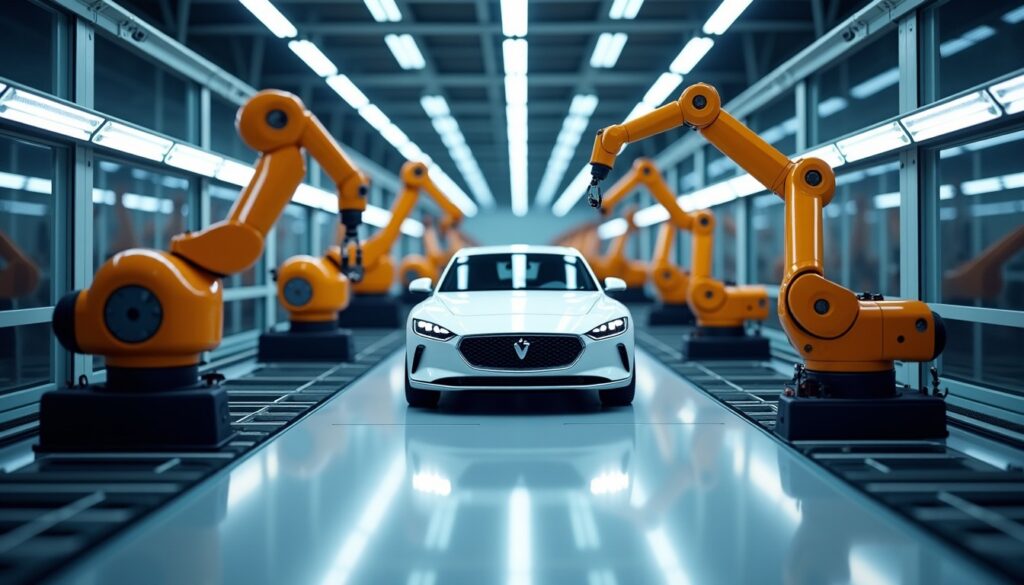
In a rapidly changing automotive industry, Xiaomi, traditionally known for its smartphones and innovations in connected gadgets, is making a remarkable entry into the automotive manufacturing sector. In 2026, the Chinese company marks a decisive turning point by integrating humanoid robots directly onto its assembly lines dedicated to its electric vehicles. This breakthrough, revealed in a video that quickly went viral, highlights the challenges and opportunities brought about by this new era of advanced automation. As China establishes itself as a global leader in industrial robotization, Xiaomi’s adopted strategy raises crucial questions about the competitiveness of traditional European manufacturers, notably Peugeot and Renault.
The clip shows two humanoid robots performing with remarkable precision the assembly of wheel nuts on the chassis of an electric car. While the pace remains modest compared to that of an experienced human worker, the success rate exceeding 90% reveals considerable potential for the robotization of sensitive processes. This smart factory model illustrates how the combination of innovative hardware and artificial intelligence could radically change automotive manufacturing in the near future. As Xiaomi continues to deploy these machines in its Beijing factory, the industry and observers are questioning the ability of European companies to keep up with this rapid pace of technological innovation.
- 1 The use of humanoid robots by Xiaomi: a revolution in automotive manufacturing
- 2 Automation at Xiaomi: a major technological and industrial challenge
- 3 Robotization in China: Xiaomi at the forefront of an automated automotive industry
- 4 Implications for European manufacturers: Peugeot and Renault facing Chinese competition
- 5 Humanoid robots: allies to boost productivity and precision
- 6 Future prospects: robotization at the heart of modern automotive manufacturing
- 7 The economic challenges of robotization: a challenge for European competitiveness
The use of humanoid robots by Xiaomi: a revolution in automotive manufacturing
The humanoid robots introduced by Xiaomi in its electric vehicle factory in Beijing represent a major break from traditional automation systems. Unlike conventional industrial robots, these machines are designed to mimic human dexterity. They can handle standard tools, move within an environment shared with human workers while performing highly precise tasks, such as tightening nuts with a delicate and repeatable gesture. This technology is still in the learning phase, but the results obtained during a three-hour test are promising with a success rate of over 90% of the operations performed.
The video released by Xiaomi perfectly illustrates this advancement: two robots are positioned at the ends of an electric car assembly line, working alternately to fasten wheel nuts. Each movement demonstrates fine mastery of gestures, a challenge previously reserved for humans. These robots are capable of keeping up with the industrial pace imposed by the line, where a car comes off every 76 seconds. It is a technological feat that paves the way for the gradual integration of humanoid robotics in the automotive industry.
Beyond technical precision, this technological innovation responds to a broader trend: the search for more flexible and modular automation. Humanoid robots can, unlike their fixed counterparts, adapt to different workstations and intervene in several types of operations without requiring complex reprogramming. This agility gives them great value in optimizing modern production lines, especially for manufacturers like Xiaomi who design their smart factories from the outset.
Automation at Xiaomi: a major technological and industrial challenge
The use of robots in automotive manufacturing is far from new, but Xiaomi’s particularity lies in the early adoption of humanoid robots capable of working directly on the line with a high degree of autonomy. This approach raises important issues, both technologically and industrially. The main challenge remains the coexistence between humans and machines in an environment as demanding and fast-paced as the automotive industry. Each operation must be synchronized to avoid any slowdown that would impact productivity.
Xiaomi CEO Lu Weibing notably emphasized that these robots are currently comparable to “trainees”: they are still learning and need to improve their speed and reliability to match seasoned human operators. However, the initial goal is to test their ability to keep up with the pace of a modern factory, which the trials have conclusively demonstrated.
Beyond the technical development, the industrial deployment of these humanoid robots raises another essential question: how to integrate such automation without disrupting the supply chain and work organization? Xiaomi adopts a gradual strategy, starting with repetitive tasks of placing nuts on a rigid frame before eventually extending this automation to other complex operations.
This integration method is crucial. It allows the company to collect valuable data, refine robot control algorithms, and ensure that their intervention genuinely increases productivity and manufacturing quality without generating hidden costs or time losses. Xiaomi relies on its technological capabilities to reduce costs while maintaining quality production, an essential aspect in a fiercely competitive sector.
Robotization in China: Xiaomi at the forefront of an automated automotive industry
The rise of industrial robotization is particularly visible in China, which has become in just a few years the world’s largest market for factory robotics. The Chinese automotive sector shows an impressive dynamic of investments in automation and innovation. Xiaomi, entering this highly competitive landscape, fully benefits from this trend to evolve its production lines.
Humanoid robots embody a natural evolution of this robotization: they bring the ability to perform operations usually done by humans, but with consistency and a substantial reduction in errors. This usage flexibility helps reduce dependence on human operators for strenuous or repetitive tasks while increasing production speed.
The application of this innovation in a factory designed from the start to be “smart” also offers a decisive advantage. Unlike historic factories, which must progressively modernize sometimes outdated facilities, Xiaomi has the freedom to build an optimized industrial process around these technologies. This facilitates the networking of machines, real-time data collection and analysis, and increased responsiveness to production contingencies.
Experts point out that this type of automated factory promotes a new distribution of added value in the automotive industry, with a greater role given to technology and artificial intelligence. Xiaomi thus appears as a pioneer capable of disrupting established rules, taking advantage of complete robotization integration and strong digital mastery.
Implications for European manufacturers: Peugeot and Renault facing Chinese competition
Xiaomi’s rapid progress in automation naturally raises the question of competitiveness for European automotive groups such as Peugeot and Renault. In Europe, although automation is already well advanced, it mainly relies on classic robots, which are less mobile and specialized in specific tasks. The integration of humanoid robots requires a new technological and organizational leap.
Currently, these machines capable of performing highly precise gestures and moving within the factory remain in an experimental state in the automotive sector. This does not prevent some industrial players from beginning to think very seriously about this revolution. Indeed, the ability to integrate these innovations within an already highly automated industrial environment will largely determine long-term competitiveness.
Moreover, historical constraints linked to European industrial infrastructure may complicate this transition. Renault and Peugeot’s production sites often date back several decades and require substantial investments to accommodate this type of dynamic technology. In contrast, Xiaomi, building its factories from scratch, can integrate these systems from the design stage, thus offering better synergy between robotization and industrial processes.
This divergence raises several fundamental questions:
- How can European manufacturers respond to the rapid emergence of disruptive technologies coming from Asia?
- What are the costs and benefits of switching to humanoid robots in existing factories?
- How to maintain competitiveness in traditional segments while investing in more automated and technological production?
The answers to these challenges will largely determine whether Peugeot and Renault can avoid being overtaken by this new wave of industrial innovation orchestrated by players like Xiaomi.
Humanoid robots: allies to boost productivity and precision
Beyond simply replacing human operators, the humanoid robots introduced by Xiaomi shake up productivity and quality standards. Their ability to perform precise, repetitive, and delicate gestures is a real asset in automotive manufacturing, where even the slightest mistake can generate considerable costs and compromise vehicle safety.
Humanoid robots also provide a consistency that cannot always be guaranteed with a human workforce subject to fatigue, distraction, or performance variations. Their integration on the assembly line ensures essential operational constancy for large-scale production in an ultra-competitive context.
More concretely, the advantages are outlined as follows:
- Reduction of human errors thanks to precise control of gestures and applied forces.
- Increase in pace by limiting stops related to operator fatigue or errors.
- Reduction of medium-term costs through better process stability and fewer rejects.
- Improvement of working conditions by relieving staff of strenuous and repetitive tasks.
- Increased flexibility to adapt to rapid production changes and customized demands.
This list summarizes why Xiaomi bets on these robots to conquer a strategic segment of the automotive market and how they could reshape the industry as a whole.
Future prospects: robotization at the heart of modern automotive manufacturing
While humanoid robots are still in the testing phase today, their potential opens exciting prospects for the automotive industry. As these machines gain speed, reliability, and adaptability, wider deployment can be expected across various production stages, from assembly to quality inspection, even preventive maintenance of lines.
This development also accompanies a transformation of industrial professions. Operators will be called upon to supervise these robots, analyze data from their operation, and intervene in programming and maintenance of automated systems. The human role will thus evolve toward more technical work and remote control, marking a profound shift in the work environment.
Furthermore, robotization will allow increased vehicle customization, with more flexible lines able to quickly adapt to specific customer orders without sacrificing pace or quality. This industrial revolution fits within a dynamic where technological innovation becomes the main driver of growth and competitiveness.
This scenario implies that European manufacturers will need to fully invest in advanced technologies so as not to lose their place against Asian players like Xiaomi, who design cutting-edge factories from inception.
The economic challenges of robotization: a challenge for European competitiveness
The integration of humanoid robots in automotive manufacturing also raises major economic questions. Xiaomi, investing in this technology from its industrialization stage, seeks to reduce production costs while improving quality. For a European manufacturer, the cost calculation is more complex, notably due to legacy infrastructures and social requirements.
A comparative table highlights some key aspects between a manufacturer like Xiaomi and traditional industrialists like Peugeot and Renault:
| Criteria | Xiaomi (Next-generation factory) | Peugeot / Renault (Historic factory) |
|---|---|---|
| Robotic integration | Designed from the start with humanoid robots | Progressive automation with fixed robots |
| Flexibility | High, thanks to mobile and versatile robots | Limited, adapted to specific tasks |
| Initial investment cost | High but optimized for performance | Lower short-term, costly in modernization |
| Adaptability | Great, with artificial intelligence and real-time data | Limited, often manual or semi-automated |
| Maintenance and supervision | Automated, with targeted human interventions | Heavier, requiring dedicated teams |
The differences do not stop there. Robotization also influences employment structure, sought skills, and the broader industrial dynamic. Faced with this new reality, Peugeot and Renault will need to redouble efforts to combine technological innovation and social conditions so as not to be left behind by players better prepared for future challenges.