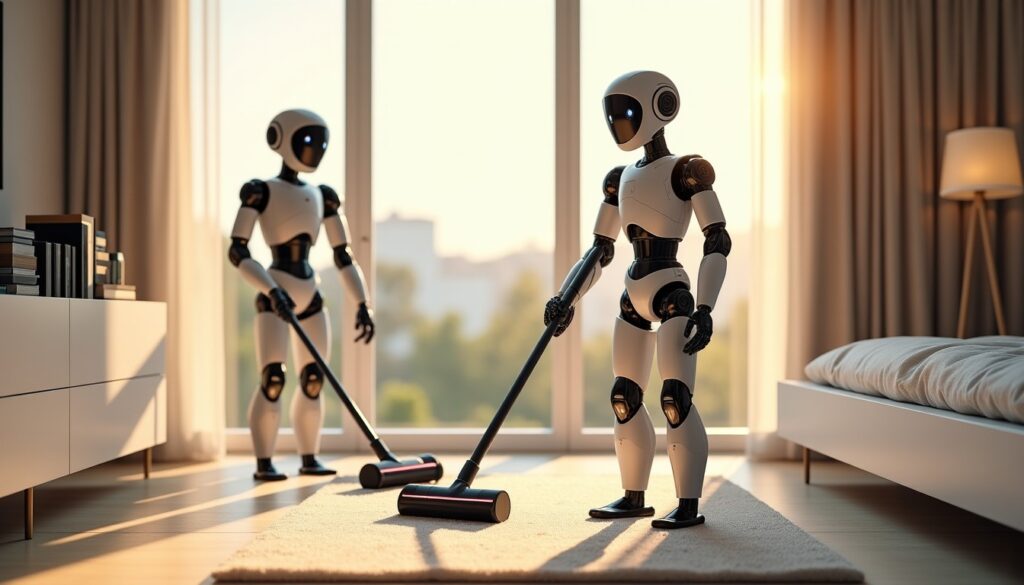
Watching humanoid robots perform household tasks indoors is no longer surprising in 2026. However, the real innovation now lies in the autonomous collaboration between these machines, as demonstrated by the latest humanoids developed by Figure AI. In a recent video, this company showcased two of its F.03 robots working together to complete the full cleaning of a room, even going as far as making a bed with remarkable synchronization. This progress goes far beyond simply executing isolated actions and marks a turning point in the integration of robots in home automation, where artificial intelligence imagines and anticipates in real time with unexpected elegance.
This feat is based on the Helix-02 system, the core of the AI that controls these machines, allowing indirect communication based solely on the observation of gestures. By interpreting each other’s movements, the robots adjust their interventions instantly, thus avoiding any collision or error. This operation, rooted in cutting-edge technology, recalls human collaboration despite the absence of direct dialogue. Mastering objects as complex as a soft duvet, they take a new step in the mastery of robotic manipulation, a crucial breakthrough to accelerate the adoption of these domestic helpers in a daily life still dominated by uncertainties and the unexpected.
- 1 Major advances of Figure AI in autonomous robotic cooperation
- 2 Technology and artificial intelligence at the core of soft object manipulation
- 3 Technical and environmental constraints surrounding robot autonomy
- 4 The impact of robotic collaboration on the home automation sector
- 5 Ethical and social challenges of integrating collaborative humanoid robots
- 6 Prospects for the evolution of collaborative humanoid robots in the coming years
Major advances of Figure AI in autonomous robotic cooperation
Until now, most humanoid robots were designed to perform predefined tasks in response to commands or simple scenarios. Figure AI disrupts this approach by introducing smooth collaboration between two intelligent agents. This innovation relies on coordination adjusted in real time, without a central conductor, which is a true technical revolution in 2026.
The Helix-02 system allows each robot to precisely analyze the environment through its onboard cameras, capturing even the smallest detail of the room to be cleaned. This information is processed individually, but in parallel, each robot observes and evaluates the movements of the other. Thus, the duo builds a shared model of their joint action, optimizing their gestures based on the presumed intentions of their partner. This process can be compared to a perfectly synchronized dance: each robot anticipates the other to avoid conflicts and ensure cleaning efficiency.
For example, when moving an office chair or closing a book, no hesitation or task overlap is noticeable. Artificial intelligence precisely manages the distribution of tasks, combining visual perception, motor skills, and fine manipulation within a single neural network. This technology avoids the typical operational rigidity of previous robots and errors due to conflicting commands.
This collaborative capacity is a decisive advance, paving the way for robots capable of simultaneously intervening in complex domestic environments filled with diverse objects and unforeseen events. A giant leap towards a future where cleaning and home management can be entirely delegated to robotic assistants in perfect harmony. The coordination of these machines highlights the rise of AI in the sphere of home automation and functional autonomy.
Technology and artificial intelligence at the core of soft object manipulation
Manipulating a rigid object is one thing, but handling soft objects like a duvet presents an immense technological challenge. In robotics, the flexibility, deformation, and instability of fabrics complicate the prediction of the necessary movements. The robots from Figure AI, thanks to sophisticated artificial intelligence, manage to master this complexity, ensuring precise and coordinated gestures in real time.
The main interest of this manipulation lies in the constant need to recalculate trajectories and applied forces whenever the fabric changes shape. Any clumsiness can cause unwanted wrinkles or a total failure of the task. However, the F.03 humanoids integrate a continuous evaluation loop, based on visual perception, analyzing each fold or deformation to immediately adjust their actions.
In the video, the synchronization is striking: the two robots grasp the duvet simultaneously, unfold it, then smooth the surface without hindering each other. This type of operation requires not only increased mechanical dexterity but also intelligence that goes beyond automatic execution. It requires a shared understanding of the object and the moment, with the robots behaving somewhat like human partners who anticipate each other’s gestures to avoid disagreement.
More generally, this technology opens unprecedented prospects in the domestic cleaning sector. In 2026, robots capable of manipulating complex fabrics will be able to handle laundry, folding, or tidying, lighten the mental load of occupants, and contribute to a smoother daily routine. This represents a qualitative leap in the design of domestic robots, where the finesse of manipulation is as crucial as strength or speed.
Concrete examples of soft manipulation applications
- Automated ironing and folding of delicate clothes
- Assembly and disassembly of bedding without human intervention
- Assistance to elderly people for laundry and blanket management
- Cleaning and maintenance of home upholstery fabrics
Technical and environmental constraints surrounding robot autonomy
Despite the impressive progress demonstrated by Figure AI, it is crucial to put this advance into context. The demonstration takes place in a perfectly controlled environment, where every object is well positioned and obstacles minimized. In reality, domestic situations are much more complex and challenging to master for autonomous robots, especially in actual apartments where trailing cables, pets, or scattered clothes are present.
The Helix-02 system relies on advanced visual perception but based on ideal conditions. As soon as the environment becomes more complex, the robustness of the algorithms must be tested against varied unforeseen events. For example, a cat suddenly moving in front of the robots can entirely alter their action plan. Similarly, a labyrinthine cable on the floor can become an insurmountable obstacle without specific programming.
These limits require engineers to develop continuous adaptation algorithms capable of integrating the variability of the real world in parallel. Thus, home automation robotics will take a decisive step when it can manage disorder, uncertainty, and spontaneous human interactions. This will undoubtedly require greater integration of multispectral sensors, voice recognition, and better behavioral anticipation.
For now, the work of Figure AI mainly serves as proof of concept and allows evaluation of the combined abilities of robots to perform complex tasks in pairs. They nonetheless lay a solid foundation to steer research towards more robust functional autonomy, essential to claim a lasting place in households.
Comparative table of constraints in controlled vs. real environments
| Criterion | Controlled environment | Real environment |
|---|---|---|
| Object arrangement | Optimal and predictable | Random, disorderly |
| Presence of dynamic obstacles | Absent | Animals, children, moving objects |
| Human interference | None | Frequent, unpredictable |
| Task complexity | Standardized | Variable with incidents |
The impact of robotic collaboration on the home automation sector
One of the major implications of this technological innovation is its effect on home automation, a booming field aiming to automate the management of dwellings to improve quality of life. With humanoid robots capable of cooperating and performing complex cleaning and maintenance tasks, we enter a new era where the smart home is also an assisted home.
Collaboration between robots opens unprecedented perspectives: systems capable of intervening as a team to manage multiple operations simultaneously in different rooms, or versatile assistants capable of acting on various objects difficult to manipulate alone. This complementarity between machines strengthens overall performance and surpasses the limitation of single robots often confined to basic functions such as vacuuming.
Furthermore, this collaborative dynamic fits perfectly within a logic of energy optimization and resource reduction. Robots communicate indirectly to minimize double movements or unnecessary gestures, thus contributing to a more responsible management of domestic resources. They then become much more than simple tools but true intelligent autonomous agents deployed in the connected home.
Beyond cleaning, one can imagine expanded applications ranging from technical maintenance to personalized assistance. In 2026, smart habitats begin to rely on these technologies to reconcile comfort, security, and efficiency, offering a user experience so far unattainable through simple automation.
List of expected benefits of robotic collaboration in home automation
- Optimization of complex household tasks
- Improved quality of life through continuous assistance
- Reduction in energy and resource consumption
- Increased safety through automated intervention
- Enhanced adaptability to daily situations
The arrival of robots capable of working side by side without human intervention inevitably raises ethical and social questions that Figure AI and the sector must now address. Increased autonomy of machines generates questions about responsibility, especially when robots operate in inhabited homes.
Who is responsible in case of an incident? A breakdown, a domestic accident due to mishandling, or loss of an object? These scenarios require clear protocols and appropriate governance, including algorithm transparency and traceability of actions. Moreover, the robot’s place in the private sphere raises concerns about the protection of personal data collected by vision systems and sensory sensors.
On the social level, the integration of such domestic assistants also risks transforming family dynamics and generating tensions linked to technological dependence. How can the autonomy offered by these technologies be reconciled with the preservation of human skills? How to avoid exclusion of populations less familiar with these tools?
Companies like Figure AI are working to develop ethical solutions, including intuitive and accessible interfaces as well as awareness of the issues. Furthermore, collaboration between robots can also foster human interactions, for example by freeing up more time for families to spend together, but this requires a fine balance between technology and humanity.
Prospects for the evolution of collaborative humanoid robots in the coming years
Figure AI’s current successes mark a fundamental step but remain preliminary in what will soon appear as a total revolution in domestic robotics. The coming years will see a deepening of collaborative capabilities, with the multiplication of units and better overall autonomy.
The integration of advanced machine learning will continue to strengthen the collective intelligence of robots, allowing them to learn from each interaction to improve their performance. They will become capable of handling even more complex environments, with varied objects and constant surprises. Progress in sensory technologies, such as haptic sensors and 3D vision, will allow refinement of their manipulations.
Thus, scenarios can be envisioned where several robots collaborate simultaneously for domestic missions, but also to assist people with specific needs, such as the elderly or those with reduced mobility. This expanded capacity transforms robotics not only into a lever of efficiency but also into a true extension of humans in daily life.
The innovations presented today by Figure AI are only a foretaste of what technology holds for the future, where collaboration between robots and their shared intelligence will outline the contours of a truly intelligent and autonomous habitat.