
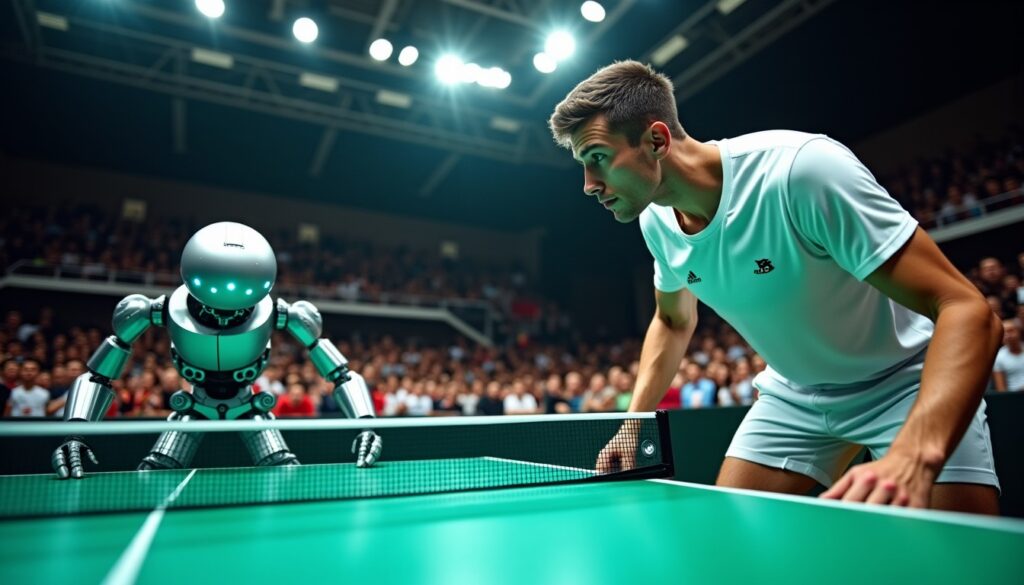
An impressive breakthrough in the field of robotics and artificial intelligence is shaking up the world of sports: a robot named Ace, designed by Sony AI, now challenges and beats world ping-pong champions. This unprecedented system is capable of competing at the highest level thanks to cutting-edge technology combining visual sensors, an articulated arm, and efficient learning algorithms. It wins three out of five matches against elite players while mastering shots and trajectories considered complex, even impossible for humans to perform. This advancement illustrates the exciting convergence between human performance and robotic power in a game known for its extreme speed and precision.
Table tennis has long been an ideal training ground for artificial intelligence, but reaching such a level of competition represents a qualitative leap. Ace, in an arena set up identically to Olympic standards, has a visual sweep of the ball 200 times per second and adjusts the power and angle of its shot in a fraction of a second. Although still improvable, its already impressive track record demonstrates that the prophecy of robotics capable of competing with the most seasoned humans in sport is becoming reality. The challenge is not only technical: without emotions or body language, this robot profoundly alters the psychological dynamics of the match.
- 1 A robotic feat: how Ace surprised the professional ping-pong world
- 2 The key technological advances behind the robot Ace
- 3 The challenges of table tennis for robotics and the innovative solutions adopted
- 4 Performance and records achieved: Ace, a champion robot on the table tennis court
- 5 Game strategies adapted by Ace to defeat human champions
- 6 The impact of Ace on robotics and the future of sports competitions
- 7 Reactions from the sports world to the emergence of Ace, the ping-pong champion robot
- 8 Perspectives and innovations promised by robotics in table tennis by 2030
A robotic feat: how Ace surprised the professional ping-pong world
The robot Ace, using advanced artificial intelligence developed by Sony AI, has marked a historic turning point in sports robotics. During real competitions, this system faced five matches against world-class ping-pong players, winning three victories. This result is all the more remarkable since table tennis is a sport where mastering speed, ball effects, and placements is essential.
The developers have developed a robotic arm with eight axes of rotation mounted on a mobile base. This configuration allows the robot to faithfully reproduce human movements in the game, with exceptional speed and precision. Thanks to a network of nine cameras, Ace simultaneously tracks the ball from multiple angles, giving it an unmatched ability to analyze position, speed, and especially rotation—a crucial element in ping-pong.
The robot’s ability to decode the ball’s spin, focusing notably on the stamped logo, allows it to instantly adapt its shot, which has unsettled several professional opponents during matches. The robot’s incapacity to feel pressure or reveal its intentions through body language makes it even harder to anticipate. This completely changes the psychology of a match where observation and reading the opponent are usually keys to victory.
Despite these remarkable performances, Ace is not infallible. It suffered two defeats in the five matches played and sometimes struggles against slow or lightly spun balls. However, the speed of its movements and its ability to handle unpredictable trajectories, such as shots brushing the net, demonstrate an already highly advanced and promising mastery.
The key technological advances behind the robot Ace
Ace is not simply a robot able to play ping-pong; it is the result of close collaboration among robotics, artificial intelligence, and mechanical engineering. The success of this system relies on several interdependent components that define its superiority in many aspects of the game.
The robotic arm and mobility
The core of the robot is an articulated arm with eight axes, mounted on a mobile base, which faithfully reproduces the precise and rapid gestures of a professional player. This mobility is essential to respond to the high speed of exchanges often very short in table tennis. Ace’s ability to constantly adjust its positioning maximizes its chances of always being in an optimal position to return the ball.
Vision and real-time analysis
To track the ball, Ace is equipped with nine cameras strategically placed around the table, allowing capture at 200 frames per second. This multi-camera, multi-angle monitoring facilitates a very precise analysis of the ball’s trajectory, speed, and especially rotation. The system uses an algorithm capable of recognizing the direction and nature of the spin in milliseconds by observing the ball’s logo—a major innovation that provides a decisive advantage in responding to shots.
Artificial intelligence and simulation training
Versatile thanks to artificial intelligence trained over more than 3,000 hours of simulation, Ace has learned to anticipate various game situations, including complex scenarios where the ball touches the net or adopts unexpected spins. The AI incorporates reinforcement learning techniques, improving with each rally to optimize its reactions in real time.
This approach also uses movements inspired by human pong players for serving, giving Ace a realistic range of shots that destabilize its opponents. This blend of human observation and algorithmic adaptation offers a rich symbiosis between robotics and traditional play.
The challenges of table tennis for robotics and the innovative solutions adopted
Table tennis is a technically and physically demanding sport that robots have long found difficult to master. The speed of exchanges, the variety of spins, and the need for a rapid response make ping-pong a true technological challenge. Here is an overview of the main obstacles explaining why Ace represents a major step forward.
- The speed of exchanges: Balls can reach speeds over 100 km/h, requiring lightning-fast reflexes and almost instant reactivity.
- Mastery of spins: Spin is a central element of table tennis. Balls can spin in several directions, making their trajectory unpredictable for an unprepared system.
- Precision of gestures: The margin of error is minimal, with the ball needing to touch the table in precise areas to score points or destabilize the opponent.
- Variation in rhythm and trajectories: Alternating fast, short, lifted, or backspin balls demands a high level of technical adaptability.
To overcome these obstacles, engineers developed an ultra-fast multi-vision system coupled with mechanical architecture capable of reaching difficult positions and fluid movements. Artificial intelligence, trained through a large number of simulations, allows not only anticipation but also improvisation in the face of unexpected situations during exchanges.
A revealing testimony comes from Rui Takenaka, a professional player who faced Ace: “On a lift serve, Ace returns the ball with a similar effect, which complicates the exchange a lot. When I served simply, I had more opportunities to attack.” This evolution shows how the robot changes classic strategies and forces champions to continuously adapt.
Performance and records achieved: Ace, a champion robot on the table tennis court
Although a few setbacks remain, Ace displays a series of impressive feats. Its ability to beat professional pong players confirms the efficiency and relevance of the integrated technologies. A summary table allows visualization of key results obtained during its first official competitions:
| Match | Opponent | Result | Key points of the match |
|---|---|---|---|
| 1 | Rui Takenaka | Victory | Excellent management of spins, quick adaptation |
| 2 | Kinjiro Nakamura | Defeat | Difficulty against slow balls |
| 3 | Takashi Yamada | Victory | Mastery of backspin shot |
| 4 | Hiroshi Tanaka | Victory | Surprising precision and speed |
| 5 | Kenji Saito | Defeat | Lack of finesse against lightly spun balls |
These results attest that the robot is seriously beginning its conquest and could soon establish new performance standards in sport.
Game strategies adapted by Ace to defeat human champions
To compete with the best, Ace does not merely mechanically reproduce standard shots. Its artificial intelligence allows it to adopt adaptive strategies at each rally, a dimension very difficult to achieve for a robot.
This strategy rests on several pillars:
- Instant reading of spins: By observing the logo and the ball’s rotation, Ace adjusts the strength and direction of its return in real time.
- Trajectory prediction: Algorithms simulate the ball’s future positions to position the arm at the best spot.
- Variation of shots: Alternation between fast balls, lobs, and backspin to surprise the opponent.
- Exploitation of human errors: Analysis of the opponent’s weaknesses during the match to exploit their weak points.
These different tactics have been successfully tested, such as during a rally where Ace used a fast backspin shot, previously considered impossible by an Olympic player. This innovative technique illustrates the creative advantage that robotics can now provide.
The impact of Ace on robotics and the future of sports competitions
Ace’s performance is not limited to a technical achievement; it also opens the way to redefining the boundaries between humans and machines in sports competition. This robot raises ethical questions but also unprecedented possibilities, such as organizing mixed man-machine competitions or training players through AI-assisted coaching.
Sony AI researchers specify that the robot continues to evolve and has recently beaten opponents even stronger than during its first competitions. This evolution suggests that sports robotics continues to gain sophistication and integration within society.
However, the existence of a robot capable of surpassing champions also poses challenges in terms of regulation, sports ethics, and social acceptability. Federations must consider new rules to integrate or limit these performances, in order to preserve the spirit of human competition.
Beyond table tennis, this progress embodies a major advance in sports robotics, with potential impact on other disciplines requiring reactivity and precision.
Reactions from the sports world to the emergence of Ace, the ping-pong champion robot
The impressive performances of the Ace robot have sparked reactions mixing fascination, caution, and passionate debates within the sports world. Some professional players see it as a stimulating challenge that could push their limits, while others fear a loss of humanity in sport.
Peter Dürr, project director at Sony AI in Zurich, states confidently: “After each new match, we have faced stronger opponents and have managed to beat them. This development confirms that artificial intelligence combined with robotics has a genuine future in competitive sport.”
Players like Rui Takenaka also acknowledge the robot’s strategic contribution: “Ace forced me to adjust my tactics faster than ever. It pushes the game to another level, and even if it’s against a machine, it’s very instructive.”
Yet debates about competitive balance and the role of humans in this sport are intensifying. Some organizers are already considering hybrid competitions, mixing human players and robots, as well as rules specially designed to regulate these new forms of dueling.
Perspectives and innovations promised by robotics in table tennis by 2030
Looking to the future, Ace’s characteristic advances herald a broader revolution in table tennis and the world of sports. The prospect of an ever more efficient artificial intelligence, endowed with faster learning abilities and increased mobility, suggests exciting scenarios.
Many innovations are already under development:
- Competition robots capable of adapting their game not only to their opponents’ shots, but also to their psychological and tactical style.
- Robotic assistant coaches, capable of analyzing in real time a human player’s weaknesses to optimize their performance.
- Advanced virtual simulations allowing amateur or professional players to train against robotic opponents without leaving home.
- Man-machine cooperation in mixed doubles, where robot-human complementarity could revolutionize tournament strategies.
These possibilities challenge the traditional conception of sport and promise to push further the limits of performance and entertainment.




