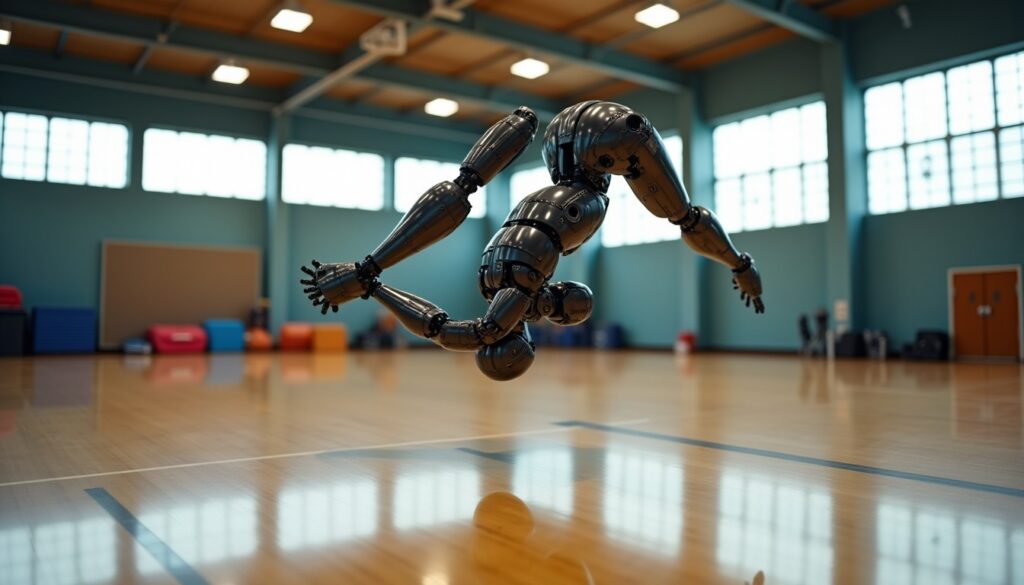
In the ever-evolving field of robotics, Boston Dynamics’ humanoid robot Atlas establishes itself in 2026 as a revolutionary benchmark. Its latest video demonstration impresses as much as it raises questions: this robot manages to chain together complex gymnastics moves, previously reserved for seasoned athletes. More than just a technological leap, this advancement testifies to the convergence of artificial intelligence, mechanical engineering, and dynamic control. The video circulating on social networks and specialized platforms features Atlas performing a handstand L-sit for several seconds without the slightest hesitation, followed by flips and obstacle courses with surprising fluidity. This performance represents much more than a spectacle: it ushers in a new era for humanoid robotics, where agility and stability surpass certain human standards.
The challenge goes far beyond mere physical prowess. Atlas, 1.88 m tall and nearly 90 kg, today resembles a technological ambassador embodying major advances in machine learning and biomimetic design. In 2026, this robot is no longer an isolated experimental device but is shifting towards ambitious industrial production, notably thanks to the involvement of the Hyundai group, which plans to integrate these humanoids into the manufacturing line of its gigantic factory in Georgia. Beyond the spectacular, this innovation raises complex questions about the place of robots in our societies, their real-world applications, and the relationship between technical performance and economic viability.
- 1 Major technological developments that make Atlas capable of impressive gymnastics movements
- 2 The physical and artistic performances of the humanoid Atlas compared to human gymnasts
- 3 The key role of artificial intelligence in mastering Atlas’s movements
- 4 How industrial manufacturing is transforming the destiny of Atlas and humanoid robotics
- 5 Atlas and the future of agility in robotics: what prospects for 2026 and beyond?
- 6 Atlas’s current limitations despite its impressive movements
- 7 Impact of Atlas’s performance on contemporary innovation and robotics
- 8 Concrete uses and next steps for Atlas in the industrial and societal world
Major technological developments that make Atlas capable of impressive gymnastics movements
Boston Dynamics’ Atlas robot relies on a mechanical and software architecture of sophistication rarely seen in the humanoid robotics sector. Its latest generation includes 56 degrees of freedom, allowing both a 360° rotation at several key joints and fine adjustment of its postures and movements. This large range of motion is essential to reproduce gymnastics moves that require extreme precision and instant responsiveness to gravity’s effects.
To master this delicate balance, Atlas uses a reinforcement learning system. This artificial intelligence technique involves thousands of hours of simulations in virtual environments where the robot repeats and refines its movements. Over trials, an algorithm optimizes the sequence of gestures based on criteria such as stability, fluidity, and execution speed. This type of learning enables it to acquire a kind of almost instinctive motor reflex. It is therefore no longer a simple programming of fixed actions but a continuous adaptation underpinning its agility.
The mechanics would be nothing without the integrated software design, notably that of the RAI Institute led by Marc Raibert, the founder of Boston Dynamics. The embedded system combines gait management, running, balance movements, and more complex gymnastics gestures into a single coherent platform. This integration allows Atlas to easily switch from trotting to a handstand, always maintaining exemplary stability. The robustness of the hardware is also essential, notably thanks to IP67 protection against dust and water, and the ability to operate in temperature ranges from -20° to 40°C.
This level of deployed technology illustrates the convergence of efforts in robotics, artificial intelligence, and mechanical engineering. To reproduce these so-called “natural” movements with such realism, Boston Dynamics had to combine hardware innovations with algorithms capable of fluid and instant decision-making. This combination largely explains Atlas’s success in surpassing some human gymnasts, especially in figures requiring a lot of coordination and unstable dynamic balance.
The physical and artistic performances of the humanoid Atlas compared to human gymnasts
Gymnastics moves such as the handstand or backflips require fine mastery and developed muscular strength. In a human, these figures are the result of many years of training and coordination between several muscle groups. Atlas impresses because it reproduces these gestures with ease and stability that defy certain human limits.
The video specifies that the robot is capable of holding an L-sit position for several seconds, a feat that requires precise balance and reinforced abdominal strength. This type of hold is usually laborious even for accomplished gymnasts and represents a completely different challenge when the weight to support reaches 90 kg, as is the case for Atlas. The humanoid does not merely imitate the posture; it manages micro-postural adjustments to remain stable in real time.
Beyond static gymnastics, Atlas also excels in dynamic movements like running, rolls, and even breakdancing. These skills require complex motor coordination and precise anticipation of forces at play. For example, the ability to switch from a fast running step to a smooth breakdance move illustrates its overall agility and advanced motor intelligence.
In comparison, several high-level athletes acknowledge that some moves could be difficult to rival for a robot. However, Atlas’s advantage lies in constancy and precision that do not fatigue, unlike humans. This regularity opens new possibilities for applications where performance and safety are crucial.
Comparative table of physical capabilities between Atlas and an average human gymnast
| Capability | Atlas (robot) | Average human gymnast |
|---|---|---|
| Height | 1.88 m | 1.65 to 1.75 m |
| Weight | 90 kg | 55 to 70 kg |
| Abdominal strength | Ability to maintain stable L-sit | Varies with training |
| Running speed | Above average (faster than some athletes) | Variable |
| Agility | High, fluid and natural movements | Excellent, depends on practice |
| Dynamic balance | Precise management and anticipation of stability loss | Variable, sometimes unstable under pressure |
The key role of artificial intelligence in mastering Atlas’s movements
Artificial intelligence plays a central role in Atlas’s ability to perform such complex and precise movements. The reinforcement learning used by Boston Dynamics resembles a method where the machine trains virtually to repeat, correct, and optimize its gestures without direct human supervision. This approach is comparable to how an athlete repeats exercises until perfecting every detail but accelerated at an inhuman speed thanks to the computing power available today.
AI algorithms also allow Atlas to anticipate its loss of balance and adjust its movements in real time. The impression that the robot “feels” its environment and prevents a fall results from instantaneous processing of sensory information provided by its integrated sensors. These sensors measure orientation, position, and speed of various body parts, enabling fine and lag-free coordination.
Beyond sports or demonstrative applications, this motor intelligence presents immense potential for industrial and medical uses. For example, a robot capable of such automatism could assist people with reduced mobility, perform hazardous tasks requiring dexterity, or navigate complex environments autonomously. The qualitative leap made by Atlas thus opens very broad perspectives in general robotics.
How industrial manufacturing is transforming the destiny of Atlas and humanoid robotics
Since its acquisition by Hyundai, Boston Dynamics has seen its ambitions accelerate the production of Atlas to transform this fascinating robot into a viable industrial product. The announced goal is colossal: to reach a manufacturing rate of 30,000 units per year in their large Georgia factory by the end of the decade. This transition from an experimental prototype to an industrial player will disrupt the sector.
Producing Atlas on a large scale involves addressing several technical and logistical challenges. First, constant quality must be ensured in the manufacturing of mechanical and electronic components. The robustness and longevity of the robot in real-world situations are crucial, especially in industrial environments where conditions can be harsh. The IP67 certification it holds guarantees reliable protection, but maintenance and repair remain critical stages.
Then, standardizing control and learning protocols will allow adapting Atlas to very diverse tasks. Hyundai’s Georgia factory exploits this modularity to configure different robots according to needs, whether for heavy handling, inspection, or worker assistance. Atlas’s versatility is thus a major asset in this phase of large-scale deployment.
Finally, industrial production of Atlas raises economic questions. Its manufacturing cost will need to decrease significantly to remain competitive compared to simpler robotic solutions. However, the added value from its performance and agility also opens a new field of application in professions previously inaccessible to classic humanoid robots.
List of key factors to succeed in Atlas industrial production
- Standardization of parts and modules to facilitate assembly and maintenance
- Increased robustness against industrial and environmental stresses
- Intelligent control systems capable of quickly adapting to different environments
- Efficient supply chain management to ensure real-time availability of components
- Operator training to properly use and maintain the robots
- Adjusted production cost to ensure sustainable profitability
Atlas and the future of agility in robotics: what prospects for 2026 and beyond?
Atlas’s success in performing gymnastics movements hints at a future where robotic mobility rivals human flexibility and precision. In 2026, technical advances have highlighted robots’ ability not only to walk or run but also to evolve in complex environments with agility. This new generation of humanoids is the flagbearer of more versatile robotics.
Potential applications are vast. In industry, the presence of robots capable of performing delicate and dynamic tasks would pave the way for intelligent automation of flexible production lines. In rescue and rescue at height or in dangerous conditions, these robots could intervene with a level of efficiency still out of reach. Finally, in entertainment, education, or research, their ability to reproduce complex human movements offers new support.
The main challenge today remains the robustness of robots over time and their social and economic integration. While technology progresses rapidly, safe and ethical standards must still be guaranteed for their use. However, mastering movements, as illustrated by Atlas, is an essential milestone heralding a new frontier in robotics.
Atlas’s current limitations despite its impressive movements
Despite spectacular progress, Atlas is not perfect. Some specialists point out that the demonstrated movements remain confined to well-controlled spaces under pre-arranged conditions. Real adaptability to completely unpredictable environments is still limited. For example, random obstacles, very uneven terrains, or direct human contact can sometimes destabilize the robot.
Then, dependence on a powerful electrical supply remains a barrier to autonomous mobility. Atlas weighs nearly 90 kg, which limits its performance over long durations without recharging or battery replacement. Weight optimization and miniaturization of components are major challenges for future versions.
Also, despite an effective reinforcement learning system, contextual analysis capability is still inferior to that of a human. Understanding emotions or adapting to unforeseen behaviors will require more advanced artificial intelligence algorithms.
Finally, Atlas’s manufacturing cost remains high, which currently restricts its use to specific industrial segments or research institutions. It will still take several years for the democratization of these elite robots to become an accessible reality.
Impact of Atlas’s performance on contemporary innovation and robotics
The development of Atlas and its feats illustrate a major trend: the growing integration of artificial intelligences in robots capable of interacting autonomously and agilely with the real world. This technical revolution is redefining goals and methods in robotics research.
Atlas’s performances have inspired many innovations in other sectors, notably medical robotics where precision and responsiveness are essential. Exoskeleton projects to assist human mobility now incorporate control systems similar to those of Atlas to improve balance and strength.
Moreover, this robotic gymnast demonstration also draws attention to possible biases related to robotization, such as fear of replacing human jobs. However, most experts agree that these technologies will foster human-machine collaborations, increasing productivity while freeing humans from risky or physically extreme tasks.
Concrete uses and next steps for Atlas in the industrial and societal world
As the impressive video goes viral, Boston Dynamics and Hyundai are preparing to launch Atlas in concrete industrial contexts. Humanoid robotics is intended notably for:
- Assistance in complex handling in factories and warehouses, with the ability to manipulate varied objects and move within confined spaces.
- Interventions in hazardous zones where humans would be exposed to chemical, radiological, or mechanical risks.
- Emergency rescue thanks to Atlas’s ability to overcome obstacles, climb stairs, or hold difficult positions during rescue operations.
- Robotics research and experiments to deepen understanding of physical interactions and optimize motor coordination algorithms.
- Cultural and educational events where Atlas’s artistic performance could be showcased, notably in robotic show demonstrations.
The next major steps include improving energy autonomy, miniaturizing components, and developing cognitive capabilities for more natural interaction with the environment and humans. These advances will gradually transform the gymnast robot into an essential player in industrial, social, and cultural spheres.