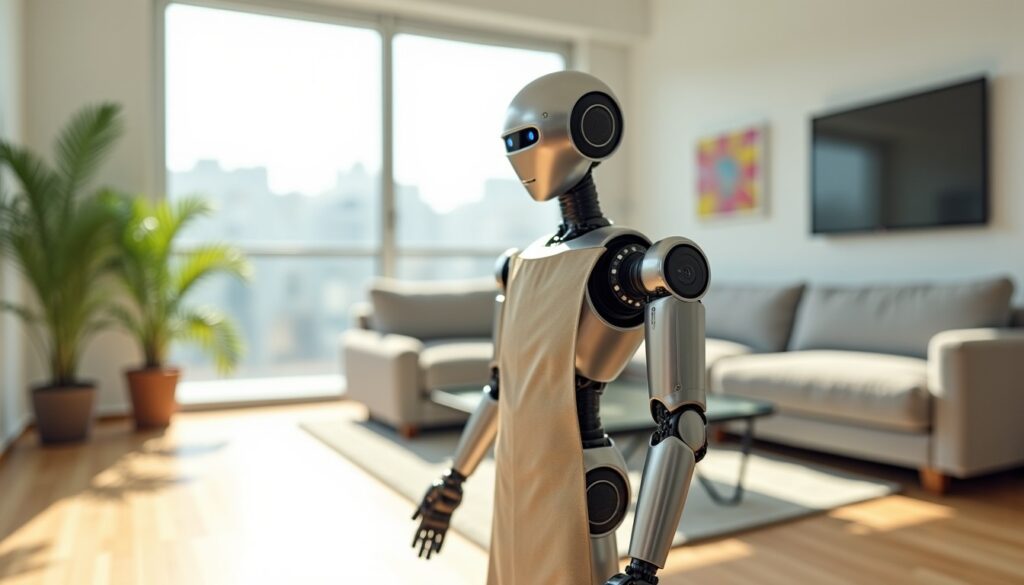
In a universe where technology increasingly infiltrates our daily lives, Figure, an American startup, unveils an innovation that stands out: a humanoid robot capable of effortlessly performing small household chores. This robot does not limit itself to simple mechanical gestures; it navigates a messy living room, identifies scattered objects, and puts everything back in order, from displaced cushions to accessories left on the table. More than a technical feat, this achievement marks a decisive step toward the efficient automation of household tasks thanks to artificial intelligence (AI). In 2026, this advancement goes far beyond a playful demonstration: it embodies a new era where robots, until now confined to industrial environments, enter our homes.
Figure leverages an architecture called Vision-Language-Action (VLA), a technology that combines visual perception, natural language understanding, and physical execution. This fusion enables the robot to grasp a chaotic environment and make real-time decisions, much like a human housekeeper. The startup benefits from strong financial support from giants like Microsoft and Nvidia, illustrating the growing interest in this form of robotic innovation. Furthermore, this breakthrough occurs in a globalized context where several players, Tesla, LG, and other startups, compete intensely to develop versatile humanoid robots capable of adapting to the diversity of individual homes.
Despite these exciting advances, challenges remain numerous. Indeed, a dwelling proves to be a complex testing ground for machines: the variety of objects, changes in layout, the presence of animals or children impose a high threshold for safety and flexibility. Thus, while Figure’s robot already masters basic gestures smoothly, its large-scale use for household chores still requires many adaptations. However, with the rapid progress of artificial intelligence and robotics, what seemed only a futuristic vision a few years ago could well become daily reality in the near future.
- 1 How Figure is revolutionizing home automation with its housekeeping robot
- 2 Artificial intelligence serving advanced domestic robotics
- 3 A global competition is driving innovation in humanoid robots
- 4 From factory to living room: the gradual evolution of domestic robots
- 5 Specific challenges of domestic robotics facing daily chores
- 6 Perspectives and future potentials of robotics in managing chores
- 7 Socio-economic implications of domestic automation by robots
- 8 Technical advances that will transform daily life thanks to robotic automation
How Figure is revolutionizing home automation with its housekeeping robot
Home automation, a discipline dedicated to the automation and control of domestic tasks, gains a new dimension with the emergence of robots capable of integrating into the home environment. Figure, through its humanoid robot, pushes the traditional limits associated with these machines. Where classic home automation often relies on fixed or mobile devices programmed for specific tasks like cleaning or security, this robot introduces adaptability and contextual understanding.
Indeed, instead of executing predefined commands, Figure’s robot analyzes its environment in real time. It distinguishes objects on a table, assesses their condition, and then decides how to handle them. This sharply contrasts with vacuum or automatic mopping robots which are only supposed to follow pre-established paths. This capability stems from the Vision-Language-Action (VLA) architecture, which links vision and language to motor commands, paving the way for more intuitive and versatile automation.
An intelligent and physical artificial intelligence
The heart of the robot is an AI called Helix, a model that does not simply interpret data or generate text. Helix incorporates advanced visual understanding, describing what it sees, and can receive instructions formulated in natural language. For example, one could simply tell the device, “Put the cushions on the sofa,” and it will understand the command and context.
This understanding is then translated into complex but precise physical gestures thanks to skilled robotic arms and hands. This symbiosis of capabilities resembles a human housekeeper capable of adapting their intervention according to unforeseen circumstances, ranging from handling heavy objects to performing delicate gestures suitable for fragile items.
This approach fundamentally changes the game for domestic automation. It opens the possibility of truly versatile robotic assistants, far from classic single-function solutions.
A solution towards a connected and interactive home
Figure’s robot perfectly illustrates the convergence between artificial intelligence and home automation. It does not only execute mechanical tasks but integrates into an intelligent system where communication between devices and immediate adaptability are key. This robot can become the pivot of a household where chores are performed effortlessly, thus improving quality of life and freeing time for more enriching activities.
Concrete example: imagine the life of Émilie, a young professional with little time to devote to cleaning. The robot could handle daily tidying, even delicate manipulations, while allowing her to monitor cleanliness status via a mobile app. Thanks to Figure’s innovation, this scenario is now becoming an accessible reality.
Artificial intelligence serving advanced domestic robotics
The complexity of domestic robotics lies in the need to understand and adapt to highly diverse environments, consisting of multiple objects, textures, obstacles, and unforeseen situations. Figure’s Helix AI is developed precisely to meet this challenge through its VLA design which combines visual analysis, natural language processing, and motor execution, forming a harmonious triptych.
Advanced visual analysis and environmental perception
Unlike traditional robots which rely on static landmarks or predefined maps, Figure’s robot uses its cameras to observe the space around it in detail. It identifies and categorizes objects – for example, distinguishing a book from a phone or a cushion. This recognition ability is dynamic: it can perceive unknown objects, which is fundamental for managing a domestic environment where objects frequently vary.
Natural language understanding for intuitive interaction
The integration of natural language processing allows this robot to receive diverse and sometimes ambiguous orders, relying on its contextual understanding. This means no complex programming or detailed scripts are required to guide it in its tasks. It can interpret instructions like “put this glass in the kitchen” or “gather the toys on the floor” and act accordingly.
Coordinated and precise physical actions
The final stage of the process involves translating understanding into movements. Figure’s robotic arms and hands offer precision and flexibility that allow performing a variety of tasks: grasping, moving, positioning, without risk of breaking or disturbing other objects. This level of control reflects a major advance in automating household chores.
A global competition is driving innovation in humanoid robots
The development of humanoid robots for domestic use is today the scene of a real global race. Figure’s successful demonstration fits into a context where several ambitious players place robotic innovation at the heart of their priorities.
Such is the case of Tesla with its Optimus robot, initially designed for industry but intended to move towards domestic uses, and the NEO robot developed by 1X Technologies, specifically designed to make life easier at home. LG, for its part, is also developing robotic solutions aimed at versatility and ease of use in a domestic environment.
Economic stakes and massive investments
The humanoid robotics market is now valued at several billion dollars with forecasts projecting a volume of around 38 billion by 2035. These figures illustrate how much companies and investors, like Microsoft, Nvidia, or funds linked to Jeff Bezos, believe in the future profitability of these technologies.
The table below shows a comparison of the main players and their projects in domestic robotics:
| Company | Robot Name | Main Use | Key Features | Notable Investments |
|---|---|---|---|---|
| Figure | Robot Helix | Versatile household chores | VLA AI, adaptability | Microsoft, Nvidia, Bezos funds |
| Tesla | Optimus | Industry & future domestic uses | Robustness, increased autonomy | Tesla Funds |
| 1X Technologies | NEO | Multifunctional domestic robot | Advanced navigation, voice interaction | Private fundraisings |
| LG | LG domestic robot | Multifunctional assistance | Compact design, home automation integration | Internal R&D investments |
From factory to living room: the gradual evolution of domestic robots
It would be wrong to believe that Figure directly deploys its robots in homes. In reality, the initial learning and refinement stages mainly take place in industrial environments, a controlled setting favorable to accumulating essential data.
Working notably with BMW, Figure subjects its robots to manipulation and locomotion tasks in demanding contexts. Thus, the factory becomes a training ground to test the resistance, precision, and versatility of the machines. This strategy allows quickly correcting errors, improving AI algorithms, and enhancing safety before transitioning to domestic use.
This process illustrates a pragmatic approach: living rooms and houses are moving spaces that only perfectly controlled robots can integrate without compromising safety or function.
Specific challenges of domestic robotics facing daily chores
Although Figure has crossed major milestones, domestic robots still face significant technical and practical difficulties once in a real-world context.
- Variability of environments: Each home is unique, with different layouts and objects.
- Fragile and unpredictable objects: Handling carefully objects that may break or be misplaced.
- Human and animal presence: Ensuring safe cohabitation without risk of accidents.
- Changing lighting and conditions: Adapting visual perception to different light levels or obstacles.
- Complexity of gestures: Moving from simple object displacement to more precise tasks.
These constraints mean that safety and reliability are at the heart of development. A robot must not become a domestic hazard or disrupt daily life. These issues explain why, in 2026, the presence of humanoid robots in homes remains for many a horizon to reach despite promising prototypes.
Perspectives and future potentials of robotics in managing chores
Despite obstacles, the trend is clearly towards gradual integration of robots into everyday household tasks. Specialization of artificial intelligences in home automation, combined with innovations in mechanics and sensors, offers an open path to a future where automation no longer limits itself to isolated functions but extends to the overall management of the home.
Among the avenues for development are:
- Continuous machine learning: robots capable of adapting their strategies according to the house visited.
- Enhanced vocal and emotional interaction: more natural communication to guide robotic housekeepers.
- Complete home automation interoperability: integration with other intelligent systems in the house for optimal synergy.
- Strengthened energy autonomy: for continuous presence without frequent human interventions.
- Accessible prices and modularity: making these technological assistants accessible to a wide public.
These advances position robotics as a key solution to radically transform chore management, thus freeing up valuable time for individuals.
Socio-economic implications of domestic automation by robots
The growing adoption of robots capable of performing household chores also raises important social and economic questions. Indeed, while these technologies promise considerable time savings and increased comfort, they also disrupt traditional dynamics of household management and domestic work.
Professions of housekeeper, cleaning, or maintenance could see their activity modified by the arrival of humanoid robots capable of performing the same tasks, but faster and more consistently. This could lead to reduced demand for certain services while creating opportunities in sectors related to maintenance, programming, or supervision of robots.
Changes in lifestyle and quality of life
On an individual level, delegating these tasks to robotic artificial intelligence would allow reorganizing the day, reducing stress, and increasing time dedicated to leisure or family. The impact could be particularly significant for the elderly or those with reduced mobility, thus enhancing social inclusion through technology.
Ethical questions and responsibility
The rise of these robots also raises questions about personal data management, safety, and liability in case of malfunction. Legislation will need to evolve to ensure ethical and safe usage, protecting users while encouraging innovation.
Technical advances that will transform daily life thanks to robotic automation
Recent advances in robotics, artificial intelligence, and automation have allowed crucial milestones to be crossed. Figure’s robot is a prime example, combining vision, language, and action to accomplish a multitude of household chores with fluidity and adaptability.
Progress in mechatronics and sensors
The robot’s articulated arms offer fine maneuverability, capable of reproducing the complexity of human movements needed to grasp, sort, or reposition various objects. Multiple sensors detect pressure, distance, or texture, allowing gentle and effective interaction with the environment.
Integration of specialized artificial intelligences
Helix AI transforms visual and auditory data into precise commands, coordinating gestures and taking unforeseen events into account. This contextual intelligence is fundamental to ensuring safe execution of tasks in a domestic setting.