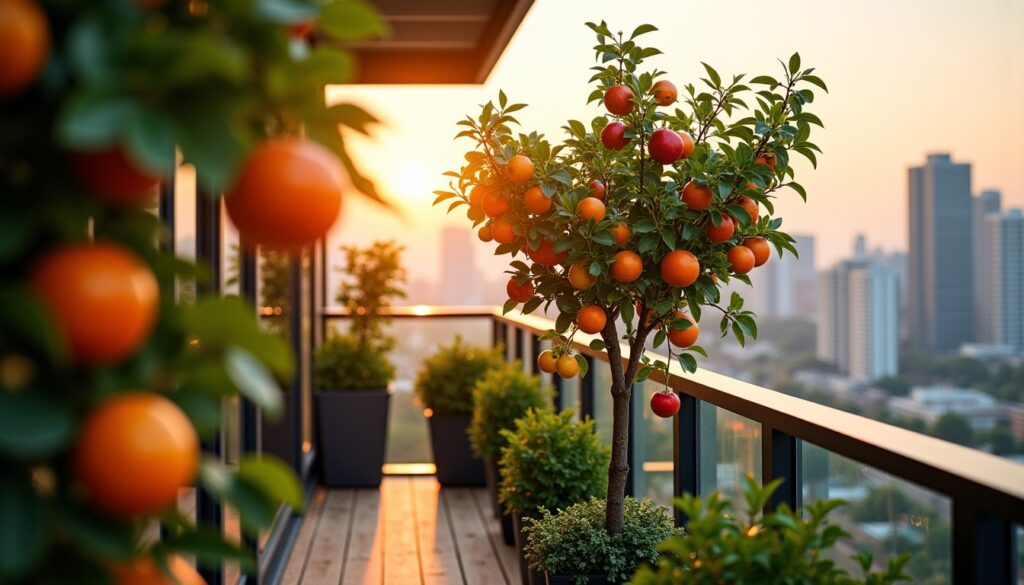
In a world where green spaces are becoming scarce and urban life is taking up more and more space, nature is reinventing itself through ingenious initiatives. Growing a fruit tree on a balcony then becomes an elegant and surprising way to reconnect with nature while enjoying an authentic taste reward. The challenge? Transforming a small urban space into a fertile and productive place. This exceptional fruit tree, adapted to the constraints of balconies, now stands as a solution at the heart of urban culture. It is no longer just a green ornament: it is a true producer, capable of offering a surprisingly generous harvest, even in a limited environment.
City dwellers, often deprived of a garden, discover that a well-chosen planting on their balcony can satisfy their growing desire for food autonomy and well-being through gardening. Between personal pleasure, ecological approach, and desire for local consumption, this phenomenon claims many advantages beyond the simple fruit: a strengthened connection with nature, accessible learning for all, and unmatched nutritional quality. The potted fruit tree impresses with its robustness and yield, bringing a touch of countryside to the urban hustle and enhancing the balcony experience.
- 1 Why choose an exceptional fruit tree for urban balcony cultivation?
- 2 The concrete benefits of container cultivation: flexibility and total control
- 3 The secrets of successful maintenance for a sustainable and generous harvest
- 4 Choosing the ideal variety: a crucial step to maximize balcony production
- 5 Advanced tips to boost the harvest and optimize fruit quality in urban cultivation
Why choose an exceptional fruit tree for urban balcony cultivation?
The concept of integrating a fruit tree into a small space may at first seem ambitious or even risky. However, when we talk about an exceptional fruit tree specially selected for its ability to grow in a pot, urban gardening becomes accessible and productive. Such a fruit tree adapts to the constrained balcony environment and deploys a harvest potential that can surprise even an experienced gardener.
Contrary to popular belief, planting a fruit tree in a pot does not mean sacrificing production. For example, the fig tree, known for its hardiness, perfectly acclimates to balcony cultivation. It benefits from the heat emitted by the surrounding walls and tolerates dry periods well. Quickly, from the second or third year, it can offer an abundance of figs, often between 30 and 80 fruits per season. The lemon tree, another often favored champion in urban cultivation, shows its potential from the first year and can produce up to 50 lemons per year, fruiting almost all year round in a mild climate.
This approach offers several major advantages in the urban context:
- Optimization of a small space: even a modest balcony becomes a true miniature orchard.
- Satisfaction of a local and healthy harvest: the fruits are free from pesticides generally used in commercial circuits.
- Ecological commitment: reducing the impacts related to food transport through local consumption.
- Educational leisure: this planting becomes a pedagogical tool for children, sensitized to the natural cycles of living beings.
- Savings: on sometimes expensive fruits like figs or lemons, personal production represents a financial advantage over the seasons.
Faced with these tangible advantages, the trend to grow a fruit tree on the balcony has strongly developed. Garden centers testify to this evolution by offering an ever wider choice of trees and adapted varieties, meeting the growing demand of city dwellers seeking nature and food autonomy.
The concrete benefits of container cultivation: flexibility and total control
Growing a fruit tree on one’s balcony is not just a decorative act. One of the great advantages lies in the complete mastery of the plant’s environment, a key factor that guarantees an exceptional harvest despite the limited space. Compared to open ground cultivation, container cultivation offers flexibility and control that few other methods can provide.
For example, the possibility of moving the pot according to the seasons allows adapting the sun exposure, protecting the fruit tree from cold winds, or even sheltering it in case of frost. This is a precious gain that maximizes the plant’s health and productivity. The urban gardener can also precisely dose watering by avoiding both excess and lack of water, a delicate balance so that roots breathe and absorb nutrients efficiently.
Custom maintenance also includes substrate management: a well-chosen mixture of potting soil, compost, and draining elements prepares the ground for optimal rooting. Moreover, fertilization can follow the growth and fruiting rhythm, allowing the fruit tree to fully exploit its nutritive reserves.
To better illustrate this adjusted productivity, here is a summary table of average productions that some commonly potted fruit trees can offer:
| Fruit tree | Average production in pot | Time before first harvest |
|---|---|---|
| Fig tree | 30 to 80 figs per season | 2 to 3 years |
| Lemon tree | 20 to 50 lemons per year | 2 to 4 years |
| Dwarf apple tree | 5 to 15 kg of apples | 3 to 5 years |
| Orange tree | 15 to 40 oranges per year | 3 to 5 years |
The table unequivocally demonstrates that even on a balcony, an exceptional fruit tree can offer a surprisingly abundant harvest. These figures reflect years of adaptation and horticultural innovation, which today allow urban cultivation to aim for both qualitative and quantitative production.
The secrets of successful maintenance for a sustainable and generous harvest
A good planting is the basis, but without adapted maintenance, no fruit tree can offer a worthy harvest. Growing a fruit tree in a pot on a balcony requires real but accessible commitment, with some key actions that ensure its flourishing and steady production over the years.
Water management is the first element to master. Too much water suffocates roots, causing their rot, while insufficiency dehydrates the plant and slows its growth. In summer, regular watering every two days is often necessary, while in winter, frequency is greatly reduced depending on the outdoor temperature.
Furthermore, repotting every two to three years becomes essential to renew the substrate, avoid its compaction, and provide sufficient volume for the roots. Pruning, on the other hand, is a crucial step at the end of winter: it stimulates branching, prevents the tree from becoming bare, and promotes fruiting.
Fertilization is generally concentrated in spring, with a potassium-rich fertilizer that encourages flowering and fruit formation. Regular vigilance is also necessary to fend off initial attacks by pests: scale insects and aphids are often the classic enemies of citrus and other urban fruit trees.
Finally, depending on the geographical area, winter protection can be vital. Some fruit trees like the lemon tree or dwarf apple are frost-sensitive and must be brought indoors or protected with a winter cover.
Here is a reminder in list form of essential maintenance actions:
- Regular watering in summer, reduced in winter
- Repotting every 2 to 3 years
- Annual pruning at the end of winter
- Spring fertilization with a potassium-rich fertilizer
- Preventive pest control
- Winter protection if necessary
Learning to listen to one’s fruit tree, understanding its seasonal needs, and adopting these good practices make all the difference between stagnant growth and a harvest that delights every year.
Choosing the ideal variety: a crucial step to maximize balcony production
The choice of variety is as much a matter of aesthetics as of yield. Given the diversity of fruit trees adapted to pot cultivation, it is advisable to favor specific species and cultivars, often dwarf, that have been selected for their ability to grow harmoniously on a balcony.
Specialists encourage the planting of:
- Ficus carica ‘Petite Negra’: a dwarf fig tree with impressive yields, perfect for a sunny and sheltered balcony, it quickly produces tasty figs.
- Citrus limon ‘Quatre Saisons’: a remontant lemon tree that fruits several times a year, ideal for mild climates and for decorating year-round.
- Malus ‘Ballerina’: a columnar apple tree, elegant, taking up little space and generous in sweet fruits.
- Prunus persica ‘Bonanza’: a very decorative and productive dwarf peach tree, which enriches the balcony with color and summer taste.
- Olea europaea: the olive tree, hardy, tolerant of drought and urban winds, can be grown for its aromatic leaves and rare fruits.
The choice of variety strongly conditions the success of the fruit tree project on the balcony and its harvest potential. Each species has particular requirements in terms of exposure, substrate, and maintenance, which invites to be well informed before planting.
Advanced tips to boost the harvest and optimize fruit quality in urban cultivation
Beyond the simple choice of adapted varieties, several techniques allow maximizing productivity and quality of fruits from a fruit tree grown in a pot on a balcony. The exceptional fruit tree thrives more when it receives particular attention that stimulates its vigor and flowering.
Exposure is a fundamental factor: a balcony facing full south or southwest is ideal to benefit from maximum sunlight. The substrate also plays a determining role. A light and draining mix, combining universal potting soil, pumice, and compost, promotes root development and avoids water stagnation. A pot of sufficient size, generally between 40 and 60 liters, ensures this root freedom.
Some effective practices to encourage fruiting:
- Manual pollination: use a brush to transfer pollen when insects are scarce, a simple practice that optimizes fruit formation.
- Fruit thinning: eliminate some excess fruits to concentrate the tree’s energy on those most likely to ripen well and be tasty.
- Mulching: cover the pot’s surface with organic matter to retain moisture and stabilize root temperature.
- Regular fertilization: apply a liquid fertilizer every 15 days during the fruiting season to support production.
These particular attentions often shorten the time before the first harvest and multiply the quantity of fruits obtained, with a direct impact on the fruit’s flavor and the fruit tree’s vigor.
Thanks to these techniques, a simple urban space transforms into a true corner of nature, imbued with the satisfaction that gardening and responsible consumption provide.