
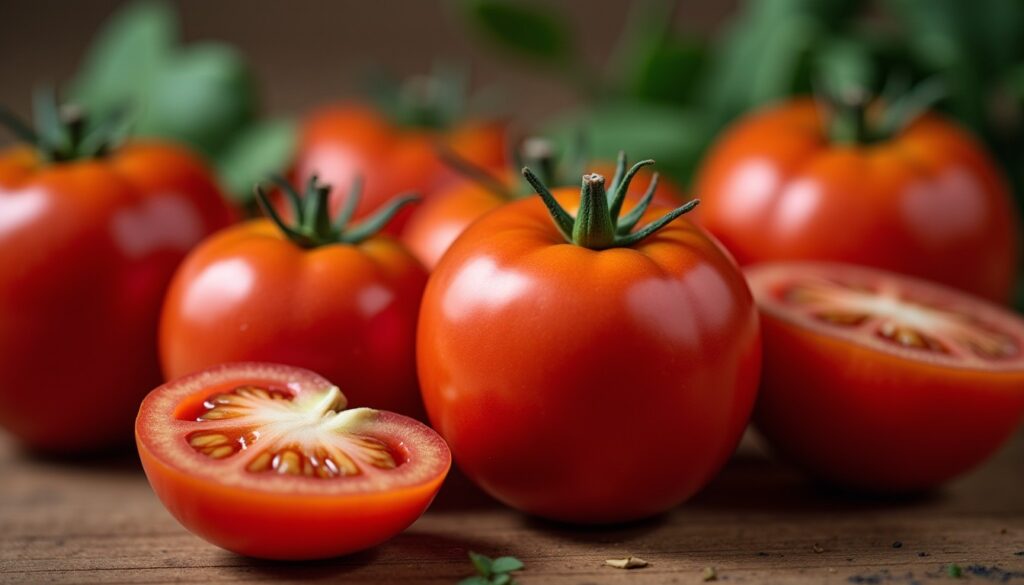
Every spring, in vegetable gardens, tradition dictates that tomatoes be planted straight upright, the stem firmly anchored in a freshly prepared clod. However, for several decades, professional market gardeners have adopted a very different method, to the point of considering it essential to ensure robustness and yield. This involves planting tomatoes lying down, a simple yet revolutionary gesture that radically transforms the plant’s root development. This technique, a genuine know-how passed on in the field, relies on the unique ability of the tomato stem to produce adventitious roots along its entire length when buried.
Market gardeners praise this method, especially to cope with increasingly marked climatic variations, with often drier springs. By burying the stem flat or slightly inclined, the plant develops a root system two to three times more extensive, capable of capturing more water and nutrients from deeper soil layers. This strategy ensures better resistance to water stress and increased vigor, essential conditions for abundant and regular harvests.
Accessible to all gardeners, the technique of lying tomatoes nevertheless relies on precise implementation, including the choice of an optimal location, careful soil preparation, and thoughtful maintenance after planting. In this article, we will delve into the heart of this method, decoding each step and every favorable condition so that your tomato plants fully benefit from this deep rooting, a guarantee of a successful horticultural season.
- 1 Why planting tomatoes lying down promotes deep and lasting rooting
- 2 Ideal conditions to succeed in lying tomato planting
- 3 Precise steps to succeed in lying tomato planting
- 4 Post-planting care: ensuring durable rooting and vigorous growth
- 5 Measurable benefits of deep rooting on tomato health and productivity
Why planting tomatoes lying down promotes deep and lasting rooting
Most gardeners consider the tomato as a rigid-stemmed plant to be planted vertically. However, this classic model overlooks a fascinating botanical characteristic of the tomato: the ability to produce adventitious roots from the buried stem. This specificity offers an exceptional opportunity to multiply the root surface.
By planting the tomato lying down, the main stem is spread in a shallow trench, generally between 10 and 15 cm deep, which exposes a larger part of the stem to direct contact with the fertile soil. Thus, all these buried parts can generate additional roots, establishing an extensive root network over a wider surface.
This multiplication of roots promotes better soil exploration, which is crucial especially when water resources become scarce or nutrients are dispersed at different depths. The root system developed by the “lying down” method is more efficient than that of a vertical plant, sometimes limited to about ten centimeters below the surface.
A vegetable garden where tomatoes are grown lying down will also benefit from better mechanical stability. In case of strong winds or heavy rains, the plants are less likely to topple because the lying stem, well anchored over a longer length, rests firmly on the soil. This technique proves even more beneficial for plants that have “legged out” in the nursery—that is, have elongated their stem without forming a truncated and solid trunk, making the base fragile.
Experienced market gardeners assert that this well-mastered method doubles to triples the effective root surface and strengthens the plants’ adaptability to climatic constraints. The result is better water uptake, more efficient absorption of nutrients, and a root system more resilient to soil diseases.
Here is why planting tomatoes lying down is a real asset for deep rooting:
- Exploitation of the natural capacity of adventitious roots along the entire buried length of the stem.
- Multiplication of the root surface in a developed horizontal trench.
- Access to more consistent moisture and a larger volume of nutrients.
- Strengthening resistance against wind and climatic hazards.
- Increased adaptability, even for leggy or slightly fragile plants.
Ideal conditions to succeed in lying tomato planting
The success of the lying planting technique does not depend solely on the gesture of laying the stem flat; it also involves a rigorous selection of the location and careful soil preparation. These elements condition the quality of root development and directly influence the plant’s vigor.
The importance of maximum light exposure
The tomato is a heliophilic plant, meaning it strongly depends on light to develop well and fruit. A plant, regardless of the quality of its rooting, will not give good results if placed in a shaded or partially shaded area. In 2026, market gardeners favor south or southwest facing locations, offering at least 6 to 8 hours of direct sunlight per day.
This generous exposure to light activates photosynthesis, an essential driver for stem growth, but also for fruit formation. Moreover, good sunlight helps limit the development of fungal diseases by reducing stagnant moisture on foliage.
Soil characteristics for optimal rooting
A well-chosen soil must combine several essential properties:
- Efficient drainage: The soil must not retain water excessively to avoid asphyxiation of adventitious roots, particularly sensitive in humid conditions.
- Light and loose texture: To facilitate the progression and branching of horizontal roots, sandy-loamy soil is often ideal.
- Slightly acidic pH: A pH between 6 and 6.8 allows good availability of essential nutrients.
- Organic richness: Good organic matter content improves fertility and encourages the development of beneficial microorganisms.
Strictly avoid low areas where water stagnates, as prolonged exposure to moisture can cause root rot. This requirement emphasizes the importance of combining lying planting with appropriate soil work, notably deep loosening.
Prepare the soil deeply before planting
Before digging the trench to accommodate the lying plant, it is necessary to loosen the soil to a depth of at least 30 to 40 cm. The intervention of a broadfork is recommended to break up compacted layers that may hinder root penetration.
Furthermore, the incorporation of organic amendments is a key step. Mature compost, decomposed manure, and phosphate-rich materials such as bone meal or ground horn are usually integrated into the soil brought up during digging. These elements both provide a regular supply of nutrients and stimulate microbial life, a crucial factor for root health.
In summary, the ideal conditions for lying planting are reflected by:
| Criteria | Conditions | Impact on cultivation |
|---|---|---|
| Exposure | 6-8 hours of direct sunlight, south/southwest orientation | Activates photosynthesis, promotes fruiting |
| Drainage | Well-drained soil, no water stagnation | Preserves roots from diseases, prevents root asphyxiation |
| Soil texture | Light and loose soil, sandy-loamy type | Facilitates horizontal root expansion |
| pH | Slightly acidic, between 6 and 6.8 | Optimizes nutrient availability |
| Organic matter | Rich in compost or decomposed manure | Enhances soil fertility and microbiology |
Precise steps to succeed in lying tomato planting
Beyond theory, success relies on the meticulous execution of the actions accompanying the planting of lying plants. Respecting these steps maximizes adventitious rooting and optimizes plant vigor throughout the season.
Plant preparation
Before planting, it is essential to remove all leaves located on the part of the stem to be buried. This precaution prevents unpleasant leaf rot under the soil, which could become a source of stress or disease for the plant. Only the terminal cluster of leaves remains visible and in contact with the air.
Digging the trench and positioning the plant
The trench must be sufficiently long and deep, typically between 10 and 15 cm and wide enough to accommodate 60 to 70% of the total plant length. The leafy top is positioned towards the sky, ideally facing south to fully benefit from sunlight.
The root ball is placed at the deepest end of the trench, ensuring a good base for initial root growth. When the stem is laid flat, it is important neither to force nor bend the plant to avoid any injury that could compromise its development.
Backfilling and initial watering
Cover the stem with amended soil, gently pressing by hand to ensure good contact between the stem and soil but without excess, which is imperative to allow sufficient aeration. Immediate watering should be generous but controlled to eliminate air pockets, essential for the successful start of adventitious roots.
List of key points for a successful lying planting:
- Remove all lower leaves on the stem to be buried.
- Dig a trench 10 to 15 cm deep and sufficiently long.
- Lay the stem flat, orienting the top towards the sun.
- Do not bend or force the stem when placing.
- Backfill with enriched soil, press lightly.
- Water heavily but without creating puddles.
Post-planting care: ensuring durable rooting and vigorous growth
The phase following planting is crucial to ensure the root system fully develops according to the potential that the lying technique allows to unlock. Attention to watering, mulching, and health monitoring proves decisive.
Rigorous watering management
Adventitious roots form in the first 10 to 15 days after planting. During this period, the soil must be kept consistently moist, without excess that could cause rotting. Root watering, ideally via a pressurized hose or drip irrigation, avoids wetting the foliage and thus limits risks of diseases such as late blight.
During active growth, the multiplication of roots allows then to space out interventions, relying on the deep roots’ capacity to naturally capture water.
The key role of organic mulching
Mulching imposes itself as a valuable ally in stimulating effective rooting. Applied in a 5 to 8 cm layer over the trench, it plays several complementary roles:
- Reduction of water evaporation, allowing significant water savings in irrigation.
- Maintaining a cool and stable soil temperature even during summer heat peaks.
- Control of competing weed growth.
- Gradual enrichment of the soil through natural decomposition.
This simple act helps reduce water needs by 30 to 40% while promoting the development of a dense and deep root network.
Measurable benefits of deep rooting on tomato health and productivity
Lying planting is not limited to an aesthetic or practical method; it concretely transforms the physiology of the tomato plant and optimizes its interaction with the soil. The comparative evaluation conducted by professional market gardeners in 2026 highlights significant differences between vertically planted and lying down plants.
| Evaluated aspect | Vertical plant | Lying plant |
|---|---|---|
| Average root depth | 20 to 30 cm | 40 to 60 cm |
| Drought resistance | Low | High |
| Overall plant vigor | Medium | Strong |
| Estimated yield | Reference | +20 to +35 % |
These figures confirm that deep rooting generated by the lying tomato technique is a powerful lever to anticipate and manage climatic hazards, improve plant vitality, and maximize harvests. In 2026, faced with increasing spring drought periods, this strategy appears more essential than ever.
Beyond productivity, plants with increased rooting show better resistance to root diseases and homogeneous development. They continue to produce quality fruits even in difficult situations where conventional plants may prematurely decline.
Integrating lying planting into one’s vegetable gardening practice is thus relying on a set of concrete advantages for more abundant harvests, larger fruits, and enhanced plant health. It is also an easy-to-adopt, low-cost method, particularly suited to the changing conditions gardeners currently face.




