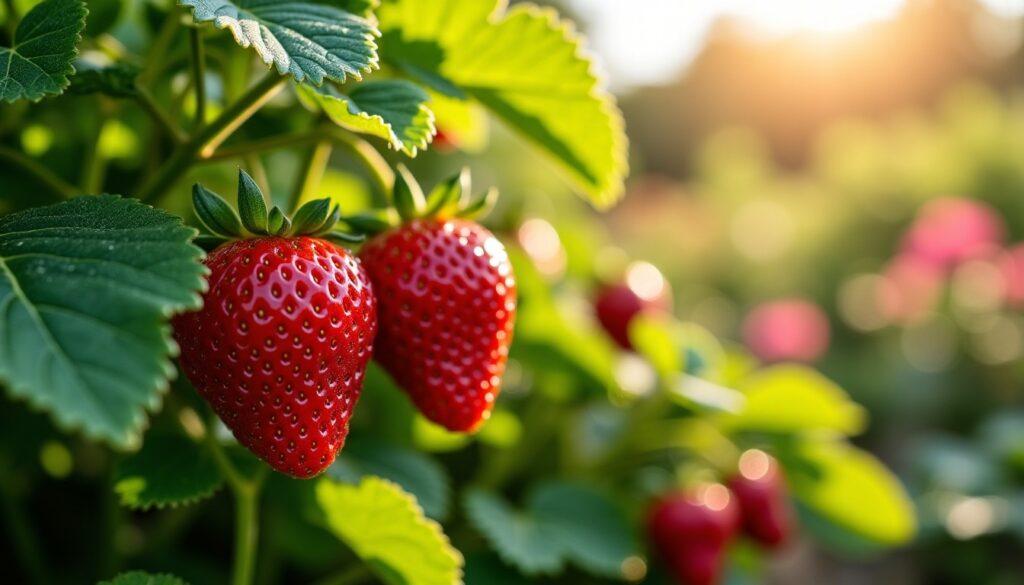
In the heart of spring, strawberry plants come back to life after a long winter period. It is the crucial moment when every gesture counts to ensure a generous and tasty harvest from mid-June. With the return of sunny days and the gradual warmth of temperatures, the attentive gardener must carefully prepare the plants, from planting to maintenance, including watering and natural protection against pests. Growing strawberries is not just a horticultural task; it is a subtle alchemy combining patience, expertise, and a touch of observation to support the plant at every stage of its development.
The choice of variety, the exact timing of planting, and soil quality will lay solid foundations for an early harvest. But more than that, it is meticulous maintenance — cleaning the plants, controlling hydration, fertilization, and protection — that will make the difference. A well-prepared and protected strawberry plant will quickly produce its red fruits, rich in flavor and aroma, just in time for the anticipated picking. Undertaking these four steps not only avoids common mistakes but also gives nature a boost in its spring rhythm.
Spring 2026 promises to be ideal for those wishing to taste the first strawberries of the season, provided these essential keys are respected. This structured approach enabled by simple but precise actions transforms the gardener’s efforts into delight from mid-June.
- 1 Plant your strawberries at the right time to anticipate a harvest from mid-June
- 2 Prepare and maintain the soil to support strawberry growth in spring
- 3 Watering and fertilizing in spring: the balance to maximize strawberry harvest
- 4 Protect your strawberries in spring: natural pest control and promoting pollination
Plant your strawberries at the right time to anticipate a harvest from mid-June
The success of a strawberry harvest in the peak summer season first depends on judicious planting. Indeed, planting strawberries in spring may seem natural, but the ideal window is not always the one one thinks of. For those wanting to enjoy their fruits from mid-June, autumn planting appears to be the most effective strategy. Planting between late August and early October allows the plants to root deeply before winter. They then enter dormancy, which gives them an essential burst of vigor to start in the following spring.
One must not risk a too harsh winter by planting too early, nor delay the planting to the point of compromising root development before fruiting. This strategically thought-out schedule gives a head start on the season. That said, it is essential to choose an early-yielding variety. Among the most reputed in this regard are Gariguette, cherished for its sweet and slightly tangy taste as well as its rapid maturity. Ciflorette, with its firm flesh and natural disease resistance, is another excellent candidate for early production. Clery, often favored in areas with mild springs, matures very early, while Mara des Bois, thanks to its remontant nature, offers the possibility to double or even triple harvests if planted in autumn.
To ensure that the strawberry plants are perfectly adapted to the local climate and garden requirements, it is better to turn to reputable local nurseries. These professionals provide plants selected for their vigor and precocity, as well as good adaptation to regional specifics, a crucial point to guarantee a mid-June harvest. Thus, planting is not limited to the act itself but benefits from thorough consideration of variety choice and timing that will condition the entire production cycle.
Technical steps for successful planting
Beyond perfect timing, planting requires special care to optimize the health and growth of the strawberry plants. Holes must be dug wide enough so as not to constrain the roots, and care must be taken to position the plant crown at ground level, neither too buried nor too exposed. After placing each strawberry plant, lightly firm the soil around it to ensure good contact between roots and soil. Finally, light but regular watering after planting favors establishment.
Prepare and maintain the soil to support strawberry growth in spring
The soil is the bed on which all strawberry development will rest. Its physico-chemical balance and organic quality directly influence plant vigor and fruit quality. Because the strawberry is a demanding but sensitive plant, it requires a light, well-drained soil enriched with humus. The acidic nature of the soil is also a determining factor. A pH between 5.5 and 6.5 is the ideal environment, a range that ensures essential nutrients will be available to roots without blockage or deficiency.
Too alkaline a soil, for example, will cause iron deficiencies visible as leaf yellowing, while poor drainage causes rapid root and fruit rot. The presence of good organic matter stimulates growth and increases fruiting by gradually supplying the necessary nutrients.
| Parameter | Ideal value | Consequence of non-compliance |
|---|---|---|
| Soil pH | 5.5 to 6.5 | Iron deficiency, leaf yellowing |
| Drainage | Good to excellent | Root and fruit rot |
| Organic matter | High | Slowed growth, poor fruiting |
To achieve this balance, soil preparation at the start of spring includes several steps: deep digging between 30 and 40 centimeters to aerate the soil, incorporation of mature compost or well-decomposed manure to enrich organic matter. Depending on soil richness, pH adjustment with blonde peat (acidic) or lime (basic) may be necessary. Once in place, mulching with straw or jute fabric protects the soil by limiting evaporation, maintaining a stable temperature, and preventing weed growth.
In summary, a strawberry plant well surrounded by a living and balanced soil will have every chance to grow vigorously and quickly produce red and fragrant fruits in spring.
Maintain the soil throughout the season
After planting, work continues with regular soil maintenance to support growth. It is recommended to renew mulch every spring, lightly hoe to remove weeds, and apply pH corrections if the soil shows signs of imbalance. This ongoing attention ensures a healthy and stable environment for the plants.
Watering and fertilizing in spring: the balance to maximize strawberry harvest
To obtain a nice harvest from mid-June, it is essential to master the watering and fertilization of strawberry plants. These two levers act directly on the health of the plants, their flowering, as well as the aromatic development of the fruit. Water is both essential and a source of risk if not administered carefully.
The strawberry needs constant moisture, close to fresh soil, but hates saturated soil. Excess water can quickly cause fungal diseases like Botrytis, responsible for gray rot which can destroy the harvest in very little time.
Recommended watering consists of providing water mainly in the morning, so that leaves have time to dry during the day. It is also advisable to target exclusively the base of the plants and avoid watering foliage and flowers to prevent disease development. Especially during flowering, a slight reduction in watering is favorable, as excess moisture can dilute the sugar concentration of the forthcoming fruits.
In case of a dry and prolonged period, strawberries will need watering every two to three days at minimum to maintain their vigor.
To optimize this water supply, drip irrigation is particularly recommended. It delivers water directly to the base of the strawberry plants, reduces waste, and limits excessive humidity on the foliage, which reduces the frequency of phytosanitary treatments.
Alongside water, fertilization is a key complementary action. Adding compost or organic fertilizer rich in potassium will promote the formation of tasty fruits. Likewise, a moderate amount of nitrogen will allow harmonious vegetative growth while avoiding excessive leaves at the expense of fruits. One of the success criteria is to properly dose these elements to maintain a balance that stimulates flowering and then fruiting.
- Water in the morning to promote rapid leaf drying.
- Avoid watering foliage and flowers to prevent fungal diseases.
- Use drip irrigation for targeted and economical watering.
- Fertilize moderately with mature compost or balanced organic fertilizer.
- Adjust watering frequency according to weather and strawberry growth.
Protect your strawberries in spring: natural pest control and promoting pollination
With the spring restart, strawberries are particularly vulnerable to various pests that can compromise future harvests. However, it is entirely possible to control these attacks without resorting to chemicals, with some simple but effective natural measures.
The main enemies encountered are aphids, which weaken young shoots by sucking sap; slugs and snails, fond of young leaves and ripe fruits; the weevil known as the strawberry blossom weevil, which cuts flower buds before flowering; as well as mites, responsible for yellowing and curling of leaves.
To limit these damages, it is advised to spray diluted nettle manure, a natural fertilizer that also strengthens strawberry defenses against attacks. Spreading fine wood ashes around the plants forms a very effective natural barrier to keep slugs and snails away. Installing an insect net during flowering prevents devastation by the blossom weevil. At the same time, encouraging the arrival of natural pest predators, notably ladybugs known for their appetite against aphids, further strengthens protection.
Ensuring flower pollination is another major challenge in spring. Good pollination guarantees the formation of well-formed and abundant strawberries. It is suggested to plant melliferous flowers like phacelia, borage, or white clover around the strawberry plants to attract bees, bumblebees, and hoverflies who perform this role. During bad weather periods or low pollinator activity, manual pollination with a fine brush can effectively replace insect action.
These ecological methods, increasingly appreciated in 2026, favor healthy and environmentally respectful cultivation while allowing an early and abundant harvest.