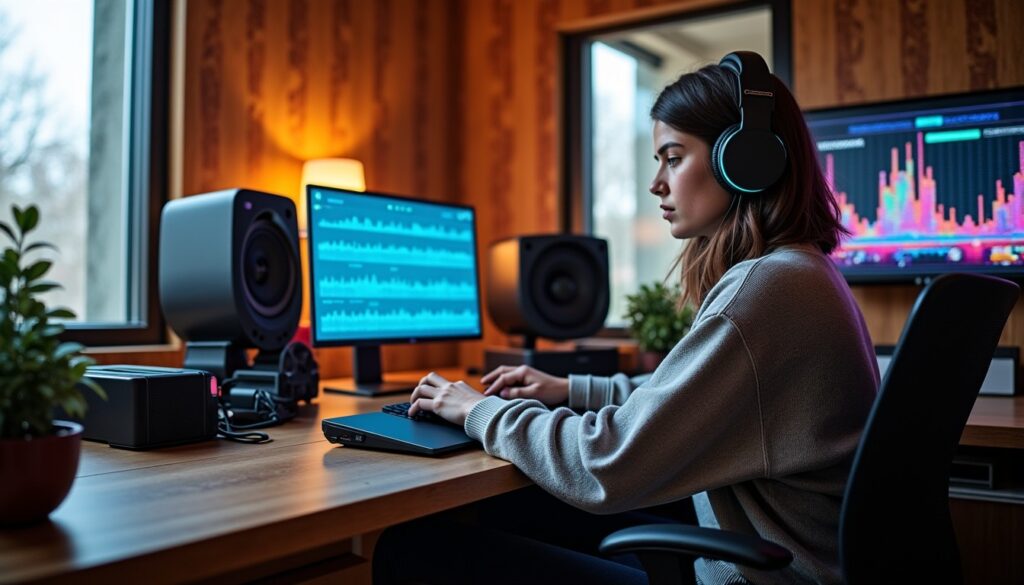
In March 2026, the landscape of music creation undergoes a profound transformation with the emergence of cutting-edge technologies such as Musicfy AI. This innovative platform harnesses the power of artificial intelligence to enable musicians, producers, and enthusiasts to create unprecedented tracks and synthesized voices of impressive quality. More than just a tool, Musicfy AI revolutionizes AI-assisted music, democratizing access to high-performance automatic composition and personalized voices, thus opening the door to true sound innovation.
Through an intuitive interface and advanced voice cloning technology, Musicfy AI offers a unique experience where human creativity combines with the power of algorithms to push the boundaries of musical technology. Exploring the platform’s features in March 2026, it becomes clear that the line between artist and machine has blurred, allowing anyone, whether novice or experienced, to produce tracks that rival those of professional studios. The future of music creation no longer takes shape solely in traditional studios but rather in hybrid environments where AI is a partner of choice.
- 1 Innovative Features of Musicfy AI for AI-Assisted Music Creation in 2026
- 2 User Experience Simplified Thanks to an Interface Accessible from the First Clicks
- 3 The Revolution in Voice Cloning: Natural and Personalized Synthetic Voices
- 4 Automatic Text-to-Music Composition: A Powerful Tool for All Levels
- 5 Track Isolation with Stem Splitter: A Major Technological Advantage
- 6 Pricing and Accessibility: A Value Proposition Suitable for Creators of All Levels
- 7 Challenges and Limitations of Musicfy AI: How to Overcome Technical Constraints in 2026
- 8 Perspectives and Evolution of Musicfy AI: What Future for AI-Assisted Music Creation?
Innovative Features of Musicfy AI for AI-Assisted Music Creation in 2026
Musicfy AI is now among the most comprehensive and advanced music generators of the year. Its main strength lies in the variety and quality of its options, adapted to the needs of a wide audience ranging from independent artists to industry professionals. The system notably offers several modules that revolutionize the way music is conceived, including voice cloning, automatic track generation via text (text-to-music), as well as precise audio track isolation.
The voice cloning module is particularly impressive, based on deep neural networks capable of mimicking the subtlest characteristics of a human voice. Whether you want to make a celebrity sing on your original compositions or create an entirely new voice, Musicfy AI offers an easily accessible solution. This technology far surpasses the old robotic clones, delivering a natural sound that captivates the audience. For example, a user can import a few minutes of personal audio for the platform to create an exclusive synthetic voice, faithful to their sonic identity.
The text-to-music feature allows transforming simple text prompts into complete musical tracks, covering a wide range of genres, from hip-hop to electronic music and jazz. During thorough tests, this option demonstrated a remarkable ability to generate coherent and harmonious melodies, avoiding repetitions and respecting classical musical structures. It’s a perfect tool for creators seeking to quickly produce a personalized sound atmosphere without having composition knowledge.
Another major asset, Stem Splitter is a technical breakthrough that easily separates the tracks of a complete piece. Whether it is to extract the vocals or isolate the instruments, this feature is essential for remixers and sound engineers. The processing is fast and precise, even on complex tracks, paving the way for completely new productions. For example, an artist can retrieve only the vocal track of a popular song and reinterpret it on a new composition without losing quality.
User Experience Simplified Thanks to an Interface Accessible from the First Clicks
One of Musicfy AI’s great strengths lies in its interface, designed to make music creation accessible to everyone, with or without musical training. Everything is designed so that users can quickly realize their ideas, whether by generating a track from a text description or by cloning a voice for personal or commercial use.
During platform use, you notice a smooth ergonomics where each option is clearly explained and guided. Menus are streamlined, allowing navigation without confusion between voice generation, musical composition, and track isolation. This simplicity does not come at the expense of advanced features, which remain fully configurable for users wishing to refine their productions down to the smallest details.
A concrete example: a beginner composer can write a simple line of text describing the desired emotion or style and obtain a complete musical mold ready to be refined in a few minutes. Similarly, a podcaster benefits from a quick solution to create original jingles adapted to their sound universe without resorting to expensive studios or complex equipment. This democratization of the creative process marks a major turning point in the history of music.
The Revolution in Voice Cloning: Natural and Personalized Synthetic Voices
In the field of voice synthesis, Musicfy AI demonstrates an astonishing mastery of the nuances and intonations needed to render a voice realistic and expressive. Unlike previous technologies where voices often sounded monotone or robotic, here the delivery is smooth and lively, capable of conveying authentic emotions.
The included voice library is already vast, with hundreds of varied and royalty-free timbres immediately usable in your productions. These voices can be modified at will in terms of pitch, tempo, or vocal effects, allowing an almost unlimited creative margin. Furthermore, the ability to import personal files to train a custom model adds a unique dimension. A singer or artist can thus preserve their identity while exploring unique, easy-to-produce variations.
This technology also offers a valuable tool for voice actors and dubbing artists wishing to automate certain parts while maintaining a natural delivery. For example, a studio can produce trailers or podcasts with a synthetic voice very close to the style of their usual narrator, without requiring a constant physical presence. This flexibility also improves productivity by reducing costs linked to traditional recording sessions.
Finally, compliance with ethical standards imposed in 2026 is a distinctive element: Musicfy AI ensures that reproduced voices do not infringe copyright thanks to a rigorous protocol and original synthetic voices, making each creation protected and secure for commercial use without legal risk.
Automatic Text-to-Music Composition: A Powerful Tool for All Levels
The ability to create musical compositions from simple textual instructions is one of the most fascinating aspects of Musicfy AI. This feature uses the latest algorithms in musical data analysis, combining harmony, rhythm, and instrumentation coherently to create pleasant and varied tracks.
The principle is simple: the user enters a prompt describing the desired atmosphere, style, or instruments, and the system generates a complete track. For example, a user might request a track combining jazz sounds with modern electronic beats or a soft ballad with a synthetic female voice. The result is often very convincing, with a natural musical structure that does not fall into monotony.
A key advantage lies in speed, since producing a complete track takes only a few minutes, which represents a considerable time saving compared to traditional methods. It also opens the door to rapid experimentation, allowing testing different ideas and adapting compositions to various multimedia projects, whether for videos, podcasts, or advertisements.
For those seeking greater control, Musicfy AI notably offers file export in MIDI format. This technical option is highly appreciated by professional musicians, who can then take each note into a DAW (Digital Audio Workstation) and manually refine the composition. This marriage of automation and customization provides rare flexibility in the world of AI-assisted music creation platforms.
Track Isolation with Stem Splitter: A Major Technological Advantage
One of the most appreciated functions by sound engineers in 2026 is undoubtedly the Stem Splitter, integrated into Musicfy AI. This technology allows distinctly extracting different layers of a track, such as vocals, drums, bass, or melodic instruments, with remarkable precision.
In practice, this means that a producer can load an existing track and isolate specific elements for remixes, mashups, or even to analyze the original composition in detail. For example, a DJ wishing to create a karaoke version can easily remove all instrumental tracks left in the mix without compromising the main vocal quality.
During several tests, this feature proved fast and efficient, surpassing old methods that were often long and unreliable. The quality of the audio splitting also allows isolated vocals to be reused for new creations without sound alteration, guaranteeing perfect integrity of the exported file.
Professional producers consider Stem Splitter a key element in the transition to AI-assisted music, facilitating creative workflows that were previously complex and technical. This advancement gives a new dimension to modern music production, speeding up the completion of innovative sound projects.
Pricing and Accessibility: A Value Proposition Suitable for Creators of All Levels
In March 2026, Musicfy AI presents a flexible pricing policy that meets the varied needs of users. A free version allows discovering the essential features, ideal for beginners wishing to familiarize themselves with AI-based musical technology without financial risks.
For more regular or professional use, several subscriptions are available:
- Starter Plan at 10 dollars per month, offering unlimited access to basic features and queue removal for content generation.
- Professional Subscription at 25 dollars per month, unlocking studio quality, advanced composition, and the ability to train personalized voices.
- Enterprise Offer with collaborative tools, adapted to creative teams requiring integrated project management.
This pricing model, compared to the current costs of studios and professional musicians, represents a considerable advantage in financial accessibility. Creators save time and gain flexibility, increasing their productivity and ability to innovate in their productions.
| Plan | Monthly Price | Key Features | Recommended Use |
|---|---|---|---|
| Free Version | $0 | Basic functions, queues, limited voices | Discovery and occasional testing |
| Starter | $10 | Unlimited access, queue removal, basic music creation | Amateur and regular creators |
| Professional | $25 | Studio quality, personalized voices, MIDI export | Professionals and demanding producers |
| Enterprise | Upon request | Collaboration, project management, advanced tools | Creative teams and studios |
Challenges and Limitations of Musicfy AI: How to Overcome Technical Constraints in 2026
Despite its impressive advances, Musicfy AI still presents certain limitations and challenges that must be analyzed to better leverage the platform. One of the main criticisms concerns loading times, sometimes long, especially when intensively using the generation of complex tracks or very specific vocal models. This technical constraint is however offset by the superior quality of the final rendering, which partly justifies the wait.
Another point concerns generating certain very complex musical styles, such as orchestral music or very specific traditional rhythms, where AI sometimes struggles to reproduce all the harmonic richness and natural dynamics. The results remain satisfactory for a large majority of popular genres, making Musicfy AI a versatile and powerful tool for most uses.
Moreover, for users wishing for very fine control over their tracks, the hybrid MIDI export approach remains recommended, allowing manual editing of certain structures to perfect the final product. This approach requires some expertise but guarantees a professional product adapted to the highest demands.
Furthermore, ethical questions related to voice cloning and copyright are taken very seriously by the developers. Musicfy AI applies rigorous and transparent standards, preventing abuse and offering a secure platform for creators respectful of the rules. This policy helps build trust in the technology and encourages responsible and creative use.
Perspectives and Evolution of Musicfy AI: What Future for AI-Assisted Music Creation?
The future of Musicfy AI looks promising as artificial intelligence continues to push the boundaries of sound creativity. Expected innovations notably include improved personalization of synthetic voices, deeper integration with other music production software, as well as optimized management of styles and emotions in automatic composition.
Collaborations between humans and AI will likely intensify, with increasingly intuitive tools capable of co-creating seamlessly. For example, a new generation of virtual assistants might support artists during the production process by suggesting alternative arrangements, automatically adjusting tempos, or even initiating musical improvisations based on user feedback.
Beyond technical aspects, Musicfy AI’s scope raises exciting questions about the role of human creativity versus the machine. While some fear sound standardization, others see this technology as an opportunity to explore uncharted territories, mixing multiple influences and algorithmic generation. This tension stimulates cultural debate around future modes of artistic expression.
In summary, Musicfy AI embodies the convergence of art and technology, shaping a new horizon for music in 2026, where every voice, note, and emotion can be generated or enhanced by artificial intelligence in the service of passion and innovation.
What are the main features of Musicfy AI in 2026?
Musicfy AI offers voice cloning, music generation from text, track isolation with Stem Splitter, as well as MIDI export for advanced editing.
Is it possible to create personalized synthetic voices?
Yes, Musicfy AI allows importing your own recordings to train a unique vocal model, thus preserving a personalized sonic identity.
What pricing plans does Musicfy AI offer?
The platform offers a free version, a Starter plan at 10 dollars per month, a Professional subscription at 25 dollars per month, and an Enterprise offer on request.
How does Musicfy AI handle copyright and royalty-free voices?
Musicfy AI offers a library of royalty-free synthetic voices and applies strict standards to protect creations and prevent violations.
Is the platform suitable for beginners in music creation?
Absolutely, the intuitive interface and guided functions make Musicfy AI accessible to everyone, even without musical knowledge.