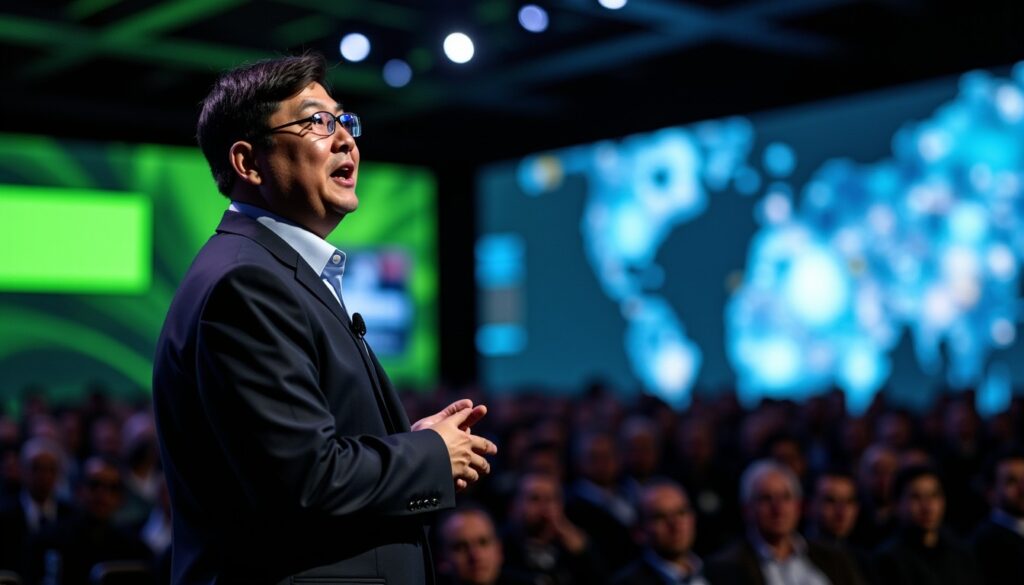
In the rapidly evolving landscape of technology and innovation, Nvidia stands out as a key player, not only because of its historic dominance in GPUs but also through its ambitions to shape the future of artificial intelligence (AI). Jensen Huang, the iconic and visionary leader of Nvidia, recently unveiled a major breakthrough: the launch of the Vera processor, a component specially designed for agentic AI. This innovation marks a strategic shift by allowing the group to explore a market opportunity estimated at 200 billion dollars, a new technological frontier at the heart of the computing industry.
While cloud giants such as Amazon, Google, or Microsoft are developing their own chips to reduce their dependence on Nvidia, the latter responds with an offensive in a previously underexploited market: that of CPU processors dedicated to artificial intelligence. The context is favorable, as the company’s recent quarter posted a record revenue of 81.6 billion dollars, with a projection of about 91 billion for the following quarter, reflecting an exponential demand for computing power.
Jensen Huang’s vision goes far beyond simple hardware. He anticipates that autonomous agents, powered by agentic AI, will form a new global computing layer, comparable to the historic importance of computers that transformed human lifestyles. The Vera processor thus aims to meet the specific needs of these intelligent agents by ensuring ultra-fast data processing and optimized management of autonomous tasks. This strategy aligns with a desire to secure Nvidia’s dominant position in a highly competitive sector, where mastery of technological infrastructures becomes crucial.
- 1 Jensen Huang’s innovation with the Vera processor revolutionizes the AI processor market
- 2 Jensen Huang anticipates the explosion of a $200 billion AI market
- 3 Nvidia’s strategic response to the rising power of AI chips from cloud giants
- 4 Technical and strategic challenges for Nvidia in the development of Vera
- 5 Impact of Vera on industrial transformation and economic prospects
- 6 Adoption strategies and expectations for SMEs in the agentic AI revolution
- 7 Future prospects: Nvidia, undisputed leader in a booming AI market
Jensen Huang’s innovation with the Vera processor revolutionizes the AI processor market
In a realm traditionally dominated by GPUs, Nvidia introduces a major innovation with the Vera processor, specifically designed for agentic AI. This type of intelligence diverges from classic learning and reasoning processes to integrate greater decision-making autonomy through agents capable of executing complex tasks without supervision.
The traditional model relies on GPUs to train and run large AI models. However, Jensen Huang believes that in this new horizon, CPUs will play a central role, particularly for fast task execution, resource management, and orchestration of autonomous functions. Vera is thus designed to meet this demand, optimizing the ultra-fast processing of “AI tokens,” the fundamental unit of information in interactions with agents.
This innovation reflects an adaptation of hardware architectures to the specific requirements of tomorrow’s AI applications. Classic cloud architectures are not always suited to this specialized processing; Nvidia therefore offers hardware that promotes smooth and efficient operation of autonomous agents, anticipating the needs of computing capable of simultaneously managing billions of interactive and reactive operations.
One key element of this innovation is the increased collaboration between Nvidia and major cloud providers as well as system manufacturers. This cooperation ensures coherent and gradual integration of Vera into critical infrastructures, securing Nvidia a leading position in the technological value chain. Nvidia’s lead in software development, notably through its CUDA ecosystem, reinforces this position.
The commercial enthusiasm is palpable: despite a recent market entry, Vera processor sales already amount to 20 billion dollars this year. This performance testifies to the strong potential and growing interest in this unprecedented segment, which could usher in a new era for processors dedicated to agentic artificial intelligence.
Technological perspectives and infrastructure adaptation
The Vera technology marks a significant evolution in computing system architecture. Rather than being confined to a typical cloud infrastructure optimized for a wide range of applications, Nvidia bets on specialization in the processing of information flows specific to intelligent agents. This specialization reduces latency, increases responsiveness, and improves energy efficiency.
For example, in autonomous robotics or intelligent driving scenarios, AI agents need to react in real time, performing thousands of complex operations in parallel. With Vera, these operations benefit from unprecedented fluidity and calculation speed, paving the way for sophisticated applications in health, logistics, and security sectors.
These advances are not only technical but also strategic: they enable Nvidia to position itself as an essential supplier for technology players eager to integrate these advanced functionalities into their products and services. The ability to efficiently process “AI tokens” thus becomes a decisive asset in the global competition of the technology industry.
Jensen Huang anticipates the explosion of a $200 billion AI market
The announcement made by Jensen Huang regarding the Vera processor opens a new growth driver widely estimated at 200 billion dollars. This estimate is notably based on the massive adoption potential of autonomous agents and the gradual spread of agentic AI across various industrial sectors.
According to the Nvidia CEO, this new market category represents an expansion of AI’s traditional role, now accessible through hardware and software solutions adapted to demanding and varied uses. The anticipated growth includes several segments:
- Automated industrial applications, such as advanced robotics and intelligent production lines
- Autonomous driving, which requires ultra-high-performance real-time processing
- Security and surveillance systems integrating agents capable of automatic detection and intervention
- Healthcare applications, notably for assisted diagnosis and autonomous management of medical devices
- Cloud and edge computing services where AI agents autonomously manage technological resources
This broad diversification offers Nvidia an unprecedented opportunity, sustainably impacting the economics of computing power and encouraging companies to revisit their technological strategies to integrate these innovations.
It should be noted that this transition also benefits from a favorable macroeconomic context. The continuous increase in AI technology investments translates into strengthened global infrastructures, particularly in developed countries, thus fostering rapid adoption of Vera processors and associated solutions.
Direct impact on the global digital ecosystem
Nvidia’s positioning in this market also influences the entire computing ecosystem. The rise of autonomous intelligent agents forces stakeholders to rethink economic models and design infrastructures capable of accommodating this new workload.
Technology industries must integrate computing power that is adapted both hardware-wise and software-wise. Thanks to its strategy, Nvidia imposes itself not only as a supplier of GPUs and CPUs but also as a key partner in the large-scale development of agentic AI. The company thus stays ahead of the competition and creates a lasting advantage by capturing a significant share of the value generated.
Nvidia’s strategic response to the rising power of AI chips from cloud giants
In a sector where competition is intensifying, Jensen Huang’s decision to develop the Vera processor comes as a direct response to the offensive by hyperscalers such as Amazon, Google, and Microsoft. These companies are investing massively to design their own AI processors to reduce their technological dependency on Nvidia.
Amazon Web Services (AWS) recently formalized a partnership with Meta for the in-house production of millions of AI chips. AWS CEO Andy Jassy even stated that these processors now technically rival those offered by Nvidia for both GPUs and CPUs.
This dynamic creates a context where Nvidia’s traditional clients become both partners and potential competitors. Nvidia must thus not only innovate but also differentiate itself to maintain its industry leadership and preserve its ability to generate massive sales, particularly in computing power adapted to artificial intelligence.
This intensified competition thus emphasizes the capacity for continuous adaptation and innovation. The diversification into the AI CPU market with Vera represents a crucial advance for Nvidia, a way to counter the emergence of alternative technologies and retain a strategic advantage.
Economic and competitive stakes
This technological battle is also part of a historic rivalry among processor manufacturers. Historically, Intel and AMD have dominated the CPU market. By launching Vera, Nvidia challenges this status quo and hopes to establish itself as a key supplier in this category.
To achieve this, the company will need to convince industrial players to adopt its hardware solutions and revise their technological architectures. This complex process requires not only high-performance products but also a software ecosystem and a network of strong partnerships capable of ensuring smooth and efficient integration.
Nvidia’s success in this segment could mark the beginning of a lasting change in the market share distribution among computing giants, with major implications for the entire industry.
Technical and strategic challenges for Nvidia in the development of Vera
Despite promising progress, Nvidia’s entry into the AI CPU market comes with challenges. Developing a processor capable of meeting the specific demands of agentic AI requires sharp technological mastery and constant innovation. Managing power consumption, processing latency, and compatibility with existing infrastructures are all obstacles to overcome.
A major challenge also lies in the need to adopt new standards that will promote interoperability between multiple AI systems and platforms. Nvidia strives to develop a software ecosystem around Vera, including powerful development tools and adapted documentation, to facilitate enterprise adoption and accelerate production deployment.
Another essential dimension relates to commercial trajectory. Gradual penetration of the CPU market gained by Intel and AMD requires time and significant effort. Nvidia thus relies on its reputation and experience in GPUs to reduce the adoption curve, while offering significant added value through performance dedicated to agentic AI.
Finally, Nvidia maintains strengthened collaborations with industrial partners and cloud providers to test its processors in real conditions, gather feedback, and quickly adjust its solutions. This agile approach is crucial in a sector as dynamic as computing power and artificial intelligence.
Impact of Vera on industrial transformation and economic prospects
The introduction of the Vera processor paves the way for a profound transformation of industrial sectors. Agentic artificial intelligence, powered by dedicated computing power, promises to accelerate robotization, improve logistics, and energize all production lines through autonomous agents capable of interacting intelligently with their environment.
This dynamic has considerable economic repercussions. By becoming a key player in this segment, Nvidia benefits from spectacular growth in AI hardware orders. The company already forecasts that revenues generated will reach several billion dollars in the coming years, driven by exponential needs for adapted computing infrastructures.
| Industry Segment | Estimated Market Opportunity (billion dollars) | Application Example |
|---|---|---|
| Advanced Robotics | 50 | Automation of complex industrial processes |
| Autonomous Driving | 40 | Intelligent and real-time responsive vehicles |
| Security and Surveillance | 30 | Autonomous alert and intervention systems |
| Cloud & Edge Computing Services | 50 | Autonomous resource management and intelligent hosting |
| Healthcare | 30 | Assisted diagnosis and autonomous medical management |
Industrial transformation relies on a convergence between technological innovation and economic adoption, where Nvidia’s growth benefits from the rise of agentic AI to generate a virtuous circle. This dynamic contributes to greater efficiency, reduced operational costs, and the emergence of new economic models in the technology industry.
Nvidia’s key role in the global AI ecosystem
By developing Vera, Nvidia is not limited to producing a simple hardware component; the company creates an essential bridge between the growing computing power needs and the complexity of autonomous intelligent systems. This strategic position allows it to influence the development of AI technologies worldwide, shaping tomorrow’s standards and practices.
Adoption strategies and expectations for SMEs in the agentic AI revolution
As the AI processor market expands, small and medium-sized enterprises (SMEs) are feeling the effects of this transformation. Jensen Huang emphasizes the importance of supporting these organizations in their integration of AI technologies through adapted offers, allowing them to take advantage of advanced computing power without exorbitant costs.
SMEs thus benefit from unprecedented opportunities to innovate in their respective fields, whether commerce, services, production, or logistics. By integrating intelligent agents equipped with processors like Vera, they can automate processes, personalize user experience, and optimize their operations at lower cost.
This technological democratization is crucial to ensuring broad AI dissemination and fostering increased competitiveness at all levels of industry. Nvidia works closely with local actors and develops compatible platforms, guaranteeing easier access to cutting-edge technologies.
- Modular solutions adapted to SME budgets
- Training and certification on agentic AI tools
- Hybrid cloud offers enabling progressive scaling
- Partnerships with local technology integrators
- Specialized technical support for integrating Vera processors
Faced with the speed of change, these strategies aim to reduce the technological gap and create a conducive environment for small and large companies to coexist and innovate harmoniously, thereby strengthening the global artificial intelligence ecosystem.
Future prospects: Nvidia, undisputed leader in a booming AI market
With its recent announcements and innovations, Jensen Huang paints a future where Nvidia will occupy an even more central place in the global technology industry. The market opportunity of 200 billion dollars linked to Vera and agentic AI is just one aspect of a wider strategy aiming to capture an ever-growing share of the computing power sector.
The California giant thus forecasts cumulative orders reaching 1,000 billion dollars by 2027 thanks to its Blackwell and Rubin processors, confirming the explosive demand for infrastructures dedicated to artificial intelligence. This positioning comes in a context where the AI revolution is seen as the next great global industrial shift, comparable to the advent of computing and then the Internet.
Nvidia does not limit itself to being a component supplier: the company becomes a key architect of the AI revolution, supporting the rise of autonomous agents across all industrial sectors. This breakthrough opens the door to disruptive innovations and a complete redefinition of global computing systems.
Faced with ever more aggressive competitors, Nvidia’s ability to innovate, secure its technological advances, and deploy comprehensive solutions will strengthen its essential position in the industry, while contributing to a future where artificial intelligence becomes ubiquitous and truly transformative.