
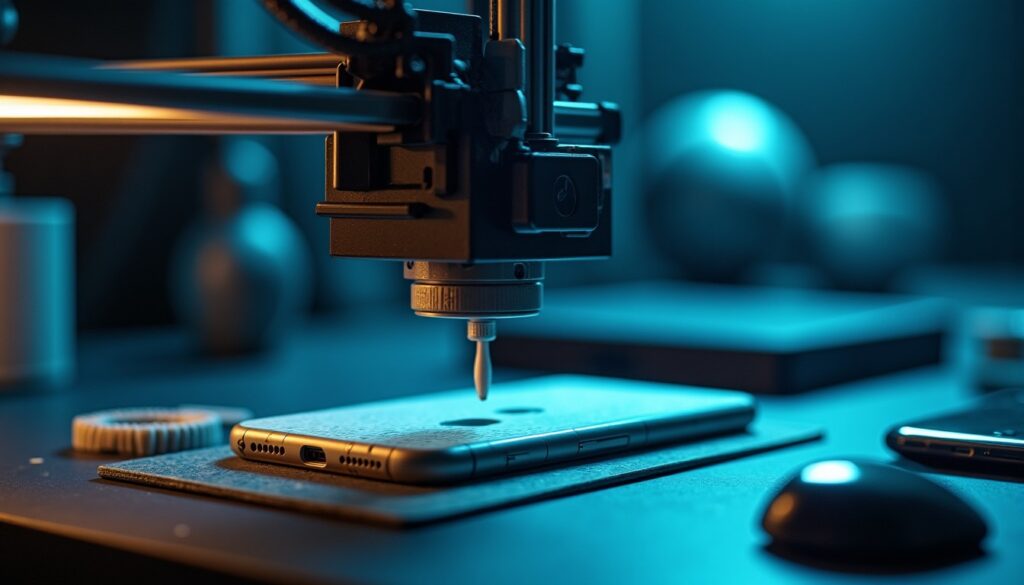
At the dawn of 2026, iPhone manufacturing could undergo an unprecedented metamorphosis thanks to 3D printing. Apple, the iconic Californian firm of innovation, is actively exploring this revolutionary technology to produce its iPhone cases in aluminum. The challenge goes far beyond simple aesthetic or functional improvement; it is a profound transformation of the entire production chain, promising substantial savings and, potentially, more affordable iPhones. The traditional machining method, resource- and time-intensive, is giving way to a layer-by-layer manufacturing process that promises a reduction in metal waste and increased design flexibility.
This new production era also fits into an ecological approach, with the use of recyclable aluminum and resource rationalization. Moreover, 3D printing opens the door to bolder designs, structures more complex and lighter than what was previously possible. While this technology is already tested on some Apple Watch and iPhone Air components, the prospect of a mass-produced 3D-printed iPhone heralds both an industrial and economic revolution, aiming to make Apple smartphones more accessible without sacrificing quality or innovation.
- 1 Apple and 3D Printing: A Strategic Turning Point for the iPhone
- 2 Technological Innovations Behind 3D Printing of Aluminum Cases
- 3 Possible Impacts on iPhone Prices Thanks to 3D Printing
- 4 Adapting the Production Chain to 3D Printing
- 5 Design, Innovation, and Creative Freedom Thanks to 3D Printing
- 6 Current Apple Experiments with 3D Printing
- 7 Challenges and Limits to Overcome for Mass Production
- 8 The Accessibility Revolution Thanks to 3D Printing
Apple and 3D Printing: A Strategic Turning Point for the iPhone
Apple’s desire to integrate 3D printing into the manufacturing of its iPhones marks a major turning point in the technology industry. Traditionally, the production of aluminum cases relies on machining, a process where large blocks are sculpted to obtain the desired shape. This process, although precise, generates significant raw material waste. In 2026, thanks to 3D printing, Apple aims to optimize every gram of aluminum used by producing cases layer by layer from a metal powder.
This approach offers several strategic advantages. Firstly, it significantly reduces metal waste which represents a major cost source as well as an environmental issue. Secondly, 3D printing facilitates design and production flexibility that was previously unthinkable with conventional methods. Concretely, this will allow Apple to produce cases with more complex shapes, incorporating reinforcements and internal openings without adding extra steps to the manufacturing chain.
In this context, Apple is not simply innovating for innovation’s sake but structuring a sustainable method that fits into its overall production improvement strategy. This revolution could, in the long term, disrupt the smartphone market by profoundly changing manufacturing costs and, by extension, selling prices.
Technological Innovations Behind 3D Printing of Aluminum Cases
Metallic 3D printing is a technology that has seen major advances in recent years, especially for the high-tech sector. This method consists of laser-fusing successive layers of metal powder to create precise, robust, and lightweight parts. Apple already uses it for certain titanium components on Apple Watches, but the next step concerns aluminum, the flagship material of iPhones.
The choice of aluminum is crucial both for its mechanical properties and its weight. However, its handling in 3D printing poses technical challenges, notably in terms of density, strength, and surface finish. Apple, thanks to its partnerships with industry specialists and research laboratories, is reportedly now able to overcome these obstacles. Selective laser sintering (SLS) or electron beam melting (EBM) processes could thus be employed, ensuring both solidity and design finesse.
This technology also allows a drastic reduction in material waste compared to traditional machining. By depositing only the necessary material, the process proves extremely economical and ecological. Additionally, 3D printing offers impressive modularity, enabling Apple to partially customize or localize production according to markets, to respond quickly to demand.
The transformation brought about by this innovation can also impact research and development. Rapid prototyping becomes simpler and less costly, opening the way to experiments on unique or limited models. Beyond time and cost savings, the technology expands possibilities in terms of structural and functional design.
Ecological Benefits of 3D Printing in Apple Manufacturing
The environmental issue is at the heart of Apple’s strategic decisions. 3D printing allows the firm to optimize aluminum consumption and incorporate more recycled materials into its products. For example, the recycled titanium used on certain Apple Watches illustrates advances already in place. The shift to 3D printing for aluminum could amplify this effort by reducing the amount of raw material needed and the waste related to machining. This gain aligns with Apple’s commitment to reduce its carbon footprint and move towards a circular economy.
Possible Impacts on iPhone Prices Thanks to 3D Printing
The main expected asset of 3D printing in iPhone manufacturing is the reduction of production costs, which could, in an unusual context for Apple, result in lower prices offered to consumers. The traditional machining process not only generates significant waste but also requires many complex machine configurations and steps, all cost drivers.
With 3D printing, the simplification of the manufacturing chain, optimal use of materials, and faster production could enable volume production with lower unit costs. One can imagine that this opens the door to a new range of low-priced iPhones, or models enriched with features without increasing the final user’s bill.
The recent launch of the MacBook Neo at $599, made possible by a similar aluminum 3D printing technique, illustrates this economic potential. For Apple, this not only represents internal optimization but also an ability to increase the accessibility of its products, a market segment where competition is strong, especially in the mid-range segment.
| Aspect | Traditional Machining Method | 3D Printing | Impact on Price |
|---|---|---|---|
| Material Use | Waste of over 40% | Optimized use, nearly 95% | Cost reduction |
| Design Complexity | Limited by machining | Complex and lightweight design possible | Added value for the consumer |
| Production Time | Longer, several steps | Faster and more flexible production | Better market responsiveness |
| Volume Production | High fixed costs | Possible economies of scale | More attractive prices |
Adapting the Production Chain to 3D Printing
The introduction of 3D printing in iPhone manufacturing relies on a profound overhaul of industrial processes. Until now, assembly lines relied on successive stages of machining, polishing, treatment, and assembly, with dedicated infrastructures for each phase. The additive layer induced by 3D printing removes many of these steps, concentrating manufacturing into a single smooth process.
This simplification does not just mean cost reduction but a spectacular increase in flexibility. Apple could thus more easily diversify the formats and versions of its models, quickly adjusting production through digital files and customized variants. This capability is key to meeting growing consumer expectations regarding customization and continuous innovation.
The adaptation does not stop at the industrial level. Logistics, supply management, and quality control must also evolve. Factories that will host these new technologies will be equipped with specific automated systems to handle metal powder, ensure the quality of printed layers, and prevent any defects. This transition represents a considerable technical and human challenge, but the expected gains in productivity and innovation are colossal.
More Local and Responsive Production
Thanks to the flexibility provided by 3D printing, Apple could consider greater localization of its production sites. Instead of outsourcing manufacturing to a few foreign factories, the brand could set up smaller but highly automated production centers close to major international markets. This strategy would reduce delivery times, transport costs, and overall carbon footprint.
Design, Innovation, and Creative Freedom Thanks to 3D Printing
One of the major advantages of 3D printing is that it opens up near unlimited design possibilities for Apple. Traditional aluminum manufacturing, which depends on mechanical constraints linked to machining, limits shapes and internal structures. In contrast, layer-by-layer printing makes it possible to design sophisticated parts with fine details, hollow or honeycomb internal structures that lighten the smartphone’s weight without compromising robustness.
This technology also offers unprecedented potential for testing exclusive finishes or directly integrating functional elements during manufacturing. For example, Apple could print cases with internal cavities to improve heat dissipation or integrate channels for antennas enhancing connectivity without additional parts.
In the long term, this could also enrich the palette of colors or textures available on cases, surpassing the usual limits of traditional surface treatment. Apple could thus introduce new products with a unique character, enhancing the appeal of iPhones while upgrading their range.
- Creation of shapes previously inaccessible thanks to 3D printing flexibility.
- Significant structural lightening without compromising strength.
- Better thermal and functional integration.
- Increased possibilities for aesthetic and technical customization.
- Reduced development times thanks to rapid prototypes.
Current Apple Experiments with 3D Printing
Apple is not starting from scratch in this industrial venture. Already, 3D-printed titanium components equip some recent Apple Watch models, notably the Ultra 3 and Series 11. These parts benefit from increased robustness while being fully recycled, aligning production with Apple’s stringent environmental standards.
Even more interesting, the titanium USB-C port of the iPhone Air is partially produced by 3D printing. This part is thinner, stronger, and more durable than the previous generation made by traditional machining. These initial successes encourage Apple to consider using 3D printing not only for accessory elements but also for the main case production.
3D-printed aluminum prototypes tested internally have already shown promising results in terms of mechanical performance, visual quality, and cost reduction. The experimentation phase remains active, with strong involvement of design and engineering teams to optimize each step of the process.
Challenges and Limits to Overcome for Mass Production
Despite its obvious advantages, aluminum 3D printing still faces major challenges before becoming the industrial standard for iPhones. First, production speed must be sufficiently high to meet the global demand for millions of devices per year. Today, 3D printing remains slower than machining for certain types of parts, which requires considerable investment in equipment and logistics.
Second, consistent quality on large series is imperative. Apple sets very high standards, especially for case finish and robustness, criteria that the process must systematically guarantee.
Third, material management, particularly aluminum powder, requires strict protocols to ensure operator safety and final quality. This adds technical and regulatory constraints to be mastered before large-scale deployment.
Finally, the initial investment to adapt factories and train teams is colossal. Even if long-term benefits are significant, the transition demands patience and rigor to avoid any supply chain disruption.
The Accessibility Revolution Thanks to 3D Printing
The democratization of 3D printing could profoundly change Apple’s accessibility strategy. By reducing production costs, the brand could offer iPhones at more affordable prices, broadening its audience to previously less targeted market segments. This change would favor a better balance between innovation and low prices, a cocktail that has so far been difficult to achieve for the firm.
The 2026 context is favorable to this evolution. Faced with the rise of competitors offering high-performance smartphones at lower costs, Apple must combine economic rigor and maintenance of a premium image. 3D printing constitutes a disruptive solution, limiting compromises on quality while optimizing margins.
This evolution would also make accessories and customizations more accessible. Indeed, 3D printing would allow on-demand production of specific variants, for example with engravings, colors, or shapes adapted to individual preferences. This flexibility would enhance the user experience while creating new commercial dynamics around iPhones.




