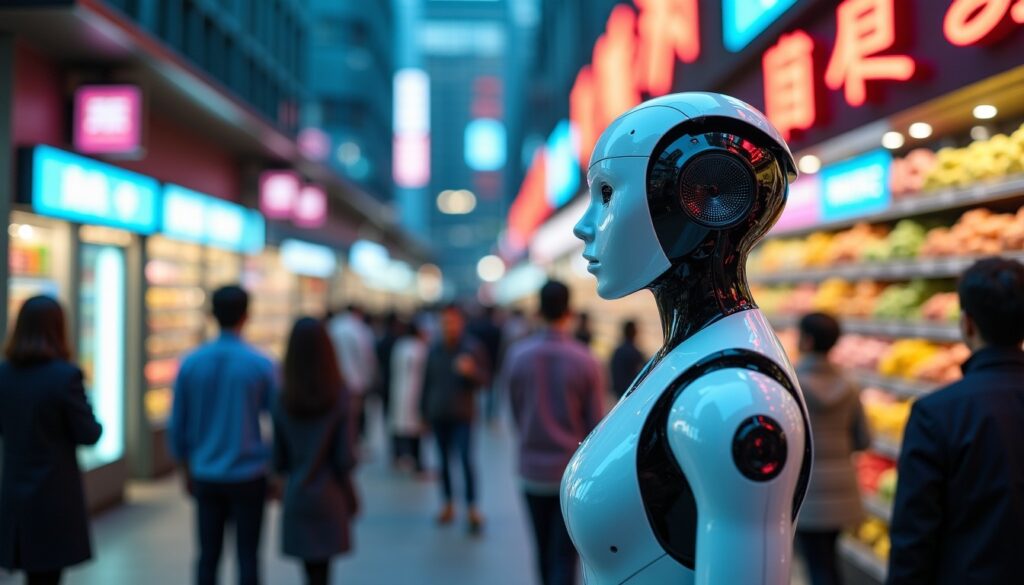
In Hong Kong, a major breakthrough in retail is about to revolutionize the customer experience thanks to a unique concept. On the lively Hung Hom waterfront, an innovative convenience store, entirely managed by a humanoid robot with advanced artificial intelligence, opens its doors 24 hours a day. Named “Xiao Gai,” this extraordinary robot is designed to transform traditional shopping habits by offering continuous, multilingual, and interactive service. This initiative illustrates a growing trend towards intelligent automation of retail outlets, driven by increasingly sophisticated robotic technologies.
The project, supported by Hong Kong’s financial authorities and developed by a Chinese company specialized in embodied AI, represents the first installation of its kind outside the Asian continent. It follows the success of a similar installation in Beijing where the “Galaxy Space Capsule” already attracts a significant daily flow of customers. The challenge is twofold: to invigorate neighborhood commerce while redefining the urban image of the installation areas through a bold technological showcase. This futuristic convenience store combines a compact modular space, shelves adapted to various needs, and a robotic interface that naturally interacts with visitors.
Beyond the technological aspect, this initiative raises fascinating questions about the role of humanoid robots in daily life and how these innovations will help shape the society of tomorrow. As robotics meets artificial intelligence in an innovative commercial context, prospects for the future of retail in Hong Kong and beyond are expanding, balancing promises of efficiency with human and ethical challenges.
- 1 The innovative convenience store of Hung Hom: a model of robotized retail
- 2 Technology and artificial intelligence at the heart of humanoid robotics
- 3 Economic impact and transformation of neighborhood commerce
- 4 Adaptability and modularity: the key to innovation in automated commerce
- 5 Ethical challenges and issues related to robotic automation in commerce
- 6 Future perspectives: towards an intelligent city powered by robotics
- 7 Influence on tourism and consumer profiles in Hong Kong
- 8 Strategies for integrating humanoid robotics into global commerce
The innovative convenience store of Hung Hom: a model of robotized retail
The deployment of “Xiao Gai” in the Hung Hom district marks an important step in integrating advanced robotics into retail. This nine-square-meter convenience store, designed as a modular capsule, uses optimized space to offer a varied selection of products, ranging from snacks to collectibles, and even over-the-counter medicines. The major innovation lies in the fully automated management ensured by a humanoid robot capable not only of assisting customers with their purchases but also of interacting and adapting to their needs in real time.
Thanks to sophisticated artificial intelligence, “Xiao Gai” analyzes consumer behaviors, advises on products, and optimizes stock management. This model promotes a smooth customer experience with no waiting or direct human assistance. Customers can thus benefit from a welcoming, multilingual service suited to Hong Kong’s cosmopolitan environment, where tourists and residents speaking different languages intersect.
Automation also ensures uninterrupted availability, allowing the store to operate 24/7, thus meeting consumer needs at any time. This continuous service represents a major asset for modernizing urban distribution, particularly in a context where demand for speed and accessibility continues to grow.
The success recorded in Beijing with the “Galaxy Space Capsule,” which saw an increase in foot traffic of up to 40%, calls for the generalization of this model in several cities. The company designing this ambitious system plans to install about a hundred similar capsules in ten different metropolises, signaling a desire to spread this innovation internationally.
Technology and artificial intelligence at the heart of humanoid robotics
The success of the robotized convenience store in Hong Kong essentially relies on cutting-edge artificial intelligence integrated into a humanoid robot with a fluid appearance and movements. This robot, named “Xiao Gai,” uses sophisticated sensors and machine learning algorithms to interact with the environment and customers intuitively.
Its ability to engage in natural conversation, understand customer needs, and offer suitable recommendations is based on advanced natural language processing and multilingual voice recognition techniques, essential in a city as cosmopolitan as Hong Kong. This smooth communication fosters a user experience close to that of a human assistant, while benefiting from the consistency and permanent availability provided by the machine.
Beyond interaction, the integrated intelligence enables the robot to manage product replenishment efficiently through predictive sales analysis. This prevents stock shortages while minimizing waste, producing both ecological and economic benefits. Automation of operations also extends to security and maintenance, with a system capable of detecting anomalies and alerting human operators if necessary.
Innovations in humanoid robotics continue to advance, and this type of application in retail is set to multiply. The combination of mechanics, computer vision, and artificial intelligence transforms robots into true collaborators capable of navigating and acting within complex environments, and of interacting with humans beyond simple programmed commands.
Economic impact and transformation of neighborhood commerce
The introduction of a convenience store entirely managed by a humanoid robot in Hong Kong profoundly changes the economic dynamics of neighborhood commerce. This model offers an innovative solution to traditional challenges such as limited opening hours, high labor costs, and complex employee management.
Automation not only reduces personnel-related expenses but also optimizes turnover through permanent availability. This continuous presence, combined with personalized robot service, fosters a significant increase in customer traffic, as demonstrated by the feedback from the robotized capsule in Beijing.
Moreover, the robotized convenience store generates a more efficient supply chain. The robot’s ability to monitor stocks in real time and anticipate needs facilitates product replenishment, reducing costs related to excess inventory and waste. In a dense urban context like Hong Kong, this optimization contributes to better management of space and goods flow.
This revolutionary model also paves the way for a cultural redefinition of neighborhood commerce. The humanoid robot enhances the attractiveness of neighborhoods by creating innovative, high-tech contact points that appeal to a young and tech-savvy audience. For merchants, it is also an opportunity to modernize their image and attract a new clientele seeking novel experiences.
| Advantages of the humanoid robot in convenience stores | Impact on commerce |
|---|---|
| 24/7 service | Increase in customer traffic |
| Effective multilingual communication | Attraction of an international clientele |
| Predictive stock management | Reduction of waste and logistical optimization |
| Natural and personalized interaction | Improvement of the customer experience |
Adaptability and modularity: the key to innovation in automated commerce
The chosen format for the “Xiao Gai” convenience store is based on a compact nine-square-meter capsule, designed for maximum modularity. This spatial choice meets the need to adapt commercial space to urban constraints and fluctuating consumption dynamics.
Modularity notably translates into the ability to quickly rearrange shelves to accommodate different product types according to seasonal or event-driven demand. For example, during tourist periods, the capsule can prioritize souvenirs and snacks, while in times of high local attendance, it will offer more essential products.
This flexibility is made possible by integrating an intelligent system capable of continuously monitoring customer preferences and adapting the selection accordingly. The humanoid robot controls the entire capsule, ensuring a consistent and smooth experience.
Furthermore, the modular installation facilitates the placement of these capsules in various neighborhoods, even in small or atypical spaces, thus reinforcing the densification of points of sale. This model pushes the digitalization of retail to a new level, combining agility and technological innovation to create an optimized and attractive shopping environment.
While the appearance of humanoid robots in retail brings undeniable advantages, it also raises complex ethical, social, and economic questions. Growing automation notably threatens certain traditional jobs and transforms human relationships in the commercial context.
Beyond concerns related to job losses, the impacts on service quality and neighborhood social dynamics must be considered. Direct human contact is replaced by robotic interaction, which can lead to a form of isolation or dehumanization of exchanges. It is therefore essential to approach these innovations with prior reflection on their harmonious integration into society.
Issues of confidentiality and data security collected by these intelligent systems also deserve particular attention. These robots gather valuable information about buying behaviors, which must be protected to guarantee consumer privacy.
Finally, the ethics of humanoid robot design itself, notably the degree of humanization and the limits to set on their autonomy, are the subject of intense debate in scientific and technological circles. To ensure a responsible future for these innovations, an appropriate regulatory framework must accompany their development and deployment.
Future perspectives: towards an intelligent city powered by robotics
Hong Kong exemplifies a pioneering integration of humanoid robotics into daily urban spaces, beyond commerce itself. The deployment of automated convenience stores could fit within a broader vision of smart cities where technology facilitates residents’ lives.
In this hyperconnected future, humanoid robots could interact with other intelligent urban systems to optimize energy management, mobility, or even public safety. Robotized retail capsules would then be just one link in an urban ecosystem driven by artificial intelligence.
Moreover, the democratization of these technologies is expected to expand, reaching not only city centers but also peripheral zones, contributing to reducing inequalities in access to services. Innovation in retail thus connects to major societal challenges, with the ambition of better quality of life for all.
Several initiatives for cooperation between public actors, private companies, and researchers today aim to accelerate the deployment of robotics in cities. Hong Kong positions itself as a testing laboratory where the successes and limits of robotized convenience stores will define major trends for the coming years.
Influence on tourism and consumer profiles in Hong Kong
Hong Kong, as a major tourist destination in Asia, especially benefits from multilingual robotic solutions like “Xiao Gai.” This humanoid robot is able to welcome and assist an international clientele, thus reducing linguistic and cultural barriers that can hinder the shopping experience of foreign visitors.
The robot adapts to the specific needs of each customer group, offering personalized recommendations and guiding tourists in discovering local products and collectibles. This capability significantly improves visitor satisfaction and loyalty.
At the same time, the visible presence of advanced technologies in commerce strengthens Hong Kong’s image as a modern metropolis oriented towards the future. For retail, this represents a lever to diversify the clientele and capture new segments, mainly tech-savvy consumers curious about innovations.
This dynamic also brings changes in residents’ shopping habits, who progressively integrate the use of robots into their daily lives, modifying expectations regarding services offered in neighborhood stores.
Strategies for integrating humanoid robotics into global commerce
The success of the Hong Kong model opens the way to strategies for integrating humanoid robotics internationally. Technology and commercial companies are today considering several axes to maximize impact and ensure customer acceptance.
Firstly, adaptation to cultural and regional specificities is crucial. For example, in some cities, the social aspect of commerce requires maintaining some human interaction, necessitating a harmonious robot-human coexistence. Hybrid solutions can thus be developed to combine technological efficiency and human warmth.
Secondly, transparent communication about the benefits and limitations of robots is indispensable to build consumer trust, thus avoiding fears related to job disappearance or excessive surveillance.
Finally, close collaboration between regulators, developers, and merchants is essential to define a legal and ethical framework, guaranteeing security, confidentiality, and respect for users’ rights. Feedback such as that from Hong Kong feeds these reflections and facilitates the development of global standards.
- Cultural adaptation of robots
- Maintaining complementary human interaction
- Educational and transparent communication
- Ethical and legal regulatory framework
- Continuous monitoring and improvement based on customer feedback