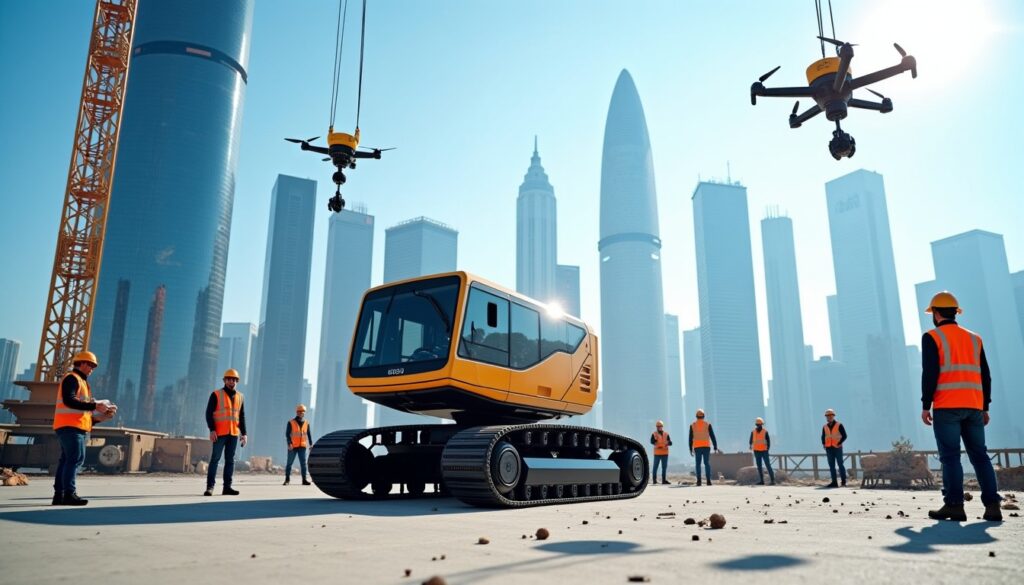
In the construction sector, often seen as traditional and slow to integrate technological innovations, the year 2026 marks a true technological revolution driven by artificial intelligence. Despite a historically limited productivity decline of 1% per year, the sector is now disrupted by tools that multiply efficiency, reduce costs, and improve safety on construction sites. This transformation addresses the major challenges of the construction industry: price volatility of materials, shortage of skilled labor, growing regulatory constraints, and the need to optimize resources.
A notable phenomenon is the rise of process automation in management, which results in a transformation of working methods, schedules adjustable in real time, but also predictive maintenance and real-time monitoring of various operations. Specifically, data analysis collected through robotics, computer vision, and IoT sensors provides a better understanding of deadlines and avoids costly delays.
Professionals in the sector have an increasing interest in these innovations, as evidenced by a 15-point increase in one year in the intention to adopt artificial intelligence, driven by affordable integrated SaaS solutions. At the same time, digital transformation now involves all actors, from independent craftsmen to large construction companies, who include these technologies in their daily tools.
- 1 Optimize automatic quote generation with artificial intelligence
- 2 Intelligent delay prediction: anticipating hazards for better planning
- 3 Automation and real-time site scheduling optimization
- 4 Automatic site photo analysis: precise and effortless monitoring
- 5 Client chatbots: automating customer relations to never miss an opportunity
- 6 Detection of safety anomalies on site: AI as operator guardian
- 7 Choosing the right AI software for integrated and efficient site management
- 8 Training construction professionals in AI for a successful transition
Optimize automatic quote generation with artificial intelligence
Quote management traditionally represents a long and tedious phase in the cycle of each construction site. In 2026, artificial intelligence revolutionizes this step by enabling automatic quote generation based on the analysis of historical data and project characteristics. This technology often relies on predictive models fed by databases containing hundreds of similar projects in terms of surface, location, and typology.
The process is greatly simplified: a craftsman or project manager can verbally dictate the parameters of the site, and the algorithm produces a well-organized and detailed quote in less than an hour, compared to several hours previously. For example, Trustup Pro, a widely used software, can reduce the quote preparation time by three.
Beyond the initial time gain, this automation also improves the conversion rate of quotes into contracts. By automating follow-ups via emails, SMS, and personalized calls, the chances of closing an offer increase by 15 to 30%. This method reduces oversights and missed opportunities caused by a lack of responsiveness.
Access costs to these solutions remain affordable, often between €150 and €250 per month for a self-employed professional, with a rapid return on investment, often within three or four months. This opens access to AI for all entrepreneur profiles in construction, even those without advanced technical skills.
This automation does not dehumanize client contact; on the contrary, it makes it more qualitative by offering a responsive interface and offers adapted in real time. Beyond the simple creation of quotes, these tools also provide commercial tracking and dynamic management of opportunities.
Intelligent delay prediction: anticipating hazards for better planning
One of the major challenges in site management is avoiding delays, which lead to substantial additional costs and loss of client trust. Thanks to artificial intelligence, it is now possible to anticipate these hazards with unprecedented accuracy by cross-referencing different data sources: weather conditions, availability of human and material resources, incident histories, and real-time progress.
Sophisticated algorithms analyze this information and identify risk factors before they manifest concretely, often up to three weeks in advance. This anticipation is a strategic asset for site managers who can thus adjust schedules, contact alternative suppliers, or redistribute resources.
Recent studies, notably by McKinsey in partnership with Orisha, show that this approach reduces costs related to errors, reworks, and delays by 15 to 25%. AI does not replace the human factor in decision-making management but proposes enlightened alternative scenarios, guiding the site manager to optimize choices.
This predictive capacity is supported by interactive dashboards that synthesize this information, facilitating reactive and preventive management. Thus, the site can adapt smoothly to very variable constraints, strengthening efficiency without compromising quality.
Ultimately, this proactive management of risks generates better planning across all projects, limits contractual penalties, and improves the company’s reputation. It illustrates the decisive contribution of artificial intelligence in contemporary construction site management.
Automation and real-time site scheduling optimization
In a universe where task coordination is complex, manual schedule management has become obsolete. Artificial intelligence imposes itself as an indispensable co-pilot to develop and adjust optimized schedules, integrating team constraints, task durations, and their interdependencies.
Concretely, a site manager enters the different activities, their estimated duration, as well as dependencies: who must intervene before whom, which resources are mobilized, which tasks can run in parallel. The AI then generates a Gantt-type schedule identifying the critical path and automatically proposes alternatives accounting for unforeseen events.
The recalculation dynamic allows adjusting the schedule in real time in case of delay or incident, optimizing resource allocation and avoiding downtime or unnecessary staff mobilization. 57% of professionals in the sector consider cost control a top priority, and this type of responsiveness offers them increased mastery.
This approach transforms the role of the site manager, who becomes a data pilot. Every morning, they can brief their teams with precise priorities based on reliable indicators, which increases productivity and reduces waste.
Schedule optimization thanks to AI also opens the door to better multi-company coordination on complex sites, placing technology at the heart of effective and smooth collaboration.
Automatic site photo analysis: precise and effortless monitoring
Collecting information on site progress is often time-consuming and error-prone. Artificial intelligence, coupled with robotics and computer vision, now allows automatic analysis of photos taken by drones or fixed cameras continuously.
These images are analyzed to precisely quantify the volume of work completed, by comparing the current state to planned BIM models. Platforms like OpenSpace or Buildots exploit this data to provide precise monitoring without manual intervention, generating usable daily reports.
Object recognition on these photos also ensures rigorous tracking of stored equipment and materials. Losses and thefts, traditionally estimated at 5-10% of the budget, are thus better controlled, contributing to more efficient and economical resource management.
This continuous monitoring allows site managers to anticipate needs, quickly detect discrepancies, and adjust operations accordingly, thus ensuring better quality monitoring and reducing the risk of human errors.
Finally, these vision technologies contribute to sustainable site management by limiting excessive material consumption and favoring predictive maintenance of infrastructure and machinery used, thereby integrating an eco-responsible dimension into the sector.
Client chatbots: automating customer relations to never miss an opportunity
The construction sector faces a frequent issue: overwhelmed craftsmen miss contracts due to lack of time to respond effectively to inquiries. The arrival of intelligent client chatbots transforms this reality.
These conversational agents based on artificial intelligence instantly respond to customer calls or messages, identify their needs, qualify the project, and send a first proposal, even outside usual hours, including weekends.
This customer relation automation guarantees unparalleled responsiveness without the craftsman needing to interrupt their work on site. Follow-up sequences are also automated, with personalized content sent to prospects to maintain their interest, thereby doubling the conversion rate of shared quotes.
This technology facilitates portfolio management, decreases the number of missed opportunities, and increases company visibility in a market as competitive as construction. Above all, it frees craftsmen from administrative constraints so they can fully focus on their profession.
A winning strategy, the chatbot becomes a modern contact interface that easily integrates into management platforms like Trustup Pro, contributing to overall successful digitalization.
Detection of safety anomalies on site: AI as operator guardian
Site safety remains an absolute priority, and with the integration of advanced technologies, AI plays a crucial preventive role. Cameras equipped with artificial intelligence analyze in real time the wearing of personal protective equipment (PPE) such as helmets, harnesses, or high-visibility vests.
As soon as non-compliance is detected, an alert is immediately sent to the safety manager. These systems also identify risky behaviors or dangerous zones, for example the proximity of moving machinery, allowing workers to be warned via connected devices (watches, badges).
Collected data show a nearly 20% reduction in accidents on sites equipped with these real-time monitoring solutions. Rather than replacing human vigilance, AI is a permanent assistant that helps maintain a safe environment while also reducing costs related to incidents.
This technology highlights the complementarity between human expertise and automation, ensuring a safer site and reinforced legal compliance in a sector mindful of its standards.
Choosing the right AI software for integrated and efficient site management
In 2026, the market offers several types of solutions integrating artificial intelligence, designed to simplify site management and maximize productivity gains. Three major categories dominate:
- All-in-one SaaS platforms: they offer native integration of numerous features, from quote generation to on-site safety, with easy handling.
- Specialized AI agents: dedicated to a specific function (scheduling, quotes, safety), these tools are often more specialized but sometimes require additional configuration.
- AI modules integrated into ERP or BIM software: these options suit already equipped companies but require careful adaptation to avoid double data entry.
| Criterion | All-in-one platform | Specialized AI agent | AI module on ERP |
|---|---|---|---|
| Monthly cost (SME) | €150-300 | €99-250 | Variable (ERP license) |
| Ease of adoption | High | Medium | Low |
| Interoperability | Native | To configure | Depends on the publisher |
To avoid losing the benefits of automation and reduce double entries, it is recommended to favor an integrated platform compatible with existing tools such as accounting software or Excel. Trustup Pro perfectly illustrates this approach, with an intuitive interface and a user journey designed for craftsmen and SMEs, requiring only four hours of training to become operational.
Training construction professionals in AI for a successful transition
The adoption of artificial intelligence in construction trades also relies on facilitated skills development through accessible training. Indeed, no prior IT knowledge is required: interfaces use natural language and simple gestures.
Short courses from a few hours up to two days are generally sufficient for immediate impact, notably on use cases such as report writing or schedule management. The French Building Federation (FFB) notably offers dedicated podcasts and masterclasses, demonstrating the sector’s commitment to this transformation.
For companies, investing in training is strategic as it maximizes the performance of digital tools and facilitates acceptance of changes within teams. This evolution contributes to modernizing the entire sector, strengthening competitiveness and meeting sustainable development expectations.
In short, artificial intelligence does not just automate; it supports the profession in a profound mutation of its practices and perspectives.
Will artificial intelligence replace craftsmen?
No. AI mainly automates repetitive and administrative tasks, such as quote generation or follow-up. It improves daily work without replacing essential technical know-how on site.
What budget should be planned to integrate AI into a construction SME?
The initial investment is moderate, with SaaS solutions ranging from €150 to €250 per month. Return on investment often occurs within 3 to 4 months thanks to time savings and efficiency.
How to quickly train in the use of AI in site management?
No technical skills are required. Short trainings, from a few hours to two days, suffice. Free resources such as FFB podcasts are also available.
What concrete benefits will chatbots bring in customer relations?
Chatbots provide immediate, qualifying, and continuous responses to clients. They double the conversion rate of quotes into contracts and free craftsmen from calls in a busy context.