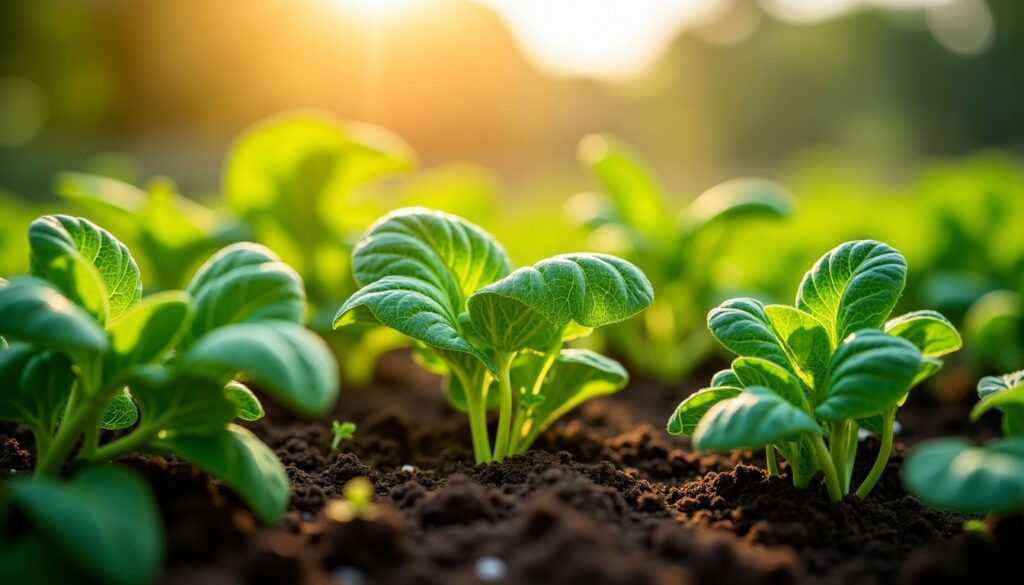
At the heart of spring, many amateur gardeners anticipate a long wait between planting seeds and the first harvest. Yet, some sowings made in mid-April surprise with their astonishingly rapid growth, offering vegetables ready to be picked in less than 30 days. This phenomenon is not due to chance, but rather a natural alchemy where plant biology, the spring climate, and careful choices come together to transform a small garden plot into an almost immediate source of freshness and flavor. While one might think that spring demands patience and slowness, these selected varieties reveal their full promise of short-term productivity, thus revolutionizing the expectations of gardening enthusiasts eager to quickly enjoy their harvest.
This plant revolution also offers a unique opportunity in 2026, where agronomic research and field experiments have refined cultivation methods to make the most of this strategic sowing window. Exploring these mid-April sowings and understanding their growth mechanisms opens the way to a more dynamic gardening experience, accessible even to beginners. Let us explore in detail the biological specificities of these express crops, the reasons behind the choice of this planting period, as well as the essential tips to guarantee a generous and quick harvest.
- 1 The biological secrets of fast-growing mid-April sowings
- 2 Why mid-April is the ideal period for a quick harvest in the vegetable garden
- 3 The 4 champion vegetables for mid-April sowing for a quick harvest in less than 30 days
- 4 Cultivation techniques to maximize rapid growth of mid-April sowings
- 5 Good practices and tips for a productive vegetable garden from mid-April
The biological secrets of fast-growing mid-April sowings
The speed with which certain plants can develop from a sowing remains fascinating, especially when considering the variable conditions of spring. Biological adaptation plays a key role in this precocity. Indeed, some vegetable species, often originating from regions where the favorable growth period is short, have naturally developed the ability to complete their life cycle very quickly. This characteristic allows them to maximize the production of edible leaves, roots, or seeds before the climate becomes less hospitable.
In spring, and more particularly in mid-April, several environmental factors converge to stimulate this rapid growth. Soil temperature, which often reaches an ideal range between 10 and 15 °C, activates the enzymes responsible for germination and promotes root growth. At the same time, the increase in daily sunlight duration often exceeds twelve hours across almost all of France, triggering intense photosynthetic activity. This photoperiod, crucial, acts as a hormonal signal for plants such as radish, spinach, arugula, and cut lettuce. These plants respond by accelerating both germination and the development of their leaves.
This biological reaction explains why sowings made at the same time but with different species produce such contrasting results. The external temperature combined with the duration of sunlight thus constitutes a powerful leverage for those wishing to grow vegetables in less than 30 days. To illustrate this reality, take the example of an amateur gardener who hesitated to sow early, convinced that it would take him well over a month to see the first results. In fact, thanks to this natural calendar, he harvested his very first radishes in just three weeks, a result that relieves the frustration often associated with traditional gardening.
The importance of humidity levels and soil quality must not be neglected either. Soil still moist in spring helps maintain a stable environment around the seeds and promotes uniform germination. In this context, mid-April sowings benefit from a rare balance where nature provides all the ingredients for rapid and effective growth. This biological knowledge now guides gardeners who wish to optimize their time and space by prioritizing these vegetables capable of thriving even before the summer heat.
Why mid-April is the ideal period for a quick harvest in the vegetable garden
The choice of timing for sowing is a crucial step for any gardening enthusiast aiming for a quick harvest. Mid-April represents a pivotal period when climatic conditions stabilize in most temperate French regions, offering a favorable environment without the major risks of late frost. In 2026, this window is all the more appreciated as it combines several essential factors for successful rapid planting.
Firstly, nighttime temperatures generally exceed 5 °C, below which germination slows or stops completely. The warmer the nights, the more efficiently plant enzymes activate and the stronger the young shoots become. Secondly, the soil begins to reach ideal temperatures for most short-cycle vegetables, promoting rapid root growth essential before the seedlings start leafing out.
Although the winter period has given way to milder temperatures, frost is not entirely ruled out in mid-April. This is where caution is necessary, especially in the cooler areas of the country. However, thanks to the use of forcing covers, urban agriculture and amateur gardening can now secure their sowings and advance the planting date without major fear of damaging young plants. These covers create a mild and protected microclimate, further stimulating growth while reducing vulnerability to bad weather.
Furthermore, sunlight is particularly optimal at this time: long enough to stimulate photosynthesis, but still gentle enough not to burn the sensitive leaves of young plants. This subtle thermal and light balance makes mid-April a dreamed moment to plant fast-growing vegetable seeds. Ultimately, this natural lighting contributes to the health and quality of the harvests, aspects that prevail in sustainable and productive gardening.
In addition to these climatic advantages, mid-April also marks a wooded stage in the calendar of experienced gardeners. It is at this time that plantings can be planned in succession, allowing harvests to be staggered over the weeks and avoiding low periods of production in the vegetable garden. A relevant choice that promotes a regular and continuous supply of fresh vegetables, thereby strengthening food self-sufficiency at home.
The 4 champion vegetables for mid-April sowing for a quick harvest in less than 30 days
Among the multitude of vegetables that can be grown, four species stand out particularly for their rapid cultivation qualities when sown in mid-April. These vegetables combine rapid germination, early growth, and a harvest often appreciated in cooking. They thus represent a wise choice for those who want to see their efforts rewarded in less than a month.
Radish, the undisputed star of express harvests
The radish, emblem of the fast vegetable garden, can be sown directly in open ground and harvested in only 20 to 25 days. Its varieties like Flamboyant 5 or Cherry Belle are particularly renowned for their precocity and their tender, crunchy roots. Its ease of cultivation even encourages beginner gardeners to try mid-April sowing.
Arugula, for vitamin-rich leaves in record time
Easy to grow, arugula develops its first edible leaves in 25 to 28 days, offering a spicy taste ideal for spring salads. Between cultivated varieties and wild arugula, it is especially successive sowings that ensure a continuous supply, while benefiting from rapid growth and a strong response to the increasing photoperiod.
Cut lettuce, freshness leaf by leaf
Harvested leaf by leaf, cut lettuce reaches maturity in 28 to 30 days. Varieties such as Lollo Rossa or Blonde oak leaf are particularly suitable, combining beautiful coloring with a tender and crunchy texture. This form of cultivation favors a prolonged and progressive harvest, much appreciated in small spaces and urban gardens.
Spinach, the softness of young shoots
Finally, spinach, with its tender young leaves, can be harvested as early as 25 days after sowing. The variety Monstrueux de Viroflay stands out as a preferred choice thanks to its rapid development and mild taste that pairs easily with many culinary preparations. Its dynamic growth in mid-April makes it a must-have in the express vegetable garden.
| Vegetable | Germination time | Harvest time |
|---|---|---|
| Radish | 3 to 5 days | 20 to 25 days |
| Arugula | 4 to 6 days | 25 to 28 days |
| Cut lettuce | 5 to 7 days | 28 to 30 days |
| Spinach | 5 to 8 days | 25 to 30 days |
These time frames result from observations made in standard contexts and may vary slightly depending on sun exposure, soil quality, or local weather conditions. Nevertheless, all these vegetables combined confirm that harvesting in less than 30 days is not a myth but indeed a reality accessible to every gardener.
Cultivation techniques to maximize rapid growth of mid-April sowings
Achieving a quick harvest does not depend solely on the choice of vegetables and sowing date. Appropriate cultural practices are essential to optimize the growth of young plants and prevent any delay. The success of an express crop begins with careful soil preparation, essential to provide the roots with a conducive and nutrient-rich environment.
First step: loosen the soil by removing stones and compacted clumps to facilitate accelerated root development. The incorporation of mature compost, applied on the surface only, will provide essential nutrients without risking burning the seeds or altering germination. A pH between 6.5 and 7 is ideal for the four identified vegetables, ensuring them an excellent nutrient uptake.
Maintaining constant moisture during the first days is crucial. Indeed, germination requires moist but never waterlogged soil. Fine watering, in the morning and evening, especially when the weather is dry, will help avoid water stress that can delay development. Light mulching is a simple yet effective strategy to retain this moisture, thus limiting excessive watering and protecting young shoots from superficial heat shocks caused by the spring sun.
Another common mistake to avoid: sowing too densely. When young plants compete for water, light, and nutrients, their growth slows down, and the risk of disease increases. Early thinning, as soon as the first true leaves appear, gives each plant the necessary space for harmonious development. This also optimizes the quality of the harvest and reduces losses.
To go even further and ensure the sustainability of the harvest, some gardeners opt for several sowings staggered every two weeks. This technique ensures regular production and avoids a massive influx of vegetables all at once, better suited to daily needs. Furthermore, using a forcing cover from sowing creates a microclimate that accelerates germination by 2 to 4 days and protects plants from climatic risks still present during this sometimes capricious mid-April.
Moreover, choosing fast varieties will notably influence the performance of your spring vegetable garden. For example, favoring the Flamboyant 5 variety for radish or Lollo Rossa for lettuce can make the difference between a brilliant success and slower growth. These technical subtleties are the result of experiences accumulated by passionate gardeners who, in 2026, now have resources and advice adapted to these challenges.
Good practices and tips for a productive vegetable garden from mid-April
Putting all the odds on your side for a quick harvest does not stop at planting. Careful and regular management of the vegetable garden completes the picture, turning simple cultivation into a festive and gourmet success.
- Stagger sowings: The first rule is not to build the harvest all at once. By sowing small amounts every two weeks, a spread-out production is ensured, avoiding unsold or wasted surpluses.
- Use a protective cover: This tool plays a major role in mid-April when temperatures can fluctuate. It accelerates germination and protects sowings from the risks of night frost or cold showers.
- Choose early varieties: Don’t settle for classic varieties but look for those selected for their rapid growth.
- Prepare the soil well: Loosening the soil, improving pH, and enriching with compost are key steps.
- Water regularly: Maintaining moisture without excess avoids uneven germination or water stress.
- Thin out seedlings: Don’t hesitate to remove overly close plants to allow healthy growth.
- Monitor plant health: Act quickly in case of diseases or pest attacks.
These simple-to-implement tips rely on observation and respect for the natural needs of plants. They make growing a high-performing vegetable garden accessible, even for those with little time or space.
Combining these practices around sowings made in mid-April ensures that radishes, arugula, cut lettuce, and spinach harvests are not only fast but also abundant and flavorful. Thus, hurried or curious gardeners can now fully enjoy their vegetable garden in less than 30 days, with renewed pleasure at each new shoot.