
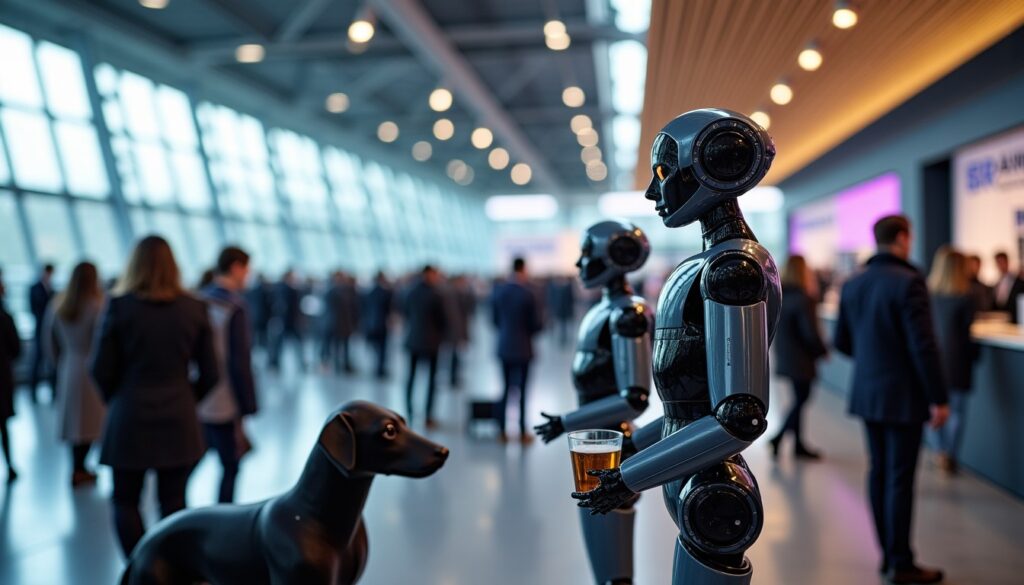
The Mobile World Congress (MWC) 2026, usually a bastion of the latest innovations in mobile telephony, has seen this year a true technological eruption focused on robotics. While foldable smartphones tried to capture attention, another category of machines fascinated visitors: humanoid robots with fluid movements, robotic dogs capable of impressive acrobatics, and robotic butlers specialized in serving beer captivated many. These robots are no longer just futuristic concepts or science-fiction fantasies, but concrete technologies gaining ground, heralding a profound transformation in the way humans interact with machines. Barriers between the physical and digital worlds are gradually fading, thanks to the integration of advanced artificial intelligence and sophisticated mechanical systems, showing that robotics is now an essential component of the global technological landscape.
The Barcelona exhibition showcased an impressive variety of devices, blending mechanical prowess and unprecedented interactive capabilities. The humanoids, capable of walking, dancing, and sometimes even engaging in basic conversation, demonstrate a rapid evolution of robotic actuators and control systems. Meanwhile, robotic dogs established themselves as major players, combining agility, robustness, and autonomy in demonstrations reminiscent of the most advanced laboratories. Finally, robotic butlers — those efficient mechanical arms capable of handling glasses and serving beer with precision — embody a trend where robotics is directly serving the consumer in everyday environments.
- 1 Agibot X2: a compact humanoid redefining human-machine interaction at MWC 2026
- 2 MagicBot Z1: the art of robotic choreography at MWC 2026
- 3 Agile and autonomous robotic dogs: the spectacular evolution of quadrupeds at MWC 2026
- 4 Robotic butlers and beer servers: robotics at the service of conviviality
- 5 Omni Hand: the prowess of the ultra-precise robotic hand at MWC 2026
- 6 TCL Tbot: the interactive robotic companion for the digital daily life
- 7 A robotic revolution underway redefining technology at MWC 2026
Agibot X2: a compact humanoid redefining human-machine interaction at MWC 2026
At the heart of the MWC aisles, a small humanoid caught visitors’ attention: the Agibot X2. Measuring about half the size of a human being, this robot represents a major advance in designing robotic machines capable of evolving in human environments. Compact yet expressive, the Agibot X2 stands out for its agility and ability to interact in a simple yet effective way with the people around it.
This robot boasts exceptional mobility at this size. It can perform dance movements, a performance that is not just an aesthetic demonstration, but a way to prove the fluidity and coordination of its joints. This ability relies on miniaturized motors and advanced learning software, enabling the Agibot X2 to adapt and respond in real time to external stimuli.
Its price is around 27,000 dollars, a cost that illustrates its positioning between an advanced prototype and a research tool. The goal is therefore not yet mass commercial distribution for the general public, but rather to demonstrate the potential of humanoids in scenarios as varied as scientific research, cultural mediation, or even professional assistance. This machine reflects a technological evolution where the human-machine interface is no longer limited to touchscreens, but becomes physical and spatial, paving the way for a future harmonious coexistence.
The capabilities of the Agibot X2 fit into a dynamic where humanoid robots are designed to walk not only like humans but also to interpret their environment, avoid obstacles, and interact in a non-intrusive way. This type of robot could, within a decade, facilitate household tasks, accompany elderly people, or intervene in offices, thereby demonstrating real potential for social integration.
MagicBot Z1: the art of robotic choreography at MWC 2026
Among the humanoids that attracted crowds, the MagicBot Z1, developed by Maoiclab, symbolizes excellence in the mastery of robotic movements. This robot stands out due to an impressive number of joints — nearly 50 — bio-inspired, offering a range and flexibility rarely seen in humanoid-shaped machines.
The demonstrations of the MagicBot Z1 often gave the impression of attending a robotic dance show, where every gesture is orchestrated with remarkable precision. This level of articulation not only allows complex choreographies to be executed but also opens the way to more practical uses, where movement fluidity will be essential, such as delivery, personal service, or even medical or social interventions.
Reproducing human movements remains a major challenge in robotics, particularly regarding balance management and simultaneous coordination of multiple segments. Indeed, harmoniously deploying 50 joints requires a sophisticated control system incorporating deep learning algorithms and precise sensors. Thanks to these advances, the MagicBot Z1 illustrates how humanoids can evolve beyond mere imitation, surpassing mechanical limits through adaptive intelligence.
These innovations also benefit the research sector, as these platforms serve as testbeds for new locomotion and motion recognition algorithms. For example, the ability to adapt body dynamics depending on unstable terrain opens exciting prospects for assistive robotics or emergency rescue in difficult environments.
Agile and autonomous robotic dogs: the spectacular evolution of quadrupeds at MWC 2026
MWC 2026 was not only the stage for advances among humanoids. Robotic dogs, descendants of the first industrial quadrupeds, also made a splash, notably due to the performance of the model presented by Agibot. This machine impresses with its ability to move with remarkable speed and stability, even chaining acrobatics like backflips, a symbolic feat illustrating the technological level reached in this sector.
These four-legged robots stand out for their robustness on rough terrain, rapid response, and action autonomy. They have managed to carve out an important role in highly varied fields: industrial inspection of complex sites, automated surveillance, exploration of dangerous zones, and assistance in disaster scenarios where human risk would be too high.
Their design combines advanced mechatronics, artificial intelligence for autonomous navigation, and sophisticated sensors to detect any obstacle or anomaly. Quadruped robots become indispensable allies for predictive maintenance in data centers, often hostile environments where every failure must be anticipated to avoid widespread outage. Thanks to optimized energy use, these robotic dogs can patrol for very long periods with formidable efficiency.
Their influence is not limited to the industrial field. Applications are emerging in logistics, with robots capable of carrying loads or following humans in carrying tasks. This versatility combined with extraordinary agility promises to disrupt both industry and daily life in the coming years.
Comparison table of robotic quadrupeds presented at MWC 2026
| Model | Weight | Autonomy (hours) | Main functions | Estimated price |
|---|---|---|---|---|
| Agibot Quadruped | 30 kg | 8 | Patrol, inspection, acrobatics | $300,000 |
| CyberPaw Explorer | 25 kg | 6 | Exploration, gas detection, assistance | $280,000 |
| RoverKin Scout | 28 kg | 7 | Logistics, carrying, security | $310,000 |
Robotic butlers and beer servers: robotics at the service of conviviality
In a more playful and convivial register, MWC 2026 unveiled robotic butlers capable of serving drinks with astonishing precision and speed. These robotic arms belong to the growing category of “cobots” or collaborative robots, designed to work safely alongside humans.
Their performance at the show, consisting of handling glasses, pouring beer, and presenting it without any awkwardness, demonstrates notable progress in fine manipulation and gesture calibration. This capability is a real technical challenge, as it requires precise control of force, applied pressure, and a keen sense of coordination.
These robots are intended to revolutionize reception in bars, restaurants, and even fast-food chains, where speed of service combined with quality of gesture is essential. In the longer term, they can help address staff shortages and ensure a smooth and innovative customer experience. The integration of artificial intelligence also allows them to learn and adapt their behavior based on customer preferences, making each interaction personalized.
This innovation also raises questions about social interaction and the balance to be found between automation and human contact. Yet, it perfectly illustrates the direction taken by robotics in the service sector, where technology can enhance conviviality without degrading it.
Omni Hand: the prowess of the ultra-precise robotic hand at MWC 2026
Alongside complete robots, a major technical discovery was presented in the form of an ultra-precise robotic hand called Omni Hand. Unlike conventional devices, this hand focuses exclusively on dexterity, exploiting a multitude of miniaturized sensors and motors to faithfully reproduce the complexity of human gesture.
Fine manipulation is undoubtedly one of the major challenges of current robotics. While many robots can move or perform simple tasks, few are capable of delicately grasping fragile objects, handling tools with agility, or performing gestures requiring great precision. Omni Hand provides a convincing answer to this challenge.
Its architecture integrates tactile and pressure sensors that adjust the force exerted in real time. This technology opens the way to applications in sectors as varied as assisted surgery, precision manufacturing, or aid for people with disabilities. By enabling robots to adopt a “human hand,” Omni Hand develops the very notion of robotic interaction as an extension of human capabilities.
List of potential applications of the ultra-precise robotic hand
- Robotic surgery for minimally invasive interventions
- Assembly and manufacturing of delicate parts
- Assistance for elderly or disabled individuals
- Handling delicate objects in laboratories or industry
- Development of robotic prostheses for better mobility
TCL Tbot: the interactive robotic companion for the digital daily life
In a more domestic realm, TCL unveiled its Tbot, an interactive companion robot designed to be placed on a desk and assist daily life. Equipped with a screen to display expressions and communicate visually, it positions itself as a bridge between a voice assistant and a personal companion.
The Tbot is capable of holding a simple conversation, reminding important tasks, offering posture advice, and helping with time management. This type of device illustrates a new phase in digital assistant technology, which tends to materialize in a tangible physical object, fostering a richer and more human interaction.
This solution primarily targets users wishing to optimize their personal organization while enjoying pleasant digital companionship. It fits into a growing market of companion robots capable of softening routine, boosting productivity, or simply providing social connection, especially in contexts of isolation or teleworking.
A robotic revolution underway redefining technology at MWC 2026
All the robotic innovations presented at the Mobile World Congress 2026 clearly show that robotics has become a central element of emerging technologies and an indispensable driver of innovation. From the smallest humanoid to the acrobatic quadrupeds, each machine embodies a further step towards deeper robotic integration in our daily lives.
The technical challenges that seemed insurmountable a few years ago are now being solved, notably thanks to artificial intelligence, which plays a key role in improving perception, autonomy, and adaptability of robots. The marriage of advanced mechanics with intelligent control algorithms opens unprecedented prospects where robots are no longer mere tools, but partners capable of coexisting with humans.
This movement, underway worldwide, is redefining modes of production, services, and even social interactions. The humanoids, robotic dogs, and beer-serving butlers presented in Barcelona are only the vanguards of a new era where technology and humanity build the future together.




