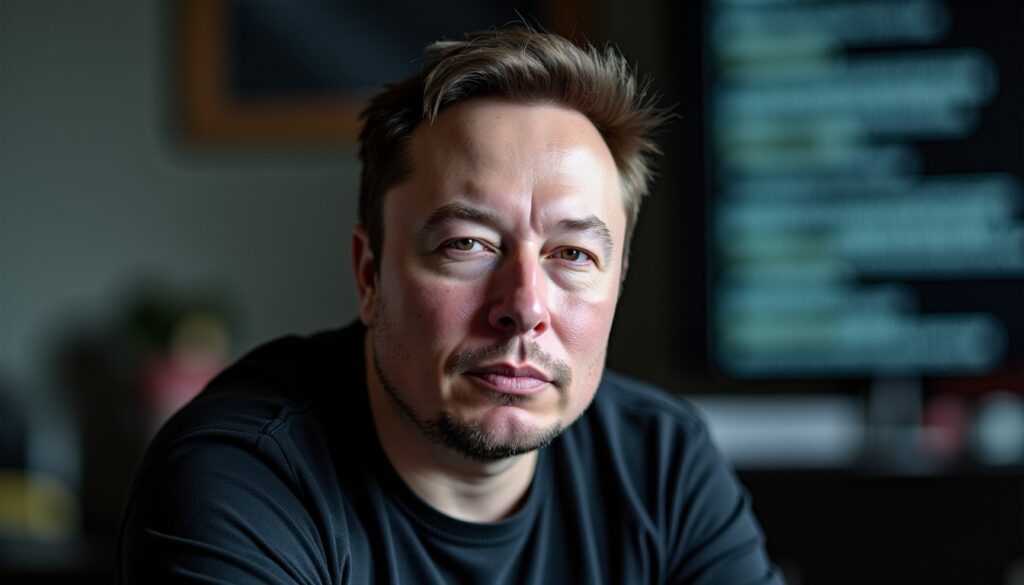
In a context where the race to artificial intelligence is reaching new heights, Elon Musk once again establishes himself as one of the most daring visionaries. With his Grok 5 project, the founder of xAI aims not only to mark a major milestone in the development of giant AI but also to meet the specific needs of a rapidly evolving sector: that of developers. At a time when AI tools are already invading programming environments, Grok 5 promises a spectacular advance, with a massive architecture counting more than one and a half trillion parameters, an order of magnitude well beyond current standards.
The positioning of Grok 5 is clear: to address software engineers by offering an assistant that goes beyond simple code generation. Relying on a large collection of data, notably from Cursor, a very popular programming assistant among developers, xAI aims to provide an artificial intelligence capable not only of understanding but also of optimizing, correcting, and reasoning on complex projects. This level of integration could well redefine the way developers work, influencing the entire software production chain.
This project comes at a pivotal time when competitors like OpenAI unveil their own next-generation AI models, notably GPT-5. With Grok 5, Elon Musk does not hide his intention to play a dominant role in this space, visibly ready to allocate considerable resources, notably through xAI’s Colossus supercomputer, optimized for NVIDIA Blackwell GPUs. This infrastructure aims to make the operation of such a gigantic AI financially viable while maximizing its efficiency.
- 1 A revolutionary architecture: Grok 5 and its 1.5 trillion parameters innovate in giant artificial intelligence
- 2 Grok 5: a software engineering assistant designed to transform developers’ daily work
- 3 Elon Musk’s strategy with Grok 5: accelerating the convergence between artificial intelligence and programming
- 4 The technological and economic challenges behind the development of Grok 5
- 5 The global race for artificial intelligence: how Grok 5 disrupts the giant AI market
- 6 Future prospects: Grok 5 and the promise of artificial general intelligence (AGI)
- 7 Key questions around Grok 5 and its impact on technology and developers
A revolutionary architecture: Grok 5 and its 1.5 trillion parameters innovate in giant artificial intelligence
The evolution of artificial intelligence architectures is undoubtedly one of the major drivers of technological advances. With Grok 5, Elon Musk introduces a model of an almost unprecedented scale, presented as a revolution compared to previous versions. The confirmation of the completed training of the Grok V9-Medium model relies on a very massive structure of 1.5 trillion parameters. This numerical inflation is much more than a mere record: it represents a new frontier in processing capacity and analysis finesse that AI can offer.
A figure of such a gigantic scale involves huge technical and logistical challenges. First, the amount of memory and computing power required to train such a model is colossal. This is where the Colossus supercomputer comes into play, specifically designed by xAI to process these data volumes with exceptional efficiency. The infrastructure also takes advantage of the latest hardware innovations, notably NVIDIA Blackwell GPUs, optimized to reduce energy costs and accelerate inferences, which is crucial for deployment in production.
This system capable of ingesting and continuously analyzing a vast set of information paves the way for richer and more complex interactions with users. Unlike traditional models that sometimes struggle to contextualize complex issues, Grok 5 aims to master advanced reasoning, pushing machine learning integration toward more generalized intelligence. The raw power thus gives artificial intelligence the ability to understand subtle relationships, optimize software solutions, or even integrate extremely specialized knowledge, a considerable asset for developers seeking efficiency and precision.
The importance of parameters in machine learning and artificial intelligence
In neural networks, each parameter represents an adjustable variable used to model the relationships in the training data. When we talk about a model with more than one trillion parameters, it means that artificial intelligence can learn an incredible volume of nuances in the processed information. This parametric richness not only allows better understanding of contexts but also the learning of deeper abstractions, essential for complex tasks such as advanced programming.
Concretely, this means that Grok 5 can potentially provide much more elaborate code suggestions, accurately detect specific bugs, and even propose logical fixes that take into account the overall software architecture. Such a level of understanding is not accessible to classic AIs and opens many prospects for innovation in software development.
However, this evolution also requires rigorous regulation and calibration mechanisms. At this stage, xAI is carrying out fine supervised tuning followed by a reinforcement learning phase. These steps are essential to refine model performance, improve its robustness against errors, and enable it to adapt to real use cases encountered by developers.
The technical innovations supporting the rise of Grok 5
Designing an AI model of this magnitude is not limited to accumulating parameters. Several technical innovations have been integrated to ensure its performance and sustainability:
- Blackwell GPU optimization: This type of GPU allows better memory management and a significant reduction in energy costs related to inference.
- MoE (Mixture of Experts) architecture: Although the precise architecture details have not been revealed, xAI explores trends like MoE, which allow efficient use of a large number of parameters by mobilizing only the necessary “experts” for each task.
- Colossus supercomputer: It offers very high computing power, essential for massive machine learning training and real-time inference phases.
- Cursor data: Massive integration of code examples and interactions from developers, enhancing Grok 5’s specialization in programming.
This cocktail of innovations illustrates Elon Musk and xAI’s desire to go far beyond a simple quantitative expansion of the model to offer fundamentally innovative technology, designed for the demands of a new generation of developers.
Grok 5: a software engineering assistant designed to transform developers’ daily work
The choice to orient Grok 5 towards specialization in programming is no coincidence. The developer community is among the most concerned by artificial intelligence tools, and their needs are specific. The success of tools like Cursor revealed a strong demand for an assistant capable of improving productivity, detecting and correcting errors, or supporting the creation of complex software.
Grok 5 aims to go far beyond simple snippet generation. Its training on Cursor data provides it with a deep understanding of languages, frameworks, but also best practices in development. This orientation allows exploiting machine learning capabilities to:
- Understand existing code: analyze entire projects to provide context-relevant suggestions.
- Automated bug correction: precise identification and proposal of logical fixes tailored to the exact need.
- Complex logical reasoning: solve problems related to software architecture, performance, and security.
- Continuous learning: model refined through reinforcement learning from real interactions with developers.
These features help to significantly reduce time spent on repetitive and tedious tasks while increasing the quality of produced software. The major innovation rests on Grok 5’s ability to evolve in real-time with its environment, opening possibilities still little explored in the field of artificial intelligence dedicated to programming.
Concrete impact on developers’ workflows
Many developers have already testified to the benefits brought by AI assistants in their daily practice. Grok 5 promises to amplify these advantages by offering more natural interaction, better suited to real-world conditions:
- Reduction of human errors: thanks to immediate and contextualized suggestions, potential bugs are spotted even before reaching the testing phase.
- Acceleration of code review processes: Grok 5 could automatically detect anomalies, inconsistencies, or possible improvements.
- Improved collaboration: AI becomes a teammate capable of understanding design decisions and proposing relevant technical compromises.
- Facilitation of learning: junior developers benefit from a digital mentor guiding their choices and progression.
These changes could radically transform software engineering, making teams more agile and projects safer.
Elon Musk’s strategy with Grok 5: accelerating the convergence between artificial intelligence and programming
Elon Musk is recognized for his ability to anticipate major technological trends, and Grok 5 embodies this vision. With xAI, the startup created specifically to pilot this project, Musk intends not only to have a competitive advantage in the artificial intelligence market but also to drive a profound change in the way humans interact with technology.
The race for giant AI is no longer a competition between simple algorithms; it now fits into a dynamic linked to infrastructure, energy efficiency, and real use cases. The example of Grok 5 illustrates this dual ambition:
- Powerful and adapted technology: developing an AI model that excels in a specific function, targeting directly the needs of developers.
- Mastered infrastructure: relying on Colossus and Blackwell GPUs to guarantee consistent performance and controlled costs.
- Human-centered approach: integrating data and feedback continuously to refine the model and make it ever more relevant.
This strategy shows a willingness not only to react to competitors’ innovations but to position itself as a leader capable of shaping the future of artificial intelligence applied to programming. The challenge is even greater as the rise of giant models raises major ethical, economic, and operational questions, which xAI wishes to address pragmatically.
The technological and economic challenges behind the development of Grok 5
Beyond the technical feat, developing such a gigantic AI raises important issues. The computing required to train a model with 1.5 trillion parameters is astronomical, and the operating cost during inference phase can become prohibitive if no optimization is implemented.
It is in this context that adaptation to NVIDIA Blackwell GPUs takes on its full meaning. These graphics cards represent a considerable advance in terms of energy efficiency and performance. Their ability to perform massively parallel calculations at high speed while reducing consumption offers a response to xAI’s demands.
Moreover, the data needed for training must be of quality and sufficiently diversified. The integration of Cursor data illustrates this approach. For an AI to become an efficient assistant, it is essential that it trains on real examples, representative of the challenges users face.
On the economic side, the bet is also risky. Investing colossal sums in training and maintenance can tip a project if the return on investment is not up to the mark. This requires xAI and Elon Musk to have very rigorous cost management but also an ability to monetize Grok 5 effectively, notably via subscriptions or licenses specifically aimed at technology companies and developers.
A summary table of technological and economic challenges
| Challenge | Description | Proposed solution |
|---|---|---|
| Computing capacity | Training and running a model with 1.5 trillion parameters requires extreme power. | Colossus supercomputer, optimized Blackwell GPUs. |
| Energy cost | Operating these models generates very high expenses and a significant energy footprint. | GPU optimization, reduction of inference costs. |
| Data quality | Need for representative and rich data to efficiently train the model. | Massive integration of Cursor data from real developers. |
| Monetization | Uncertain short-term return on investment. | Business offers targeted at developers and tech companies. |
This framework highlights the risks taken and the requirements xAI must meet for Grok 5 to become a commercial and technological success.
The global race for artificial intelligence: how Grok 5 disrupts the giant AI market
In 2026, the world of artificial intelligence is a highly competitive field. OpenAI, Google DeepMind, Anthropic, and other major players offer their own giant models. Since the launch of GPT-5, comparisons between these systems have intensified, making each announcement a strategic event.
The imminent presentation of Grok 5 changes the game by positioning itself not only on the parameter size but especially on the direct and concrete application to a target community: developers. This differentiated approach induces a new dynamic in the market:
- Competition by specialization: unlike generalist AIs, Grok 5 targets a precise sector, increasing effectiveness.
- Focus on human-machine collaboration: the assistant becomes an active partner in software development.
- Infrastructure optimization: cost and consumption reduction is key for sustainability.
This trend also highlights a shift toward so-called “niche” AIs, perfectly adapted to specialized professional environments. The added value in daily work is a strong argument compared to the often too diffuse versatility of preexisting large models.
Comparison between Grok 5, GPT-5, and Claude Opus 4.6
| Characteristic | Grok 5 (xAI) | GPT-5 (OpenAI) | Claude Opus 4.6 (Anthropic) |
|---|---|---|---|
| Number of parameters | 1.5 trillion | 1 trillion | 800 billion |
| Specialization | Software development and programming | Versatile generalist AI | Conversational & secure AI |
| Infrastructure | Colossus + NVIDIA Blackwell GPU | Azure supercomputing | Google Cloud Platform |
| Energy optimization | Yes, advanced | Intermediate | Yes, advanced |
| Public release date | Within 2-3 weeks (2026) | Already released | End of 2025 |
Future prospects: Grok 5 and the promise of artificial general intelligence (AGI)
Among the most striking statements, Elon Musk asserts that Grok 5 has “a real chance of reaching artificial general intelligence (AGI).” This ambition places the project not only in an incremental innovation logic but also in a long-term quest to surpass current machine capabilities.
The concept of AGI refers to an intelligence capable of performing any cognitive task that a human could, with the same flexibility and understanding. If Grok 5 manages to integrate this level of versatility, it would represent a revolution in technology and usages.
However, the path to AGI is fraught with obstacles, notably concerning:
- Generalized understanding: being able to contextualize problems outside specific domains.
- Learning autonomy: developing mechanisms to learn without constant supervision.
- Ethical awareness: integrating safeguards to prevent unforeseen and dangerous behaviors.
The work undertaken on Grok 5, with its constant adjustments by reinforcement learning, could precisely serve as a basis for evolving toward these ambitious goals. The startup xAI highlights in its communications that each development step is also an experiment aimed at building this more universal intelligence.
Key questions around Grok 5 and its impact on technology and developers
The rise of Grok 5 raises fundamental questions for programming professionals and more broadly for the technology industry. These concerns relate to reliability, security, as well as possible consequences on the job market and the way to innovate.
- How does Grok 5 guarantee the quality and security of the produced code? Thanks to supervised and reinforcement learning, Grok 5 is trained to automatically detect and correct potential errors, thus increasing software reliability.
- What are the risks related to increased dependence on AI in software development? Excessive dependence could reduce human skill, but xAI works to promote a balanced collaboration between humans and machines.
- How can Grok 5 accelerate innovation in tech startups? By automating repetitive tasks and proposing optimized solutions, Grok 5 frees up time to focus on creativity and strategy.
- What is the economic model envisaged for Grok 5? xAI directs its offering towards subscriptions and licenses dedicated to companies and developers, ensuring professional and sustainable use.
What does Grok 5 bring compared to previous versions?
Grok 5 marks a major advance with an architecture of 1.5 trillion parameters, a strong specialization in programming and deep integration of Cursor data to better assist developers.
When will Grok 5 be available to developers?
According to Elon Musk, the public release is expected within 2 to 3 weeks, after the current fine-tuning and reinforcement learning phase.
How does Grok 5 differ from other giant AIs like GPT-5?
Grok 5 focuses specifically on programming, with an optimized infrastructure and a larger parameter base, making it particularly suited to developers’ needs.
What is the importance of Cursor data in Grok 5’s training?
This data from real developer interactions allows Grok 5 to understand real uses and concrete coding issues, thus improving its relevance and effectiveness.
Could Grok 5 reach AGI?
Elon Musk believes Grok 5 has a real chance of becoming a general artificial intelligence, capable of surpassing current machine capabilities thanks to its ongoing innovations and reinforcement-based learning.