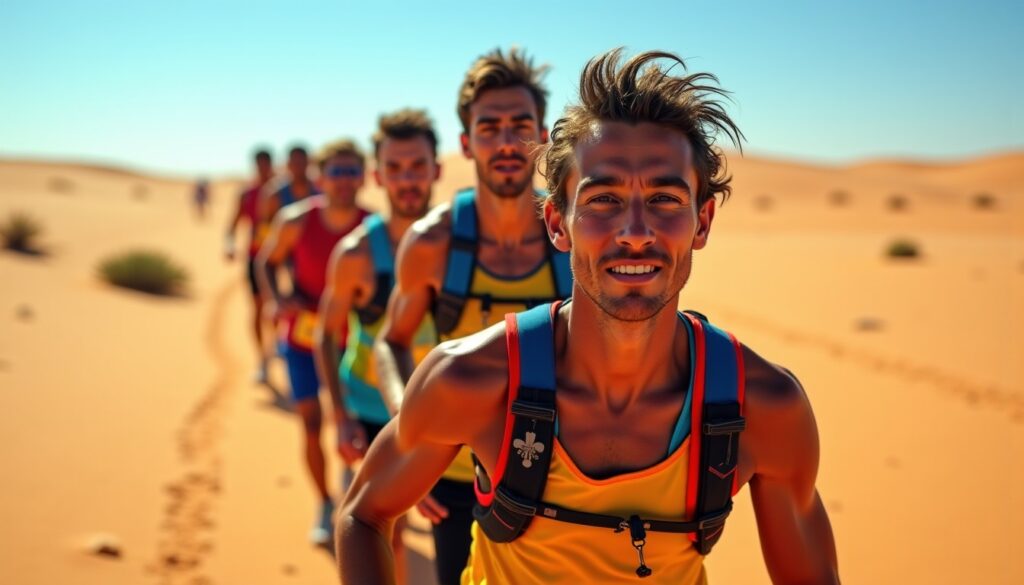
Six days, nearly 250 kilometers to cover across the inhospitable landscapes of the Moroccan Sahara, battered by temperatures often reaching 50 degrees in the sun: the Marathon des Sables is not just a simple race, but embodies a true human and sporting epic. Since its creation in 1986 by Patrick Bauer, this ultratrail event has become the ultimate reference for runners seeking to test their limits in one of the most extreme environments on the planet. However, the classic image of the solitary runner defying the scorching heat is evolving significantly. Today in 2026, the Marathon des Sables is undergoing a transformation. This metamorphosis revolves around three major axes that outline a new era for the event: diversity and inclusion, which constitute the social and human richness of the race; decarbonization, essential to address ecological challenges; and innovation, which shapes the sustainability as well as the global influence of this ultratrail icon.
In the context of a globalized society where ecology, social justice, and accessibility are gaining increasing importance, the Marathon des Sables is reinventing itself without denying its DNA. This mythical race thus becomes a captivating case study, showing how an extreme sporting event can combine performance, social engagement, and sustainability. What perspective should be taken on this evolution? How are diversity and inclusion concretely expressed on the ground, facing decarbonization which is imposed as an imperative? What economic models and international strategies support this ambition? The following sections dissect this profound mutation, illustrating the path taken and the prospects ahead.
- 1 The historical foundations of the Marathon des Sables: from solitary audacity to a global sporting myth
- 2 Diversification of formats: extending the horizons of ultratrail while respecting the original spirit of the Marathon des Sables
- 3 Diversity and inclusion as human and social pillars of the Marathon des Sables
- 4 An ambitious decarbonization for controlled ecological impact
- 5 International influence and strategic innovations to sustain the image of the Marathon des Sables
The historical foundations of the Marathon des Sables: from solitary audacity to a global sporting myth
At the origin of the Marathon des Sables lies the personal feat of the Frenchman Patrick Bauer. In 1984, after having crossed alone more than 350 kilometers of the Algerian desert, he forged the vision of an extreme race where participants would be autonomous, carrying their own supplies. The first edition in 1986 gathered only 23 adventurers from three nationalities, mostly from a small circle of explorers and ultratrail enthusiasts passionate about impossible challenges. This intimacy gave the race a pioneering, almost confidential dimension, embodying as much physical surpassing as communion with a harsh, wild, and isolated environment.
But success quickly grew. In two decades, the Marathon des Sables went from a marginal event to an unmissable rendezvous in the international ultratrail scene. The table below presents an explicit overview of this exponential growth:
| Year | Number of participants | Nationalities represented |
|---|---|---|
| 1986 | 23 | 3 |
| 2000 | 600 | 30 |
| 2010 | 900 | 60 |
| 2024 | 1,100 | 100+ |
This growth reflects several factors. First, rigorous communication and management, preserving the authenticity and the brutal aspect of the challenge without yielding to commercial pressure. Then, an ability to meet the changing expectations of runners who today seek not only performance but also a unique experience rich in emotion and meaning. Finally, constant attention to welcoming an ever-growing diversity of participants, which will be discussed more precisely.
As the event approached its 40th anniversary, it had to adapt to competition from other ultratrails that were less extreme but just as glamorous or media-driven. This adaptation notably involves a wise diversification of the offer.
Diversification of formats: extending the horizons of ultratrail while respecting the original spirit of the Marathon des Sables
Faced with ever fiercer international competition, the Marathon des Sables had the intelligence to broaden its proposal. Beyond the flagship 250-kilometer race, new formats have been created, aiming to include a wider range of profiles without diluting the nature of the event.
Short and preparatory courses for novices
One of the major barriers to public participation was the extreme difficulty and near-military format of the original race. To attract less experienced athletes or simply those wishing to taste the adventure, shorter distances have been put in place. These short formats, sometimes around 50 to 80 kilometers, offer immersion in the desert with simplified logistics and enhanced support. This fosters ecological awareness of the fragility of the environment while preparing for future, more ambitious challenges.
Global expansion with relocated editions
For several years, licenses have been granted to partners on different continents, notably in Asia and America, who organize races inspired by the original concept but adapted to local specificities. This strategy allows for influence beyond the Sahara, reaching new sporting and tourist markets without competing with the main event. It offers a ground for experiences and innovations in terms of hospitality, digitalization, and eco-responsibility.
Creation of satellite events and immersion training camps
To enhance participants’ experience, the Marathon des Sables also offers a range of preparation camps, on-site workshops, and associated events allowing runners to familiarize themselves with extreme conditions, resource management, and environmental preservation. These initiatives encourage the transmission of best practices around sustainable sport.
An innovative digital experience
To meet the demand of runners’ relatives and fans, an immersive digital platform has been launched, offering live tracking, interviews, and educational content on Saharan biodiversity. This strengthens the emotional bond and creates a supportive and engaged international community.
The restructuring of the economic ecosystem naturally accompanies this strategic turn:
- Multiplication of revenue sources through partnerships with committed premium brands.
- Development of exclusive audiovisual content distributed to a global audience.
- Licensing offers for derivative events with strict oversight to protect the image.
These adjustments ensure the financial sustainability of the Marathon while enhancing its social and ecological attractiveness. The development of these formats further increases diversity and inclusion within the event.
Beyond mere sporting commitment, one of the major transformations of the Marathon lies in its inclusive dimension. Long dominated by young male athletes, the race has made remarkable progress to open its doors to a more varied audience.
Remarkable growth in female and senior participation
In 2026, nearly 20% of the runners are women, a figure reflecting a strong societal evolution within the discipline. Awareness, support, and coaching initiatives have been established to encourage this diversity, combating persistent stereotypes around endurance and the extreme. Moreover, the rise in senior participants, often well beyond 60 and sometimes over 70 years old, demonstrates the intergenerational richness of the race. These athletes bring another approach, blending experience, wisdom, and determination, challenging preconceived ideas about physical limits.
Inclusion of people with disabilities: a human and organizational challenge
In recent editions, the participation of amputee runners, visually impaired, or those suffering from chronic conditions illustrates the organization’s deep social commitment. Accompanied by dedicated volunteer guides and supported by adapted medical protocols, these athletes bring a powerful human dimension. Their presence transforms the competition into a collective adventure, where perseverance and solidarity prevail.
To facilitate this inclusion:
- Rules have been adjusted to allow adapted courses.
- Specialized medical teams are permanently present.
- Communication promotes the diversity of profiles, rooting a model of sustainable and responsible sport.
These social commitments breathe new life into desert ultratrail, symbolizing a horizon where everyone can find their place regardless of physical limits or gender.
An ambitious decarbonization for controlled ecological impact
Sustainability has become a central issue for any global sporting event. For a race held in a fragile environment like the Sahara, environmental impact cannot be ignored. The organization of the Marathon des Sables faces a significant carbon footprint linked to numerous international travels, land transport, and logistics necessary for the survival of runners in these extreme conditions.
Aware of criticism from recent years, the management has committed to a proactive decarbonization approach:
Reducing waste and protecting Saharan ecosystems
Bottlenecks of plastic bottles, a major source of pollution, have been drastically reduced thanks to the introduction of reusable bottles, refill points, and a “zero plastic” policy on the course and in bivouacs. This initiative has allowed a reduction of plastic waste by more than 70% compared to previous editions.
Carbon offsets and optimized logistics
The organization has established partnerships with certified bodies to offset unavoidable emissions by financing local reforestation projects and renewable energy. At the same time, efforts have been made to limit the number of support vehicles and encourage logistical consolidation, thus reducing unnecessary journeys and fuel waste.
Education and participant engagement
Awareness plays a central role. Before, during, and after the race, runners are informed about the ecological fragility of the Sahara. Clean-up actions are organized with local volunteers, creating a shared dynamic of responsibility.
These measures, although still perfectible, are a source of inspiration for other sporting events seeking a more virtuous model.
International influence and strategic innovations to sustain the image of the Marathon des Sables
The Marathon des Sables is today a highly reputed sporting brand built on more than thirty-five years of authenticity and human adventures. This identity, closely linked to the emblematic landscapes of the Sahara and the poignant stories of participants, is leveraged to deploy an ambitious international influence.
Export strategy and global franchises
Official licenses now allow the organization of Marathon des Sables races in several regions of the world, such as Asia, the Middle East, and North America. This reasoned expansion always favors strict respect for original values: authenticity, effort, respect for the natural environment. It also generates revenue that funds the main race and its social and ecological projects.
Development of a global digital community platform
The implementation of a social network dedicated to the Marathon offers its members a space to share testimonials, training advice, and initiatives related to sustainability. This digital link strengthens social engagement and the sense of belonging, offering all, participants or spectators, an interactive and enriching experience.
Technological innovations for safety and the environment
To guarantee safety in the desert, advanced GPS devices and drones are used to monitor runners and intervene quickly if necessary, minimizing the need for heavy and intrusive human resources. Moreover, the use of eco-friendly technologies in bivouac management and communication reinforces the overall sustainable sport strategy.
The vitality of the Marathon des Sables therefore rests on a balance between tradition and modernity, between social inclusion and ecological responsibility, between performance and innovation. These solid pillars promise a future where the emblematic Saharan ultratrail will continue to fascinate and set an example for the world of sustainable sport.