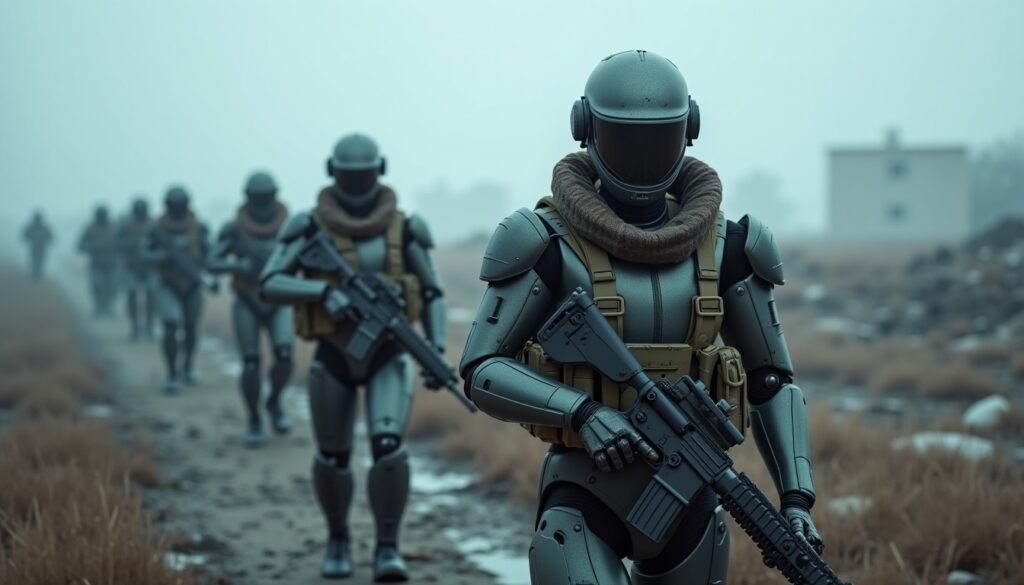
The conflict in Ukraine marks a major turning point in contemporary military history, where technology redefines the rules of combat. Since the massive introduction of combat drones, ground robotization has taken a new step with the arrival of humanoid robots on the battlefield. These advanced machines, capable of undertaking perilous missions, transform the very nature of military operations and raise both crucial strategic and ethical questions. Ukraine is today the scene of a robotized war, a true open-air laboratory where the design and use of robot soldiers shape the warfare of the 21st century. From frontline reconnaissance to logistical support, these humanoid robots embody the future of autonomous armies while disrupting traditional notions of international security.
In February 2026, the American company Foundation deployed two prototypes of soldier robots, the Phantom MK-1, closest to the Ukrainian front lines. This unprecedented operation aims to test the performance and reliability of these machines in an environment as chaotic as that of a modern battlefield. The combination of artificial intelligence, advanced bipedal mobility, and manipulation of human weaponry opens new perspectives but also raises questions about the potential limits and abuses of an army of machines. Faced with the ethical challenges related to robotized warfare, armies must balance operational effectiveness, cyber risk, and respect for international rules. The integration of humanoid robots in a real conflict outlines the uncertain boundary between technological progress and human dilemmas.
- 1 Deployment of humanoid robots on the Ukrainian battlefield: a new military era
- 2 Ukraine, an open-air laboratory for innovative military technology
- 3 The multiple applications of humanoid robots on the Ukrainian battlefield
- 4 Ethical and security challenges in the integration of military humanoid robots
- 5 Industrial and economic perspectives around military humanoid robots
- 6 Technical and operational challenges amid the chaotic battlefield environment
- 7 Geopolitical consequences of integrating humanoid robots in armed conflicts
- 8 Possible abuses and precautions in the use of military humanoid robots
Deployment of humanoid robots on the Ukrainian battlefield: a new military era
The deployment of humanoid robots on the battlefield in Ukraine represents a significant milestone in military evolution. Until recently, modern conflicts largely relied on autonomous aerial and ground drones, but these remained limited in their ability to physically interact with the complex environment of a war zone. The arrival of Phantom MK-1 humanoid robots changes this dynamic by introducing machines capable of moving in varied environments and managing sophisticated tactical missions.
Designed by the American start-up Foundation, these robots were sent in February 2026 to the front line to carry out reconnaissance, logistics, and support tasks for soldiers. Their main role is to undertake the most risky missions, traditionally exposing humans to deadly dangers. Robotization in this context thus offers a dual advantage: reducing human losses and optimizing performance on the ground. While the Phantom MK-1s are equipped to detect and analyze their environment thanks to camera vision systems, they forego technologies like LiDAR to prioritize lightness, robustness, and rapid large-scale deployment.
The use of humanoid robots becomes a field of technological confrontation where armies test real-world military innovations accelerated by the war in Ukraine. The extended use of UGV ground drones for ammunition transport or securing rear lines has already taken a crucial role. Now, the integration of robotic actors capable of acting directly on the front line illustrates a new strategic approach, where cooperation between humans and artificial intelligences changes the very nature of combat.
Phantom MK-1: a concrete example of robotized warfare in action
The Phantom MK-1 measures about 1.75 meters tall and weighs 80 kilograms, giving it a silhouette close to that of a human soldier but with superior strength and endurance. Capable of handling a wide range of human weapons, these robots have sophisticated bipedal mobility thanks to cycloidal actuators that provide smooth and silent movements. This feature is essential in a context where stealth and the ability to react to unstable or rugged terrain are key factors for mission success.
These robots are remotely controlled by human operators. This retention of humans in the decision loop, particularly for any lethal engagement, remains a fundamental element of the military ethics protocols adopted by Western forces. However, the embedded artificial intelligence technology enables the Phantom MK-1 to anticipate certain obstacles and manage its movements autonomously to relieve operators from immediate tactical constraints. It thus acts as an extension of the human hand in a hostile environment where life is often at stake.
The hypothesis of total automation of lethal decision-making remains, however, a subject of intense debate within international security circles. For now, the economic model of these robots favors leasing, estimated at about 100,000 dollars per unit per year, which facilitates their deployment and quickly improves their reliability through feedback from the Ukrainian battlefield.
Ukraine, an open-air laboratory for innovative military technology
The conflict in Ukraine is no longer limited to a conventional confrontation. It has become a real testing ground for many innovative military technologies. The combination of extreme conditions, intense conflict dynamics, and mobilization of industrial and governmental actors creates an ideal ecosystem to accelerate the development, testing, and implementation of robotic and digital solutions on the battlefield.
Since the beginning of the Russian invasion, Ukraine has seen widespread use of aerial and ground drones enabling real-time intelligence acquisition, shelling enemy positions, or conducting delicate logistics missions. Ground robots have the specificity of being able to hold terrain over time, thus sparing human soldiers from repeated or overly exposed operations.
Every day, thousands of robotized operations are carried out, especially for transporting ammunition and supplying frontline units. These activities reinforce robotic presence on the front and refine machine capabilities in shifting and unpredictable environments. According to a Time analysis, the Ukrainian battlefield has now become a kind of “testing ground” for future warfare where military technology and artificial intelligence play a crucial role in every phase of combat.
Why innovative companies focus their efforts on the Ukrainian conflict
The exceptional conditions of the conflict offer an especially rapid opportunity for private companies and military research institutes to test their products in real situations. No other operational theater on the planet offers such intensity of engagement with a diversity of tactical, strategic, and human challenges. This “acceleration” forces actors to constantly react and adapt their prototypes to improve robot reliability and meet security imperatives.
Many Western actors see in this context a way to reduce human mortality while increasing operational efficiency through automated solutions adapted to the challenges of modern warfare. The immediate feedback collected on the front line provides manufacturers with a solid basis to improve intelligent systems, sensors, and the mechanical robustness of robots.
At the same time, this emergence also raises issues regarding the security of systems against cyberattacks, electronic jamming, and sabotage. The more an army relies on autonomous machines, the more it must rethink its defense strategy regarding these new vulnerabilities, thus questioning the very notion of international security in the age of robotized warfare.
The multiple applications of humanoid robots on the Ukrainian battlefield
The Phantom MK-1s display remarkable versatility in their operational roles. Their design and capabilities not only allow them to be present on the frontline for reconnaissance, but they are also employed for logistical tasks, demining, and even direct troop support—missions traditionally dangerous and demanding for human soldiers.
Here are some of the main functions assigned to these humanoid robots:
- Tactical reconnaissance: through missions of scouting enemy positions, observing adversary movements, and analyzing terrain to avoid ambushes.
- Logistical support: transport and distribution of ammunition, supply of water and food, enabling troops to remain alert without interrupting operations.
- Demining and hazardous material management: handling explosives and neutralizing mines, thus limiting direct exposure of soldiers to lethal risks.
- Assistance in direct combat: intervening in support operations for human units, providing precise fire capabilities on targets.
This diversity of missions shows that humanoid robots are no longer mere tools, but integral parts of military operations, capable of evolving in complex environments and interacting with human soldiers while lightening their workload.
| Function | Description | Key Advantages |
|---|---|---|
| Reconnaissance | Scouting and tactical analysis of terrain and enemies | Reduction of human risk, better tactical awareness |
| Logistical support | Transportation of ammunition and supply in combat zones | Maintenance of operational effectiveness, speed |
| Demining | Neutralization of explosives and landmines | Limitation of human losses, enhanced safety |
| Combat assistance | Active support in combat and weapon handling | Increased precision, direct support to soldiers |
Ethical and security challenges in the integration of military humanoid robots
The deployment of humanoid robots in the context of the conflict in Ukraine highlights several fundamental questions concerning military ethics and international security. While these machines help reduce human losses and improve operations, they also spark debates about the role of humans in lethal decision-making and responsibility in cases of errors or abuses.
The choice to maintain human control over all decisions involving the use of lethal force is a red line regularly emphasized, notably by the designers of the Phantom MK-1 and Western armies. However, the risk of increased automation in the coming years remains real, within a context of arms race where each side could be tempted to accelerate the deployment of more independent autonomous armies.
From a security perspective, dependence on humanoid robots also exposes armed forces to cyberattacks, jamming, or the neutralization of control systems. This vulnerability forces states to strengthen their digital defenses and strictly regulate the deployment of these technologies to avoid uncontrollable escalations.
The emergence of these technologies also implies a reevaluation of international war conventions. Current rules must be adapted to integrate these new robotic actors to ensure respect for human rights and limit the risks of abusive use of automated force.
Industrial and economic perspectives around military humanoid robots
The rise of soldier humanoid robots such as the Phantom MK-1 opens a new market to military technology players. The innovative economic model based on leasing these machines facilitates their rapid diffusion and frequent updates, thus meeting the shifting operational demands of the battlefield.
Foundation’s industrial ambitions match the scale of the challenges: the start-up plans to produce nearly 50,000 units by the end of 2027. This ramp-up requires advanced industrialization, standardization of components, and simplified maintenance to guarantee maximum robot availability on the front. This dynamic also generates significant spillovers for research in artificial intelligence and advanced robotics, nurturing a virtuous circle of continuous innovation.
However, this development raises questions about the overall socio-economic impact. The growing use of robots could reshape the military and industrial landscape, changing the nature of employment and training in the armed forces, while creating increased dependence on cutting-edge technologies provided by a limited number of international actors.
Technical and operational challenges amid the chaotic battlefield environment
The deployment of humanoid robots on a real battlefield confronts designers with major challenges. Terrain complexity, human unpredictability, extreme weather conditions, and attempts at electronic jamming represent as many obstacles that these autonomous machines must overcome.
The robustness of the Phantom MK-1, relying on optical solutions rather than systems like LiDAR, aims to ensure simplified maintenance and reliable operation despite shocks or disruptive environments. However, each new operation on the Ukrainian front helps identify flaws to correct and adapt algorithms to enhance responsiveness and security.
One essential question remains: how far can a critical mission be entrusted to a robot without compromising success and soldiers’ lives? Trust in these systems requires close collaboration between military experts, robotics engineers, and human operators. This cooperation is the key to pushing robotized warfare toward ethical and pragmatic efficiency.
Geopolitical consequences of integrating humanoid robots in armed conflicts
The integration of humanoid robots on the Ukrainian battlefield has profound repercussions on global geopolitics. This step towards an autonomous army disrupts the traditional balance of power and demands new thinking around military alliances and defense strategies.
Faced with growing deployment of robotized war machines, nations are pushed to modernize their armed forces, triggering an arms race focused on artificial intelligence and robotics. This evolution could reverse power relations in favor of the most technologically advanced countries, reshaping diplomatic and strategic maps worldwide.
Moreover, the issue of international regulation becomes urgent. The refusal or acceptance of autonomous robots in combat zones impacts states’ credibility on the global stage, as well as perceptions of their respect for human rights and The Hague Conventions. Thus, the conflict in Ukraine acts as a revealer of the new norms likely to govern all future wars.
Possible abuses and precautions in the use of military humanoid robots
The growing presence of humanoid robots in armed conflicts is not without risks or abuses. Besides the possible excessive automation of lethal decisions, some fear a trivialization of war due to the dehumanization of combat. The fact that robots do not bleed could also make the decision to engage in a confrontation easier, potentially to the detriment of peaceful diplomacy.
Dependence on technology also exposes armies to invisible vulnerabilities, notably cyberattacks aimed at taking control or neutralizing these machines. Enemies may exploit these flaws to turn the technology against its users, creating a new type of asymmetric threat.
Finally, pressure to further automate military functions may push some actors to act outside legal and ethical frameworks, jeopardizing international norms and global stability. Continuous vigilance and dialogue among states, researchers, and humanitarian organizations are indispensable to manage and regulate these developments.