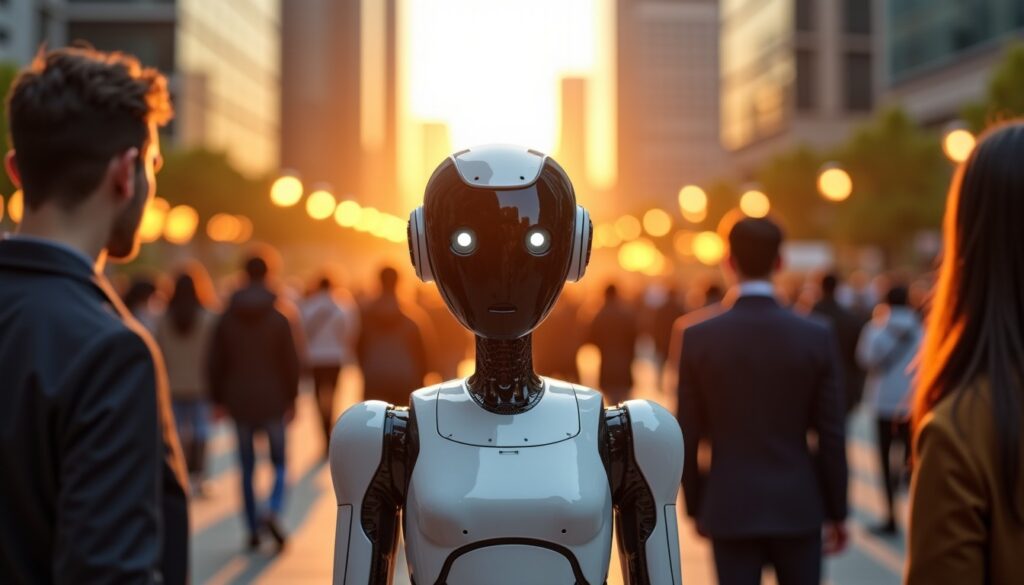
In just a few years, dating apps have completely transformed the way we connect, flirt, and build emotional bonds. The swipe, that iconic gesture popularized by Tinder since 2012, has set the rhythm for these interactions, turning the search for love into a rapid scroll through images and profiles. But today, a new era is opening thanks to artificial intelligence (AI), which is about to further revolutionize this field. Bumble, one of the main dating platforms, positions itself as a pioneer by integrating an AI called Bee, ready to assist users in their romantic search, without requiring them to master humor or verbal seduction. This technological shift raises exciting questions: how far can AI replace humans in romantic encounters? And should we fear a loss of authenticity in this era of automated feelings?
As technology increasingly invades our digital communication methods, Bumble relies on this virtual assistant to offer a highly personalized experience, ending the traditional swipe. This evolution responds to a fatigue phenomenon especially noticeable among Generation Z, weary of the superficiality and monotony of classic interactions. Bee promises to soften the seduction process by proposing compatible profiles based on a deep understanding of each user’s needs and desires, without requiring skills in humor or quick wit. Innovating to seduce without the stress of social performance, that is Bumble’s new promise in 2026.
- 1 The introduction of AI “Bee”: the end of swiping and a new era of digital seduction
- 2 The origins of the swipe and why Bumble bets on a technological break
- 3 Ethical and social challenges of automating romantic encounters
- 4 How AI redefines the very notion of humor and seduction
- 5 The impacts of technological change on user habits in 2026
- 6 AI in dating: barrier or accelerator for authentic relationships?
- 7 A forward look: the future of online dating with artificial intelligence
- 8 Frequently asked questions about AI and seduction on Bumble
The introduction of AI “Bee”: the end of swiping and a new era of digital seduction
In 2026, Bumble launches a revolutionary tool named Bee, an artificial intelligence designed to guide users through the complex world of online dating. This major change goes beyond aesthetics: AI has become a true digital matchmaker, capable not only of identifying compatible profiles but also of suggesting personalized date ideas tailored to the affinities and expectations of both parties.
Bee works by directly engaging with the user, gathering precise information about their interests, values, and even emotional preferences. Unlike the swipe, where judgment is immediate and often superficial, this approach favors a fine and nuanced understanding, which aims to recreate a more human form of communication without the bias of impulsive first visual impressions.
Beyond simple selection, Bee also automates the initial phase of interaction, helping to formulate appropriate opening messages, thus easing the pressure often felt during first exchanges. This automation represents an important advance, especially for people less comfortable with humor or verbal seduction, key aspects in traditional exchanges where wit and humor play a crucial role.
While this innovation generates enthusiasm, some wonder about the real space left for authenticity and spontaneity. The shift from the human dimension of exchange to algorithm-assisted communication inevitably changes the very nature of online romantic relationships.
The origins of the swipe and why Bumble bets on a technological break
The swipe concept imposed a new paradigm in online dating since 2012, notably thanks to Tinder and later amplified by other platforms like Bumble. This simple and addictive mechanic consists of swiping a profile to the right to indicate interest, or to the left to skip. It democratized access to digital dating, but its success also generated side effects.
The swipe encouraged rapid and sometimes superficial consumption of profiles, where appearance and the first impression often prevail over compatibility depth. Managing emotions and creative efforts, such as humor or original conversation development, have become challenges for some users, while others develop a form of weariness due to the multiplicity of choices.
Bumble, aware of these limits, has chosen to depart from this logic through a technological break. By integrating Bee, the app offers an alternative where artificial intelligence genuinely takes over to optimize seduction without users needing to focus on sometimes complex social skills like humor or flirting techniques.
This strategy also aims to captivate Generation Z, which from 2026 shows a certain fatigue with the repetitiveness of swiping, preferring more contextual and personalized methods of romantic approach.
When AI integrates into dating apps: a lasting change
Before Bumble, several platforms introduced AI elements to diversify online relationships. For example, Hinge turned to generative AI to stimulate creativity in initial messages, offering ideas based on the user’s profile. Meanwhile, some platforms have been using AI for several years to detect fake profiles and limit scams, thus enhancing the security and reliability of encounters.
However, Bumble goes further with Bee: AI no longer just supports, it chooses, suggests, and drastically adapts the experience, profoundly changing the traditional flow of digital dating.
The implementation of Bee places Bumble at the heart of a complex debate about AI integration in the intimate realms of human life. Love, often seen as a deeply human adventure, full of surprises, flaws, and emotions, is now subjected to algorithms and data analysis. This phenomenon raises many ethical questions, ranging from trust in machines to preserving diversity in relationships.
It is well known that AI systems are never completely neutral. They sometimes reproduce biases present in their training data. Safiya Umoja Noble, a renowned researcher, has demonstrated that these technologies can reinforce discrimination related to gender, ethnic origin, or social status. For example, an algorithm could accidentally favor certain profiles, systematically excluding others.
Beyond risks related to bias, we must also question the tendency of algorithms to propose profiles too similar to users. If every encounter becomes a statistical prediction, where unpredictability and discovering the other are reduced to a perfect match, the very essence of romantic charm may erode.
Social repercussions of AI in seduction
The automation of romantic relationships through AI can lead to excessive standardization of profiles and connections, thereby reducing the richness and diversity of encounters. From a societal viewpoint, this could increase loneliness, paradoxically by making selection processes more efficient. Dependence on a digital matchmaker could also cause emotional disengagement among users, who gradually lose confidence in their own ability to seduce or understand others.
In sum, the technological takeover of digital romantic communication raises the fear of a world where we love less with the heart and more with data and calculations. This tension between progress and authenticity lies at the heart of interrogations about the future of dating.
How AI redefines the very notion of humor and seduction
In the dating world, humor has long been an essential ingredient to seduce. The ability to make laugh, to skillfully use words with lightness and to defuse exchanges is a powerful factor of connection. Yet, Bee disrupts this by taking over on this terrain, thanks to an artificial intelligence capable of generating intelligent, adapted, and pleasant dialogues.
For some users, this automation represents a true liberation: no need to be funny or have a sharp sense of humor to start conversation and spark interest. AI handles these interactions, finely simulating what the human brain would spontaneously do in a seductive context.
But this transfer also raises questions: authentic humor relies on deep knowledge of emotions, context, and cultural nuances. Is AI really capable of capturing these subtleties? Can the absence of spontaneity lead to shallower, less lively exchanges?
When seduction becomes an automated performance
Bumble with Bee offers a new model where seduction is partially delegated to a machine. This relativizes the classic notion of romantic meeting as both a personal and imperfect art. Automation can certainly facilitate communication but also risks turning the search for the ideal partner into a mechanical process, devoid of surprises and raw emotions.
In this perspective, humor is no longer a vector of originality or talent but a programmed module aimed at maximizing compatibility. This paradigm shift provides a critical view on what we truly seek in our relationships: fragile sincerity or a high-performing algorithm?
The impacts of technological change on user habits in 2026
According to recent trends, Gen Z shows profound disinterest in traditional online dating modes based on swiping. This slowdown translates into a significant drop, around 21%, in the number of paying subscribers on classic platforms like Bumble over the past year.
In the face of this reality, the integration of Bee appears as an attempt to regain ground by offering a service that wants to be more human, less psychologically exhausting, and more focused on quality rather than quantity of exchanges. AI helps reduce cognitive overload linked to excessive choice by targeting profiles through an in-depth analysis of real affinities.
This personalization is crucial to establish a new dynamic in line with a generation valuing depth and relevance in their romantic relationships. But it also implies a change in habits: users must become familiar with an operation where the algorithm plays a central decision-making role.
Comparison of traditional modes and AI on dating apps
| Characteristics | Traditional swipe | AI Assistant Bee |
|---|---|---|
| Initial interaction | Quick visual choice, immediate judgment | Progressive dialogue, deep understanding |
| Emotional engagement | Often superficial, based on appearance | More nuanced, based on real compatibility |
| Ease to start conversation | Frequent difficulties, depends on humor | Automated personalized messages |
| Personalization of suggestions | Simple algorithms, little contextualization | Fine analysis, proposals adapted to profiles |
| Risk of rejection | High due to direct look | Reduced thanks to AI assistance in approach |
AI in dating: barrier or accelerator for authentic relationships?
The debate on the impact of artificial intelligence in romantic relationships remains open. While some see this technology as an opportunity to better harmonize meetings and reduce many blockages linked to digital communication, others perceive a risk of dehumanization of interactions.
Automation proposed by Bumble via Bee can facilitate contact and provide a boost especially for the shyest, but it also raises questions about the authenticity of emotions. How far can we rely on a machine to create a bond that, by essence, rests on uncertainty and individuality?
Moreover, entrusting an algorithm with guessing our romantic affinities and desires raises the question of digital trust. Can we really count on a series of data and calculations to guide us towards a meaningful story? Each experience seems unique, hardly reducible to an equation, despite advances in artificial intelligence.
List of major benefits and risks of AI in seduction
- Advantages: time saving, reduced stress related to flirting, profile personalization, enhanced fake profile detection, assistance in message writing.
- Disadvantages: possible loss of authenticity, reproduction of social biases, standardization of choices, increased dependence on technology, reduction of spontaneity and unpredictability.
A forward look: the future of online dating with artificial intelligence
As Bumble innovates with Bee, the future of online dating seems to be marked by close collaboration between humans and machines. Rather than completely replacing personal initiative, AI has the potential to accompany, advise, and amplify the romantic experience.
It is conceivable that future intelligent assistants will become emotional coaches, helping to better understand one’s own emotions, develop one’s love language, and refine choices, while offering suggestions adapted to context and current mood. This type of support does not eliminate the importance of lived experience and human unpredictability but enriches them through an analytical and preventative dimension.
However, this projection relies on an ethical and transparent use of artificial intelligence, involving a delicate balance between automation and individual freedom. Users must remain vigilant not to lose their ability to listen to themselves in favor of blind trust in algorithms.
As romantic relationships evolve with these new technologies, a central question arises: how to preserve humanity and mystery in a world dominated by data and digital communication?
Frequently asked questions about AI and seduction on Bumble
How does the AI assistant Bee work on Bumble?
Bee talks directly with the user to understand their preferences, then proposes compatible profiles and suggests personalized date ideas.
Can AI really replace humor in seduction?
AI can generate funny and well-adapted messages, but the authenticity and spontaneity inherent in human humor remain difficult to fully reproduce.
What are the risks of letting AI choose our partner?
Risks include reproduction of social biases, standardization of proposed profiles, and a dependence that could reduce personal initiative and spontaneity.
Have platforms already used AI before Bumble?
Yes, apps like Hinge have used generative AI to help with conversations, and several others have integrated anti-fraud systems since 2024.
Can AI improve the quality of dating?
By personalizing suggestions and facilitating communication, AI has the potential to improve dating quality but must be used with caution.