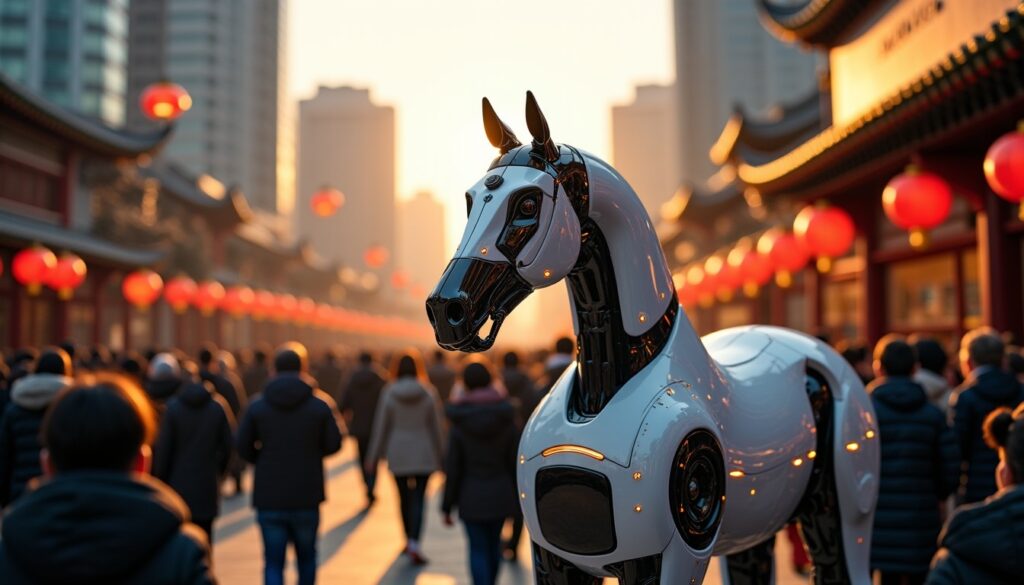
In a world marked by ever more fascinating technological advances, China once again stands out by unveiling an innovation that captures global attention: the very first robotic horse. This mechanical quadruped, the result of the ingenuity of a Hangzhou-based start-up, DEEP Robotics, symbolizes a major step in the evolution of robotics applied to transport and automation. Combining biomechanics, artificial intelligence (AI), and animal design, this robotic horse does not merely imitate an animal; it embodies the future of agile robotics, capable of operating in complex environments while offering new perspectives for industry and society.
China, which has made robotization a national priority for several years, today confirms its status as a leader in this sector with this iconic innovation. More than a high-tech gadget, this robotic horse symbolizes the convergence of tradition and technology: it fits into a culture that celebrates the Year of the Horse in 2026 while offering a cutting-edge technical solution for future challenges. From transport to research in difficult environments, this machine raises questions and hopes regarding the role of quadruped robots in daily life and critical operations.
- 1 The origins and genesis of the robotic horse in China: a major innovation in quadruped robotics
- 2 Technical design and biomechanics: how the robotic horse combines agility and robustness
- 3 Onboard artificial intelligence: the engine of the robotic revolution in China
- 4 Concrete applications of the robotic horse: beyond aesthetic innovation
- 5 The economic and strategic impact of this robotic revolution in China
- 6 The articulation between automation and tradition in the design of the robotic horse
- 7 The challenges and opportunities related to the integration of the robotic horse into Chinese society
- 8 Looking to the future: the robotic horse as a pioneer of a new era in automated transport
The origins and genesis of the robotic horse in China: a major innovation in quadruped robotics
The story of the robotic horse begins in the city of Hangzhou, at the heart of Zhejiang province, where DEEP Robotics has focused its efforts on pushing the limits of quadruped robotics. For several years, China has encouraged its companies to innovate under the aegis of national programs such as “Made in China 2025,” promoting the development of advanced technologies, notably in industrial robotics. This robotic horse perfectly fits into this dynamic, combining local cultural tradition and cutting-edge technologies in an ambitious project.
The concept was born from the need to have a robot capable of moving efficiently over rough terrain, reproducing the natural biomechanics of a horse. This approach required significant engineering work, particularly on the design of bionic legs and hoof-shaped feet. These elements are not purely aesthetic: they ensure remarkable balance and stability for the robot, allowing it to tackle various surfaces while maintaining fluid and realistic movement.
The DEEP Robotics team also leveraged advanced perception and locomotion technologies, notably a 96-line LiDAR and a SLAM (Simultaneous Localization and Mapping) system, essential to ensure the robot’s autonomy and safety in complex environments. The challenge was to equip this quadruped with artificial intelligence capable not only of adapting its trajectories but also managing obstacles in real time. These advances lay the foundations of an evolving robotics, ready to adapt to various tasks in the years ahead.
This project illustrates the ongoing industrial revolution in China, where the marriage between technology and local culture takes on a new dimension. Celebrating the Year of the Horse with a robot that is both performant and culturally symbolic demonstrates a bold strategic vision placing innovation at the heart of new technological uses.
Technical design and biomechanics: how the robotic horse combines agility and robustness
At the heart of this revolution, the robotic horse stands out for its advanced technical design. The major challenge was reproducing the natural movement of a horse, including the ability to trot with stability despite a substantial weight. Weighing barely 30 kg and about half a meter tall, this robotic horse combines lightness and solidity, a balance often difficult to achieve in locomotor robotics.
The bionic legs, equipped with several degrees of freedom, are programmed to precisely reproduce equine biomechanics. The hooves, designed to ensure optimal grip on various surfaces, provide the robot with impressive stability, even on uneven or rugged ground. This biomimetic architecture is not limited to an aesthetic copy; it truly optimizes the robot’s mechanical functioning, making it more efficient in its movement than many classic quadruped robots.
The propulsion system relies on a sophisticated motorized mechanism running on petroleum, offering enough power for the horse to reach speeds of up to 5 meters per second. However, the designers recommend a cruising speed at half of this value to ensure stability and comfort. The machine is also weather-resistant, with an IP66 protection rating, making it operational in rain, mud, or dusty environments. This robustness allows deployments in varied environments, thus harmonizing with the operational needs of industrial and security sectors.
Another major asset lies in the robot’s ability to operate within a wide temperature range, from -20°C to 55°C, thus ensuring reliability year-round. The combination of LiDAR technology and AI allows the robot to map its environment in 360° and automatically avoid obstacles, guaranteeing smooth navigation without constant human intervention.
Additionally, there is an innovative power supply system with hot-swappable batteries, allowing an autonomy of about three hours. This energy modularity is essential to meet field requirements and extend mission duration without loss of productivity.
Key technical features of the robotic horse
| Characteristic | Description |
|---|---|
| Weight | 30 kg |
| Height | 0.5 meter |
| Maximum speed | 5 m/s |
| Protection rating | IP66 (resistant to rain, mud, dust) |
| Operating temperature | -20°C to 55°C |
| Autonomy | 3 hours (hot-swappable batteries) |
| Onboard technologies | 96-line LiDAR, AI, SLAM |
| Load capacity | Transport of a person up to 50 kg |
Onboard artificial intelligence: the engine of the robotic revolution in China
The innovation of the robotic horse does not lie solely in its biomechanical aspect: it is also the refined mastery of artificial intelligence that grants this robot its exceptional capabilities. The integration of advanced algorithms allows not only autonomous movement but also continuous adaptation to the kilometers traveled and the obstacles encountered.
The navigation system relies on LiDAR and SLAM technology to create an interactive, real-time mapping. This function is essential to ensure the robot is not only reactive but also proactive in its movements, anticipating obstacles and smoothly modifying its route. This level of autonomy illustrates the strong trend towards increasing automation in Chinese industrial robotics, driven by innovative startups.
Beyond simple navigation, the AI also serves energy and mechanical optimization. Movements are calculated to minimize consumption, extend battery life, and reduce wear on mechanical components. The system learns from its experiences, perfecting its biomechanics and improving stability over repeated uses.
This integrated artificial intelligence opens up numerous possibilities: rescue missions in hard-to-reach areas, automated inspection of hazardous sites, assistance in light transport in varied environments, or demonstrations in cultural or artistic contexts. The human-machine interaction is significantly enhanced, promoting smoother coexistence between robots and users across various activity sectors.
Concrete applications of the robotic horse: beyond aesthetic innovation
One often overlooked aspect of this technological revolution is the importance given to the real usability of the robotic horse. Far from being a mere exhibition object, this quadruped robot was designed to meet specific needs across several sectors. Its biomechanical design combined with robustness gives it rare versatility, capable of operating where dog robots or drones would not be suitable.
The robotic horse excels particularly in:
- Search and rescue missions: thanks to its agility on difficult terrains, it can access areas inaccessible to traditional vehicles, carrying equipment or first aid supplies.
- Industrial inspection: in dangerous environments such as mines or chemical sites, it can operate autonomously to detect anomalies or failures.
- Light transport: capable of carrying up to 50 kg, it facilitates logistics in difficult contexts or congested urban areas.
- Cultural and artistic demonstrations: to mark the Year of the Horse, the device is also a technological symbol combining tradition and modernity.
The benefits of such uses are numerous. For example, in mountain rescue, a robotic horse could transport heavy medical equipment in steep areas, significantly reducing intervention time. In industry, it reduces human risks by monitoring infrastructures instead of human operators.
In the near future, even broader integration into personalized urban transport can be envisioned, where this type of machine would complement other innovations such as electric scooters or autonomous vehicles, especially in hard-to-access pedestrian zones.
The economic and strategic impact of this robotic revolution in China
The launch of the robotic horse marks a strategic turning point in Chinese technological policy, which sees robotics as a major lever to strengthen its economy and global influence. By raising more than 70 million dollars in its latest funding round, DEEP Robotics illustrates market confidence in this type of disruptive innovation.
On the economic level, this technology opens several prospects:
- Creation of skilled jobs for research, production, and maintenance of quadruped robots.
- Boosting exports of high value-added robotic technologies in a context of global competition.
- Reduction of costs and risks in industrial and rescue sectors thanks to advanced automation of robotic mobility.
- Support for “smart city” ambitions with the integration of robots in urban management and automated individual transport.
But beyond the economy, this innovation has a strong symbolic character, embodying the Chinese will to combine tradition and modernity. By choosing the tool of the robotic horse to celebrate the Year of the Horse, China strengthens a narrative where technology and culture no longer oppose but complement each other. This strategy also promotes the country’s international influence in the field of innovation and robotics.
The articulation between automation and tradition in the design of the robotic horse
While China traditionally celebrates the Year of the Horse as a major moment of its cultural and spiritual calendar, the appearance of a robotic horse represents an unprecedented fusion between ancestral heritage and futuristic technology. This apparent mix may surprise but reveals a profound reflection on the place of machines in our society.
The use of a form as symbolic as the horse is no coincidence. In Chinese culture, the horse represents strength, freedom, and success. Thus, transposing this image into a robot reveals the ambition to project these qualities into an automated future, where machines take an active place in daily life, but always under the sign of power and agility.
Unlike some industrial robots that prioritize raw functionality, DEEP Robotics’ robotic horse maintains a refined aesthetic, with a bionic design respecting natural proportions. This aesthetic choice highlights the importance given to a harmonious integration of the machine into the human environment, suggesting a peaceful coexistence between tradition and modernity.
This cultural dimension also enriches the commercial and marketing discourse around the machine. Offered in a limited edition and sold around 50,000 dollars, it targets companies seeking more than a mere robot: a prestige object that testifies to their commitment to the booming technological revolution. This robotic horse thus becomes a symbolic ambassador of the future, where tech and culture intertwine.
The adoption of such an innovative robot naturally raises questions related to its integration into society. The DEEP Robotics robotic horse, despite its potential, will have to adapt to multiple practical and societal realities to fully find its place.
Among the major challenges are:
- Social acceptance: how does the public perceive this type of robot, which blends a symbolic animal with a machine? Awareness campaigns will be needed to promote understanding and reassure regarding safety.
- Regulations: autonomous mobility in urban settings raises legal issues, especially concerning liability in case of accidents or interference with pedestrian traffic.
- Cost and accessibility: with a high price, the robotic horse is currently a niche product; technological evolutions will need to be considered to make it more accessible in the future.
However, these challenges come with promising opportunities:
- Continuous improvement via AI: the machine learns and constantly adapts, offering prospects for rapid and customizable evolution.
- Multiplication of use cases: the robot’s modularity allows it to be deployed in various sectors, maximizing its economic and social impact.
- Strengthening of Chinese technological leadership: this project contributes to positioning China at the forefront of global quadruped robotics.
Ultimately, the robotic horse perfectly illustrates the complexities of the transition between tradition and modernity, between culture and technology. Its success will depend as much on technical performance as on its harmonious integration into the Chinese social ecosystem and more broadly worldwide.
Looking to the future: the robotic horse as a pioneer of a new era in automated transport
While the robotic horse already represents a technical and cultural achievement, its true potential lies in its ability to inspire new uses on a global scale. Quadruped robotics is emerging as a key sector in the transformation of transport modes and industrial operations in the coming years.
With light transport capacities and autonomous navigation, this type of machine could profoundly change urban logistics, particularly in pedestrian zones, natural parks, or hard-to-access sites. Their maneuverability, combined with energy autonomy and robustness, paves the way for fleets of robots capable of intervening in sectors as varied as tourism, security, or precision agriculture.
Prospects for 2026 and beyond notably include:
- The deployment of robotic horses in smart cities for on-demand transport missions, facilitating mobility for people with reduced mobility.
- Integration with other automation systems, such as drones and autonomous vehicles, in smooth and interconnected supply chains.
- Increased participation in emergency operations, where intervention speed and mobility on rugged terrain are crucial.
- Development of customized versions for specific uses, whether industrial, medical, or cultural.
In sum, this robotic horse could become a pillar of the next generation of robotics, embodying a synthesis between technical performance, intelligent autonomy, and respect for human values. In China, as in the rest of the world, this quadruped robotic revolution is an invitation to rethink mobility, automation, and interactions between humans and machines.