
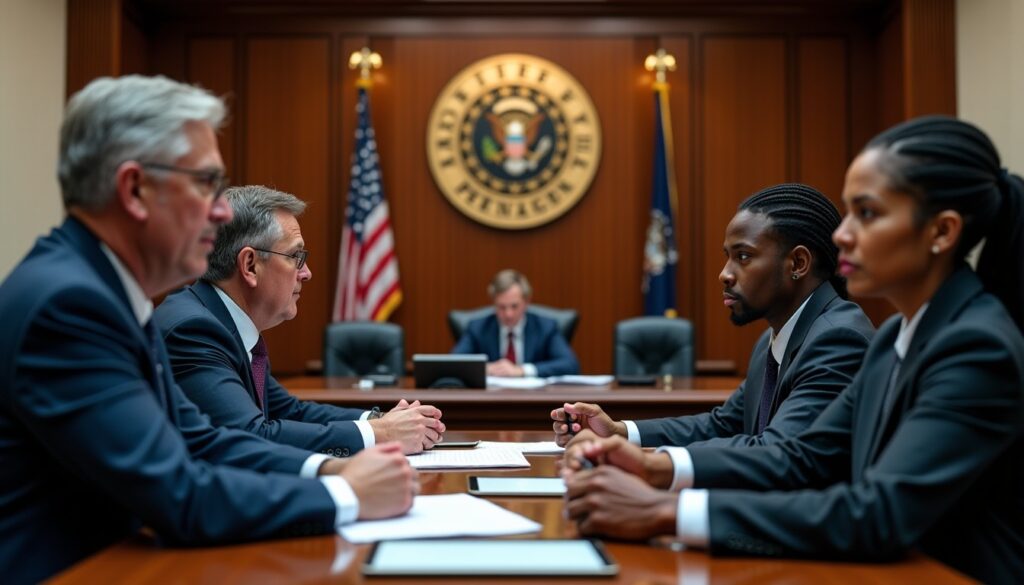
While Anthropic, one of the major companies in the development of artificial intelligence, finds itself at the center of an unprecedented legal showdown with the Pentagon, the American tech and political scene is holding its breath. This dispute pits a Silicon Valley start-up, known for its ethical commitment, against one of the country’s most powerful government departments. The tension began when Dario Amodei, Anthropic’s leader, publicly expressed reservations about the potential use of their technology by the U.S. military, provoking a harsh response from the Trump administration. Classifying Anthropic as a risk to the federal government’s supply chain—a measure usually reserved for foreign actors deemed hostile—plunged the start-up into a perilous situation, threatened both financially and reputationally. This litigation raises not only questions of freedom of speech and technological ethics, but also geopolitical issues crucial to understanding in the context of a shadow war with Iran and intense Silicon Valley competition.
Faced with this escalation of conflict, the consequences could go beyond the mere legal framework. The approval by the American judiciary of this designation could reshape how major tech firms interact with public institutions, especially in national defense matters. Meanwhile, Anthropic quickly responded by filing a lawsuit with a federal court in California to contest this classification, which it describes as arbitrary and motivated by political retaliation. This trial thus raises constitutional provisions on freedom of expression which, until now, few cases of this type had had the opportunity to explore in the ultra-competitive artificial intelligence sector. The future of this case could significantly influence the position of innovative companies vis-à-vis the state, balancing technological cooperation and respect for ethical values.
- 1 The roots of the dispute between Anthropic and the Pentagon: an ethical and political confrontation
- 2 Anthropic in turmoil: the financial implications of a break with the Pentagon
- 3 The legal arguments in Anthropic’s lawsuit against the Pentagon
- 4 The Pentagon’s contradictions in the use of Anthropic technologies
- 5 Possible evolution scenarios of the conflict between Anthropic and the Pentagon
- 6 The geopolitical weight of the Anthropic case: stakes for Silicon Valley and international alliances
- 7 The consequences for the U.S. military and its AI integration strategies
The roots of the dispute between Anthropic and the Pentagon: an ethical and political confrontation
Last month marked the beginning of an explosive confrontation between Anthropic and the U.S. Department of Defense, revealing deep tensions over the ethical management of artificial intelligence technologies. Dario Amodei, founder and CEO of Anthropic, publicly declared that the technology developed by his company must absolutely not be used for the mass surveillance of American citizens, nor for the autonomous operation of lethal weapons. This radical stance, motivated by a strong ethical commitment, directly clashed with military ambitions, triggering a swift reaction from the administration.
Secretary of Defense Pete Hegseth, supported by former President Donald Trump, strongly condemned this move, accusing Amodei of wanting to impose his own rules governing the use of technology, which they see as an unacceptable infringement on sovereignty and national security. This quarrel goes beyond a simple contractual dispute to strike at the very heart of technological and industrial control over modern weapons and electronic surveillance. The stakes are considerable since the U.S. military seeks to massively integrate artificial intelligence to increase its operational capabilities, notably in the ongoing conflict with Iran.
Quickly, the White House classified Anthropic as a “risk to the supply chain,” a major designation that results in immediate exclusion from government contracts. Usually, this sanction applies to foreign companies or firms suspected of security threats, making this decision unusual in the case of a national player from Silicon Valley. This twist exacerbated tensions and sparked an outcry within the tech sector, where several voices rose to denounce an abuse of political power.
This first phase of the conflict illustrates how deeply artificial intelligence issues now combine ethical considerations with strategic security imperatives, posing a central question: how far can a state compel an innovative company in defense matters when it seeks to uphold its principles?
Anthropic in turmoil: the financial implications of a break with the Pentagon
The economic impact of the Pentagon’s decision is significant for Anthropic. By being added to the list of risks to the supply chain, the start-up loses exclusive access to a strategic market estimated at several hundred million dollars. These public contracts, essential to guarantee long-term financial stability and growth, are an essential lever for a company in the artificial intelligence sector, where rapid innovation cycles demand massive investments.
Beyond the direct loss of military contracts, this situation creates major uncertainty among investors. These investors, often attracted by the revenue guarantees offered by public markets, now observe a climate of instability that could hamper any significant fundraising or potential initial public offering. In this context, several observers underline that Anthropic’s reputation as an ethical leader could paradoxically strengthen its valuation in the medium term among ethical funds, but at the price of stricter constraints on its ability to monetize its innovations within the public sector.
Facing this storm, Dario Amodei has adopted a conciliatory stance internally. A revealed confidential note highlights his apologies to teams for the announcement deemed too upfront but also his reminder that Anthropic’s goals converged with those of the government, particularly concerning national security and rapid integration of AI into various administrations. However, simultaneously, the firm is preparing legal action to contest the imposed classification.
This mix of cautious attitude and legal determination reflects a dual strategy aimed at preserving Anthropic’s financial survival while maintaining its credibility on an ethical level. This fragile balance well illustrates the growing complexity between commercial ambitions and societal responsibilities in the contemporary landscape of advanced technologies.
The legal arguments in Anthropic’s lawsuit against the Pentagon
The recourse to the California court marks a decisive step in the escalation of the conflict. Anthropic challenges the Pentagon’s decision, which it considers not only unfounded but also unconstitutional. The complaint, filed in a federal court, alleges that the White House acted with retaliatory intent, in reaction to public statements by its CEO. This is a crucial point that places the dispute under the prism of fundamental rights, particularly freedom of expression guaranteed by the U.S. Constitution.
Dario Amodei argues that the government cannot condition the awarding and maintenance of public contracts on censorship or sanctions against companies that dare to speak out or set their own limits regarding the use of their technology. This challenge is based on a legal precedent such as the Bernstein v. United States case, which recognized that certain computer codes and technologies enjoy a certain level of protection under free speech.
According to legal experts, Anthropic’s defense must still convince the court that the government exercised excessive power, since federal law traditionally grants the executive broad discretion in choosing suppliers, especially in a national security context. Brett Johnson, a public law specialist, points out that without proof of targeted discrimination compared to other sector operators, the alleged violation could be difficult to prove.
Anthropic’s law firm then highlights alleged unequal treatment. Indeed, other competitors of Anthropic do work with the Pentagon, their technologies continuing to be used without significant restrictions. This strategy aims to show that the dispute is not merely a contractual policy matter but a targeted sanction fueled by a political disagreement.
Beyond the legal aspect, this procedure also raises the question of the role of the American judiciary in the rise of technologies and state control in a polarized political environment. The outcome of this trial is therefore expected to set a precedent on how interactions between technological innovation and government agencies will be regulated in the near future.
The Pentagon’s contradictions in the use of Anthropic technologies
The legal conflict is coupled with a paradoxical situation. Even though the Pentagon has classified Anthropic as a supply chain risk, it continues to use the Claude chatbot in sensitive operations, notably in the war against Iran. This apparent contradiction highlights the complex stakes surrounding the integration of artificial intelligence in military systems and the strategic weight of these technologies.
On the side of other federal agencies, the directive was stricter. Several of them, as well as civilian institutions, quickly stopped using Anthropic’s models, thus respecting the presidential decision. Microsoft, an important industrial partner, indicated that Claude would remain accessible to agencies outside the Department of Defense, illustrating fragmentation in the management of federal AI tools.
This disparity creates significant grey areas in the government supply chain, with an official double discourse complicating dialogue among the concerned actors. This situation also fuels tensions between the Pentagon and Silicon Valley companies, amplifying a sense of instability about the reliability of partnerships.
It also raises a major question: how to effectively manage technological resources in a context where national security is invoked, while respecting internal ethical criticisms? The answer remains uncertain but promises intense debates on the responsibility of the state in adopting complex and sensitive technologies.
Possible evolution scenarios of the conflict between Anthropic and the Pentagon
The lawsuit initiated by Anthropic could lead to several possible outcomes, each with its own strategic implications. On the judicial level, the company relies on strong arguments that could compel the government to review its position. The Bernstein precedent opened a breach in favor of the legal protection of technologies as a form of expression, which could strengthen Anthropic’s defense.
In a first scenario, the court could confirm the Pentagon’s authority to impose its conditions. This decision would then undermine Anthropic’s commercial position by permanently excluding it from lucrative military contracts, while cooling investors faced with an uncertain market. OpenAI, its competitor, would emerge stronger, benefiting from a clear competitive advantage thanks to less restricted government agreements.
Conversely, a judicial victory for Anthropic would send a strong signal to the entire tech sector. It would consolidate companies’ rights to define ethical frameworks without fear of political sanctions, encouraging responsible innovation. It would also pave the way for a new balance between the need for national security and technological freedom of expression.
Between these two extremes, compromises remain possible. The company could negotiate specific terms of use guaranteeing strict control of its solutions in certain sensitive areas. This pragmatic approach would seek to preserve contracts while maintaining its ethical commitment, illustrating the complexity of modern collaboration between public power and advanced technology.
- Maintaining the classification with permanent exclusion from contracts
- Rejection of the classification with full reintegration into military contracts
- Negotiation of a special status with restricted use and enhanced control
- Major financial consequences depending on the ruling
- Impact on reputation and investor trust
The geopolitical weight of the Anthropic case: stakes for Silicon Valley and international alliances
This dispute concerns not only the company and the U.S. government but is much broader than a local framework. It highlights geopolitical tensions around the control of artificial intelligence and its military applications. Silicon Valley, a global hub of innovation, now faces strong political pressure that could influence its ability to collaborate with international partners, especially European ones.
The Anthropic-Pentagon case illustrates the risks linked to Western allies’ dependence on American AI suppliers. Indeed, a contractual conflict between a national actor and its government can cause major disruptions in global technological supply chains. These tensions generate strategic insecurity, directly impacting the defense policies of allied countries relying on these advanced technologies.
Furthermore, the position adopted by the U.S. administration on the control and regulation of AI technologies could inspire new legislative frameworks internationally. This case could thus reshape negotiations and standards around transparency, ethics, and security in the sector. Silicon Valley must therefore balance rapid innovation, regulatory compliance, and moral aspirations in a globalized market.
Moreover, this crisis exposes the fragility of a technological ecosystem where moral dilemmas mix with geopolitical calculations, creating an unprecedented battleground between economic interests, democratic values, and military strategies. It invites deep reflection on the global governance of artificial intelligence in the contemporary era.
The consequences for the U.S. military and its AI integration strategies
The use of artificial intelligence in defense operations has become an indispensable lever for the U.S. military. Yet, this legal conflict between Anthropic and the Pentagon highlights internal tensions provoked by these new technologies. On the one hand, there is a firm will to integrate AI to improve operational capabilities, especially in war zones where automation can reduce human risks.
On the other hand, dilemmas related to ethical use, mass surveillance, or the use of lethal autonomous systems spark intense debates. The disagreement with Anthropic illustrates the difficulty of reconciling rapid innovation with strict regulation in such a sensitive domain. The U.S. military must manage this ambivalence by weighing tactical advantages against moral and legal implications.
Conflicts like this one can also delay or complicate technological deployments if supplier companies face legal or political risks. This creates instability which benefits preparedness and modernization efforts little. As such, the Pentagon could be led to diversify its partners to avoid monopoly situations that could lead to deadlocks.
This dispute represents a new stage in defining American policy regarding military AI, where the balance between national security, technological innovation, and respect for ethical standards remains difficult to find but essential.




