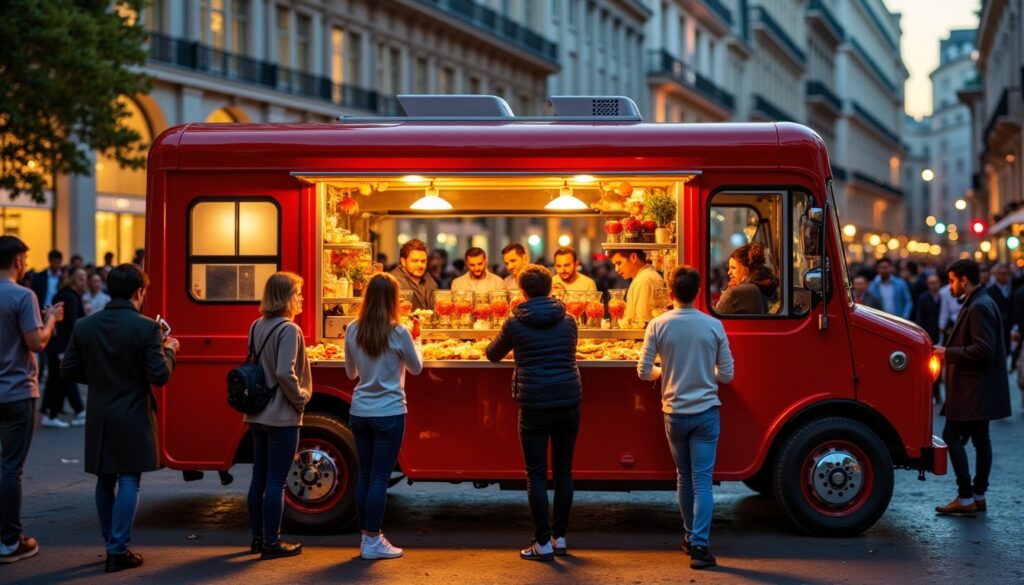
Eating on the go, on the corner of a busy street or in front of a steaming counter, is a practice deeply rooted in our history. This street culinary tradition, now called street food, draws its roots far back into Antiquity, at the time of the Romans and their famous thermopolia. These counters where hot and quickly served dishes were sold met the needs of an urban population seeking simple and affordable meals. Since then, street catering has continuously evolved, adapting to social, economic, and cultural changes. From the everyday simplicity of medieval markets to the spectacular rise of contemporary food trucks, this mode of consumption illustrates both continuity and a gastronomic revolution, blending tradition and food innovation.
This culinary evolution reveals much more than a simple adaptation to the hectic rhythms of modern life: it reflects a society in motion, eager for discoveries and concerned with respecting seasons and quality. Today, street food is no longer limited to convenience; it becomes a true gastronomic laboratory that challenges conventions and democratizes access to refined and creative street cuisine. The gourmet odyssey from the ancient thermopolium to the chic food truck illustrates this remarkable capacity for adaptation and innovation that accompanies and shapes our contemporary eating habits.
- 1 The fascinating origins of street food: from the Roman thermopolium to medieval markets
- 2 The 20th century: renaissance and explosion of street food with itinerant vendors and food trucks
- 3 The global boom of food trucks: convergence of food innovation and culinary tradition
- 4 Street food and culinary innovation: the surprising marriage between ancestral traditions and modern techniques
- 5 The lasting impact of street food on our eating habits and its promising future
The fascinating origins of street food: from the Roman thermopolium to medieval markets
If we look up to the earliest forms of street catering, it is by scrutinizing the alleys of Pompeii that we discover one of the first sophisticated street food systems. The thermopolium, which literally means “sold hot,” was a built-in counter where dishes kept warm attracted a varied clientele. These establishments served simple but nutritious meals at all hours of the day, such as stews, stewed vegetables, bread, and mulled wine. This form of fast food met the needs of those who did not have a kitchen at home, mainly the working classes such as slaves, artisans, or passing travelers.
Archaeologists have revealed that more than 80 thermopolia existed in the city of Pompeii alone, operating from dawn to welcome early workers. The variety of dishes offered varied according to the seasons and locally available ingredients, already demonstrating a certain culinary wisdom oriented towards proximity and freshness. The thermopolium thus reflects an urban organization where the speed and simplicity of street meals integrated into the intense rhythm of Roman city life.
Continuing this tradition, the Middle Ages saw street catering emerge around markets. These, true hubs of social and economic urban life, teemed with rotisserie cooks, itinerant pastry chefs, and soup vendors. The food offered, often rustic, was intended for a working population, including artisans, merchants, and travelers. Meanwhile, in Asia, street food had already been flourishing for centuries, in Persian bazaars as well as the crowded alleys of Beijing or Delhi, where varied skewers, pancakes, and daily spiced broths attracted both residents and visitors.
This almost universal presence of street food throughout the centuries demonstrates its fundamental role in social organization. Rapid access to a hot and affordable meal has always been an effective way to meet the dietary needs of a predominantly urban and active population. Markets and street stalls thus became the first stages of popular gastronomy that would endure through the ages.
The 20th century: renaissance and explosion of street food with itinerant vendors and food trucks
The 20th century opens a new era for fast catering with massive urbanization and changing lifestyles. Industrialization creates a new class of urban workers in constant motion. Forced to eat quickly outside their homes, they saw the birth of a prolific informal economy. In large metropolitan areas, street vendors then offered regional or international specialties, embedding street food into the collective imagination.
In New York, the famous hot dog trucks and pretzel vendors on sidewalks symbolize this revival. These simple and inexpensive foods become an urban way of life. At the same time, in Southeast Asia, governments institutionalized street food through hawker centres in Singapore, Malaysia, and Thailand, creating covered spaces where street cuisine is both regulated and celebrated as cultural heritage.
This period also introduces the notion of street food as an identity marker. Dishes such as the Vietnamese bánh mì, an emblematic sandwich born of Franco-Vietnamese fusion, the Middle Eastern shawarma, Mexican tacos, or the South African bunny chow illustrate how street food recounts migratory journeys and cultural exchanges. Each bite becomes a gustatory and narrative memory, strengthening the feeling of belonging to a community while opening to the world.
This cultural dynamic lays the foundations for the food truck phenomenon that would mark urban gastronomy from the 2000s onwards. These kitchen trucks, born from a desire for innovation and economic adaptation, revolutionize food offerings by providing a mobile, fast, and often high-quality service, far from the usual constraints of traditional restaurants.
The global boom of food trucks: convergence of food innovation and culinary tradition
Since their explosion in the United States in the 2000s, food trucks have established themselves worldwide, becoming a phenomenon with multiple faces. If we look at current figures, it is estimated that by 2026 the United States will have more than 35,000 food trucks generating approximately 2.7 billion dollars in revenue. In Europe, France and the United Kingdom are not left behind: respectively 8,000 and 10,000 kitchen trucks mark the beat of a street gastronomic revolution, with annual revenues of 600 million euros and 1.2 billion pounds respectively.
| Country | Estimated number of food trucks | Annual revenue |
|---|---|---|
| United States | 35,000+ | 2.7 billion dollars |
| France | 8,000+ | 600 million euros |
| United Kingdom | 10,000+ | 1.2 billion pounds |
But the food truck is no longer limited to standard fast catering. Far from being a simple point of sale, it has become a culinary experimentation laboratory where starred chefs break free from the constraints of table service to offer creations as audacious as they are refined. Foie gras burgers, lobster tacos, or nitrogen-prepared ice creams embody this hybridization between haute cuisine and the conviviality of the street, transforming street cuisine into an unprecedented sensory experience.
This hybridization, which blends gastronomic excellence and urban practicality, illustrates to what extent street food is a highly dynamic space for food innovation. It also testifies to a democratization of taste, attracting both students seeking affordable options and senior executives eager for new culinary sensations.
Street food and culinary innovation: the surprising marriage between ancestral traditions and modern techniques
At the heart of current trends, street food creatively reconciles tradition and modernity. Current street kitchens continually explore cultural fusion on the plate, giving rise to unprecedented dishes. Thus, there are kimchi burgers mixing Korean flavors and American fast food, lentil curries wrapped in Breton wraps, or matcha mochis filled with chestnut cream, symbols of an unprecedented culinary blending.
This ability to revisit classics while integrating global influences enriches the urban gourmet landscape with remarkable diversity. In addition to flavor alliances, innovative culinary techniques are now entering mobile kitchens. Molecular cuisine, artisanal fermentation, or low-temperature cooking, once reserved for gastronomic establishments, are increasingly integrated into food trucks and stands.
Thanks to these processes, tomorrow’s street food is shaping up to be both technical and gourmet, capable of respecting seasons and offering dishes that are both quick and of high nutritional quality. This quest for excellence profoundly transforms city dwellers’ relationship with food and their perception of what street cuisine can offer. This movement also encourages the emergence of a more responsible and demanding food consciousness.
- Experimentation with new culinary combinations
- Use of modern gastronomic techniques in urban environments
- Respect for local products and seasons
- Waste reduction and adoption of sustainable practices
- Accessibility and creativity at the heart of street cuisine
The lasting impact of street food on our eating habits and its promising future
On a global scale, street food has become an essential vector for democratic access to culinary diversity. It makes flavors from all corners of the globe affordable, awakening curiosity and openness. The public thus discovers new spices, varied cooking methods, and a sometimes little-known heritage richness. The transmission and valorization of culinary traditions are thereby strengthened, as is the inspiration to cook these recipes oneself at home.
But this enthusiasm also poses considerable challenges, particularly in terms of health and environmental management. Single-use packaging, waste management, and disparities in the application of hygiene standards are issues requiring increased attention. Fortunately, many street food actors are now investing in eco-responsible practices, promoting compostable packaging, short supply chains, and the fight against food waste.
Moreover, the rise of vegetarian and vegan diets significantly influences the street food offering, with a proliferation of dishes based on plant proteins, nourishing bowls, and plant-based alternatives that are both tasty and environmentally friendly. Technology is also joining this landscape, facilitating the geolocation of food trucks, contactless payment, and even the introduction of culinary robots to ensure consistency and speed.
In short, street food by 2026 is part of a dynamic oriented towards a sustainable, innovative, and ever more gourmet future, confirming its role as a reflection and major player of our contemporary societies and their culinary aspirations.