
In the contemporary American rural landscape, an unexpected confrontation pits tradition against technological revolution. As artificial intelligence infiltrates all economic sectors, an often overlooked reality emerges: the need for massive physical infrastructures to support this advancement. Agricultural lands, long sanctuaries of permanence and agricultural continuity, have become today major strategic stakes for the installation of massive data centers, essential to artificial intelligence. But far from accepting this forced transformation, many farmers show fierce resistance, refusing to give up their land even under the pressure of dazzling financial offers. This struggle reveals issues deeply linked to the defense of a way of life, environmental preservation, and food sovereignty in the face of globalization and digital industrialization challenges.
This complex dynamic raises several questions: why do farmers pay such close attention to protecting their land against the interests of cloud giants? What are the environmental and social impacts of these data center projects in rural areas? How does the spectacular rise in land prices affect agricultural succession and the rural model? Through the examination of concrete cases and in-depth analyses, this article explores the resistance of American farmers, determined to preserve their heritage in the face of the inevitable technological advance of artificial intelligence.
- 1 Farmers facing gigantic financial offers: a refusal that defies economic logic
- 2 Why does artificial intelligence require so much agricultural land? Understanding the data center strategy
- 3 Environmental impacts of these technological projects: major concerns among farmers
- 4 Land pressure and price rise: a threat to traditional agricultural succession
- 5 Promises of jobs and economic dynamism: a controversial assessment
- 6 The fight for food sovereignty led by farmers opposed to land artificialization
- 7 Political stakes and institutional responses to rising tensions in rural areas
- 8 Limits of artificial intelligence expansion without agricultural lands: a challenge for cloud giants
- 8.1 Why do farmers refuse to sell their land to AI projects?
- 8.2 What are the main environmental impacts of data centers in agricultural areas?
- 8.3 How does the rise in land prices influence agricultural succession?
- 8.4 Do data center projects create many jobs in rural areas?
- 8.5 What do communities do to protect agricultural lands?
Farmers facing gigantic financial offers: a refusal that defies economic logic
In several rural regions of the United States, farming families find themselves today at the heart of an unprecedented tug of war with promoters of projects related to artificial intelligence and the massive data centers it requires. Mervin Raudabaugh, 86, is the perfect example of this resistance. Owner of a farm in Pennsylvania he has operated for over 50 years, he recently refused an offer of 15.7 million dollars for 105 hectares, preferring to guarantee the agricultural sustainability of his lands rather than yield to financial temptation.
Similarly, in Kentucky, Ida Huddleston declined an even more impressive proposal: 33 million dollars for an area of 260 hectares intended to host a data center with a power of 2.2 gigawatts. Another operator in Wisconsin also said no to a record offer of 80 million dollars. These refusals are not mere acts of defiance but testimonies of a deep conviction that money cannot replace the cultural, family, and environmental value attached to these lands.
This opposition is striking in its determination and highlights an essential reality: market value is not enough to convince, especially when multiple generations and the very identity of a territory are at stake. Farmers choose to prioritize a heritage often passed down over centuries, refusing to be dispossessed in favor of a technology they perceive as an invader.

Why does artificial intelligence require so much agricultural land? Understanding the data center strategy
At first glance, the connection between traditional agriculture and digital technologies may seem minimal. Yet, the nature of the infrastructures indispensable to the functioning of artificial intelligence explains this growing grip on rural lands. The key lies in the massive need for physical spaces and energy resources.
Data centers, these immense warehouses housing thousands of servers, are the beating heart of artificial intelligence. To ensure continuous and rapid data processing, they require large spaces but also significant electrical supply. Most of these facilities prefer to deploy in areas where electricity is cheaper, where water is available for cooling servers, and where land is less congested: the countryside, therefore. This is notably why Kentucky, Pennsylvania, or Wisconsin have become preferred targets.
To illustrate this reality, one can take as an example the project refused by Ida Huddleston: it was a site capable of supplying 2.2 gigawatts of electric power, equivalent to a small power plant dedicated to powering the servers. This power implies huge cooling systems requiring intensive use of water, which is drawn directly from local aquifers.
The consequence is a double pressure: on the one hand on the physical availability and agricultural use of lands; on the other hand on already fragile natural resources.
List of essential needs for AI data centers in rural areas:
- Access to vast land areas to install the infrastructures
- Abundant and low-cost electricity to continuously power the servers
- Significant water supply for cooling systems
- Logistical accessibility facilitating construction and maintenance
- Low population density to limit nuisances and usage conflicts
These criteria perfectly explain why agricultural zones become strategic grounds in the industrialization of AI, risking a lasting disruption of the balance between technology and nature.
Environmental impacts of these technological projects: major concerns among farmers
Farm operators do not limit themselves to refusals based on purely patrimonial or economic considerations. They also express tangible concerns about the environmental impact of AI data centers.
These facilities are real energy sinks. Their electricity consumption equals that of small towns, often requiring the use of fossil fuel power plants or increased pressure on local energy grids. This increased consumption results in higher greenhouse gas emissions, compromising the territories’ commitments to a ecological transition.
But the problem does not stop at energy. Server cooling, essential to avoid overheating, consumes colossal quantities of drinking water, exacerbating tensions on aquifers. This can durably affect water resources. In several regions, farmers notice a decline in water quality, making irrigation more expensive and less efficient.
Moreover, the construction of these infrastructures causes fragmentation of natural and agricultural habitats. The installation of buildings, roads, and power networks profoundly modifies landscapes, reducing biodiversity and limiting species migration. The transformation of rural areas into industrial zones disrupts a fragile ecological balance.
It is this combination of negative effects that alerts farmers and justifies their fierce defense of their lands, refusing that these spaces become technical zones to the detriment of nature and food production.

Land pressure and price rise: a threat to traditional agricultural succession
The pressure exerted by these AI-related projects is not limited to land transactions alone. On a larger scale, it generates inflation in agricultural land prices, progressively excluding young farmers from the land market.
In 2025, official USDA data revealed that the average value of agricultural lands in the United States reached approximately 4,350 dollars per acre, an increase of 4.3% compared to the previous year. In some highly sought-after regions for their agronomic quality, such as the Midwest, prices frequently exceed 10,000 dollars per acre.
This surge is fueled by colossal offers from tech investors, who propose record sums to acquire the most strategic parcels. But this dynamic hardly benefits the sustainability of family farms. Farm succession becomes more difficult, directly affecting national and regional food sovereignty. The more land concentrates in the hands of industrial groups, the less traditional agricultural models can be maintained.
The table below illustrates this increase in land prices over the years and its impact on new farmer installations:
| Year | Average agricultural land price (US $/acre) | Average cropland price (US $/acre) | Impact on agricultural succession |
|---|---|---|---|
| 2022 | 3,900 | 5,200 | Moderate, installation still possible but difficult |
| 2023 | 4,100 | 5,400 | Increased budget pressure |
| 2024 | 4,180 | 5,700 | Progressive decline in new installations |
| 2025 | 4,350 | 5,800 | Very difficult installation in sought-after regions |
| 2026 (estimate) | 4,520 | 6,000 | Risk of abandoning family farming |
This trend worries agricultural communities who see in this uncontrolled real estate inflation a direct threat to the very concept of agriculture as a sustainable activity rooted in the territories.
Promises of jobs and economic dynamism: a controversial assessment
Faced with the farmers’ displayed resistance, data center project promoters regularly put forward economic arguments. They promise thousands of temporary jobs during construction phases and significant fiscal contributions for communities, presented as major benefits for rural regions.
However, the reality observed after commissioning is less convincing. Analyses, notably reported by media like Ars Technica, highlight a marked imbalance. While the construction sites indeed attract a significant workforce, these sites operate with a permanent staff often limited to around fifty jobs. This number remains low to compensate for the profound transformation of the territory and the rejection they provoke.
In some remote counties, where the agricultural population is already in decline, this limited job creation does not meet local populations’ expectations. Farmers therefore remain skeptical, considering that the loss of land and environmental impacts do not justify these limited economic fallouts.
The fight for food sovereignty led by farmers opposed to land artificialization
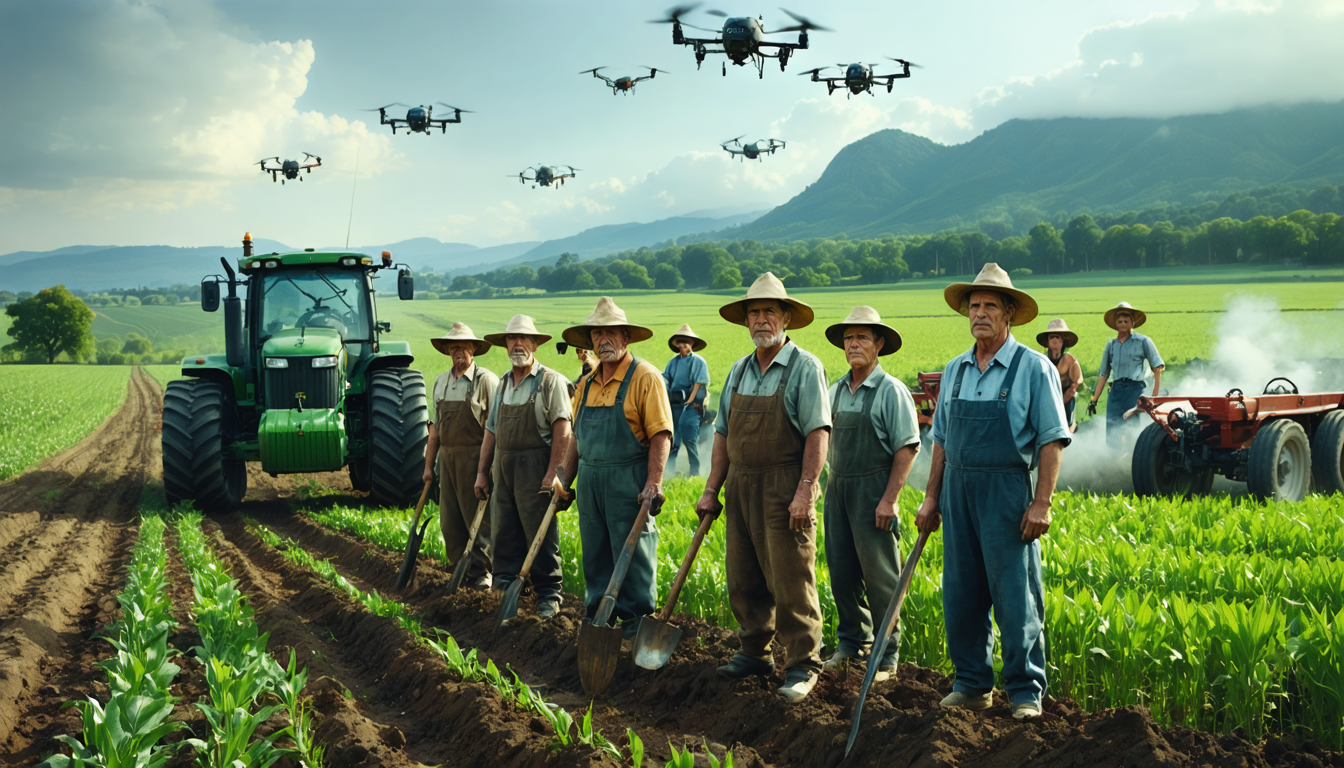
Beyond economic, environmental, and patrimonial considerations, farmers’ resistance to data center installations highlights a fundamental issue: food sovereignty. Agricultural lands are not only real estate assets; they represent the basis of a local and national food system ensuring essential nourishing production.
Globalization has increased dependence on sometimes fragile and vulnerable food circuits. The growing artificialization of these lands undermines regions’ ability to produce autonomously, preserve traditional farming methods, and guarantee food security in the face of climatic, economic, or health crises.
These farmers, often heads of family farms, defend a model rooted in ancient practices respectful of soils, resources, and communities. They consider that yielding to digital giants would widen a gap between technological modernity and ground realities, going against sustainable and responsible natural resource management.
This is a genuine form of resistance to technological globalization, where artificial intelligence would not only be a vector of innovation but also a factor of artificialization and fragmentation of the territory.
Political stakes and institutional responses to rising tensions in rural areas
The massive refusal of many farmers to sell their land to data center promoters has not gone unnoticed. It has sparked debates within institutions and local authorities. Some rural communities have announced intentions to adopt zero net artificialization policies to more strictly regulate the conversion of agricultural lands into technological infrastructures.
On their side, organizations such as Inrae have faced contestations, proving that the issue goes beyond mere economic stakes to touch on deep values linked to rurality. Exchanges with agricultural unions, notably the FNSEA, have intensified to find a balance between technological innovation and territory preservation.
However, concrete solutions still seem insufficient in the face of exponential demand for land. Farmers call for more consultations, better consideration of environmental issues, and explicit recognition of the fundamental role of traditional agriculture in land planning.
Some measures envisaged or already in place:
- Regulation of land sales to technology companies
- Creation of protected areas dedicated to traditional agriculture
- Promoting young farmers’ installation through targeted aids
- Integration of environmental imperatives in installation projects
- Strengthened dialogue between digital actors and rural communities
Limits of artificial intelligence expansion without agricultural lands: a challenge for cloud giants
Without the necessary spaces to build their infrastructures, the ambitions of major digital players face concrete obstacles. Even heavyweights like OpenAI encounter growing difficulties in increasing their computing capacity. The exponential growth in demand for artificial intelligence comes into tension with geographical and environmental constraints.
The question arises in these terms: how will we continue developing increasingly data- and energy-hungry technologies if access to rural lands is limited? This tension tests the viability of a technological advance disconnected from territorial and ecological realities.
Thus, farmers’ resistance is not reduced to a simple local conflict but illustrates a real physical and political limit to technological globalization. Without compromise, the deployment of artificial intelligence could be hindered by the defense of anchored and respectful agriculture of its lands.
Why do farmers refuse to sell their land to AI projects?
They prioritize the preservation of their family heritage, traditional agriculture, and the environmental impacts linked to data centers. The money offered does not compensate for these values.
What are the main environmental impacts of data centers in agricultural areas?
High electricity and water consumption, pollution of aquifers, and fragmentation of natural habitats, which durably affect local ecosystems.
How does the rise in land prices influence agricultural succession?
Price inflation makes land access more difficult for young farmers, threatening the transmission of family farms and food sovereignty.
Do data center projects create many jobs in rural areas?
They generate a significant number of temporary jobs during construction, but only about fifty permanent jobs, often insufficient to compensate for negative effects.
What do communities do to protect agricultural lands?
Some adopt zero net artificialization policies, regulate land sales, and create protected zones to preserve traditional agriculture.