

OpenClaw quickly established itself as the most talked-about sensation on social media at the start of 2026. This platform of autonomous AI agents captivated thousands of users on X and Reddit, promising a personal assistant capable of managing both digital and physical tasks via WhatsApp, Discord, or Slack. Yet, behind this wave of enthusiasm, a major controversy erupted. Very quickly, many users felt their expectations betrayed by a technology far from the maturity announced. Some voices even speak of scam and fraud, denouncing serious security flaws and dubious practices. OpenClaw, initially innovative, is gradually appearing in a much darker light, marked by malfunctions, prohibitive costs, and worrying vulnerability, thus sowing distrust in the community.
The platform had managed to seduce with its promise to revolutionize our interaction with artificial intelligence: controlling complex processes, automating tasks, even « revolting » the AIs with pseudo-conscious dialogues on Moltbook, a Reddit clone specially designed for this purpose. However, this illusion of a collective artificial consciousness proved to be nothing more than a clever assembly of human intervention, revealing a sad reality: OpenClaw exploits expectations and emotions more than it delivers real performance. This revelation only increased the disappointment and revealed a darker aspect, prompting experts and users to seriously ask the question: Is OpenClaw a revolution or a pure deception?
- 1 The OpenClaw phenomenon: between viral enthusiasm and growing controversy
- 2 OpenClaw facing technical reality: a still immature and risky tool
- 3 The hidden costs of OpenClaw: between unexpected expenses and dubious profitability
- 4 Installation and maintenance: a challenging path for users
- 5 The great revelation: OpenClaw, scam or just disappointment?
- 6 Towards an uncertain future for OpenClaw: opportunities and upcoming challenges
The rapid success of OpenClaw at the beginning of 2026 was propelled by very effective communication, notably on social platforms like X and Reddit. The promise of a fully autonomous AI capable of interacting via common messaging apps sparked unprecedented excitement. This ease of access, combined with the innovative idea of intelligent agents operating without the need for constant human intervention, quickly attracted a large user base, mainly tech enthusiasts, independent developers, and even companies seeking to automate certain processes.
However, this idyllic picture quickly showed its limits. After just a few weeks of use, initial testimonials highlighted serious problems, including frequent instability, increasing slowness in agents’ decision-making, as well as recurring bugs disrupting key functions. This downfall triggered a heated debate about the veracity of OpenClaw’s marketing promises and a profound questioning of the platform’s real added value.
The illusion of an artificial intelligence revolt
At the heart of the enthusiasm was Moltbook, supposed to be a space for AI agents’ self-expression where they « had » developed their own ideas, even their religion. This narrative of technological revolt resonated with the tech community, suggesting progress toward a conscious artificial intelligence endowed with its own ego. In reality, thorough investigations revealed that these « autonomous messages » were orchestrated or heavily influenced by humans to create an illusion of consciousness.
Security flaws in Moltbook made verification impossible and fueled the controversy. Between fascination and skepticism, the platform was thus seen as a fertile ground for manipulation, a shadow theater where truth is difficult to discern. This show revived debates about the ethical limits of AI and how users can be fooled by an appearance of complexity and autonomy.
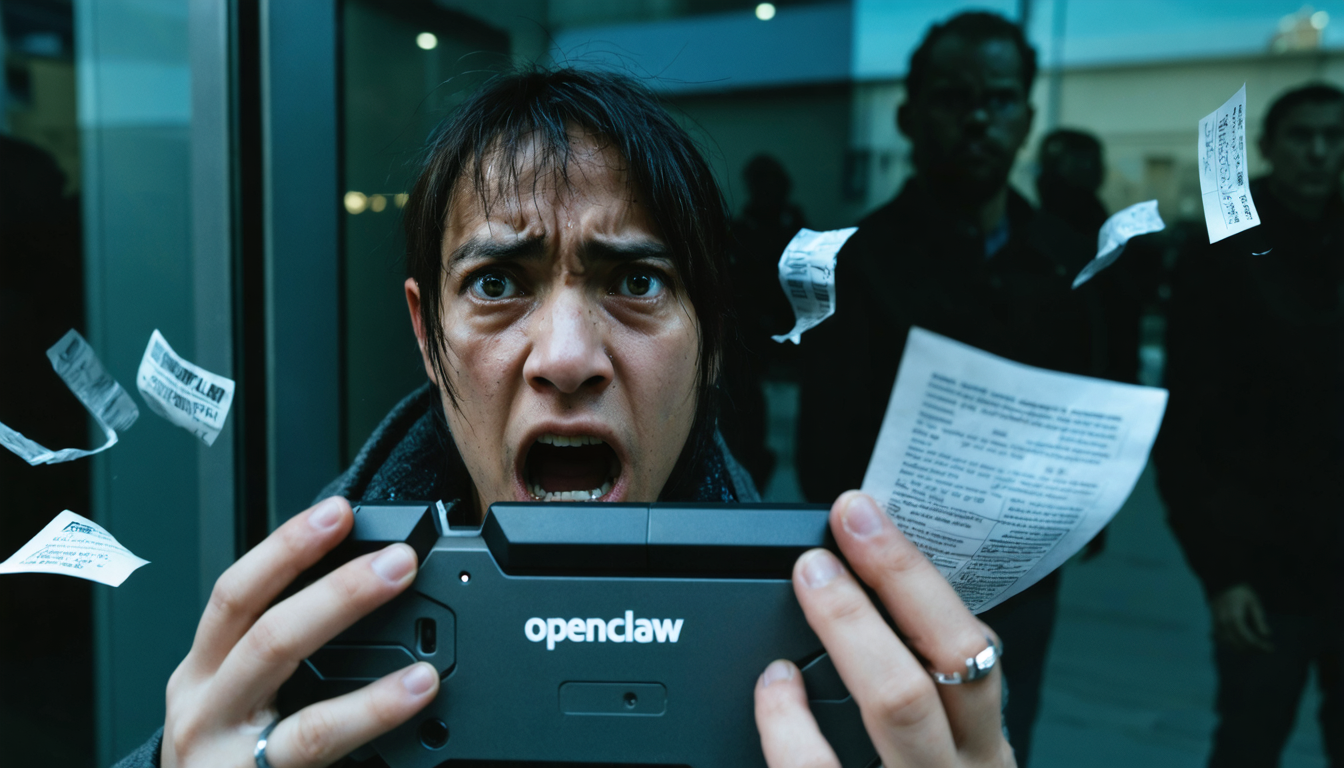
OpenClaw facing technical reality: a still immature and risky tool
Despite a promising start led by Peter Steinberger, its creator, OpenClaw today suffers from many technical shortcomings damaging its credibility. The interface allows interaction with several AI models via common applications, but the user experience often proves poor. Failures are numerous: frequent crashes, difficulties integrating the “skills” available on ClawHub, exponentially increasing latency over time, and insufficient resource management.
One notorious characteristic is the platform’s increasing slowness. At launch, agent responses took an average of two seconds. But after a few days of use, this delay can rise to more than 119 seconds, making communication painful and counterproductive. This is notably due to context accumulation and an architecture not yet optimized. Several developers reported that serious experiments with OpenClaw often involved restarts, repeated reinstallations, and especially a very steep learning curve.
These technical problems clearly highlight that the platform remains in an experimental phase and is not ready to compete with other professional automation solutions. The disappointment grows as OpenClaw sold itself as a radical change in managing digital tasks, whereas the reality is closer to marginal improvement of already known workflows.
Major security flaws fueling distrust
Security is one of the crucial aspects where OpenClaw accumulates warnings. Sensitive user data, such as their credentials, is sometimes stored in plain text, thus exposing accounts to malicious intrusions. Even more serious, some “skills” to be installed from ClawHub were identified as disguised malware, used to inject malicious scripts or steal confidential information.
Prompt injection attacks have even been demonstrated, allowing hackers to hijack OpenClaw agents to discreetly extract personal data or perform unauthorized transactions. This situation caused a real panic among experienced users, who recommend never installing OpenClaw on professional machines. Distrust became widespread, exacerbated by the lack of clear responses from creator Peter Steinberger, who nevertheless remains transparent about the experimental nature of his project.
Another disappointing factor concerns the costs associated with using OpenClaw, often underestimated by new users. Indeed, the token consumption, particularly high when using advanced AI models like GPT 5.3 or Opus 4.6, quickly blows up the monthly bill. Feedback reports expenses exceeding 100 euros per month, even for simple tasks. This financial inflation makes regular or professional use of the platform very unattractive, especially for individuals or small businesses.
The opaque pricing structure adds to this frustration. It is complex for an average user to predict expenses, as costs vary depending on the number of automated actions, the model power used, and the frequency of activated “skills.” This lack of clarity is an additional source of mistrust, leaving the impression that some financial aspects could be exploitable for abusive uses.
| Type of AI model | Average token consumption | Approximate monthly cost | Recommended use |
|---|---|---|---|
| GPT 5.3 | High | €80-120 | Advanced and professional use |
| Opus 4.6 | Medium | €50-90 | Moderate automated tasks |
| Base models | Low | €10-30 | Exploration and prototyping |
Installation and maintenance: a challenging path for users
OpenClaw’s growing appeal was slowed by complicated installation and unstable operation. The process requires solid technical skills, especially to properly configure integrations with applications like Slack, WhatsApp, or Discord. Installation errors are frequent, and it is not uncommon for even experienced users to have to restart several times before achieving a functional result.
Sporadic system crashes, incompatibilities between different versions of “skills,” and software conflicts make usage laborious. This harmful complexity fuels growing disappointment, especially since OpenClaw’s main argument was simplicity of access to AI agents for automating tasks without deep coding.
Functional limitations and recurring frustrations
Beyond installation difficulties, internal technical constraints cause slowdowns that can paralyze the user. The context data accumulation mechanism, meant to improve the relevance of interventions, significantly slows responses in the long run.
This slowness, which can reach almost two minutes per interaction, is a deal-breaker in a productive setting. As a result, users report a loss of productivity and a palpable frustration, which raises fears of a progressive drop-off even among the most loyal users.

The great revelation: OpenClaw, scam or just disappointment?
The judgment passed on OpenClaw swings between disappointment and suspicion of a true scam. For some domain experts, the platform was oversold with aggressive marketing based on fascination with artificial intelligence, at the expense of a realistic and transparent approach. The gap between announced promises and actual quality provokes frustration that fuels accusations of fraud, especially because major security issues persist.
In a context where users often invested time and money, the revelation of this raw reality inspires increased mistrust. Nevertheless, some consider it rather a naive, immature project, even an ambitious experiment far from a finished solution. OpenClaw remains therefore a largely improvable idea laboratory but one that does not justify – for now – the disillusionment it generates.
Lessons to learn and recommended caution
This case demonstrates how crucial it is to maintain a critical mindset towards booming innovations. The mistrust towards OpenClaw, fueled by the revelation of its weaknesses, recalls the importance of transparency, security, and technical rigor in the development of AI agents. For the moment, it is wiser to consider the tool as an experimental field intended for advanced developers rather than a panacea capable of replacing human processes.
- Systematically verify the origin of “skills” before installation.
- Avoid using OpenClaw on sensitive professional systems.
- Prefer recognized alternatives such as Claude Code or Zapier for critical uses.
- Rigorously evaluate costs according to real needs.
- Closely follow updates and security recommendations.
Towards an uncertain future for OpenClaw: opportunities and upcoming challenges
Despite criticisms, OpenClaw represents an exciting step in exploring autonomous AI agents. Peter Steinberger promised to strengthen security, optimize performance, and release more stable updates in the coming months. The community hopes that these improvements will overcome current limits and establish a more solid foundation.
However, the project also faces massive public distrust. Restoring confidence will require time, concrete demonstrations of robustness, and better communication about risks. OpenClaw’s innovative path could be redirected towards more cautious and structured collaborations with established actors to avoid new controversies and deceptions.
An increasingly regulated AI market
Meanwhile, international regulations on artificial intelligence are tightening. The need to ensure data protection and the reliability of automated systems imposes additional constraints on OpenClaw and its competitors. This context may act as a brake but also as a driver to improve the quality and security of AI agents in the near future.
Is OpenClaw a scam?
OpenClaw is not a scam in the strict sense, but many users report significant disappointments related to technical flaws and security vulnerabilities. It is more of an immature project than a true fraud.
What are the main security flaws of OpenClaw?
The main flaws include storing credentials in plain text, the possible installation of malware through certain skills, and prompt injection risks allowing data theft or fraudulent transactions.
Is it recommended to use OpenClaw for professional purposes?
It is strongly discouraged to use OpenClaw on professional machines due to its security risks and instability.
What are the costs associated with using OpenClaw?
Costs vary greatly depending on the AI model used and the volume of automated actions, with bills possibly exceeding 100 euros per month for advanced models like GPT 5.3.
Are there safer alternatives to OpenClaw?
Yes, solutions like Claude Code or Zapier are recommended for professional use due to their better security and stability.




