
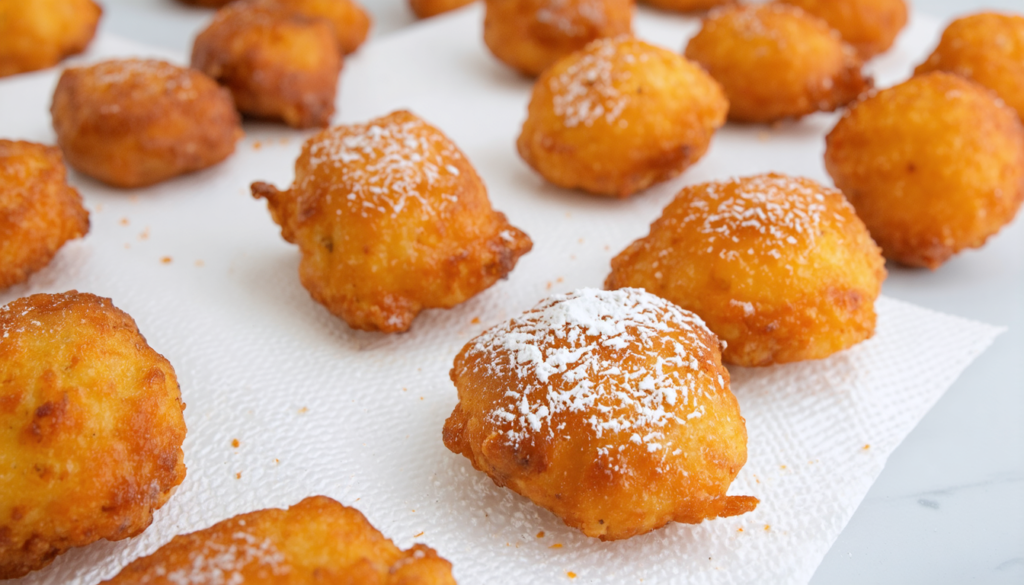
In the colorful and vibrant alleys of Venice, during the festive carnival season, a culinary tradition has been preserved for centuries: that of Italian carnival fritters. These golden delights, crispy on the outside and incredibly light on the inside, are much more than simple pastries. They embody a true moment of sharing and family transmission, a secret recipe carried through generations. My grandmother, originally from the Venetian region, carefully maintains this gourmet tradition passed down from her great-grandmother who was a pastry chef. Each year, her fritters enchant our taste buds and fill the house with the scent of citrus and spices, symbols of a rich and authentic culinary heritage. These frittelle, as they are called in the local dialect, reflect an era when the simplicity of ingredients blends with rigorous technique to give birth to a sweet treat that delights young and old alike. Today, I reveal the secret recipe, the one that makes all the difference, so that you too can offer your family and friends the unique taste of a timeless Italian tradition.
- 1 The key ingredients of the secret recipe for Italian carnival fritters
- 2 The detailed preparation: steps to succeed in the risen dough of the Italian tradition
- 3 The secrets of frying and the final touch for successful fritters
- 4 The tradition of carnival fritters in Italian families: much more than a pastry
- 5 The perfect match: choosing the ideal drink to accompany Italian carnival fritters
The key ingredients of the secret recipe for Italian carnival fritters
The preparation of these fritters requires careful selection of ingredients, essential to achieving that airy texture and delicate aroma that characterize my Italian grandmother’s secret recipe. Each component plays a crucial role, not only in flavor but also in the consistency and structure of the dough. Here is a detailed overview of the essential components:
- Type 00 flour: this Italian flour, of incomparable fineness, is the indispensable base. It gives the fritters remarkable lightness.
- Fresh eggs: they bring richness and structure to the dough while helping to bind the other elements.
- Powdered sugar: measured precisely for a perfect balance between sweetness and subtlety.
- Butter, melted but not hot, for a soft texture.
- Warm whole milk: activates the yeast while hydrating the dough.
- Dehydrated baker’s yeast: key element for an airy risen dough that reveals a light crumb.
- Citrus zest (organic lemon and orange): their fresh and natural scent is the secret of this recipe that invites indulgence.
- Amber rum: a subtle touch that enhances the aromas and helps preserve the freshness of the fritters.
- Fine salt and powdered vanilla: to perfect the balance of flavors.
- Sunflower oil for frying, chosen for its neutrality and ability to reach a stable temperature.
- Powdered sugar, sprinkled when serving for a melting sweetness.
The quality of these ingredients is crucial: the flour must be freshly sifted, the eggs should be at room temperature, and the zest used must come from organic citrus to preserve their essential oils without pesticides. This attention to every detail transforms a simple pastry into a true festive treat, unique to the Italian carnival tradition.
| Ingredients | Quantities (for about 8 people) | Role in the recipe |
|---|---|---|
| Type 00 flour | 300 g | Base of the dough for a light texture |
| Eggs | 3 pieces | Provides structure and richness |
| Powdered sugar | 80 g | Balanced sweetness |
| Melted butter | 50 g | Soft texture |
| Warm whole milk | 150 ml | Hydration, activation of the yeast |
| Dehydrated baker’s yeast | 7 g | Dough rising |
| Lemon and orange zest | 1 piece each | Fresh and natural aroma |
| Amber rum | 30 ml | Aromatic lift and preservation |
| Fine salt | A pinch | Flavor balance |
| Powdered vanilla | 1 sachet | Subtle aroma |
| Sunflower oil | About 1 liter | Frying |
| Powdered sugar | 100 g | Final glaze |
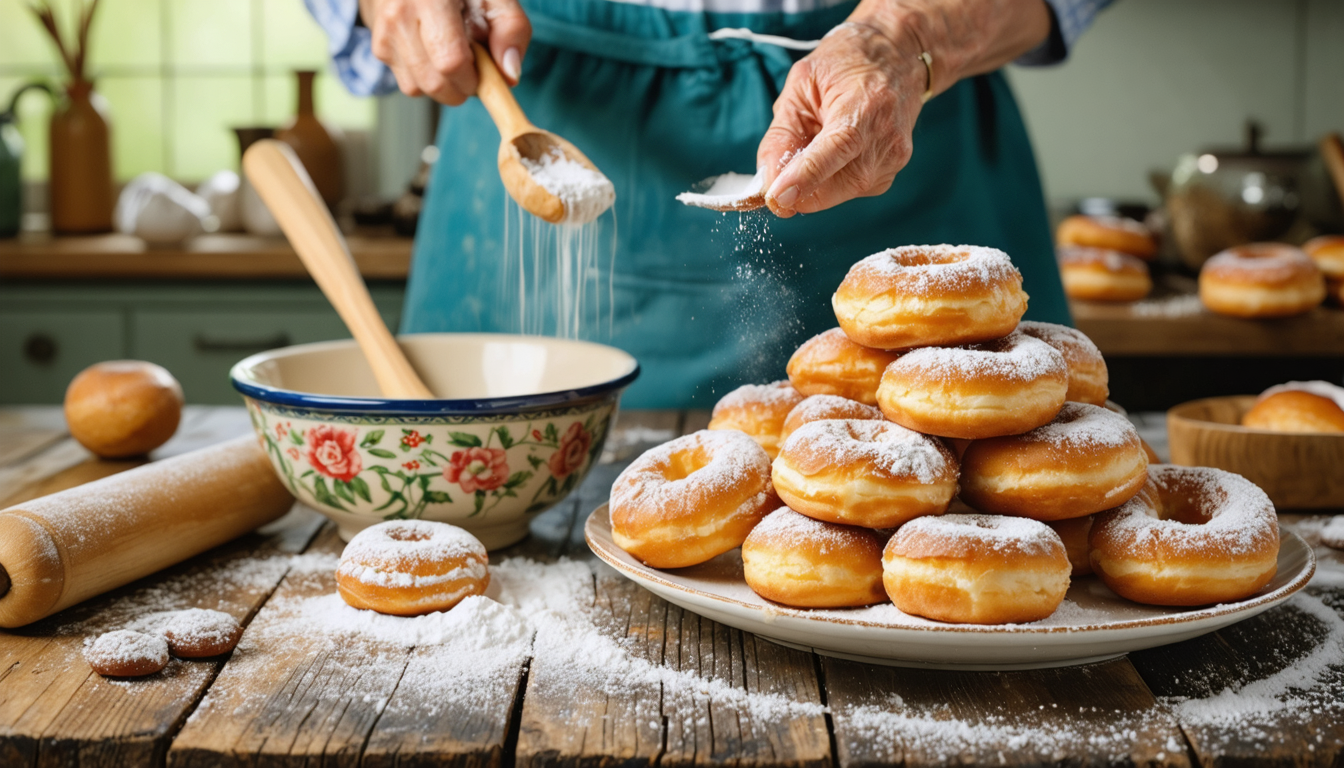
The detailed preparation: steps to succeed in the risen dough of the Italian tradition
The key to success for these carnival fritters lies in a perfectly mastered risen dough, developed with patience and precision, a true ancient secret recipe. Every step is important to guarantee a light, soft, and slightly flavored dough. Here is how to proceed, step by step:
Activating the yeast
Start by warming the milk to about 37 degrees Celsius, an ideal temperature close to that of the human body, promoting the life of the microorganisms in the yeast. In a small bowl, pour this warm milk then add the dehydrated baker’s yeast. Mix gently and let rest for about 10 minutes. You will see small bubbles appear, a sign that the yeast is activated and ready to make the dough rise. This step is essential to ensure optimal texture development.
Mixing dry and wet ingredients
In the bowl of your stand mixer or a large mixing bowl, sift the type 00 flour to avoid lumps and obtain a light dough. Add the sugar, fine salt, and vanilla. In the center, make a well where you will gently crack the eggs one by one. Then, pour in the milk-yeast mixture, the butter previously melted and cooled, and the amber rum. Finely grate the lemon and orange zest over the mixture to release an intense and natural citrus aroma.
Manual or mechanical kneading
Using the hook of your mixer or your hands, knead the dough for about 8 to 10 minutes. You should obtain a supple, slightly sticky, and elastic dough that detaches from the sides of the bowl but remains malleable. If the dough seems too liquid, add a little flour; if too stiff, add a little warm milk. This kneading activates the gluten, guaranteeing an airy and soft dough. This step, which requires some effort and patience, is crucial for optimal texture.
The dough rising, a crucial step
Form a ball of dough and place it in an oiled bowl to prevent sticking. Cover tightly with cling film and over the top with a clean cloth. Place the bowl in a warm area, away from drafts. My grandmother used to place it near a radiator in winter or in the switched-off oven with just the light on. Let rest for at least 2 hours, until the dough doubles in size. This fermentation gives the fritters their lightness and develops their subtly complex aromas.
The care given to these steps highlights the richness of the family know-how, passed down from generation to generation, and the passion for this secret recipe that makes the Italian carnival fritters famous in my family.
The secrets of frying and the final touch for successful fritters
Frying is undoubtedly the most delicate phase in the making of these Italian treats. My grandmother, with her experience, found the perfect balance between a crispy and soft texture. Let’s look at the techniques to achieve this long-awaited cooking.
Controlling the oil temperature
Pour about a liter of sunflower oil into a fryer or a large pot. It is essential that the oil bath is at least 8 cm deep to allow the fritters to float freely. Heat the oil to exactly 170 degrees Celsius, controlled with a cooking thermometer. This precise control prevents the fritters from burning on the outside while remaining raw inside.
Without a thermometer, a chef’s trick is to dip a small piece of bread into the oil: it should brown in 40 seconds to indicate the ideal temperature.
Cooking in small batches
For even cooking, gently drop 4 to 5 portions of dough into the hot oil. The fritter will quickly puff up and rise to the surface. Let cook for 2 to 3 minutes on each side, turning carefully with a slotted spoon, until achieving a beautiful uniform golden color. Avoid overcrowding the fryer, as this would lower the temperature and make cooking ineffective.
Draining and powdered sugar, the final touch
Once cooked, place the fritters on several layers of absorbent paper to eliminate excess oil. While still warm, generously sprinkle them with sifted powdered sugar. The sugar slightly melts on contact with the heat, forming a delicate glaze that enhances these treats. My grandmother sometimes liked to add a hint of ground cinnamon to the powdered sugar, adding a subtle spicy note that awakens the palate.
- Tip for frying: always monitor the oil temperature to avoid greasy or burnt fritters.
- Use two spoons or oiled hands to form regular portions of dough.
- Prefer unsalted butter and organic citrus for an authentic aroma.
- If desired, add soaked raisins and pine nuts in rum for a more traditional version.
- Store the fritters in an airtight box, but preferably consume the same day.
The tradition of carnival fritters in Italian families: much more than a pastry
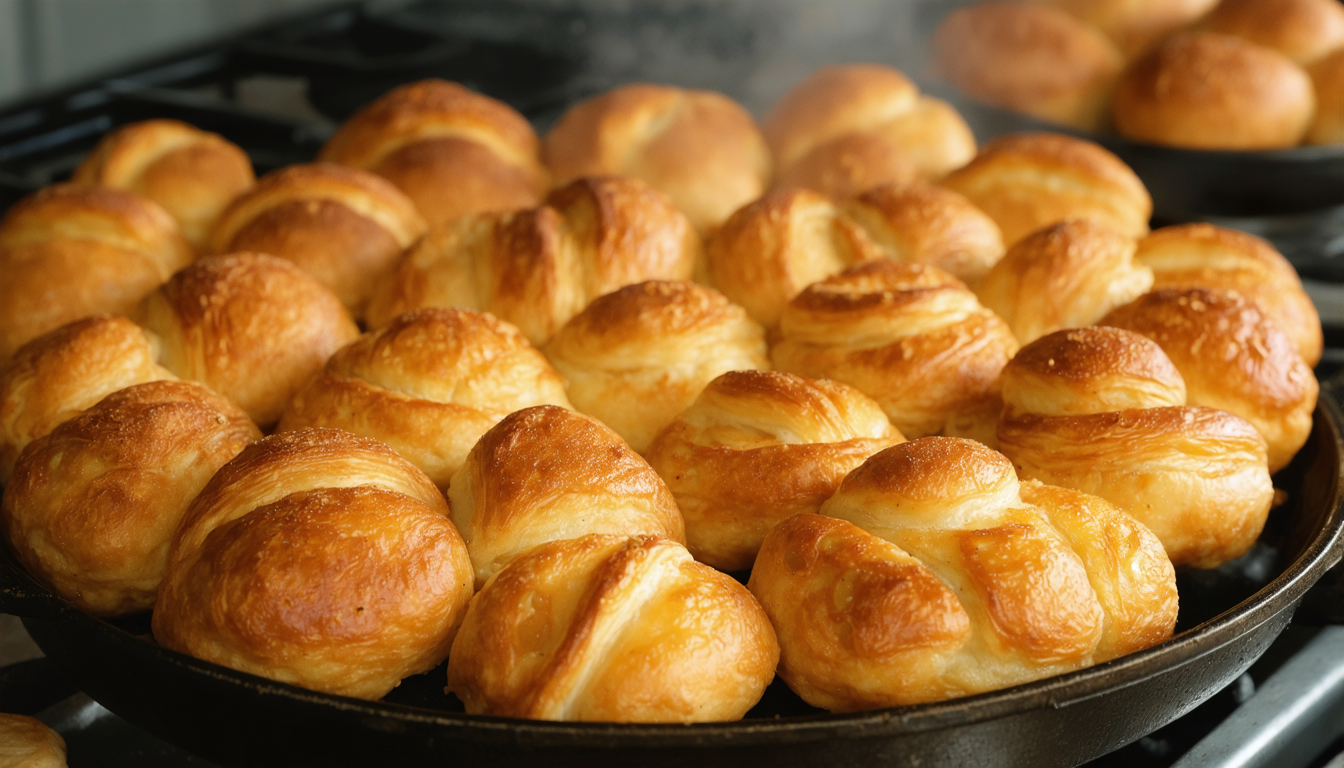
Carnival fritters embody a rich tradition, deeply rooted in Italian customs. Each region, each family, has its own secret recipe and variants, witnesses to the history and cultural diversity of Italy. In my family, this sweet treat signifies reunion and sharing. It evokes rainy Sundays spent in the crowded, laughter-filled kitchen, while the dough was gently rising.
The different regional names
Depending on their origin, these fritters have various names:
- Frittelle in Veneto, characterized by their citrus aroma and light texture.
- Chiacchiere in southern Italy, thin and crispy, often sprinkled with powdered sugar.
- Castagnole in Emilia-Romagna, small golden balls often flavored with lemon or orange zest.
- Bugie in Piedmont, another delicate and sweet version to celebrate carnival.
An old school story with ancient roots
The very concept of these pastries dates back to Roman times, when frictilia were consumed during the Saturnalia, pagan festivals marking the ancient calendar. In the Middle Ages, the tradition was preserved in the form of fritters, allowing the use of reserves of butter, sugar, and eggs before Lent began. In Venice, the carnival was an occasion to wear colorful masks and buy these frittelle from fritoleri, specialized street cooks.
The transmission of the secret recipe was done from mother to daughter, reinforcing family and cultural ties. This rare know-how still marks the start of the year with intact passion. In my family, this pastry is much more than a simple dessert: it is a treat that tells a story, revives childhood memories, and strengthens the feeling of belonging to a millennial tradition.
The perfect match: choosing the ideal drink to accompany Italian carnival fritters
To perfect this indulgent moment, the chosen drink plays an essential role. An Italian tradition wouldn’t be complete without a pairing that reflects the sweetness and conviviality surrounding these carnival fritters. Here are some suggestions to enhance every bite.
Prosecco, a refined classic
Prosecco, with its delicate fine bubbles and fruity taste, is a perfect match. Served chilled between 6 and 8 degrees Celsius, it wonderfully balances the greasiness and sweetness of the fritters, offering a refreshing and festive sensation. In 2026, Prosecco remains the most popular sparkling Italian drink to accompany festive moments, notably the carnival.
Non-alcoholic options for all ages
For children and those who prefer to avoid alcohol, a non-alcoholic spritz made from blood orange juice and sparkling water lightly and freshly revives the Venetian spirit. This subtly tangy mix perfectly complements the delicate flavor of the fritters, allowing the whole family to share this moment.
A winter indulgence: cioccolata calda
Finally, for cooler afternoons, nothing beats a cioccolata calda, this Italian hot chocolate, rich and creamy, both sweet and comforting. Its velvety texture delicately contrasts with the lightness of the fritters, bringing a touch of comfort to this traditional pleasure. This pairing makes perfect sense in the colder months, a widely appreciated nod during less mild carnivals.




