
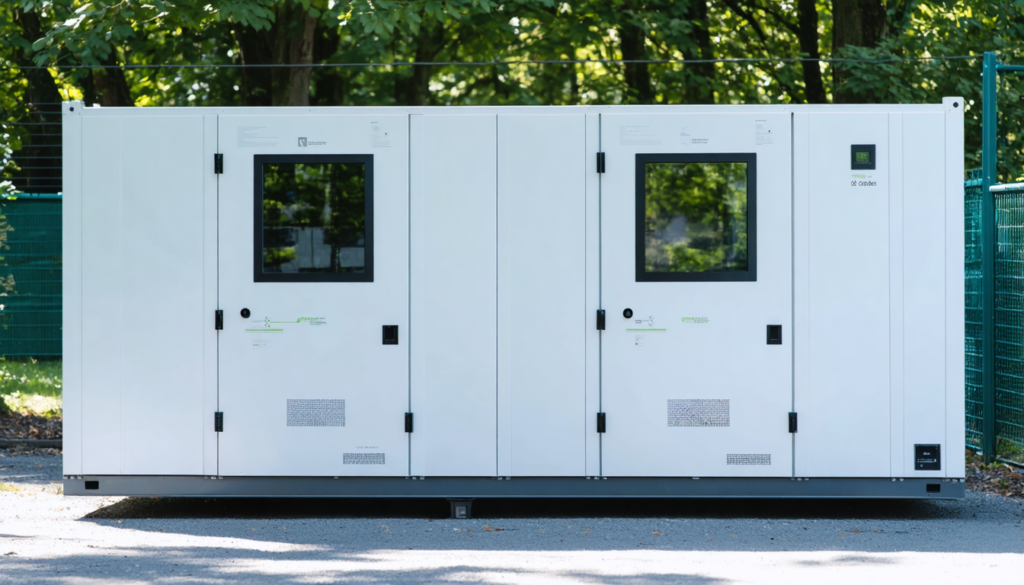
Faced with the rise of the energy transition, energy storage is now becoming a major challenge. While electric vehicles still attract significant attention, another segment is increasingly drawing investors: home batteries. Lunar Energy, a young American company, embodies this revolution. Founded six years ago, the California-based startup has just announced a spectacular fundraising round of 232 million dollars, consolidating its position among the key players in stationary storage. This financial operation not only marks a turning point for the company but also illustrates the rise of a clean technology aimed at sustainably transforming the way households manage their energy consumption.
With production deployed in California, Georgia, and the state of Washington, Lunar Energy relies on an innovative approach that combines modular capacity, software efficiency, and grid integration. The goal? To provide each home with the means to become a miniature power plant capable of responding to grid fluctuations, reducing energy bills, and optimizing the use of renewable energies. As public policies evolve, notably in the United States, the startup also relies on a favorable context for broader exploitation of these smart home batteries.
The fundraising, divided into two major rounds – a Series C round of 130 million dollars and a Series D round of 102 million – allows Lunar Energy to envisage significant scaling up. The company aims to increase from 20,000 units produced this year to a capacity of 100,000 units per year by 2028, while extending its footprint to strategic markets such as Texas, Puerto Rico, and Hawaii. These are regions where energy management needs are particularly urgent due to climatic hazards and disrupted electrical infrastructures.
- 1 The revolutionary impact of Lunar Energy on the home battery market
- 2 The major role of fundraising in Lunar Energy’s growth
- 3 Lunar Energy, a key player in the American energy transition
- 4 Challenges and stakes for Lunar Energy faced with global storage competition
- 5 The growing importance of home batteries in the overall energy strategy
- 6 Future prospects for Lunar Energy and home batteries
The revolutionary impact of Lunar Energy on the home battery market
The home battery market is undergoing profound upheaval thanks to the emergence of innovative technologies. Lunar Energy is fully part of this dynamic. Its solutions go beyond simple static storage: they become intelligent, communicative, and modular, allowing each household to play an active role in electricity management and distribution.
This innovation is largely driven by a modular design: each battery consists of independent 5-kilowatt-hour modules that can be assembled on demand to reach between 15 and 30 kilowatt-hours. This modularity meets the specific and evolving needs of users. Owners can thus start with a compact system and expand their installation according to their consumption or new requirements linked to their environment.
By integrating sophisticated virtual power plant software, Lunar Energy paves the way for coordination between multiple home batteries. This centralization balances flows between production, local consumption, and grid injection, especially during peak periods. Households thus become true players in the energy transition, capable of optimizing their produced solar energy, reducing dependence on the traditional grid, and even generating income by participating in demand response programs.
For example, a household equipped with Lunar Energy batteries in the state of Washington can store excess solar electricity during the day and redistribute it to the grid at times of highest demand, thus contributing to stabilizing regional electricity transmission. These concrete actions demonstrate the ability of this type of clean technology to transform consumers into consumer-actors.
Technical advances at the heart of Lunar Energy’s innovation
Beyond modular capacity, the real revolution lies in the intelligence embedded in these batteries. In addition to storage, the in-house software enables fine management of domestic devices, optimization of charge and discharge cycles, and anticipation of outages related to extreme weather conditions. Lunar Energy thus anticipates that its system will protect American households during violent storms or prolonged network interruptions.
This technology adapts to the real needs of users while integrating harmoniously into the electrical grid. It reduces consumption peaks through intelligent management of electric vehicle charging stations and household appliances, thereby smoothing overall demand and facilitating the integration of renewable energies. This level of automated coordination is now considered a necessary step for the success of the energy transition.
Lunar Energy’s technical innovations also rely on the robustness and reliability of the components used. Manufactured in the United States, the batteries benefit from an advanced production process, ensuring better durability against international competition. Moreover, the deployment strategy aims to maintain a balance between manufacturing quality and rapid capacity expansion, thanks to strategically located factories on the west coast and the southeast of the country.
In summary, Lunar Energy does not just offer a classic home battery: it places its technology at the heart of an intelligent, flexible, and resilient energy ecosystem, adapted to the demands of modern consumers and the constraints of an increasingly strained electrical grid.
The major role of fundraising in Lunar Energy’s growth
The recent 232 million dollar fundraising allows Lunar Energy to move to a new stage of its development. Thanks to these funds divided between Series C and Series D, the company benefits from significant financial input that will enable it to boost its industrial and commercial capacities.
In a context where clean technologies require heavy investments from the production phase, succeeding in such a round is a mark of confidence for investors. Activate Capital led the Series C financing with 130 million dollars, demonstrating strong conviction in the startup’s potential. Meanwhile, B Capital and Prelude Ventures led the Series D, adding an additional 102 million. Together, these rounds have brought the total raised by the company to over 500 million dollars since its creation.
These funds are essential to address two major axes. The first aims to increase production: Lunar Energy plans to manufacture 20,000 units by the end of the year and exceed 100,000 annual units by 2028. This ramp-up requires optimizing assembly lines, extending industrial capacities, and recruiting specialized technical profiles.
The second axis concerns commercial development. Lunar Energy now targets key pivotal markets such as Texas, Puerto Rico, and Hawaii. These areas, heavily affected by recurrent electrical outages due to climatic events, present a crucial need for home energy storage solutions. In-depth knowledge of these local specificities will allow the startup to adapt its offers and maximize its impact.
| Phase | Amount Raised (million dollars) | Main Investors | Objectives |
|---|---|---|---|
| Series C | 130 | Activate Capital | Strengthening production capacity |
| Series D | 102 | B Capital, Prelude Ventures | Commercial expansion into new markets |
This fundraising also reflects a broader investment trend towards stationary storage. As government incentives evolve, notably with a recalibration of aid for electric vehicle battery production, venture capital is turning towards home batteries, which offer immediate proximity to the consumer, autonomy gains, and genuine collective utility.
Lunar Energy, a key player in the American energy transition
Lunar Energy’s role goes beyond simply providing home batteries. The company fits into a strategic perspective where the energy transition is combined with grid resilience and the dynamization of renewable energies. Through its solutions, it addresses major challenges related to massive electrification and grid constraints.
The United States finds itself at an energy crossroads. Driven by favorable federal and regional policies, renewable energy production is intensifying, pushing for infrastructure adaptation. However, with increased consumption peaks, the need for flexible and scalable solutions becomes crucial. Stationary home batteries offer a pragmatic response by storing excess electricity and participating actively in demand management.
In this context, Lunar Energy’s technology, notably its virtual power plant, enables households not only to secure their power supply in case of failure but also to contribute to the overall stability of the grid. This collaborative approach between end users and grid operators illustrates a new form of energy economy, more decentralized and environmentally friendly.
Moreover, the startup also offers advanced home management features. The integrated software can remotely control electric vehicle charging or the use of household appliances to avoid consumption peaks. This intelligent management benefits consumers by reducing their bills and operators by improving infrastructure management.
In summary, Lunar Energy plays a pioneering role in integrating large-scale energy storage into the American residential fabric, contributing sustainably to grid modernization and the democratization of green energy.
Some key points illustrating Lunar Energy’s commitment:
- Development of virtual power plants allowing the pooling of battery capacity from several households
- Adaptation of systems to climatic conditions with outage anticipation
- Optimization of electricity consumption to reduce carbon emissions
- Rapid production expansion to meet growing demand
- Integrated approach combining quality hardware and intelligent software
Challenges and stakes for Lunar Energy faced with global storage competition
The home battery market now attracts a multitude of players, from innovative startups to industrial giants. Lunar Energy must face increasing competition, often embodied by companies with colossal financial and technological resources.
Among the most visible challengers are Base Power, which recently raised one billion dollars to accelerate its development. With spectacular rounds, this company also aims to redefine residential energy storage. Furthermore, Tesla remains an essential competitor thanks to its Powerwall range and its advanced integration with its virtual power plant. Tesla’s historical expertise, combined with the network effect created by its thousands of installations, gives it a strategic lead.
Redwood Materials, founded by a former Tesla executive, has also entered stationary storage, focusing on battery recycling and material circularity. The electromobility pioneer Ford also shows growing interest in this segment, announcing concrete initiatives to develop its own energy storage solutions.
In this context, Lunar Energy must capitalize on its own strengths: a modular technology adapted to various segments, scalable software, and American industrial presence. However, the battle looks tough, especially on costs, where Asian competition continues to weigh on pricing. Differentiation then passes through quality, resilience, grid integration capability, and after-sales service to convince clients and partners.
Strategies identified to remain competitive:
- Invest in software innovation to improve energy management and battery centralization
- Strengthen local production chain to reduce lead times and costs
- Establish strategic partnerships with energy suppliers and local stakeholders
- Incorporate user feedback to develop adapted features
- Communicate on sustainability and environmental impact of the solutions offered

The growing importance of home batteries in the overall energy strategy
Beyond the residential framework, stationary storage now establishes itself as a strategic element in managing electric grids. With the rise of intermittent energies such as solar and wind, grid flexibility becomes essential. Home batteries contribute to this flexibility through their capacity to store excess energy and release it at the right time.
This contribution is not only reserved for isolated cases. Thanks to virtual power plants capable of aggregating tens or even hundreds of thousands of home systems, it is possible to build powerful, distributed, and quickly mobilizable reserves. This modularity facilitates the scaling up of decentralized storage, providing a pragmatic response to energy demand fluctuations.
Grid operators increasingly identify home batteries as an alternative to building new traditional power plants, which are often expensive and greenhouse gas emitters. By limiting consumption peaks and supporting grid stability, these systems hold significant economic potential.
By integrating these elements into public policies, governments seek to accelerate adoption of these technologies. Renewed financial incentives and better market regulation now favor their large-scale deployment, putting pressure on manufacturers to achieve speed and efficiency.
Key advantages of home storage that reinforce its adoption:
- Significant reduction in electricity costs for households
- Increased energy autonomy thanks to on-site renewable energy storage
- Active participation in the stability and resilience of the electrical grid
- Reduction in CO2 emissions through optimized consumption
- Flexibility and quick installation thanks to system modularity
Future prospects for Lunar Energy and home batteries
Positioned at the forefront of energy innovation, Lunar Energy demonstrates a business model perfectly aligned with current and future market evolutions. With the energy transition accelerating worldwide, demand for effective, durable, and smart energy storage solutions is booming.
Among the development axes considered, Lunar Energy plans to intensify research on improving battery energy density, extending their lifespan, as well as deploying increased capacities in strategic geographic areas. This strategy is also supported by collaborations with research centers and universities, aiming to accelerate technical innovation.
The massive financing obtained with this 232 million dollar fundraising will also serve to strengthen the supply chain, secure essential materials, and optimize the manufacturing sector, thus limiting risks related to market volatility.
If the company achieves its ambitions, it could well reach or exceed a valuation on the order of one billion dollars, positioning Lunar Energy as an indispensable leader in the North American market and beyond, with potential export to other regions with strong energy demand.
In conclusion, Lunar Energy’s trajectory perfectly illustrates the rise of home batteries as a cornerstone of the energy transition, driven by robust innovation and financing.




