
In a global context where the race for artificial intelligence is reaching new heights, a Japanese startup is disrupting the technological landscape by claiming to have taken a decisive step toward a general artificial intelligence (AGI). Integral AI, based in Tokyo, claims to have developed an AI capable of learning like a human, without supervision, without predefined data, and without pre-imposed limits. This announcement challenges certainties, questioning the traditional monopoly held by American and Chinese giants in major innovations. The ambition is dizzying: to imitate human intelligence in its ability to adapt and develop through autonomous exploration, like a child discovering its environment.
This statement offers a fascinating perspective on the future of Japanese technology and opens a passionate debate on the very definition of AGI, its mode of operation, and its deep implications. Yet, Integral AI’s announcement remains shrouded in mystery, as no scientific evidence or public demonstration has yet validated their claims. It remains to be seen whether this breakthrough will mark a true technological revolution or a marketing masterstroke in a fiercely competitive market.
- 1 Integral AI and the promise of artificial intelligence with human-like intelligence
- 2 Japanese technology at the forefront of general artificial intelligence development
- 3 Robotic experiments: proof of unprecedented learning autonomy?
- 4 Debrief on Integral AI’s storytelling and strategy in the global AI ecosystem
- 5 Ethical and societal challenges of a general artificial intelligence with human-like intelligence
- 6 Essential caution in the face of a revolutionary announcement without public validation
- 7 Potential impact on the future of artificial intelligence and the global market
- 8 Key questions about general artificial intelligence: understanding Integral AI’s challenges
- 8.1 What is general artificial intelligence (AGI)?
- 8.2 What specificities does Integral AI claim for its AGI model?
- 8.3 Why does this announcement raise suspicion in the scientific community?
- 8.4 What are the potential impacts of an autonomous AGI on industries?
- 8.5 What precautions are necessary to regulate the development of AGI?
Integral AI and the promise of artificial intelligence with human-like intelligence
The emergence of an AGI, an artificial intelligence capable of generalist and autonomous learning, represents a goal long considered mythical in the AI field. Founded by Jad Tarifi, a former Google engineer, Integral AI aims to transcend the limitations of current models, which often rely on vast databases and human interventions for their learning. According to the startup, their revolutionary technology would allow their robotic systems to acquire new skills entirely through observation and experience.
This learning autonomy marks a turning point: unlike traditional artificial intelligences that require being fed labeled data, Integral AI’s AGI would rely on a mechanism inspired by human development. Like a child discovering an unknown environment by experimenting, the machine would be capable of gradually enhancing its intelligence without external assistance.
Integral AI thus presents an innovative definition of general artificial intelligence by focusing on three major criteria:
- Autonomous learning : The machine’s ability to learn without human intervention or prior data.
- Behavioral stability : Intelligence must master its skills without showing erratic or unpredictable behavior.
- Energy efficiency : Operation must be close to normal human energy consumption, thus avoiding the enormous costs generally associated with traditional AIs.
By precisely framing their definition, Integral AI aims to avoid classic semantic debates on what is or is not an AGI, while highlighting their technological advance. This approach recalls historical episodes such as the repeatedly claimed but not independently validated “quantum supremacy.”

Japanese technology at the forefront of general artificial intelligence development
The vision carried by Integral AI fits into a broader trend of AI innovation in Japan, a country recognized for its robotic expertise and mastery of embedded systems. Tokyo, where the startup is based, constitutes a strategic center that intelligently merges fundamental research and cutting-edge industrial applications.
Integral AI’s approach also seems to rely on architectures inspired by the human neocortex, seeking to reproduce cognitive complexity through layered structures allowing dynamic and evolving information management. This cognitive modeling aims to surpass classic supervised learning models to achieve fluid and adaptable intelligence.
The development of an AI with human-like intelligence poses considerable challenges in terms of integration, energy optimization, and security against unexpected behaviors. The Japanese startup claims to have solved these problems by establishing a rigorous framework ensuring safe and controlled learning. This would place Integral AI at the forefront of a future where robots would no longer be mere executors but autonomous agents capable of creative initiatives and unprecedented adaptations.
This desire to embed technology in a sustainable and responsible dynamic contrasts with the global trend that often favors very energy-hungry large models. Thus, this Japanese approach could mark a turning point in how artificial intelligence is conceived and deployed.
Robotic experiments: proof of unprecedented learning autonomy?
Integral AI highlights concrete experiments where their robots were able to learn new tasks without any human supervision. These machines would be capable of observing their environment, testing different actions, then evaluating results to maximize their skills. A total autonomy, unprecedented according to the founders.
In the scientific community, this claim is all the more revolutionary as it suggests a break with the current paradigm: machine intelligences still requiring massive human interventions to redirect their learning and correct their mistakes.
Moreover, the startup specifies that their software architecture reproduces certain principles of the cerebral cortex, offering a cognitive structure robust enough to manage complex and diversified learning. This process mimicking biological functioning would enhance the reliability and coherence of system behaviors.
However, despite these exciting promises, no scientific protocol nor validated results have yet been published. The community is therefore awaiting independent verification in the form of publications, video demonstrations, or reproducible benchmarks, which have become the norm in the sector.
Debrief on Integral AI’s storytelling and strategy in the global AI ecosystem
The birth of Integral AI, led by a former Google employee seeking absolute research freedom, offers a strong narrative that highlights Japanese innovation capacity far from the traditional hubs of Silicon Valley and Chinese centers. The geographical and technological positioning creates a powerful imagination around the link between advanced robotics and autonomous intelligence.
This carefully orchestrated storytelling relies on a pragmatic vision focused on applied robotics, avoiding brutal technological messianism. The startup presents its product as a pragmatic and responsible solution, in a country where energy is scarce, and where energy management of computer systems is a priority.
However, this staging also arouses some mistrust because it heavily relies on progressive disclosures via press releases rather than the rigorous publication of scientific results. The contrast is striking with the expectations of a complete technical dossier, the foundation of credibility in the advanced artificial intelligence field.
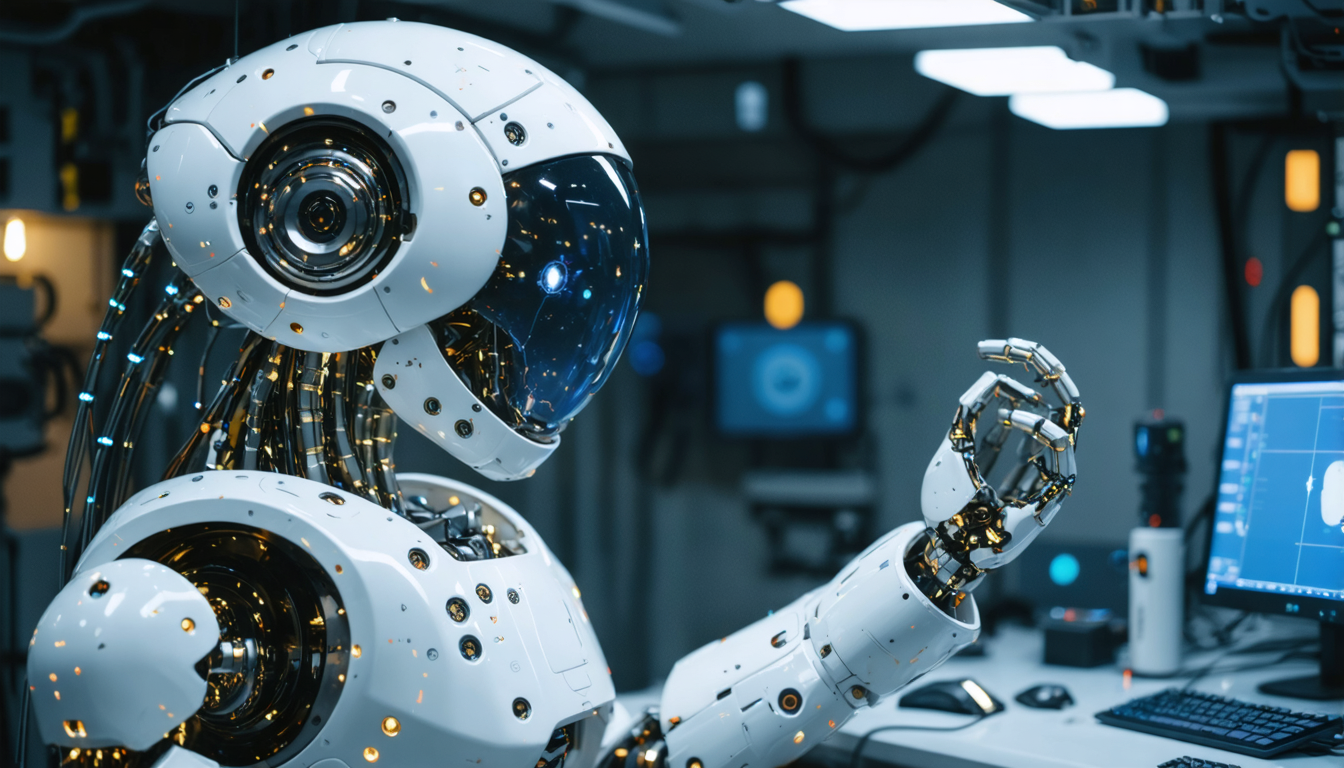
Ethical and societal challenges of a general artificial intelligence with human-like intelligence
If the promise of an AGI with human-like intelligence were realized, the implications would far exceed the technological sphere to affect all layers of society. The ability for a machine to learn without supervision raises important questions of control, responsibility, and regulation.
Adaptive robots would then become actors in a new economic, social, and political order. The question of their autonomy poses challenges concerning data protection, human interaction security, and the role of non-human intelligences in decision-making processes.
Such a change would require the development of appropriate legal frameworks, the establishment of international standards to guarantee peaceful coexistence between humans and artificial intelligences, as well as increased vigilance against possible abuses.
Moreover, this revolution could radically transform key sectors :
- Industry : Autonomous and adaptive robots would replace rigid automatons, improving flexibility and efficiency.
- Scientific research : AI capable of conducting its own investigations and discoveries without supervision.
- Education : New learning methods based on a bidirectional exchange between humans and AI.
- Medicine : Intelligent assistance and continuous adaptation to specific patient needs.
- Logistics : Dynamic optimization of flows thanks to adaptive machine intelligence.
This transformation would open a new chapter where machines would become true evolving partners of humanity.
Essential caution in the face of a revolutionary announcement without public validation
It is essential to maintain a critical view towards Integral AI’s claims. The scientific community reminds that no major breakthrough has been able to impose itself over the last decade without being rigorously evaluated and validated by peers. This lack of independent validation leads to skepticism, even if the proposed ideas remain exciting.
Premature announcements in the field of artificial intelligence are numerous, where disappointing or inaccurate results have ended up tempering the initial enthusiasm. That is why methodological rigor is more necessary than ever for AGI to become a credible subject.
Integral AI will therefore have to provide tangible evidence: detailed data, open experimentation protocols, public demonstrations under controlled conditions. Without this, the promise of a truly autonomous AGI will remain a dream or a marketing concept. Vigilance therefore remains essential in this intense race for technological revolution.
Potential impact on the future of artificial intelligence and the global market
If Integral AI’s advances were confirmed, the upheaval for the sector would be total. Robotics, traditionally confined to repetitive tasks, would enter an era of adaptability and continuous self-improvement, redefining the very nature of automated work.
The general artificial intelligence market would become an open competition ground where Japanese, American, and Chinese players would attempt to provide different answers to the growing complexity of economic and social needs. This situation would also stimulate investments and the necessary legislative support to master these technologies.
Here is a comparative table of the main characteristics between the advanced AGI advocated by Integral AI and traditional current AI:
| Criteria | Integral AI AGI | Traditional AI |
|---|---|---|
| Autonomous learning | Complete, without supervision or preexisting data | Dependence on labeled datasets |
| Behavioral stability | Control maintained and absence of chaotic behaviors | Risks of erratic behaviors depending on training data |
| Energy consumption | Compared to that of a learning human | Very high, requires enormous resources |
| Adaptation capabilities | High, continuous exploration and self-improvement | Limited to specific and fixed tasks |
| Envisioned applications | Robotics, research, education, medicine, logistics | Industrial automation, data processing |
A Japanese technology that could redraw the contours of global AI innovation
Integral AI’s positioning in the artificial intelligence landscape illustrates a surprising rise of Japanese technology facing the historical dominance of North American and Chinese actors. This scenario invites reconsidering the location of major innovations in this field.
The success of this startup could thus encourage other projects to emerge in an ecosystem that values both fundamental research and applied robotics, generating a dynamic conducive to the birth of a new technological era.
Key questions about general artificial intelligence: understanding Integral AI’s challenges
What is general artificial intelligence (AGI)?
An AGI designates an artificial intelligence capable of learning and adapting to any task, unlike specialized AIs that are limited to a specific domain.
What specificities does Integral AI claim for its AGI model?
Integral AI claims that its model learns completely autonomously, maintains behavioral stability, and consumes energy comparable to that of a learning human.
Why does this announcement raise suspicion in the scientific community?
Because Integral AI has not yet published rigorously controlled results, nor shared independent evidence on the real effectiveness of their technology.
What are the potential impacts of an autonomous AGI on industries?
Sectors such as robotics, medicine, logistics, and education could be profoundly transformed by the integration of machines capable of self-learning and continuous adaptation.
What precautions are necessary to regulate the development of AGI?
It is crucial to establish strict international regulations, clear ethical standards, and control mechanisms to ensure safe coexistence between humans and artificial intelligences.