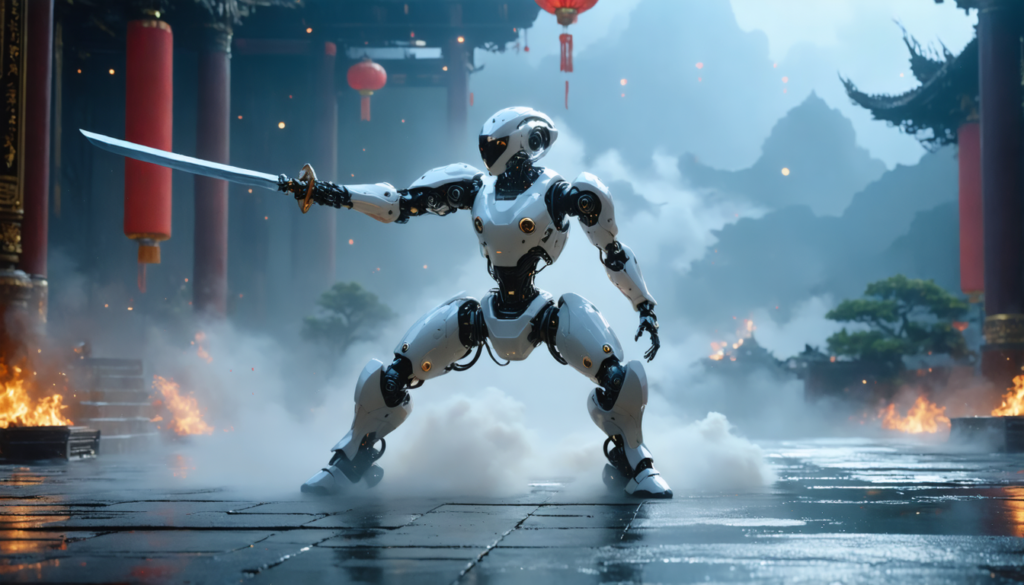
At the dawn of 2026, the global technological scene is shaken by a demonstration as spectacular as it is unsettling. During the Lunar New Year celebrations, a Chinese humanoid robot named Robotera L7, dubbed “Linghu Chong,” performed a complex fencing choreography, armed with a sword. This appearance is not just a simple aesthetic show: it symbolizes the convergence between tradition and high technology, while raising many questions about the future of robotics, autonomous weapon systems, and their geopolitical implications. Between engineering prowess and military stakes, this demonstration fuels the debate about the place of artificial intelligence in our societies and the risks it could pose for global security. In a context where China asserts its technological leadership against competitors like the United States, this unprecedented alliance between robotics and martial tradition could well mark the birth of a new era, where the future and connected weapons redefine the very notion of combat.
This innovation opens a vast field of reflections, both on technological advancements and their civil-military uses. The frequency of demonstrations by humanoid robots accurately performing kung fu or sword choreographies raises questions about the fine line between spectacle, symbolic power, and military developments. The scenario of a robot capable of such precise actions changes our vision of robotics, shaking the certainties about what we believe possible in physical manipulation, motor coordination, and the AI slowly integrated into these machines. At the crossroads of technological innovation, ethics, international security, and cultural soft power, the question is raised: how should we understand this fusion between advanced robotics and traditional weaponry, and what will be the consequences for our common future?
- 1 An unprecedented technological feat: the evolution of humanoid robots in China
- 2 The cultural symbolism and China’s soft power through armed robotics
- 3 The links between civilian and military robotics: a duality with crucial stakes
- 4 Major technical challenges in creating a humanoid robot armed with a sword
- 5 Geopolitical implications and security risks of armed robotization
- 6 Ethics and regulation: the growing debates on controlling armed robots
- 7 Futuristic perspectives and scenarios: towards a new robotic technological era?
- 8 Security challenges related to the integration of armed robots in military forces
An unprecedented technological feat: the evolution of humanoid robots in China
The Robotera L7, resembling a human, stands 1.71 meters tall and weighs approximately 65 kilograms, distinguished by a fluidity and mastery of movement of rare complexity. Behind this elegant silhouette, crafted from titanium and carbon fiber, lie cutting-edge technologies that push the boundaries of robotics. This biped offers a total of 55 degrees of freedom, distributed among 7 joints per arm and 12 in each hand, enabling precision and dexterity never seen before.
This robot is capable of maneuvers such as rapid running reaching 14.4 km/h, complex acrobatics including flips and 360° rotations, and, of course, the handling of a sword during a martial arts choreography. This demonstration is not just a simple stylistic exercise: it illustrates sovereign control of dynamic balance, a millimetric management of weapon inertia, and perfect timing to execute fluid movements while anticipating potential imbalances.
In barely three years, China has moved from the first clumsy robots to humanoids capable of choreographic performances worthy of the best human artists. This progression is explained by massive investment in artificial intelligence research, notably algorithms evaluating mechanical dynamics and motor coordination in real time. The startup Robotera, incubated at Tsinghua University in Beijing, epitomizes this rise, also integrating advanced sensor technologies for instantaneous feedback on the device’s positions.
This advance represents a crucial leap, not only for civilian robotics but also for the development of military applications, where precise mastery of complex actions in dynamic environments is a major requirement. The Lunar New Year demonstration is thus not isolated but fits into a global innovation strategy where technology, culture, and defense intersect in China.
The cultural symbolism and China’s soft power through armed robotics
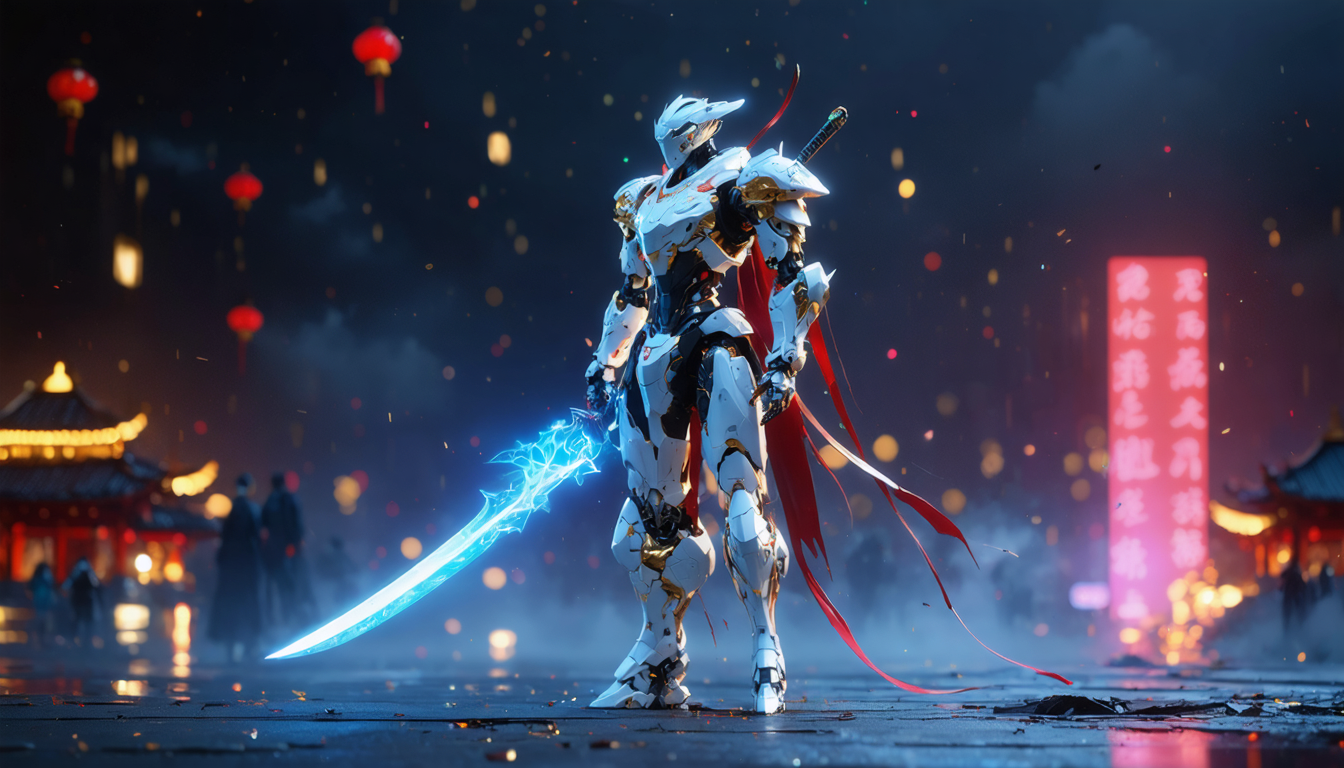
The Lunar New Year scene offered a powerful image where the ancient and modern merge. The sword wielded by Linghu Chong is not limited to a simple stage prop: it embodies a historical symbol laden with tradition, evoking Chinese martial arts and the philosophy of ancient warriors. This allegory, associated with a state-of-the-art robot, expresses China’s desire to assert its identity through technical innovation.
Beyond the spectacle, this demonstration is part of a smart soft power strategy, where technology becomes a vector of cultural and geopolitical influence. The 2026 Spring Gala, watched by over a billion people, did not only charm with the virtuosity of the robots but also allowed several Chinese companies — including Robotera, Unitree, and UBTECH — to showcase a fusion of cutting-edge robotics and centuries-old traditions such as kung fu and martial acrobatics.
This dual positioning aims to highlight two facets: first, China’s advanced technical capacity to master humanoid robotics with near-artistic finesse; second, the ambition to establish a narrative where China modernizes its heritage while dominating global innovations. This cultural-technological bet is a way to unite the country’s internal forces while imposing a model of excellence internationally.
At the same time, this display serves as an indirect demonstration for the international community, emphasizing that Chinese technology is not merely tinkered with in laboratories but is capable of combining potential military power with historical continuity.
The links between civilian and military robotics: a duality with crucial stakes
Behind the artistic choreography of the Robotera L7 lie applications with far more serious consequences, notably in the military field. The management of complex movements and the precise handling of weapons are transferable skills to combat robots. The example of the December 2025 presentation by the People’s Liberation Army (PLA) of a remotely operated combat robot illustrates this convergence.
Moreover, the deployment of armed quadrupeds equipped with LiDAR during amphibious exercises and the operational use of UBTECH’s Walker S2 for surveillance along the Vietnamese border demonstrate the growing power of robotic systems with a security vocation. These machines, insensitive to fatigue, fear, or pain, offer an undeniable tactical advantage through their endurance and precision on the field.
The exploitation of artificial intelligence allows these robots to anticipate enemy movements, adapt in real time to unforeseen situations, and operate semi-autonomously under human operator supervision. This highlights the dual nature of this technology, serving civil tasks while being directly transferable to future armed conflicts, thus challenging global ethical and legal frameworks.
This duality fueled by Chinese research envisions a future where armed robots would have a major strategic role, redefining the very nature of war. It is imperative to assess the risks linked to this rapid evolution without neglecting the potential benefits related to reducing human casualties on battlefields.
Major technical challenges in creating a humanoid robot armed with a sword
Designing a robot capable of wielding a sword with such skill requires overcoming considerable challenges. The management of the weapon’s weight, inertia, and coordination of movements are all technical obstacles. For example, handling a sword involves variable dynamic forces that must be anticipated and compensated for to avoid any fatal imbalance.
The Robotera L7 must also integrate real-time trajectory prediction and instantly calculate motor responses to adjust its posture. This complexity far exceeds simple classic robotic movements: it requires sophisticated AI algorithms capable of modeling real-world physics and executing extremely precise sensory feedback.
Furthermore, attention to joints and degrees of freedom is paramount. With 7 degrees per arm and 12 in the combined hands, the L7 can perform gestures as subtle as a handshake or a smooth sword deployment. This advanced robotics also uses cutting-edge materials that combine lightness and strength, essential to enable rapid movements while maintaining the required robustness during prolonged manipulations.
The technical challenges are also related to energy autonomy and thermal management. Even though this robot impresses with its feats, its battery limits its usage time, and its performance is restricted under harsh environmental conditions, showing that perfection is still far from being reached.
Geopolitical implications and security risks of armed robotization
The emergence of armed humanoid robots, such as Robotera’s, disrupts geopolitical balances. The spectacular Chinese demonstration reflects an intense technological race where the United States, Europe, and China compete to dominate the future of robotic weapon systems. The visibility given to these advances reinforces competitive pressure, fueling a climate of uncertainty and global strategic anxiety.
The major risk is the uncontrolled proliferation of such equipment, their ability to be modified for offensive uses without transparency or regulation. Without clearly defined international treaties, the spread of autonomous armed robots could exacerbate the arms race, increase regional conflicts, and reduce human control over lethal force usage.
Moreover, robots insensitive to fear or pain, and deployable massively with mere remote operators, make military engagements colder and dehumanized, raising strong ethical questions. The management of technical errors or malfunctions in this context could have dramatic consequences.
Finally, these developments force states to rethink their military doctrines, defense strategies, and technological surveillance mechanisms. By showcasing this ability to fuse advanced technology with millenary culture, China plays a key role in this global strategic renewal.
Ethics and regulation: the growing debates on controlling armed robots
As technology advances, ethical debates around armed robots intensify. In China as elsewhere, the issue of legal regulation arises acutely. How to frame machines capable of executing combat tasks with partial or full autonomy? What safeguards should be adopted to prevent these robots from becoming uncontrollable or being misused?
International discussions are emerging, placing transparency, respect for human rights, and the prohibition of fully autonomous lethal systems at the center of concerns. China has shown some openness by publicly acknowledging its advances and expressing the need for ethical laws to prevent reckless use. Nevertheless, military and strategic realities sometimes slow the progress of binding standards.
An aspect still little explored is the societal impact on work and human relationships. The gradual replacement of humans by robots in various functions, notably logistics or security, raises questions about employment and the place of machines in society. The example of Robotera L7, although spectacular, also raises this issue, highlighting the political and economic choices behind these innovations.
This complex debate calls for accelerated diplomatic convergences to prevent technology from becoming a factor in crises more severe than current conflicts.
Futuristic perspectives and scenarios: towards a new robotic technological era?
The spectacle of a robot armed with a sword is no doubt a precursor of a profound transformation. As artificial intelligences become more powerful and robots more autonomous, the line between science fiction and reality fades. Some experts imagine a future where human combat will be largely supplanted by battle-hardened robots capable of field operations without physical or emotional risk.
Scenarios envision mixed armies composed both of human soldiers and machines coordinated by centralized artificial intelligences. Others even speculate on the appearance of competitions where robots would face off in futuristic arenas, combining technical prowess and lethal efficiency, inspired by shows like the Chinese New Year spectacle.
This anticipation nonetheless raises crucial issues in terms of security, control, and trust. Who will resolve ethical conflicts on the battlefield? How to guarantee these machines remain under human control? These questions, currently at the heart of international reflections, will define the trajectory of this new technological era, where innovation and caution must coexist.
The integration of armed robots in military forces represents a colossal challenge on several levels, notably regarding security, reliability, and resilience against cyberattacks. Humanoid robots, such as the Robotera L7 equipped with a sword, feature complex interconnected systems making them potentially vulnerable to hacking or sabotage attempts.
Ensuring command reliability, secure communications between operators and machines, and the robots’ resistance to hostile environments are essential conditions for their deployment. The slightest error in this context can cause catastrophic consequences, ranging from collateral damage to uncontrollable escalation of hostilities.
Moreover, software protection is crucial to avoid hijackings that could transform these machines into uncontrollable weapons. States must invest heavily in developing dedicated security systems, strengthen their cybersecurity programs, and establish strict control protocols to limit risks.
Operator training and implementing even partial human supervision mechanisms remain indispensable to maintain control of these systems. At the same time, rapid intervention protocols in case of malfunction or cognitive attack must be established to prevent any disaster.
| Security Challenges | Proposed Solutions | Concrete Example |
|---|---|---|
| Vulnerability to cyberattacks | Advanced encryption and dedicated firewalls | Chinese military systems with reinforced anti-intrusion protocols |
| Communication reliability | Secure and redundant channels | Remote control of Walker S2 robots at the border |
| Resilience in hostile environments | Robust materials and integrated self-diagnostics | Amphibious exercise tests with armed quadrupeds |
| Human supervision | Specialized training and intervention protocols | PLA operators supervising robots in semi-autonomous mode |
Faced with these challenges, international collaboration in sharing best practices and coordinating standards is necessary to ensure a safe and controlled evolution of armed robots in the future.