
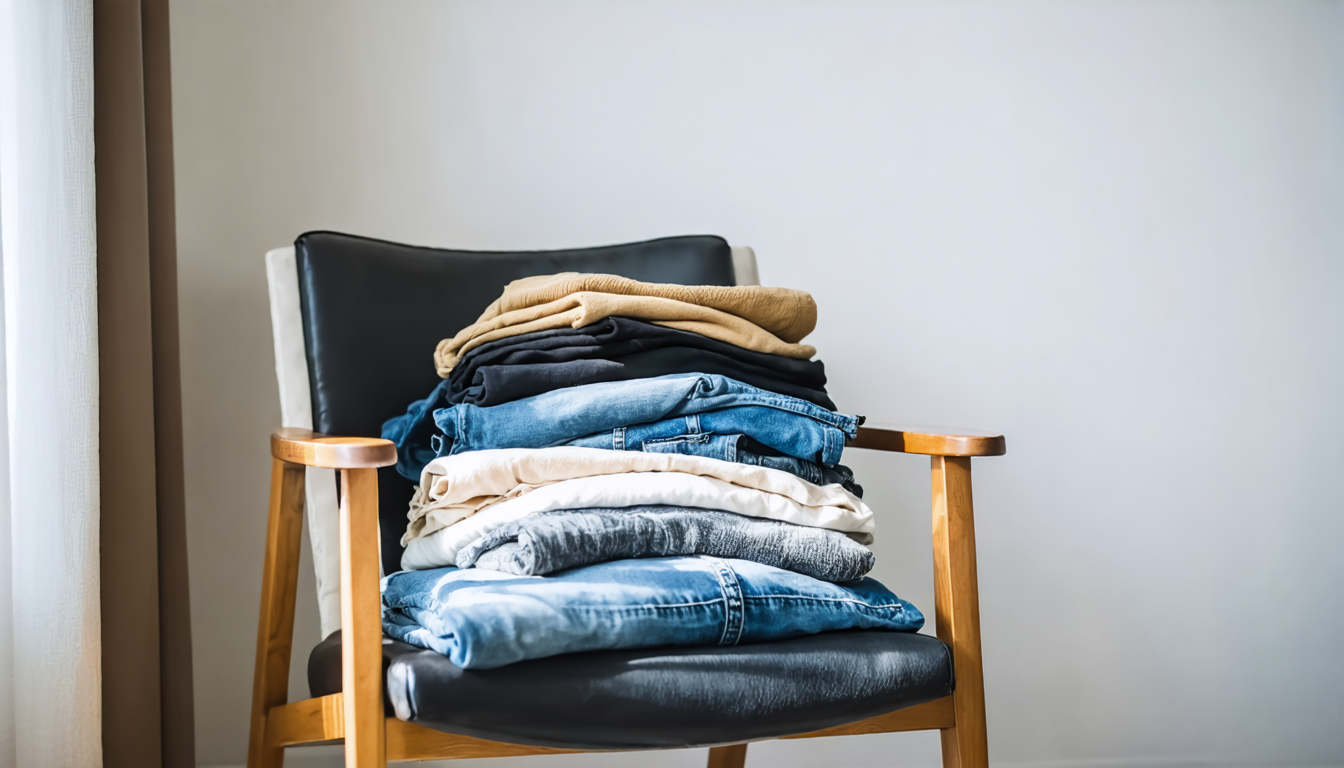
The famous chair piled with clothes in a corner of the room is a familiar image found in many households. This heap of sweaters, jeans, jackets, or t-shirts casually placed without much thought can, however, carry unsuspected meanings. Far from being a simple sign of neglect or disorder, this accumulation often reveals a specific and rich facet of the personality of the person who uses it. A transitional behavior, an expression of a particular lifestyle, or even an indicator of a subtle relationship with organization and disorder, this use of furniture invites us to decode our daily habits and their impact on our psychology. Observed in more than two-thirds of adults, especially young active people, this domestic gesture sketches surprisingly varied profiles, blending creativity, pragmatism, and a need for balance between structure and spontaneity.
With the increasing constraints of modern living spaces and the intensification of a often hectic pace, the chair piled with clothes becomes much more than a simple temporary support. It transforms into an element of the interior filled with messages, revealing compromises and strategies adopted to manage the flow of daily life. In 2026, facing a society that values both productivity and self-expression, this phenomenon deserves an in-depth analysis to understand what it truly says about our way of functioning, our relationship to time, and, ultimately, our way of being.
- 1 Why your chair piled with clothes is a mirror of your personality
- 2 The complex link between apparent disorder and personal organization
- 3 Psychological impacts of a piled chair: between stress and creativity
- 4 Transforming the accumulation of clothes into a positive and organized habit
- 5 The balance between order and spontaneity in your clothes-filled interior
Why your chair piled with clothes is a mirror of your personality
Placing clothes on a chair may seem trivial, but this daily gesture often betrays specific personality traits. First, it reveals a particular relationship to organization. Far from marking a simple lack of order, this habit reflects a kind of pragmatism. Indeed, for many, the clothes chair constitutes a parallel organizational system that escapes norms but functions perfectly according to a personal logic.
People with strong mental creativity often favor flexibility over rigid structures. They leave their clothes near them, creating a micro-universe where each piece can be easily accessible. This way of doing things corresponds to nonlinear thinking, where the fluid association of ideas also manifests in spatial management. Thus, accumulating clothes and accessories on a chair resembles a form of self-expression: a balance between order and a controlled disorder.
The table below illustrates the most common traits linked to this habit:
| Personality Trait | Manifestation in the Habit | Observed Frequency (%) |
|---|---|---|
| Creativity | Nonlinear thinking, improvisation | 72 % |
| Pragmatism | Time optimization, personal system | 65 % |
| Spontaneity | Quick decisions, flexibility | 58 % |
| Adaptability | Flexibility in the face of changes | 61 % |
Moreover, individuals who accumulate their clothes on a chair often seek to maintain a certain informal control over their environment. This improvised setup responds to a need for transition between active life and moments of rest. Some even prefer to air out their clothes before putting them away or reuse certain items deemed still clean but not freshly washed. Thus, this is not an impulsive disorder but a well-thought-out strategy to manage space and daily life.
The complex link between apparent disorder and personal organization
The disorder visible on a chair piled with clothes often unsettles outsiders, who see it as a sign of lack of attention or rigor. Yet this chaotic aspect often hides a very structured mode of organization, adapted to the demands and constraints of contemporary lifestyle.
Understanding this paradox means considering that the tolerance threshold for disorder varies greatly between individuals. Some live in a very orderly environment where everything has its place, while others prefer a certain visual rumpling that nevertheless does not disturb their efficiency. The cluttered chair then acts as a kind of secondary wardrobe, a personal system where informally located clothes represent daily choices and priorities.
In practice, this approach presents several tangible advantages:
- Quick access to frequently worn clothes without requiring complete tidying.
- Mental energy savings by reducing the time spent on decision-making each morning.
- Creation of a breathing space where some textiles can air before washing or storage.
- An expression of spontaneity in outfit choices, adaptable according to mood or weather.
It can be noted that this organizational tinkering often intensifies during periods of stress or major changes, like a temporary installation seeking to optimize the relationship with time. Much more than simple negligence, this method betrays a hierarchical mental functioning according to personal logics, sometimes invisible to those around.
Psychological impacts of a piled chair: between stress and creativity
The immediate environment strongly influences our emotional state, and a chair piled with clothes is no exception. Despite a chaotic appearance, this type of habit can relieve certain psychic tensions by offering a transition between active periods and moments of relaxation.
However, neuroscience has revealed that the perception of a cluttered space induces cognitive load. The brain is solicited by the multitude of visual information, which can increase cortisol production, a hormone linked to stress. Nevertheless, in the eyes of specialists, this impact is far from uniform:
- People with a structured and methodical profile feel this visual stress more strongly.
- Creative, spontaneous, and adaptable individuals, on the contrary, often develop a high tolerance for disorder, even a valuing of imperfection.
Notably, some research shows that creativity can flourish in slightly disordered environments. Rather than reducing efficiency, this context stimulates forms of innovation by freeing thought from rigid constraints. The chair piled around which these debates revolve thus becomes a paradoxical symbol, mixing agitation and a source of mental balance for those who master its use.
Transforming the accumulation of clothes into a positive and organized habit
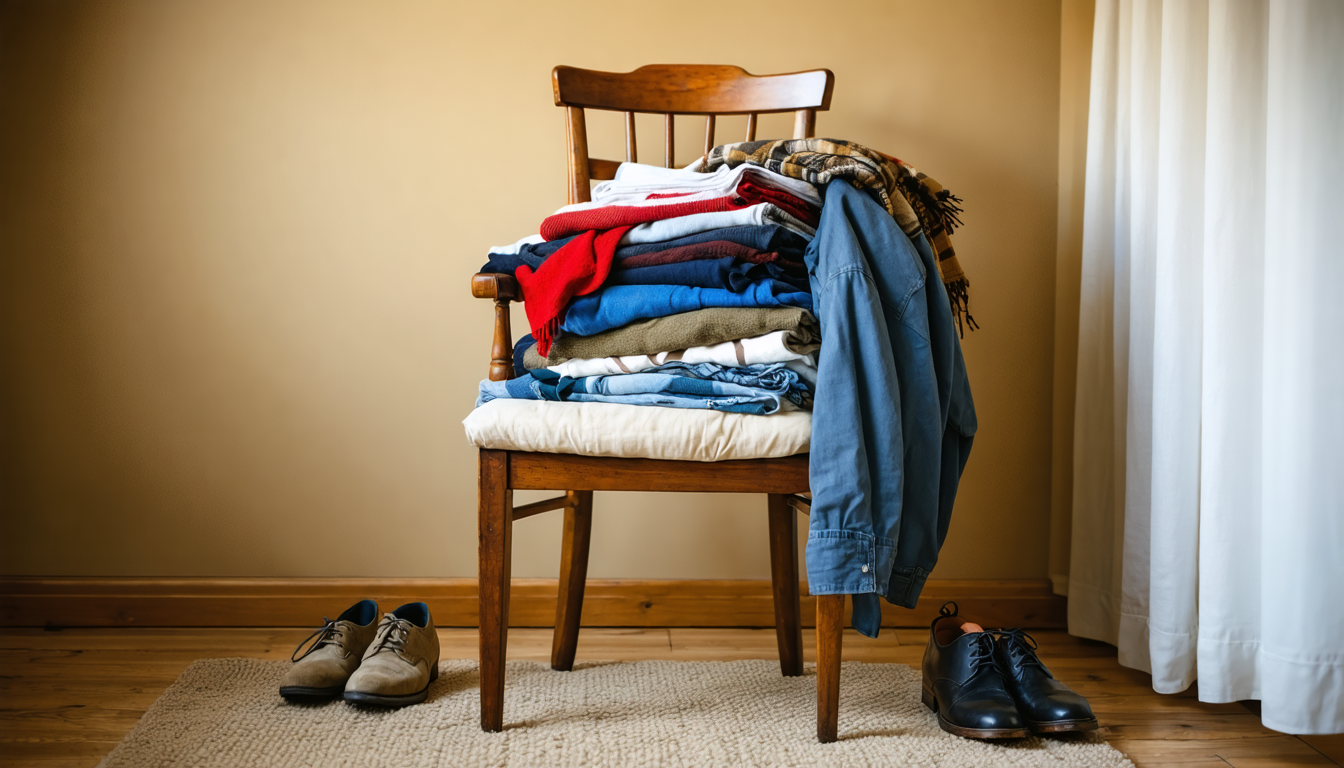
For many, the temptation is strong to consider the piled chair as a problem to solve. Yet, rather than trying to eliminate this natural behavior, it is appropriate to better understand the motivations underlying it and integrate it into an adapted system.
The first step lies in recognizing real needs: lack of space, desire to air clothes, morning time optimization… Identified, each cause can give rise to a targeted solution without disrupting the individual’s internal dynamics. For example, installing a rack dedicated to intermediate clothes can maintain quick access while limiting accumulation.
Here are some effective strategies to turn this habit into an asset:
- Set a maximum limit: fixing a precise number of items accepted on the chair prevents overflow and facilitates management.
- Establish a weekly sorting ritual: take a moment each week to efficiently put away accumulated clothes.
- Use baskets or bins: clothes can be sorted visually and without clutter, maintaining true fluidity in the space.
- Adopt the two-minute rule: immediately tidy anything that takes less than two minutes to avoid the snowball effect.
To sustainably implement these changes, it is better to proceed step by step, thus avoiding any feeling of excessive obligation. What matters is to maintain a balance between structure and self-expression through a comfortable and coherent environment.
The balance between order and spontaneity in your clothes-filled interior
The overloaded chair, beyond a simple piece of furniture, becomes a true barometer of the relationship with order and spontaneity. Many people recognize themselves in this alternation between a desire for organization and an attraction to controlled disorder. This transition space reflects the complexity of managing daily life, where not everything can be perfectly planned.
At the heart of this phenomenon, psychology suggests that such management of clothes allows a certain fluidity between different phases of the day. For example, leaving a pair of jeans or a sweater within reach facilitates the transition between intense active life and moments of relaxation, acting as a visual and material pause.
This mode of functioning, very common in 2026, invites us to reconsider our criteria for order in the home. Rather than aiming for rigid organization, adopting a modular system respecting each person’s personality is the key to an interior conducive to mental well-being.
It is not about seeking perfection, but rather valuing the ability to adapt to the flow of daily life, combining functionality and self-expression. You see your chair piled with clothes not as a burden but as a reflection of your unique lifestyle, where lifestyle and personality are expressed in harmony with your interior.