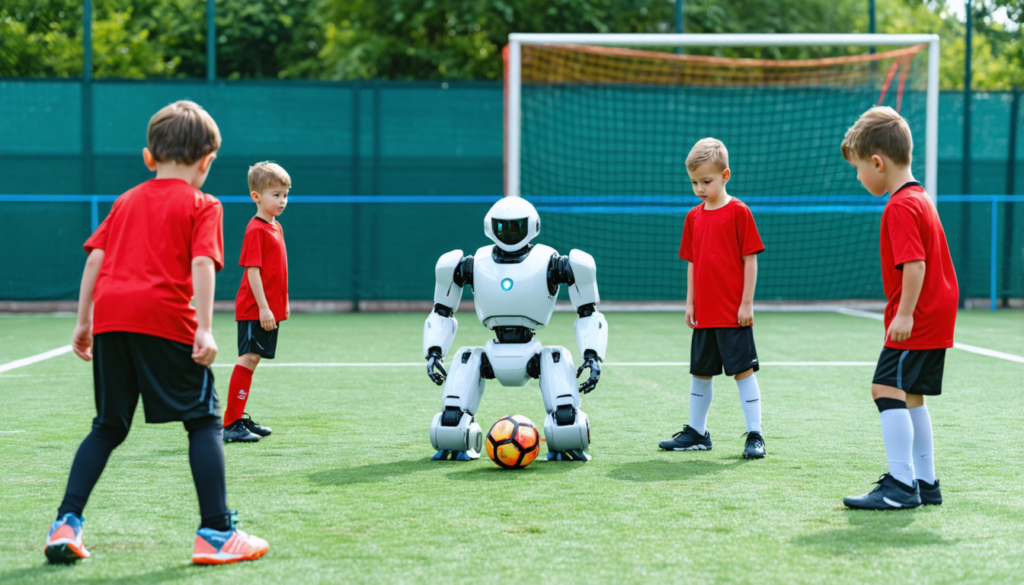
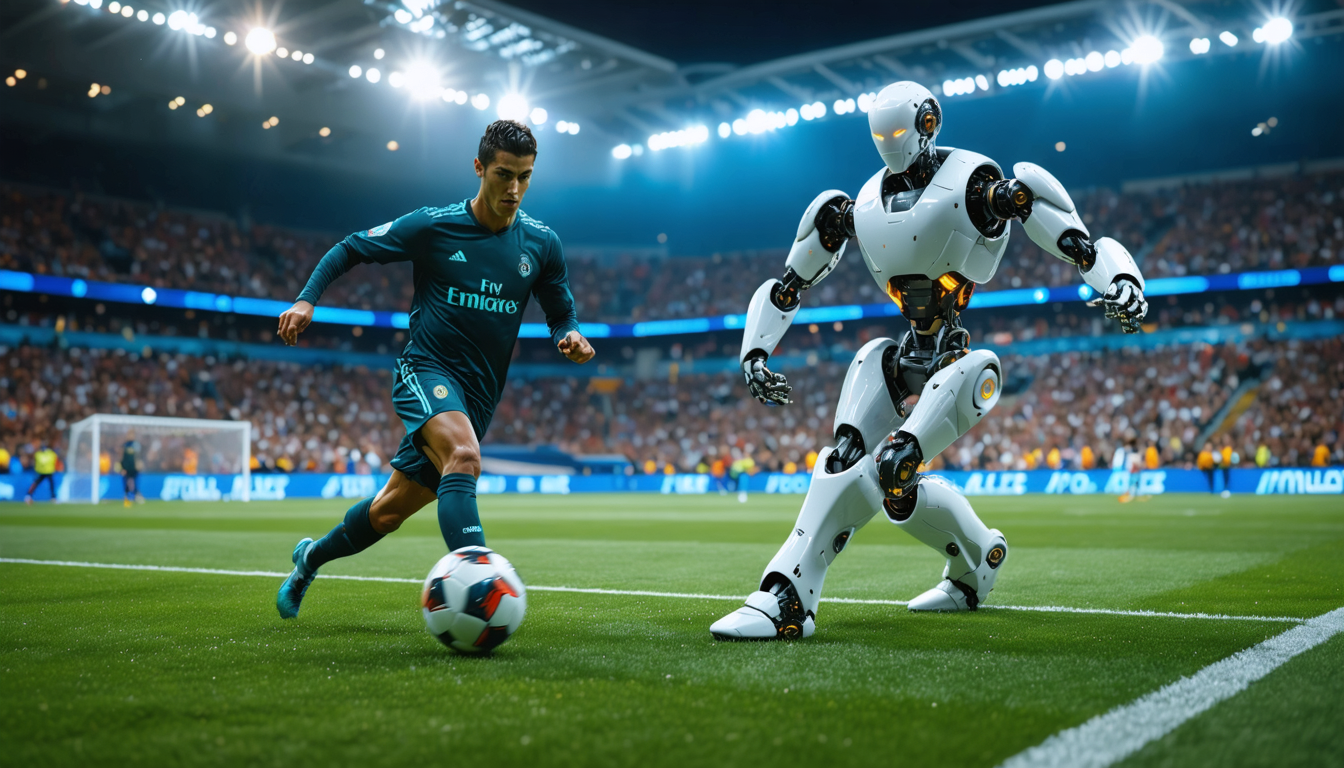
During a spectacular demonstration combining sporting excellence and technological advancement, Cristiano Ronaldo, one of the greatest football legends, embarked on a rather surprising challenge: facing an ultra-fast robot goalkeeper during a penalty shootout. This unprecedented challenge, organized by Mark Rober, an engineer who worked for NASA and became a major figure in scientific entertainment on YouTube, combines the surgical precision of artificial intelligence with human instinct and technique. Confronted with a robot goalkeeper capable of analyzing the ball’s trajectory in less than 6 milliseconds thanks to 22 infrared cameras and powered by two 50-horsepower motors, the five-time Ballon d’Or did not fail to surprise the audience with a performance that was both strategic and spectacular.
This face-to-face between a human being and a machine goes beyond the simple realm of sport to question the limits of techno-sport and artificial intelligence in competitive contexts. The event, captured on video, shows an unexpectedly surprising outcome, as the Portuguese champion, after meticulously studying the robot’s functioning, managed to outsmart it by exploiting a physical flaw in the automaton’s mechanics. This opposition between human performance and algorithmic prowess opens a fascinating new chapter in football history, where the machine tries to rival genius and creativity on the field.
- 1 The creation of the robot goalkeeper: when engineering meets football
- 2 Cristiano Ronaldo’s incredible challenge against the robotic goalkeeper
- 3 The evolution of robotic goalkeepers and their impact on modern football
- 4 Artificial intelligence at the service of sport: use cases and perspectives
- 5 Technical comparison: the robot’s advantages over a human goalkeeper
- 6 The role of social networks and video sharing in popularizing this challenge
- 7 What lessons to draw from this spectacular face-off?
The creation of the robot goalkeeper: when engineering meets football
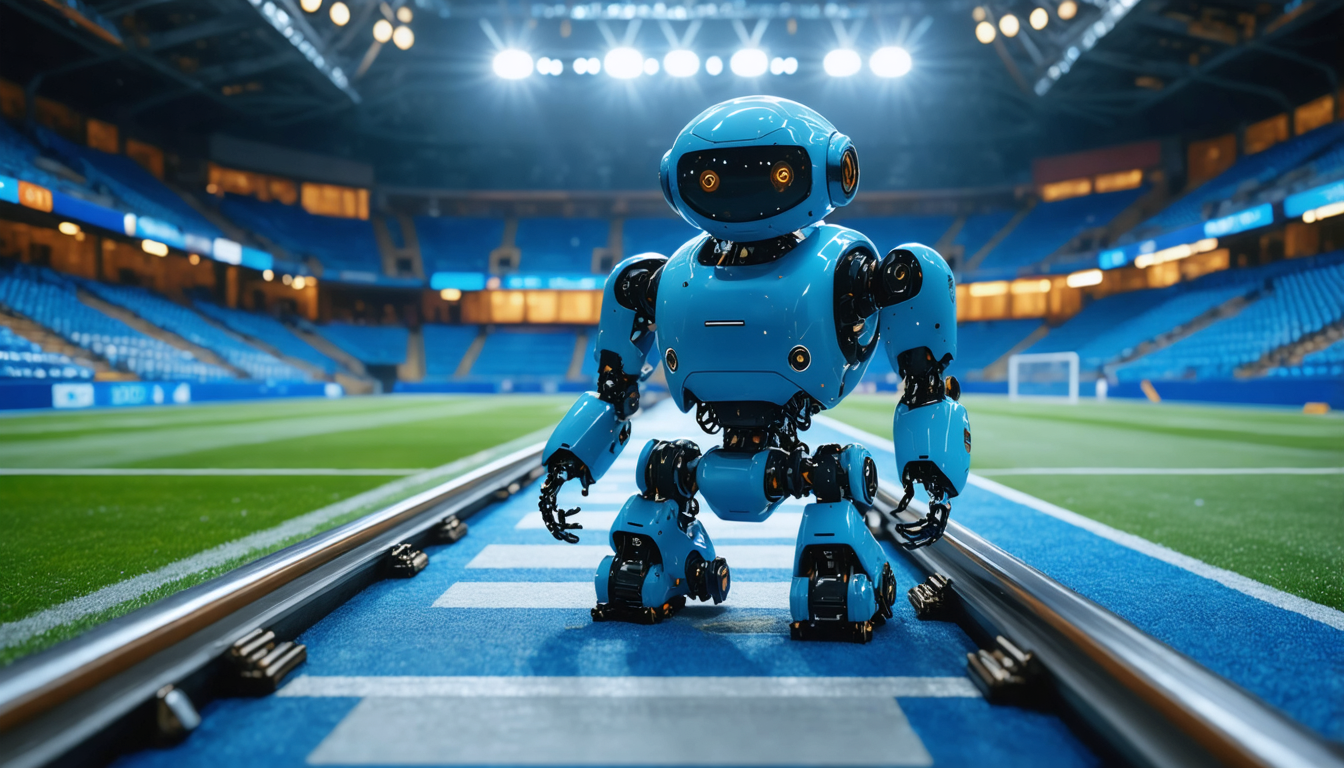
At the heart of this unique challenge lies an extraordinary project led by Mark Rober. A former NASA engineer, Rober combined his passion for science and spectacle by creating a robot goalkeeper capable of stopping football shots during penalties. This robot was not designed as a mere gadget: it is a true technological feat intended to push the limits of what a machine can achieve in a sporting environment.
Originally, the prototype resembled a simple cart system sliding on a rail. However, to make this robot competitive against professional shots reaching 130 km/h, the engineer integrated 22 OptiTrack infrared cameras, each capable of capturing 500 frames per second. These cameras track reflective stickers attached to the ball in order to calculate a three-dimensional trajectory in real time with millimetric precision.
Every seven milliseconds, a computer processes these images to precisely predict where the ball will strike, and two powerful 50-horsepower motors propel the carbon fiber cart at over 65 km/h to try to intercept the shot. The robot faced significant technical challenges, including wear caused by the force of the shots, which required structural reinforcements, the addition of dense foam for shock absorption, and the improvement of electronic components and motors to exceed the initial power by 250%.
These advances make this robot an unprecedented goalkeeper, capable of anticipating and intercepting balls at an extraordinary speed and precision far beyond traditional human performance. The challenge thus became a true technological race aiming to push the boundaries between sport and artificial intelligence.
Cristiano Ronaldo’s incredible challenge against the robotic goalkeeper
When Cristiano Ronaldo accepted this unusual challenge, the world of football and techno-sport held its breath. For the multiple Ballon d’Or winner, renowned for his precision and power on penalties, it was not simply a matter of attempting a feat, but of adapting to a technology that represents the future of sport.
Faced with a robot capable of analyzing and reacting in less than 6 milliseconds, human reflexes seem powerless. At such an execution speed that shots cover the 11-meter regulation distance in about 250 milliseconds, a traditional goalkeeper cannot hope to anticipate effectively. It is therefore a true confrontation between instinct, technique, and human strategy against a machine as fast as it is precise.
To counter the robot’s mechanical superiority, Ronaldo played the card of observation and patience. By noticing the railed cart’s architecture, he detected a small blind spot that the robot could not reach. Combining power and precision, he tried to target this weakness, thus demonstrating a facet of adaptability and tactical intelligence rarely explored in a man-machine duel.
This unexpected outcome, filmed and shared on various platforms, illustrates how human ingenuity can complement and even surpass ultra-advanced technologies, despite their almost superhuman capabilities. Ronaldo thus proved that with on-field analysis and technical mastery, he remains a formidable player capable of “deceiving” the most sophisticated algorithms.
The evolution of robotic goalkeepers and their impact on modern football
The emergence of ultra-performing robotic goalkeepers implies a profound mutation of contemporary football, particularly in training, strategy, and mental preparation of players. These machines, thanks to their outstanding precision and impressive speed, can serve both as formidable training partners and advanced analysis tools.
Concretely, the most technologically advanced clubs are already considering integrating such robots into their training sessions. They not only provide ever more perfect penalty shots but also accustom goalkeepers to high-pressure situations with near-failproof movements and saves. Furthermore, these robots can record and analyze shooters’ styles to help coaches better understand opponents’ tendencies and patterns.
Moreover, these innovations impact competition in general by pushing players to constantly raise their technical level, notably in precision, power, and variation in their shooting approach. This upgrade in demands fosters an even richer spectacle, where the man-machine confrontation brings a new dimension to the beautiful game.
Practical applications in training centers
Young footballers now benefit from optimized training ecosystems where the robots’ reaction capabilities and analyses enable accelerated skill development. By practicing penalties against these highly reactive robots, they develop reflexes and stress management close to excellence.
This techno-sport environment promotes mental preparation through realistic simulation of competitive situations, as well as the refinement of technique through near-infinite and measured repetition. The help of artificial intelligences integrated into these devices allows exercises to be adapted to each player.
Artificial intelligence at the service of sport: use cases and perspectives
The example of this robot goalkeeper confronted with a football legend clearly illustrates the growing role that artificial intelligence plays in sport. This technology is no longer limited to mere data collection or video refereeing, but now intervenes in the competitive phase, transforming the very nature of sporting duels.
The AI at the core of this robot combines computer vision, real-time processing, and advanced mechatronics to offer unparalleled reactivity. In 2025, this convergence of disciplines begins to revolutionize various sports practices, whether in football, basketball, or tennis.
Advances in machine learning allow machines to constantly learn new playing styles, refining their predictions and strategies. Thus, unlike rigid programming, the robot goalkeeper continuously becomes more efficient with each session, adapting to individual characteristics of shooters.
This dynamic interaction between human and machine opens unprecedented avenues, such as human-robot coevolution, where sports strategy now includes the capacity to influence AI behavior to surprise the opponent. Techno-sport thus becomes a true laboratory of technological but also human innovation.
Technical comparison: the robot’s advantages over a human goalkeeper
| Criterion | Mark Rober Robot goalkeeper | Professional human goalkeeper |
|---|---|---|
| Reaction time | 6 milliseconds | About 200 milliseconds |
| Maximum movement speed | 65 km/h | 35-40 km/h |
| Anticipation accuracy | 3D prediction at millisecond precision | Based on experience and intuition |
| Endurance capacity | Does not tire, requires maintenance | Physical and mental fatigue in matches |
| Adaptability | Continuous improvement via machine learning | Limited by physical and psychological capacities |
The table clearly highlights that this robot goalkeeper surpasses the human in speed and accuracy, notably thanks to its sensors and artificial intelligence. Yet, the human factor of strategy, instinct, and real-time situation analysis remains irreplaceable, as demonstrated by Cristiano Ronaldo during the competition.
The broadcast of this confrontation between Ronaldo and the robot goalkeeper not only captivated football fans but also generated global enthusiasm through digital platforms. Videos of this encounter quickly went viral, inaugurating a new genre of techno-sport content mixing fascination and debate.
The power of video sharing made it possible to open the debate on the place of artificial intelligence in sport, the limits of a machine facing human creativity, and the new forms of competition that these technologies imply. These exchanges enrich reflection both for experts and enthusiasts.
Furthermore, Mark Rober, a real showman and science communicator, has used his influence to democratize these innovations, showing that science combined with passion can generate spectacle and inspire new avenues of sports evolution.
What lessons to draw from this spectacular face-off?
This duel between Cristiano Ronaldo and the robot goalkeeper marks a turning point in the meeting between technology and sport. It reminds us that, despite phenomenal advances in artificial intelligence capable of replicating and even surpassing certain human abilities, the human dimension, made of observation, adaptation, and creativity, remains a major asset.
Far from diminishing competition, this integration of techno-sport and AI in football can instead enrich the practice, offering players ever greater challenges and providing spectators with unprecedented spectacles. The unexpected outcome of this challenge, where Ronaldo identified and exploited a mechanical flaw in the robot to score, illustrates the strategic superiority of the human brain over the machine.
Ultimately, this experience opens the way to a new era where the collaboration between technological innovation spirit and sporting genius writes the rules of a reinvented and ever more exciting competition.