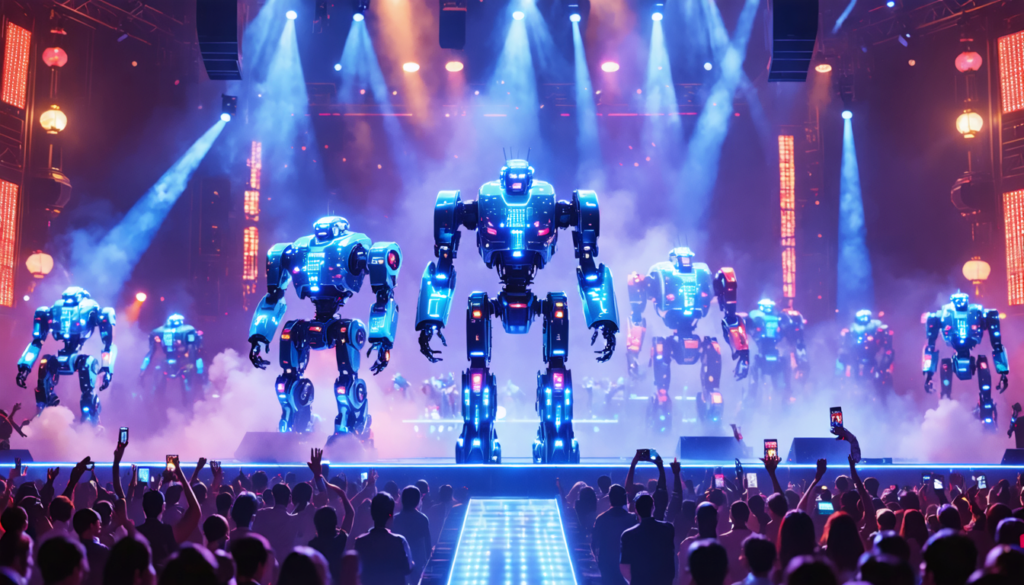
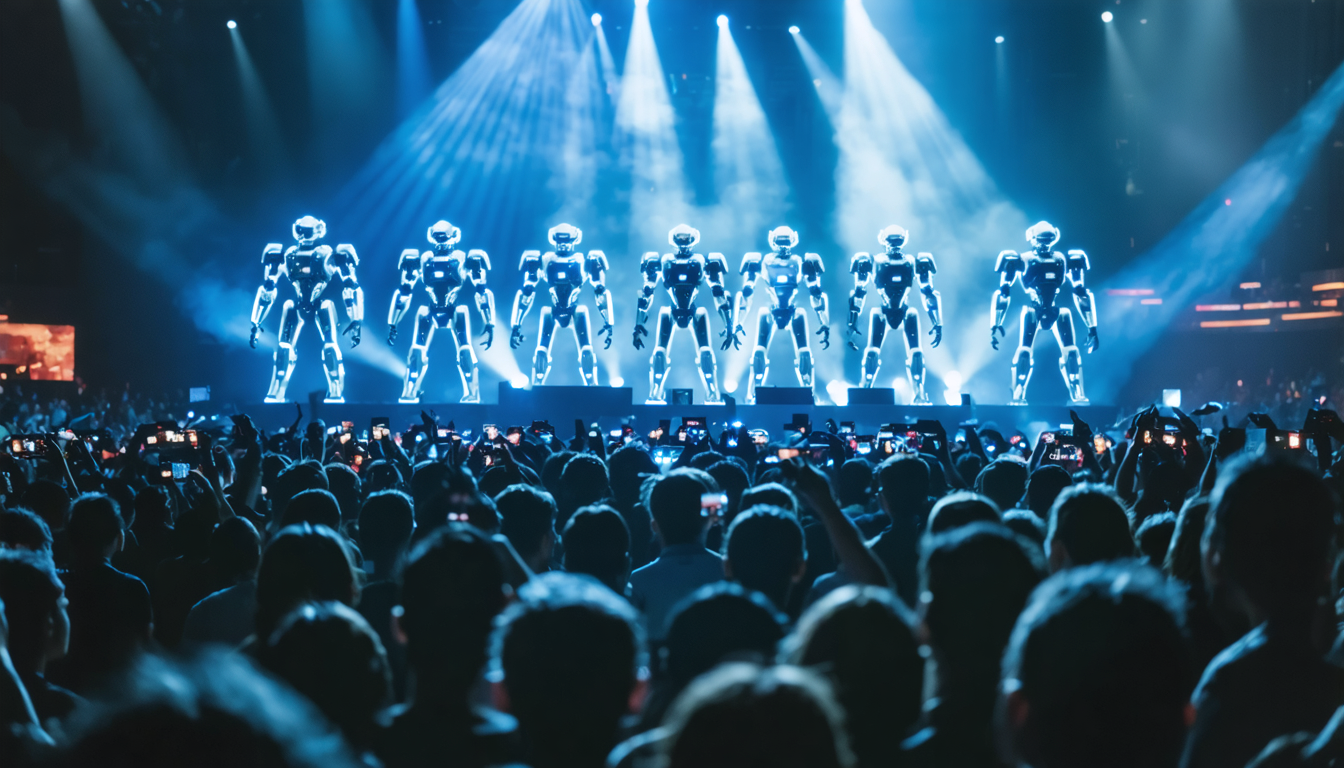
In a show where technology meets art, China is making waves today on the world stage. More than ever, humanoid robots are asserting themselves as full-fledged artists, captivating audiences with their precision and energy. During a concert in Chengdu, six robots developed by Unitree Robotics achieved an astonishing feat, dancing with the fluidity and synchronization of a human troupe. This spectacular performance testifies to the impressive progress in robotics and its growing integration into the performing arts world. Surpassing mere mechanical presence, these electronic machines electrify the stage and redefine the boundaries of artistic performance.
The appearance of these robots in a concert setting is not a mere gimmick, but a striking demonstration of technological expertise. The Chinese-American singer Wang Leehom, a key figure in contemporary music, skillfully leveraged this innovation to offer his audience an unprecedented experience. The dance, charged with emotion and expressiveness, is now shared between human and robotic bodies, giving rise to a new form of hybrid art. This emergence raises both enthusiasm and questions, particularly about the future of artistic performances and their relationship to humans and machines.
- 1 How Chinese Robotics Is Revolutionizing Dance on Stage
- 2 Perfect Synchronization: When Technology Rhymes with Art
- 3 A Global-Scale Show: The Symbolic Reach of the Robotic Performance
- 4 Towards Domestic Integration: Robotics in Our Homes
- 5 Ethical and Artistic Issues of Robotics in Live Performance
- 6 Technical Challenges to Maintain an Impeccable Robotic Performance
- 7 Comparison Table of Performances Between Human Dancers and Unitree G1 Robots
- 8 List of Major Impacts of Robots in Live Performances
How Chinese Robotics Is Revolutionizing Dance on Stage
The traditional image of the robot as a rigid automaton is no longer valid. Unitree Robotics, thanks to its G1 humanoids, has pushed the boundaries of the possible by integrating six robots into a complex and rhythmic choreography. These robots, now capable of executing fluid and coordinated movements, illustrate a major advance in robotics applied to performing arts.
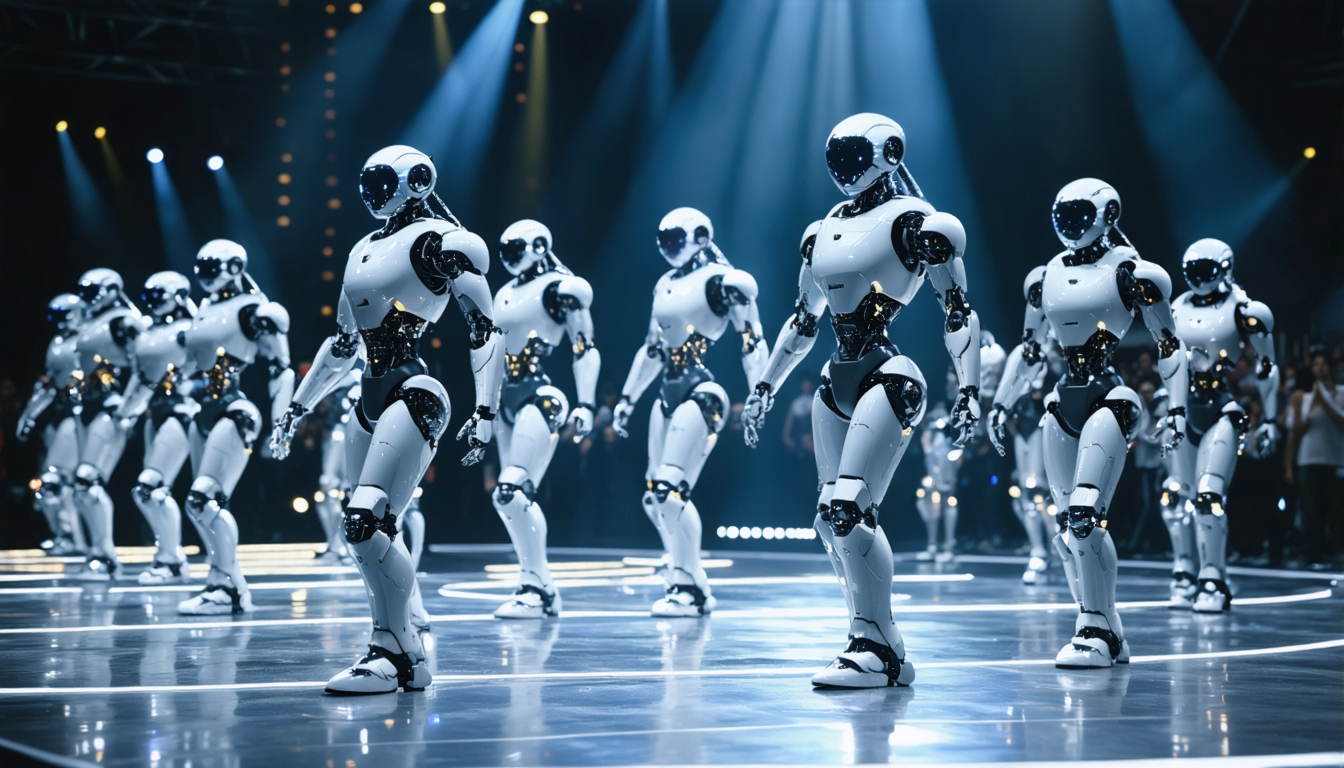
The performance shows robots dressed in silver costumes, perfectly synchronized with the music. They accompany Wang Leehom during his track “Open Fire” by performing precise movements: arms, kicks, rotations, but also complex acrobatics such as the “Webster flip.” This acrobatic figure, performed simultaneously by all units, dispels any notion of slowness or approximation. The result is a mechanical ballet worthy of a human troupe, with flawless fluidity and balance thanks to a real-time control system.
This performance marks a turning point, not only for Unitree Robotics but also for live performances. The mastery of the robotic body offers the possibility to explore new styles and push the limits of stage movement. From now on, the stage is no longer reserved solely for human dancers: robots bring an unprecedented and spectacular dimension, combining technology and aesthetics. These advances are changing the face of concerts and opening the way to an unprecedented collaboration between man and machine.
Perfect Synchronization: When Technology Rhymes with Art
The key to the success of this performance lies in meticulous synchronization between robotic movements and music. Behind every dance step, there are sophisticated algorithms managing balance, coordination, and rhythm in real time. The complexity of this choreography demands millisecond precision, which only cutting-edge technology can ensure.
The observable fluidity is the result of several years of research on embedded artificial intelligence and dynamic robotics. Unitree G1 robots are equipped with a set of sensors allowing them to adapt to variations in the performance, preventing desynchronized movements. The “Webster flip,” a flagship figure of the show, perfectly illustrates this mastery: six robots simultaneously execute a somersault, a feat whose success depends as much on programming as on mechanical quality.
This fluidity completely challenges the stigma surrounding robots as slow and clumsy machines. These humanoids are capable of rivaling professional dancers in terms of coordination and precision. Their ability to move in a complex space in harmony with the music electrifies the audience and broadens the range of possibilities on stage. The alliance of mastered gesture and technological power creates a show of rare intensity, eliciting admiration and amazement worldwide.
A Global-Scale Show: The Symbolic Reach of the Robotic Performance
This concert impresses far beyond Chinese borders. The quality and originality of the performance have sparked lively debates on social networks and international media coverage. Elon Musk himself recognized on the X platform the sophistication of the robots, emphasizing that now these machines can do everything, including dance.
This phenomenon reflects rapid and increasingly spectacular evolution in the field of robotics. Remembering that barely a year ago, robots only performed simple gestures during the New Year Gala shows how much the discipline has progressed. Now, robots can compete with humans in artistic fields, touching emotion and creativity.
The impact of this advancement is twofold: on one hand, technology offers new forms of expression on stage, and on the other, it profoundly questions our relationship to live performance. The participation of robots in a concert pushes the boundaries of creativity and imposes a new aesthetic made of precision and innovation. This international success raises genuine interest and lays the groundwork for a cultural revolution in the world of entertainment.
Towards Domestic Integration: Robotics in Our Homes
Unitree Robotics is not limited to the professional stage. One of the company’s major ambitions is to bring this technology into consumers’ daily lives. Their goal: to manufacture domestic robots integrating the ability to dance with natural fluidity, capable of adapting their movements to the music playing at home.
The feature called “Let the Music Continue” thus promises to revolutionize interactions between humans and machines within households. The robotic assistant, in addition to its classic management tasks, will become a source of entertainment and social interaction. This innovation illustrates how robotics is evolving toward a more human, playful, and participative presence in everyday life.
By offering this experience to individuals, Unitree Robotics democratizes technology while opening the way to a new form of emotional communication. The robot, once perceived as a cold and distant tool, becomes a partner capable of awakening joy and energizing family environments through dance. This vision extends the mutation already underway in the entertainment world to bring it into the private sphere.
Ethical and Artistic Issues of Robotics in Live Performance
The appearance of dancing robots does not leave the artistic world untouched. This upheaval raises essential questions about the place of humans in creation. Can we reasonably imagine that these machines might one day replace dance troupes? What impact would that have on the soul of the show and the value of the performance?
Currently, these robots are above all technological showcases, spectacular demonstrations that fascinate through their virtuosity. Yet, concern is rising over the temptation of some producers and organizers to prioritize robotic reliability over human spontaneity. This could lead to reduced rehearsals, lower pay for artists, and above all, a loss of the unpredictable and living dimension that makes the richness of the show.
Art, by definition, relies on the expression of subjectivity, human sensitivity, complemented by the natural uncertainties and surprises of the stage. The algorithmic perfection of robots could standardize performances, eliminating the diversity and uniqueness that make each show special. These questions underline the need to find a balance between technological innovation and preserving the raw emotion inherent in human creation.
Technical Challenges to Maintain an Impeccable Robotic Performance
Integrating robots into complex choreographies comes with major challenges. Behind the apparent fluidity lies cutting-edge engineering and extremely rigorous programming. The slightest delay in the execution of a movement can compromise the entire synchronization, hence constant monitoring and real-time adjustments.
Robots must manage multiple variables simultaneously: balance, change of direction, limb coordination, and adaptation to sound volume and musical rhythm. To guarantee perfect fluidity, Unitree Robotics developers have implemented machine learning algorithms capable of optimizing movements while taking into account the specificities of the robotic body.
A technical error could transform a graceful movement into a clumsy gesture, ruining the artistic illusion. This extreme requirement pushes robotics to a level of excellence rarely reached. It also requires close collaboration between engineers, musicians, choreographers, and performance specialists to adjust every detail according to stage constraints. This teamwork is indispensable to deliver an impeccable performance every night, capable of electrifying the audience.
Comparison Table of Performances Between Human Dancers and Unitree G1 Robots
| Criteria | Human Dancers | Unitree G1 Robots |
|---|---|---|
| Fluidity of Movements | Excellent, highly expressive | Very good, precise control |
| Synchronization | Variable depending on experience | Perfect thanks to algorithms |
| Acrobatic Ability | Limited by human physique | Perform complex flips |
| Real-Time Adaptability | Excellent, human intuition | Based on sensors and AI |
| Emotional Expressiveness | Very high, human sensitivity | Limited, depends on programming |
| Production Costs | Salaries, long rehearsals | High initial investment, but lower recurring costs |
List of Major Impacts of Robots in Live Performances
- Increased Accessibility to ultra-precise performances for various cultural events.
- Risk Reduction related to injuries during acrobatics thanks to mechanical reliability.
- New Artistic Languages integrating the unique capabilities of robotics.
- Shift in the Role of Artists, focusing more on creation and management than execution.
- Possibility to Broaden Horizons by merging human and robotic dance for an unprecedented show.
- Ethical Debate on the potential replacement of humans by machines on stage.