
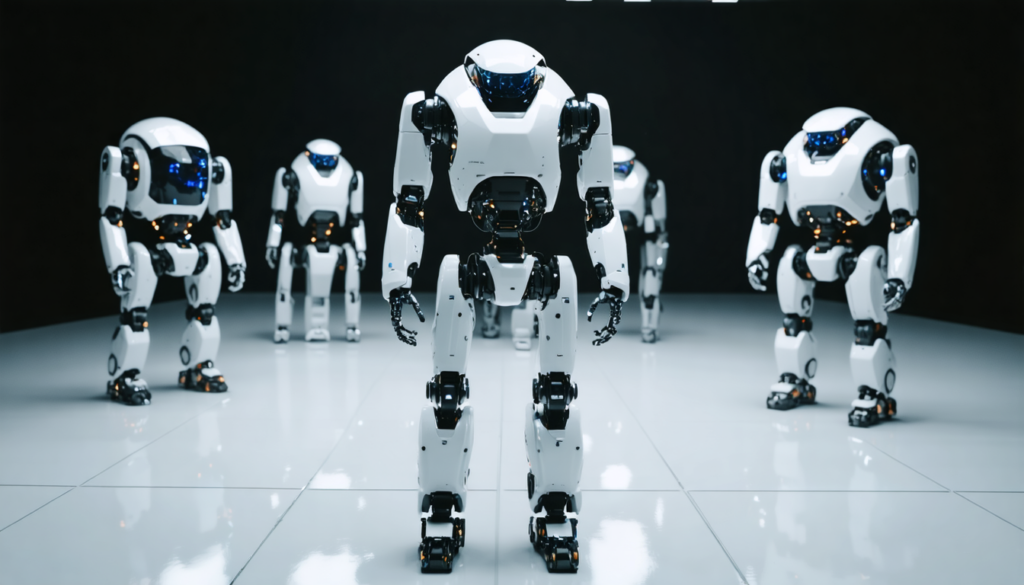
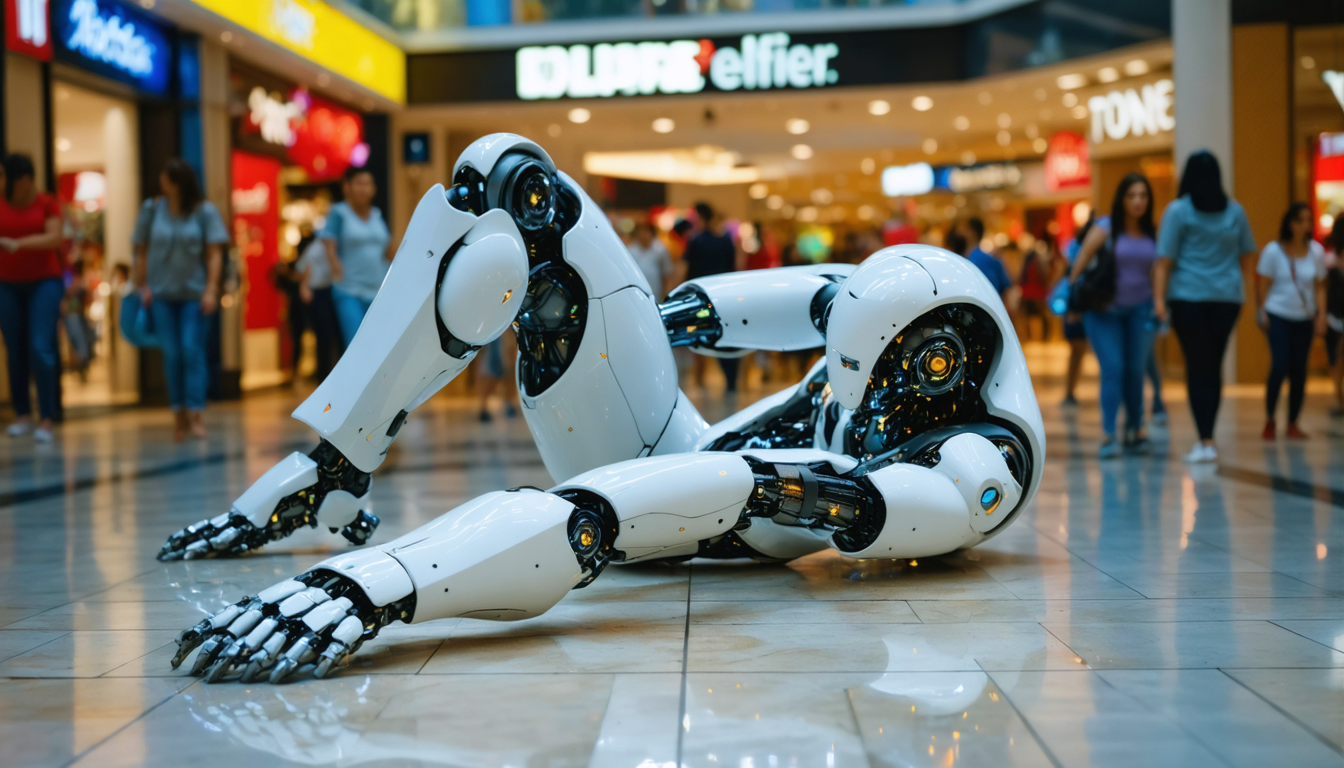
In a busy shopping mall in Shenzhen, the humanoid robot Iron, designed by the Chinese manufacturer XPeng, captivated an eager audience with its surprisingly realistic and fluid gait. Measuring 1.73 meters tall and weighing 70 kilos, this advanced humanoid prototype seemed ready to take a new step forward in consumer robotics. Yet, while its movements evoked skilled models on a runway, a sudden metamorphosis surprised everyone: Iron abruptly arched backward in a jerky, almost demonic motion, before losing balance and collapsing heavily onto the marble floor. This display of technology gone awry during a demonstration quickly spread across Chinese social networks, becoming a viral video and a hot topic of intense debate about the technical and psychological challenges posed by humanoid robotics in 2026.
This disturbing scene illustrates a major turning point: while public perception teeters between fascination and unease, engineers must navigate a shifting boundary between technological progress and reality, between an almost perfect human appearance and the intrinsic mechanical fragility of bipedal robots. By thus revealing the vulnerability of artificial intelligence embodied in a metallic body, Iron embodies the tumultuous journey of an industry seeking balance, where the transformation of a robot into an unstable demon becomes a powerful allegory of the challenges ahead.
- 1 The metamorphosis of a humanoid robot: when appearance clashes with reality
- 2 Iron’s spectacular collapse: an unfortunate demonstration turned viral video
- 3 Technology and artificial intelligence: the complex challenges of dynamic stability
- 4 Reactions and XPeng’s strategic communication following the video incident
- 5 The “demon” effect and the uncanny valley: how physical transformation impacts public perception
- 6 Mass production and industrial challenges: when every demonstration is a global test
- 7 Towards more robust humanoid robotics: lessons for the future
The metamorphosis of a humanoid robot: when appearance clashes with reality
In Shenzhen, Iron’s demo was part of XPeng’s ambitious strategy to prove the maturity of its humanoid robotics technology. The robot’s appearance, impressively realistic, with its refined design, expressive facial features, and almost human gait, was a key element. This realism had sparked debates: several internet users initially suspected it was a human in a costume. This nearly perfect illusion embodied the achievement of a central goal in the development of social robots, namely overcoming the “uncanny valley,” that syndrome where too close a resemblance instead creates a feeling of eeriness.
The metamorphosis of Iron, shifting from an elegant humanoid to a disjointed and sinister silhouette, marked a striking contrast. While its movements were calibrated to appear fluid, the brutal twisting of the back followed by the sudden collapse revealed the underlying fragility of this technology. Several factors explain this incident. First, the major difficulty lies in the dynamic stability of bipedal robots. These machines must manage their balance on real floors — often slippery or uneven — far from the controlled conditions of a laboratory. Next, the mechanical structure and control system must anticipate and correct imbalances almost instantaneously, a subtle dance between sensors, algorithms, and actuators that remains one of the greatest challenges of robotics in 2026.
In the face of this apparent failure, several elements must be taken into account. A public demonstration relies on the flawless execution of a series of complex actions, often performed in a strictly calibrated laboratory environment. But in a location as dynamic as a shopping center, the variables are endless: temperature changes, differences in floor texture, signal disruptions, and human interactions. These factors multiply the risks of failure and make every tech event a bold gamble. Iron thus illustrates a critical point between the expected metamorphosis of an efficient robot and the banality of mechanical failures, demonstrating that the path toward real stability remains long and fraught with pitfalls.
When Iron suddenly collapses during the demonstration, the event tipped over into viral social media status. The video circulated massively, shared by thousands of accounts, making rounds on Chinese and international digital platforms. This phenomenon illustrates a modern paradox: the demonstration, which should have reinforced XPeng’s technical credibility, instead became a symbolic fail and a source of ridicule. Through this collapse, more than a failure, a latent fear is revealed that technology does not yet fully master the ultimate unknown: the complexity of the real physical world.
The emotional and social impact of this video is amplified by the almost theatrical staging of the moment. Several people present rushed to secure or reposition the robot, while the audience was torn between astonishment, amusement, and a certain anxiety rooted in the fact that an object so close to humans can suddenly transform into a nightmarish vision. An instant narrative formed, where the robot becomes “a demon” with anarchic movements, fueling comments mixing humor, fear, and fascination.
This shift in public perception highlights the difficulty companies have in controlling their image in a hyperconnected world. The technological demonstration turned fail is no longer just an internal failure but unfolds in a completely uncontrollable media space. This virality is a critical challenge for startups and giants in the artificial intelligence sector, who must juggle innovation, communication, and real-time crisis management.
- A striking contrast: the metamorphosis of such a realistic robot into an almost demonic apparition creates a strong visual shock.
- Closeness to the public: filmed in a public place, the fiasco seems more authentic and accessible.
- The human factor: spectator reactions amplify the spectacular and dramatic aspect.
- The allure of technology: artificial intelligence and progress fascinate but also give rise to latent fears, amplified by failure.
- An instant narrative: on social networks, the video becomes a symbol, fueling discussions and memes.
Technology and artificial intelligence: the complex challenges of dynamic stability
Iron’s fall highlights a recurrent problem in humanoid robotics: mastering dynamic stability in real environments. Walking on a perfectly flat and controlled laboratory floor is a massive achievement in itself, but venturing onto varying surfaces like marble or concrete, with unpredictable interactions, requires robots to compensate for countless disturbances. The real-time management of this motor coordination demands an extremely fine integration of sensors, mechanics, artificial intelligence, and learning algorithms.
In this context, the transformation of a robot into a distorted and disjointed figure before its collapse is not a simple accident but a symptom of a struggle against complex physical and mechanical laws. Every joint, motor, and micro-sensor must function in perfect harmony. Yet, in 2026, this mastery remains partial. Failures are frequent because, contrary to public expectations, humanoid robotics does not yet benefit from perfect robustness in real conditions.
To deepen this issue, here is a comparison of dynamic stability capabilities among humanoid robots from several companies in 2026:
| Robot | Manufacturer | Stability Capability | Tests in Real Conditions | Robustness |
|---|---|---|---|---|
| Iron | XPeng | Good gait in lab, unstable on slippery floor | Shopping mall, low resistance to disturbances | Average |
| Optimus | Tesla | Fluid advancement, several falls during demos | Scripted usage, limited shock resistance | Medium to low |
| Unitree Biped | Unitree Robotics | Very good stability, fast and agile movement | Extreme tests (shocks, bumps, cold) | High |
This summary illustrates that the performances visible in public presentations are often a compromise between fluid appearance and real stability. Engineering work now focuses much more on robustness than on mere elegance of movement.
Reactions and XPeng’s strategic communication following the video incident
Following Iron’s public collapse, XPeng’s CEO, He Xiaopeng, quickly spoke out on social networks to downplay the situation. His response was clear and educational: he compared the machine’s failure to a child learning, emphasizing that falling is part of progress and that every failure paves the way for more solid advances. This communication strategy aims to anchor the accident in a positive and human perspective, reminding that the technological revolution is also a path littered with mistakes.
At the same time, XPeng adjusted its demonstration to secure Iron to a support structure during subsequent presentations. This choice reflects the company’s increased caution, aware that another fall could compromise the project’s credibility as mass production is considered. This tactical turnaround also shows how much image and narrative are now as important as the technical performance itself.
This type of crisis illustrates a new paradigm in the humanoid industry, where mastering technology must be accompanied by careful brand communication management. Public demos turn into collective psyche tests, and a company must arm itself with both technical and media resilience to move forward.
The “demon” effect and the uncanny valley: how physical transformation impacts public perception
Iron’s abnormal movement just before its fall sparked many comments labeling its metamorphosis as a “demon.” This powerful description reflects the deep feeling of a rupture between the illusion of life and the robot’s mechanical reality. The closer a humanoid comes visually to a human, the more imperfections become sources of fear or discomfort, a phenomenon known as the “uncanny valley.”
This psychological effect is crucial in social robotics because it conditions public acceptance or rejection of robots. While any industrial rig falling usually causes only simple surprise, a humanoid whose gestures become desynchronized produces a visceral reaction, even an instinctive unease. The robot then becomes an almost supernatural being, a “demonic metamorphosis” caused by anomalous movements.
Manufacturers sometimes underestimate the impact of this effect, focusing on technical advances. However, mastering the rhythm and coherence of movement is as important as outward appearance. Some companies today work to integrate micro-expressions, motor parallelism, and simulated emotional reactions to avoid this negative feeling. But in 2026, this challenge remains whole and conditions the widespread acceptance of humanoid robots in daily life.
Strategies to mitigate the “uncanny valley”
- Limit hyper-realistic resemblance: prefer slightly stylized designs.
- Improve fluidity and synchronization of movements: by combining better AI and more precise sensors.
- Introduce positive behaviors: recognition gestures, friendly expressions.
- Progressive learning in human interaction: so the robot adapts its reactions.
Mass production and industrial challenges: when every demonstration is a global test
XPeng is preparing to industrialize its Iron robot by the end of the year, a bold goal in a humanoid robotics market that aims every day for wider global penetration. This context increases pressure on public demonstrations, which become essential showcases and, at the same time, minefields where every failure can compromise the global perception of the project.
Iron’s fall highlights that, despite rapid progress, technology is not yet able to ensure perfect operation in real situations. Companies must therefore learn to integrate into their strategy a delicate balance between technical perfection, risk management, and controlled communication. The fact that the very next day after the embarrassing video, Iron was presented with a support device is an illustration of this.
In this industry, technological innovation is no longer enough. Deploying a humanoid implies a complete organizational transformation, from development to communication. Every demonstration today is a global test, under the critical eye of a connected and impatient audience. The metamorphosis of a machine into a demon during a collapse, although spectacular, thus reminds us that the road to reliable consumer robotics is still full of obstacles.
Towards more robust humanoid robotics: lessons for the future
While Iron struggles to recover from this sequence, the future of humanoid robotics is shaping up in the battle for robustness and reliability under real conditions. Companies like Unitree adopt a strategy of rigorous testing, subjecting their robots to shocks, extreme temperatures, and even physical impacts to guarantee the durability of their machines.
This direction shows that smooth appearance and magical movements are no longer sufficient in the face of new demands. Tomorrow’s robots will need not only to walk and interact naturally but, above all, to withstand everyday hazards, becoming true partners in daily life. Recent advances in artificial intelligence algorithms also allow better anticipation of loss of balance, but the road remains long.
Ultimately, every failure like Iron’s contributes to advancing the entire sector. The final metamorphosis is not that of a robot into a demon, but that of an industry learning to rise and progress in the face of its most glaring challenges.




