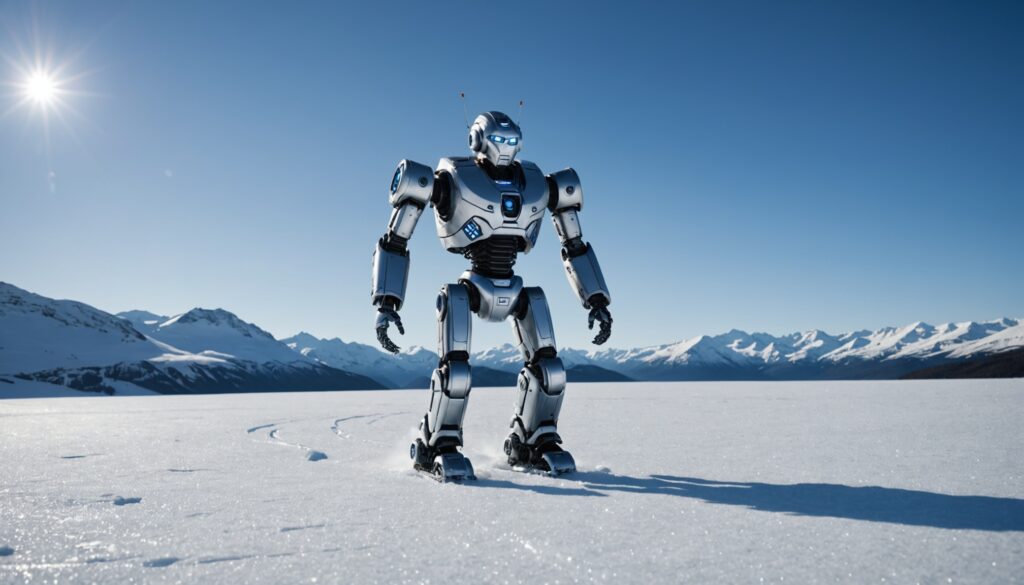
In a frozen and unforgiving landscape in northwest China, a technological feat has just captured global attention. A humanoid robot, nicknamed G1, has achieved an unprecedented accomplishment: exceeding 130,000 steps walked on ice at temperatures around -11°C. This record, at the crossroads of advances in robotics and endurance on extreme terrain, intrigues as much as it fascinates. More than a simple performance, this demonstration opens new possibilities for the future of autonomous machines in hostile environments, going far beyond the usual laboratories.
The scene unfolds in the Altay region, Xinjiang, where climatic conditions offer an almost extraterrestrial setting, with temperatures that can drop to -47.4 °C. Yet, it is precisely in this extremely harsh environment that the G1 ventured onto an icy area more than 186 meters long and 100 meters wide, progressing entirely autonomously. The video published by Unitree Robotics, the Chinese manufacturer of this robot, immortalizes this rare feat and highlights the importance of autonomous navigation, mechanical robustness, and adaptation to climatic constraints in the future of robotic development.
- 1 The technical challenges of a robot walking on ice at extreme negative temperatures
- 2 A historic performance: 130,000 steps on ice, what this means for robotics
- 3 The key role of autonomous satellite navigation in this ice-walking record
- 4 Robust design and advanced technology for a remarkable entry-level robot
- 5 Exceptional endurance demonstrated by a humanoid robot in extreme conditions
- 6 Unitree Robotics: a major player challenging competition through climate innovation
- 7 Future implications of this ice robotic performance for society and industry
The technical challenges of a robot walking on ice at extreme negative temperatures
Walking on ice is a formidable challenge, even for humans. For a robot, this challenge is multiplied by the complexity of the mechanical and electronic systems involved. The slippery surface, unstable supports, and strict thermal requirements imposed by a temperature of -11 °C demand exceptional mastery from the machine over its posture and movements.
Unitree Robotics’ G1 offers a fascinating example of adaptation to these constraints. Its structure includes between 23 and 43 joint motors, each capable of producing up to 120 newton-meters of torque, ensuring the power necessary to maintain balance and move forward despite the slipperiness of the surface. The batteries, often the first elements to suffer in such conditions, are particularly protected thanks to a clearly visible insulating jacket, as well as plastic shells securing the joints.
These choices illustrate that despite the sophistication of onboard technologies, pragmatic and sometimes simple solutions remain essential to withstand extreme conditions. Indeed, fine mechanics must survive the cold that slows down and quickly damages sensitive components. Temperature thus represents not only a limiting factor for the endurance of the robot but also a major obstacle to long-term reliability.
Autonomous control is also put to a severe test. Navigation on icy surfaces requires algorithms capable of correcting in real time the instability induced by the ice. The onboard sensors, notably a 3D LiDAR system and an Intel RealSense depth camera, allow the G1 to map and anticipate the environment to adjust its steps precisely. This system relies on the Chinese Beidou localization network, which offers remarkable accuracy thanks to centimeter-level measurements, a decisive asset to avoid slipping.
Thanks to this alliance between mechanics, electronics, and advanced artificial intelligence, the robot reaches a new milestone in terms of endurance and stability on particularly hostile natural terrain. This feat opens unprecedented prospects regarding the use of robots in icy exploration, industrial, or rescue environments in extreme zones.
A historic performance: 130,000 steps on ice, what this means for robotics
The 130,000 steps taken by the G1 are not just an emblematic figure but reflect a fundamental innovation in endurance robotics. This uninterrupted walk lasted not only several hours but took place under climatic and terrain conditions that made every step hard-earned.
This impressive number attests to remarkable mechanical and energy endurance. The battery system, with its 9,000 mAh capacity, allowed for two hours of autonomy at a maximum speed of 2 meters per second. Thus, the robot was not limited to a cautious pace but was able to evolve at a sustained cadence, consolidating its position as a pioneer in long-term reliability.
This performance marks a crucial milestone after many historic attempts by humanoid biped units on difficult terrains. While some robots were limited to controlled environments, the G1 proves that prolonged autonomous walking on ice at negative temperatures is now a reality. This breakthrough also resonates in the development of robotics for practical tasks in industry, scientific research, or even logistics in inaccessible areas.
Another key aspect is validation in real conditions. The robot followed a precise route without direct assistance, demonstrating the maturity of autonomous systems allowing increased machine responsibility in field missions. Even drawing an emblem of the Winter Olympics while walking highlights stability and precision of control previously unmatched.
Here is a table summarizing the main parameters of this record:
| Parameter | Details |
|---|---|
| Number of steps | Over 130,000 |
| Ambient temperature | Approximately -11 °C |
| Surface covered | 186 m x 100 m (icy area) |
| Battery autonomy | 2 hours (9,000 mAh battery) |
| Maximum speed | Up to 2 m/s |
This mastery of endurance paves the way for a new generation of robots capable of working in hostile climates without constant human intervention.
At the heart of this feat, autonomous navigation is not limited to simple piloting; it forms the foundation enabling the G1 robot to effectively adapt to slippery and shifting surface conditions. This navigation mainly relies on the Chinese satellite positioning system Beidou, known for its high precision, often compared to GPS with centimeter accuracy.
Using Beidou allows the G1 to stay on a precise path, avoiding obstacles and abrupt corrections that could compromise its balance. Artificial intelligence algorithms work in synergy with satellite data and onboard sensors (LiDAR, cameras) to analyze ground conditions in real time and anticipate necessary adjustments in step cadence and orientation.
This autonomous navigation system goes beyond usual industrial or logistical applications. In a natural and unstable environment, it proves indispensable to guarantee the safety and efficiency of robotic walking. The subtle dance between calculated impulses and the moving reality of the terrain makes the difference between imminent failure and a demonstration as spectacular as the one observed.
Moreover, the ability to adjust its trajectory without direct human intervention is a strong argument for future missions of exploration, rescue, or surveillance in isolated or climatically extreme regions.
Robust design and advanced technology for a remarkable entry-level robot
The G1 might surprise with its positioning: presented as an entry-level humanoid robot since its launch in May 2024, it nevertheless combines advanced technical features that allow it to compete against much more expensive machines.
Measuring about 127 cm and weighing only 35 kilograms, this robot integrates a flexible structure using a motorized architecture ranging from 23 to 43 motors depending on the configuration. This variation allows adapting power and precision according to mission needs, an advantage in terms of versatility.
Its sensor suite is complete: the 3D LiDAR provides precise three-dimensional mapping of the surroundings, while the Intel RealSense camera offers deep perception. Noise-reducing microphones optimize the reception of external sounds, illustrating a desire to equip the device with multi-sensory sensitivity.
In terms of energy, the removable battery offers about two hours of autonomy at full charge, which, combined with a powerful eight-core processor, gives it the capacity to perform demanding tasks over the long term. This technical configuration makes the G1 a multifunctional robot capable of operating in difficult zones accessible only on foot.
The marketing of the G1 starts at 99,000 RMB, approximately 14,240 dollars, making it accessible for companies seeking a reliable and robust model without reaching the exorbitant budgets of high-end humanoid robots. In 2025, Unitree Robotics already claimed to have delivered over 5,500 units, proof of strong market adoption.
Exceptional endurance demonstrated by a humanoid robot in extreme conditions
The ability to maintain continuous walking on ice for several hours at a temperature of -11°C illustrates a major advance in humanoid robot endurance. This performance goes well beyond classic laboratory demonstrations and approaches real operational conditions.
The cold represents a huge challenge, severely testing electronics and motors. Usually, batteries rapidly lose capacity and mechanical materials can become brittle. Yet, the G1 overcame these obstacles thanks to a thoughtful design incorporating thermal insulation and specific protections.
This endurance is also a response to a growing need: more and more applications require robots capable of operating in polar regions, on glaciers, or in accident sites where human presence is difficult or even dangerous. Energy autonomy and mechanical robustness thus become priority criteria.
Here is a list of potential applications favored by this exceptional endurance:
- Scientific exploration in cold and inhospitable regions
- Emergency interventions in snowy or accident-prone areas
- Environmental patrols and surveillance on slippery terrains
- Logistic support in mining or oil industries in extreme environments
- Technological tests and demonstrations for advanced robotics research
These possibilities demonstrate the importance of investing in research and the durability of robotic systems to face growing climatic and natural challenges.
Unitree Robotics: a major player challenging competition through climate innovation
The walking demonstration of the G1 in freezing cold comes in a context of intense global competition. Manufacturers are constantly striving to improve the resistance, mobility, and autonomy of their humanoid robots. Other companies like Deep Robotics communicate on capabilities down to -20 °C with their DR02 model, certified IP66, but Unitree pushes boundaries even further by testing at much lower temperatures, down to -47.4 °C during certain trials.
This technological advance is not limited to raw performance but fits into a pragmatic and economical approach. By maintaining a relatively accessible entry threshold, Unitree democratizes access to technologies until now reserved for highly specialized or costly machines.
Moreover, through this record, Unitree sends a clear message: environmental sustainability is becoming a central criterion in the development of humanoid robots. The ability to adapt to extreme thermal variations and slippery surfaces is now imperative to conquer new markets, notably those linked to severe cold, polar exploration, or military and civilian applications.
With over 5,500 robots sold in 2025, the Chinese company demonstrates a solid commercial momentum and growing international recognition. This trajectory suggests that other endurance and adaptation records could soon be broken, reflecting a permanent revolution in robotics.
Future implications of this ice robotic performance for society and industry
This new milestone in autonomous robots has profound consequences across several sectors. Firstly, it could transform how operations are envisioned in extreme environments. For example, deploying robots capable of walking on ice at very low temperatures could revolutionize rescue missions in polar or mountainous regions.
In industry, robots like the G1 can help inspect infrastructures exposed to freezing, perform maintenance in conditions that humans cannot endure for long, or transport loads in areas where traditional mobility is compromised.
Furthermore, scientific research directly benefits from these advances, enabling the installation and maintenance of devices in isolated zones for collecting environmental, climatic, or geological data. This robot could also inspire new manufacturing standards, integrating thermal resilience as a key aspect.
To better understand the stakes related to this emerging technology, here is a summary of the main expected benefits:
- Increase in safety for human operations in extreme environments
- Extension of areas accessible to scientific and industrial measurements
- Cost optimization through reduction of direct human interventions
- Promotion of sustainable development via the use of efficient and resilient robots
- Acceleration of technological innovation through real-world application
Each of these implications reflects a progressive shift where robots and humans could collaborate more closely, allowing the physical limits of exploitable environments to be pushed further.