Imagine a device that merges the charming world of a cartoon with the rigor of cutting-edge technology for home cleaning. This dream is now tangible thanks to Memo, a futuristic household robot developed by Sunday Robotics. Featuring a humanoid silhouette and remarkably fluid movements, Memo redefines home automation by drawing directly from human gestures. Rather than merely vacuuming or sweeping blindly, this robot learns through an unprecedented process called “Skill Capture,” which allows anyone to teach household tasks with a simple connected glove. The result is a revolution in household appliances: a versatile assistant capable of intelligently adapting to the uncertainties of domestic life.
The emergence of this household robot seems straight out of a cartoon, with its natural, almost human gestures and welcoming design. The technology implemented goes beyond simple sensors, integrating advanced artificial intelligence that analyzes and reproduces human behaviors like never before. At a time when most domestic robots remain limited to rigid routines, Memo offers a major innovation: learning by imitation without any tedious programming. This advancement marks a turning point in the future of cleaning and domestic assistance, providing a personalized solution to the complexity of indoor environments.
- 1 A futuristic technology inspired by cartoons for a revolutionary household robot
- 2 The technical challenges behind Memo’s intelligent automation
- 3 A multifunctional household robot capable of managing the complexity of the modern home
- 4 Memo facing the ethical and societal challenges of domestic robotics
- 5 The future of domestic robotics: between cartoon dream and scientific reality
- 6 A simplified user experience thanks to the Skill Capture innovation
- 7 Economic and commercial perspectives for the futuristic household robot Memo
A futuristic technology inspired by cartoons for a revolutionary household robot
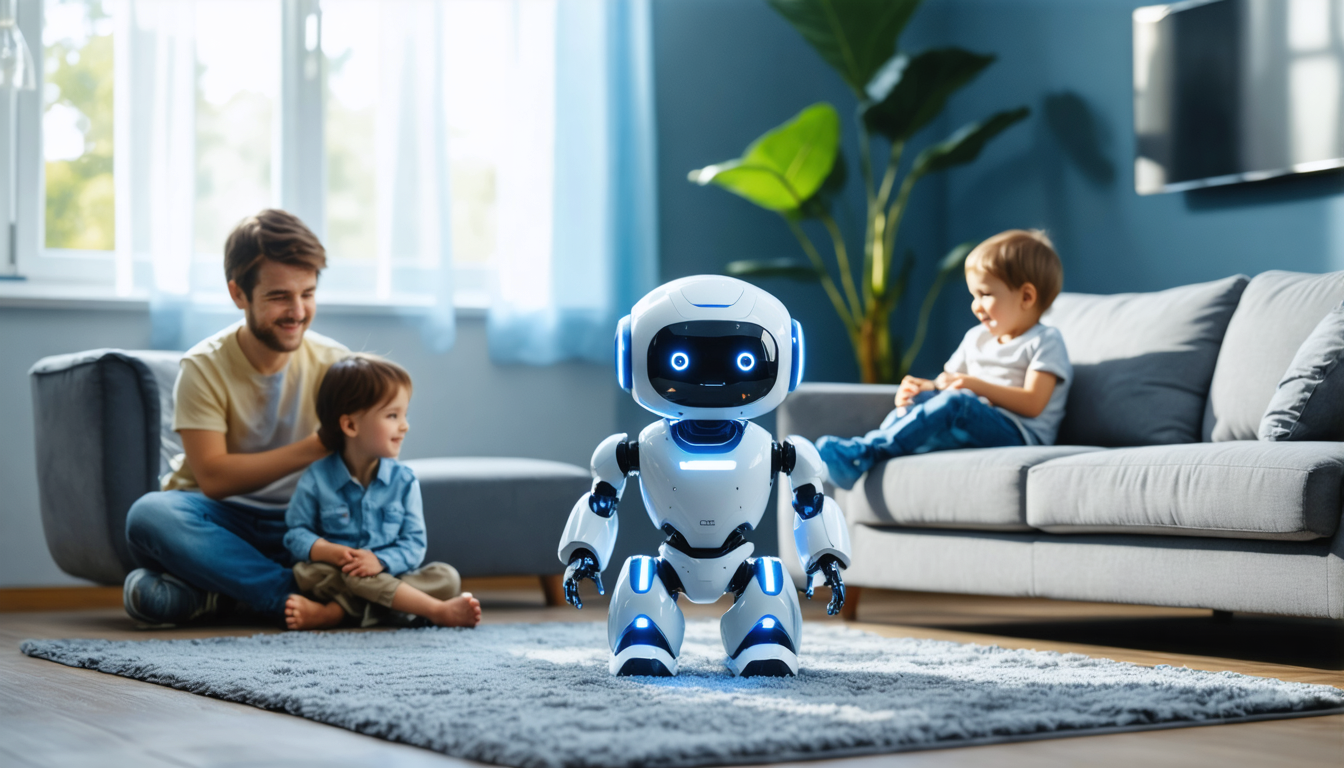
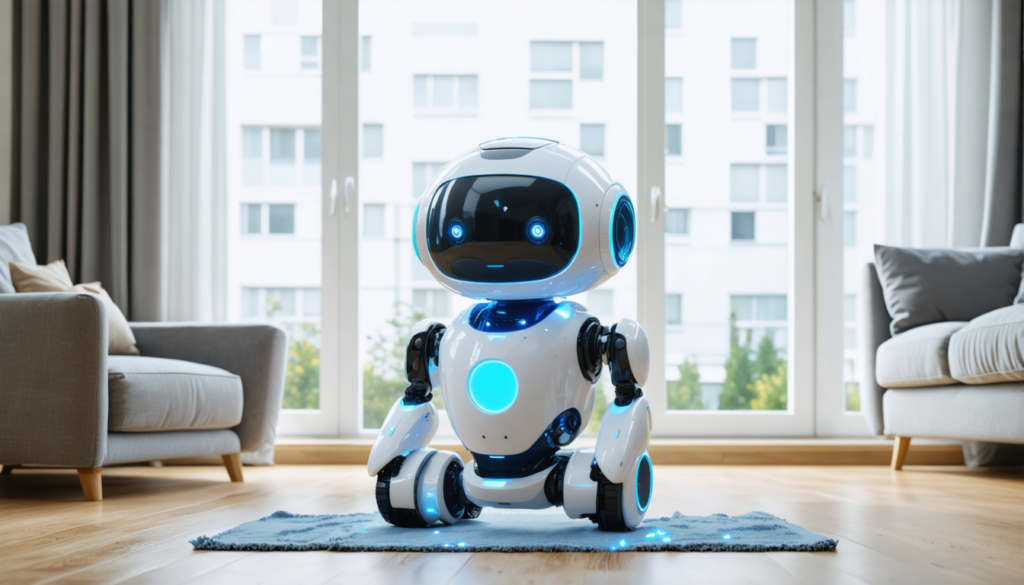
Memo first captivates with its carefully crafted aesthetic evoking a cartoon character, which contrasts with the traditional industrial style of household robots. This playful appearance facilitates harmonious integration into a family setting, reducing the distance often felt toward machines. But beneath this soft exterior lies revolutionary technology, centered on adaptive learning. Where traditional robots get stuck facing household surprises such as obstacles or unexpected objects, Memo analyzes each human gesture in real-time.
The heart of this innovation lies in the Skill Capture function, materialized by a smart glove. By putting it on, a user can easily teach it any household action, from laundry to making coffee. Unlike traditional programming, here there is no need to manually code movements: the system automatically records and digitizes the gestures. This learning-by-imitation process removes technical constraints, making usage accessible even to those with no knowledge of robotics.
Learning by imitation opens the door to a truly versatile household robot. The algorithm memorizes, refines, and combines the taught skills to handle a wide range of domestic needs. This model highlights a drastic change in how machines can integrate at home, offering a more flexible and less limited alternative than a simple preprogrammed vacuum cleaner or dishwasher.
The technical challenges behind Memo’s intelligent automation
Memo’s true success does not come only from its appearance or simplified learning, but especially from its ability to adapt precisely to varied domestic environments. Each home presents a wide range of configurations, obstacles, and objects of various shapes that complicate traditional programming of household robots. Most devices offered so far on the market operate with fixed patterns or simplified maps, which limits their effectiveness against unexpected situations.
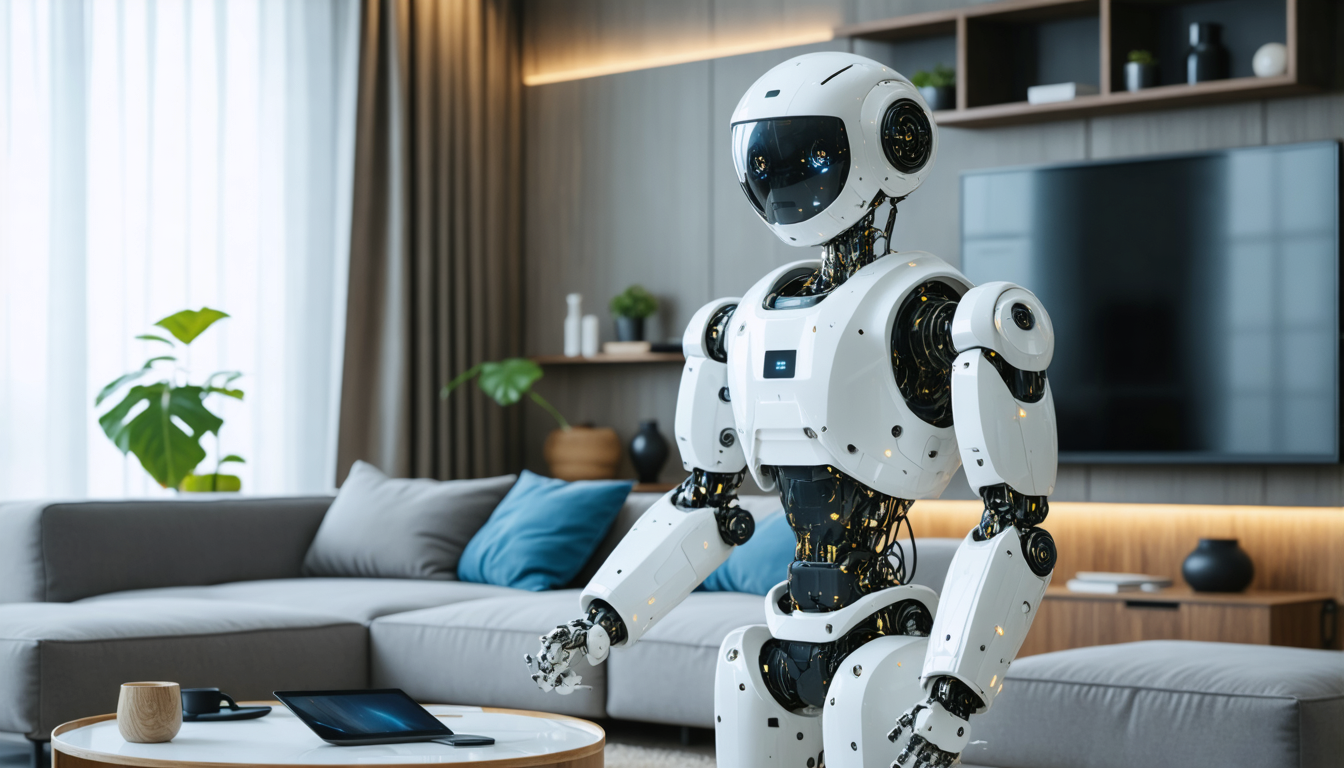
Memo, through its architecture, relies on a sophisticated mobile platform combined with a torso-arm mechanism with a soft silicone shell. This structure grants it almost human dexterity. The robot’s agile arms can grasp, move, or delicately manipulate all kinds of objects, from fragile glasses to folded clothes. This advanced mechanical combination reflects a dual objective: ensuring precision and fluidity in carrying out household tasks while minimizing risks of damage.
Adaptive programming calls upon machine learning algorithms that interpret environmental signals in real-time. For example, when Memo is tasked with cleaning a table, it can detect the unexpected presence of a vase or fragile object and adjust its movements accordingly. This flexibility prevents the typical errors such as dropping objects or blockages encountered by traditional household robots.
This technological feat requires significant computing power integrated into a compact embedded system. Sunday Robotics succeeded in condensing high analytical power into a domestic machine without compromise on size or safety. The presence of a silicone shell not only protects the robot but also ensures a more serene coexistence with the user.
A coordination challenge to replicate complex human gestures
The gestures we naturally perform, such as grabbing a dishcloth, folding clothes, or pouring coffee, involve fine coordination and precise perception of forces at play. Reproducing these movements within a household robot is a monumental challenge. Memo meets this challenge thanks to the Skill Capture Glove which records the movements, pressure, and orientation of human hands to transform them into exploitable data.
On this basis, the robot’s motors coordinate its arms with remarkable precision, avoiding the mechanical and rigid gestures characteristic of previous robots. Dynamic learning ensures that with each new demonstration, mastery progresses until reaching an almost natural level. This process brings Memo closer to a domestic companion rather than a mere machine.
A multifunctional household robot capable of managing the complexity of the modern home
Beyond simple cleaning, Memo embodies a major innovation in comprehensive domestic assistance. It is not limited to vacuuming or mopping floors: thanks to its extended manipulation capabilities, this revolutionary robot can handle numerous daily tasks with rare adaptability.
Among the demonstrated uses are the ability to fold and sort laundry, load and unload a dishwasher, or even prepare an espresso. These functions, long reserved for human intervention, are now automatable with precise and reproducible results.
In a world where the mental load associated with chores increasingly weighs on households, this advancement is significant. Memo acts as a true assistant, significantly reducing the time spent on household tasks. This revolution thus transforms the very concept of household appliances, favoring multifunctionality closely tailored to personal habits.
The key features offered by Memo include:
- Precise and delicate handling of objects of all sizes and shapes.
- Simplified learning by imitation without any programming.
- Versatility in household tasks: cleaning, tidying, cooking.
- Dynamic adaptation to unexpected obstacles and objects.
- Intuitive interface via the Skill Capture Glove for teaching gestures.
Memo facing the ethical and societal challenges of domestic robotics
While Memo fascinates with its technology and potential to revolutionize cleaning, it also sparks a deep debate about the evolving role of robots in daily life. The growing dependence on these automata raises questions about privacy management, security, and human relationships within the home.
The integration of a robot able to access all areas of the house, capable of reproducing highly complex gestures, implies increased vigilance. Errors or misunderstandings in learning could cause incidents, especially in sensitive environments like the kitchen with its hot or sharp appliances.
Sunday Robotics has thus engaged in an open dialogue to anticipate these risks, planning a limited beta program at the end of 2026. This phase will allow observation of interactions in real homes while ensuring respect for personal data and user safety.
Moreover, the issue of psychological dependence on a household assistant is also raised. The challenge is to maintain a balance between automation and human involvement to avoid a decline in traditional domestic skills.
A summary table of the main challenges
| Challenges | Description | Planned solutions |
|---|---|---|
| Safety | Risk of accidents due to learning errors in complex environments. | Testing phase in real conditions with human supervision. |
| Privacy | Possibility of collecting sensitive data by the robot within the home. | Enhanced data protection and limited beta version. |
| Technological dependence | Risk of excessive use harming domestic autonomy. | Encouragement of balanced use with regular human intervention. |
| Social impact | Changes in family dynamics and social interactions. | Educational support and awareness for responsible use. |
The future of domestic robotics: between cartoon dream and scientific reality
Thanks to Memo, the futuristic image of a household robot directly inspired by a cartoon becomes tangible in our homes. This unique bridge between childish imagination and technological advancement introduces a new era where domestic tasks turn into interactive and personalized exchanges.
Sunday Robotics embodies this revolution in cleaning through integrated innovation combining fluidity, intuitive learning, and versatility. This approach promises to profoundly change our perception of household appliances, now seen as a true domestic companion.
This qualitative leap in robotics goes far beyond mere automation; it paves the way for intelligent cohabitation where the robot becomes an actor capable of learning and adapting with progressive autonomy. This future is beginning to take shape, outlining a home where cleaning chores give way to harmonious collaboration.
A simplified user experience thanks to the Skill Capture innovation
The introduction of the Skill Capture Glove by Sunday Robotics transforms interaction with a household robot into a natural and accessible process. This smart glove captures in detail every movement made by the user, enabling rapid and efficient skill transmission.
Unlike traditional approaches requiring advanced coding skills, the user simply performs the task as they normally would. The robot then memorizes these gestures and integrates them into its database for perfect reproduction. This system resembles a reversed pedagogy, where the learner is actually the teacher of their assistant.
This innovation is not limited to cleaning but can be applied to all sorts of domestic and even culinary actions, thereby reinforcing the robot’s versatility in daily life. Ultimately, this technology removes a major barrier between humans and domestic machines, facilitating mass adoption.
- Precise recording of hand and finger movements.
- Intuitive interface with no programming required.
- Progressive expansion of the robot’s skill library.
- Ability to adapt gestures to specific contexts (e.g., kitchen, bathroom).
- Error reduction through continuous learning.
Economic and commercial perspectives for the futuristic household robot Memo
Memo represents a paradigm shift in the home appliance and smart home industries. By surpassing classic household robots, it opens an innovative market where personalization and artificial intelligence are at the core of the offering.
Sunday Robotics, launching a limited beta program in 2026, aims to establish itself as a pioneer in a growing sector. The robot currently targets households with a certain purchasing power due to its significant development cost, but medium-term prospects foresee a gradual democratization through more affordable versions.
The commercialization of Memo could drive a new dynamic, encouraging appliance brands to incorporate more intelligence and learning into their products. In an era where consumers are eager for smart home innovations, this advance also opens doors to collaborations between manufacturers to enhance the digital ecosystem of the connected home.
Key factors for Memo’s commercial success:
- Ability to adapt to the specific needs of each household.
- Simple and accessible interface for all users.
- Premium offer justified by versatility and quality of performance.
- Progressive launch strategy with a rigorous beta program.
- Potential to extend into other areas of domestic robotics.