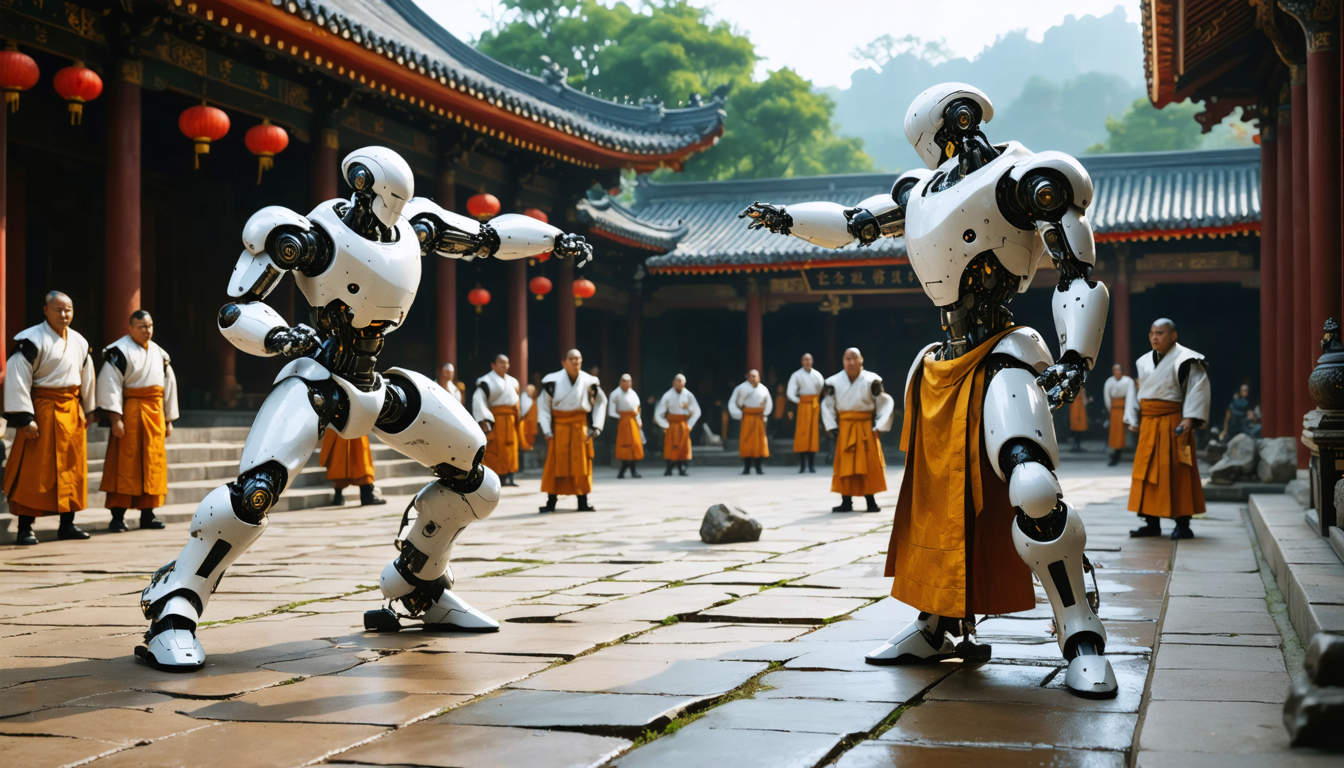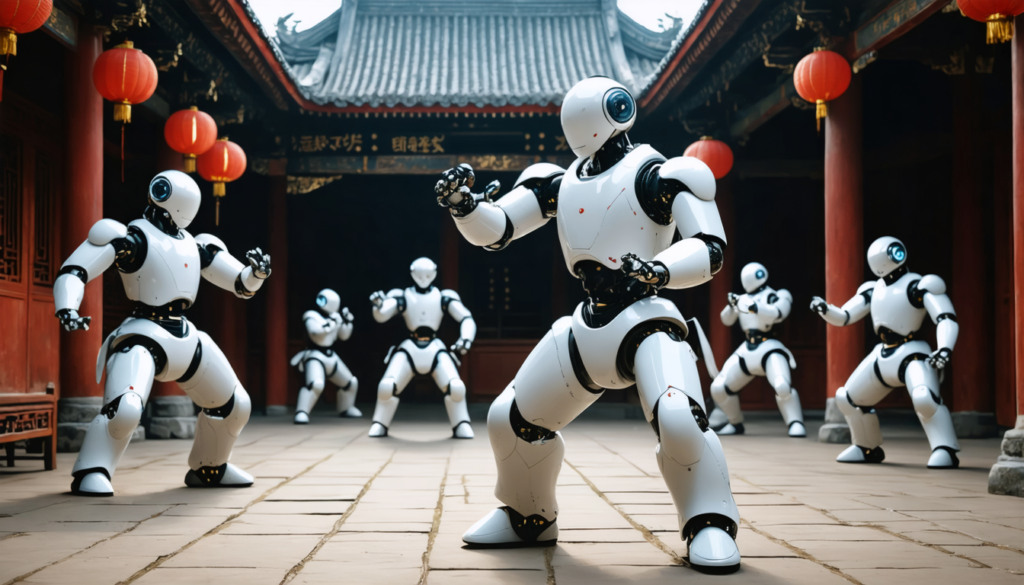
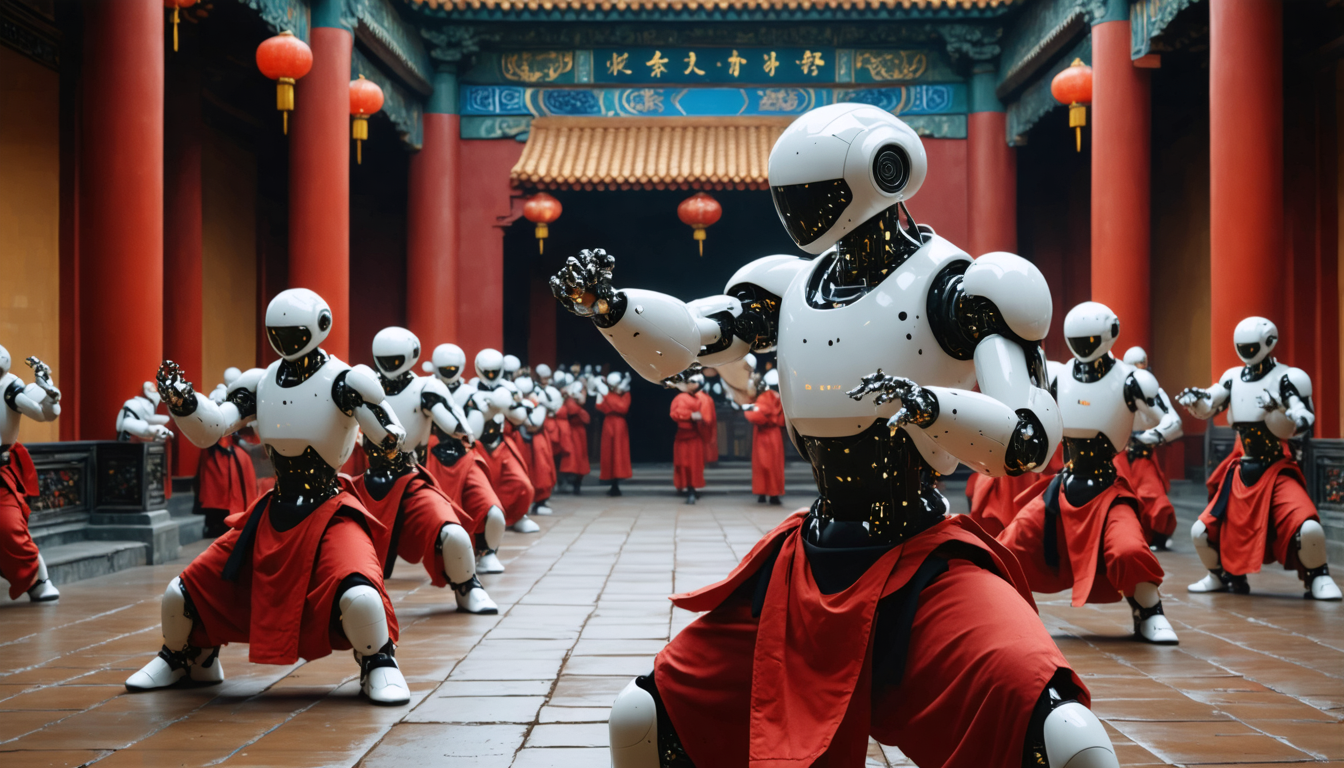
In a striking convergence between millennia-old tradition and advanced technologies, humanoid robots are now training in the classical martial arts of kung-fu alongside Shaolin monks in the iconic Henan temple in China. This scene, filmed and widely shared on social media, not only illustrates a technological feat but also makes tangible a new dialogue between ancient Chinese culture and innovation in robotics and artificial intelligence. The machines, endowed with near-human precision and flexibility, reproduce codified movements with impressive synchronization, blurring the boundaries between spiritual discipline, physical training, and automation. This spectacular immersion into the world of robots in 2026 attests to the growing capacity of humanoids to learn and adapt through observation, using cutting-edge AI systems, thus creating new fields of application for these technologies beyond laboratories.
While these robots appear today in a context as emblematic as the Shaolin kung-fu temples, their skills far exceed mere demonstration. These developments herald a profound transformation in the way machines can interact with their environment, imitate complex gestures, and integrate into demanding human practices, both cultural and physical. The video, which has gone viral, reflects a rapid evolution of robotic know-how, particularly thanks to innovative learning systems and AI models capable of generalizing their knowledge from few data. The success of these joint trainings between robots and monks paves the way for unexpected applications while reviving the debate on human-machine integration in sensitive fields such as martial arts.
- 1 Humanoid robots: a technological leap in the service of traditional kung-fu
- 2 Agibot: the pioneering Chinese firm of artificial intelligence applied to martial arts
- 3 Learning and training: when robotics draw inspiration from martial arts to progress
- 4 The cultural and philosophical stakes of integrating robots into Shaolin practices
- 5 The evolution of humanoid robots towards practical applications beyond demonstrations
- 6 The place of respectful technology in the balance between human and robot
- 7 Perspectives and future uses of humanoid robots in martial arts and beyond
Humanoid robots: a technological leap in the service of traditional kung-fu
Recent advances in humanoid robot design highlight a spectacular evolution of robotics, far beyond the classical industrial domain. Today, these human-like machines can accomplish complex physical tasks such as running, jumping, or even dancing, with surprising fluidity. Their appearance in practices as codified and demanding as kung-fu reveals an unprecedented level of mechanical and software mastery. The Lingxi X2 robot, produced by the Chinese company Agibot based in Shanghai, embodies this revolution. About 1.3 meters tall and weighing just over 33 kilograms, it displays remarkable agility thanks to sophisticated motors, a lightweight structure, and a powerful artificial intelligence algorithm.
The cultural dimension of Shaolin kung-fu adds an additional layer to this progress. Shaolin martial arts are not merely sequences of gestures; they represent a form of mental and spiritual discipline, a heritage transmitted over centuries. The robots must therefore integrate not only the physical dimension but also the rigor and precision specific to this culture. Their learning is based on advanced imitation algorithms, combined with dynamic training capable of adjusting movements in real time. This explains the remarkable fluidity and synchronization observed in the official video, where several robots perform complex forms together, such as the palm strike, the monkey transition, or the Webster somersault, without losing harmony or aesthetics.
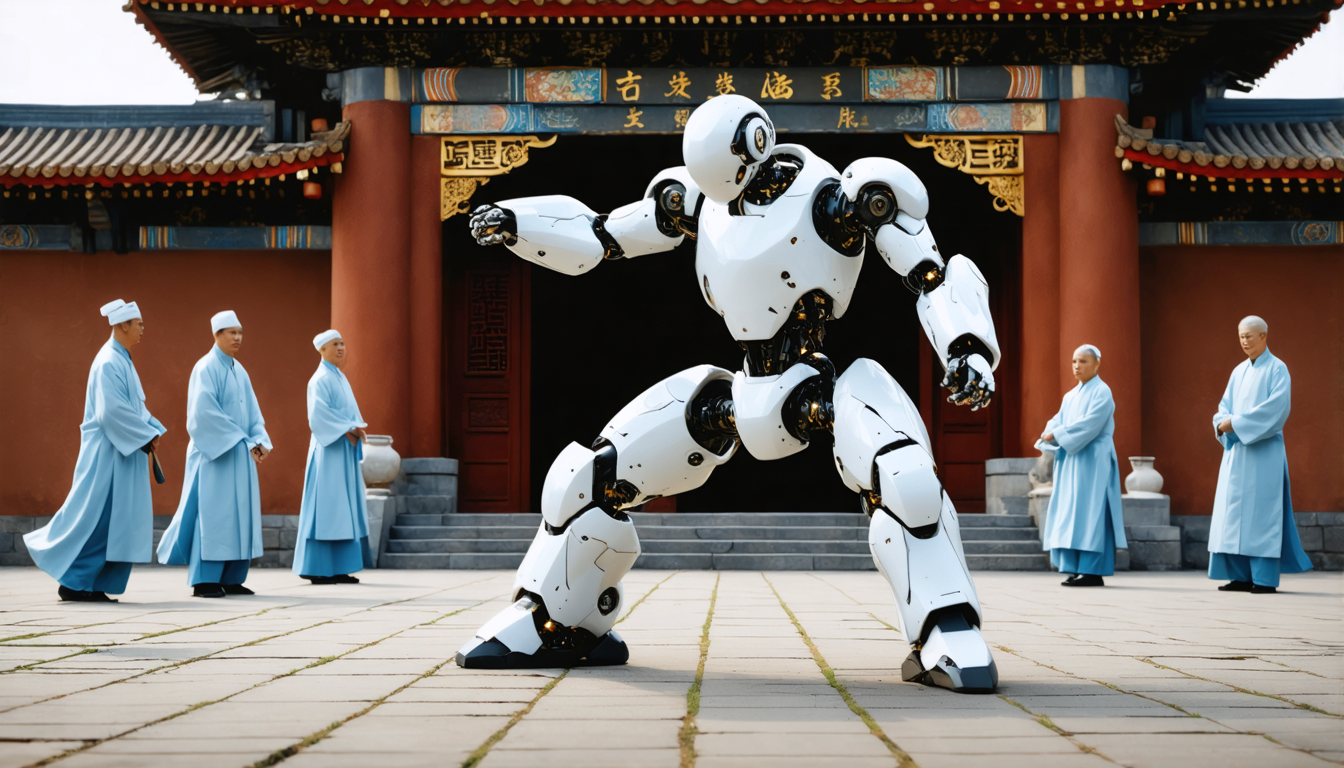
Agibot: the pioneering Chinese firm of artificial intelligence applied to martial arts
The company Agibot, founded in Shanghai, has quickly established itself as a leader in developing humanoid robots capable of reproducing human movements with surprising precision. Since its inception, it has multiplied spectacular demonstrations, illustrating the versatility of its machines. Already in March 2025, Agibot impressed the world by unveiling its Lingxi X2 machine riding a bicycle outdoors, a feat revealing its expertise in dynamic balance and coordination. This ability to combine power, agility, and complex balance then translated into mastering demanding gymnastics figures, such as the Webster somersault, highlighting a rare finesse of motor control, welcomed in a robot.
With the training of machines in Shaolin martial arts, Agibot crosses a new threshold. This approach aims neither at staging nor mere exhibition, but rather at the practical demonstration of a next-generation artificial intelligence system. This system, called GO-1 (Genie Operator-1), allows flexible, intuitive, and adaptive management of movements, giving robots the ability to understand and anticipate human gestures without requiring exhaustive training on each specific task. An essential feature when it comes to improvising or interacting live with other beings – human or robotic – in a rich and variable environment. This innovation is at the heart of the new generation of humanoid robots.
The key role of the GO-1 model in coordination and mastery of movements
The core of the performance lies in the artificial intelligence that pilots each robot’s movement. The GO-1 model functions as a cognitive interface, capable of interpreting, adapting, and anticipating complex sequences thanks to a revolutionary learning method called “latent actions.” This technique relies on the intelligent exploitation of visual images captured in the past and in real time, rather than on a classical accumulation of annotated and preprogrammed data.
Concretely, GO-1 offers unprecedented generalization capacity in humanoid robotics. It allows robots to learn by themselves through observation, without requiring exhaustive examples or permanent corrections. Thus, several robots can practice and synchronously include complex sequences, as highlighted by the footage filmed at the Shaolin temple. This particular adaptability facilitates not only coordination between machines but also their adjustment to changes in terrain, speed, and movement intensity. The smooth integration of visual data ensures a better understanding of the nuances of traditional kung-fu while respecting the cultural discipline.
Learning and training: when robotics draw inspiration from martial arts to progress
The dynamic learning of humanoid robots is nourished more than ever by fine observation and rigorous repetition, much like Shaolin monks who spend years perfecting their discipline. The scope of this method far exceeds simple mechanical reproduction. Indeed, the AI embedded in these machines captures the subtleties of the human body in motion, going beyond raw gesture to integrate notions of fluidity, balance, and breathing, fundamental in kung-fu.
Through this shared training, humanoid robots acquire a more intuitive and sensory knowledge of movement. While Shaolin monks transmit their ancestral knowledge, these machines gather a multitude of behavioral data that feeds their artificial intelligence model. This reciprocal learning loop, although symbolic, opens the way to a hybridization between human discipline and technology. For Agibot, this process is strategic: it aims to develop robots capable of integrating into real environments where interaction complexity requires flexibility and anticipation.
Moreover, this unprecedented training confronts robots with requirements of physical safety and respect for cultural context. Algorithms must balance efficiency and caution, in order to prevent accidents while preserving the integrity of martial sequences. This allows addressing several challenges coordinating technique, ethics, and tradition.
The cultural and philosophical stakes of integrating robots into Shaolin practices
The alliance between robots and Shaolin monks naturally raises questions around respecting Chinese culture and the symbolic value of kung-fu. This martial art, unfolding for centuries as a path that is spiritual, philosophical, and physical, embodies the balance between man, body, and mind. The presence of robots alongside the monks transforms this traditional framework, mixing ancient fervor and technological advancement.
For some observers, this collaboration seems like a modern tribute; an innovative bridge between past and future. For others, it may also generate unease, reflecting a fear about what this robotic fusion could mean for preserving authentic human practices and the deep connection to cultural roots. Yet, thanks to the use of a respectful and non-intrusive artificial intelligence, Agibot’s goal remains above all educational and experimental rather than competitive or belligerent.
This experiment at the Shaolin temple thus invites reconsideration of what discipline and mastery are. Is it only the fruit of decades of training by a human being, or is it also a skill that can be reproduced and even improved by technological power? This question, far from trivial, testifies to a upheaval of paradigms around the notions of “living” and “machine,” but also the possible forms of learning in a society where technology occupies an increasing place.
The evolution of humanoid robots towards practical applications beyond demonstrations
While robots performing in demonstrations such as those at the Shaolin temple awaken curiosity, their usefulness is gradually extending towards more concrete uses. Fine control of the robotic body, the ability to anticipate and synchronize, open the door to scenarios where precision and reactivity are essential, notably in jobs requiring delicate manipulations or interventions in complex environments.
Examples of possible applications:
- Medical care assistance: robots could assist surgeons in complex gestures requiring great precision.
- Rescue interventions: in dangerous areas, humanoids can intervene to rescue or transport injured persons.
- Delicate industrial work: assembling sensitive parts or maintenance in hostile environments.
- Educational support: robot-assisted learning for physical activities, including martial arts.
- Companionship for elderly or disabled persons: intuitive and responsive interaction according to needs.
The table below illustrates key progress of Agibot’s humanoid robots compared to human abilities in various fields related to kung-fu and physical training in general:
| Ability | Lingxi X2 Robot (2026) | Experienced Shaolin Master |
|---|---|---|
| Movement precision | ± 1 mm on average | ± 0.5 mm (depending on the gesture) |
| Group synchronization | Excellent, thanks to GO-1 | Excellent |
| Adaptation to terrain | Good, vision-based learning | Very good |
| Physical endurance | Unlimited (in theory) | Variable, depending on physical condition |
| Learning ability | Fast, systematic observation | Slow, based on human experience |
The place of respectful technology in the balance between human and robot
Criticisms surrounding robots in martial arts are numerous, often fueled by fear of denying human skills in favor of dehumanizing automation. Yet, designers insist on a complementarity between man and machine, emphasizing technology serving humans, and never replacing them.
Agibot’s bet is to create robots that learn by watching, thus assimilating gestures not in a purely mechanical logic but rather in a respectful and adaptive approach. This vision reduces the gap between discipline and creativity, opening the way to collaborative training, both benevolent and demanding.
Moreover, robots help to valorize Chinese culture and martial arts by offering a new global showcase for these disciplines. They enrich transmission while reinforcing the educational impact. The challenge now is to achieve harmonious integration of these machines into society, taking into account ethical, cultural, and human considerations accompanying each technological advance.
Perspectives and future uses of humanoid robots in martial arts and beyond
The development of robots capable of learning and reproducing complex movements in martial arts marks a major step in advanced robotics and artificial intelligence. As these machines gain autonomy and adaptability, they open important perspectives in sectors as varied as health, education, security, and sports.
Following the demonstrations at the Shaolin temple, researchers plan to extend learning by observation to other martial techniques, as well as demanding physical activities. Developing even more agile robots, capable of interacting naturally with humans in dynamic situations, remains a priority. This trend illustrates a movement towards enriching coexistence between robots and humans.
Finally, these developments also raise the question of the place of artificial intelligence in domains traditionally reserved for humans. They invite a rethinking of the notion of training, mastery, and learning in an era where machines and humans coexist to meet common challenges.