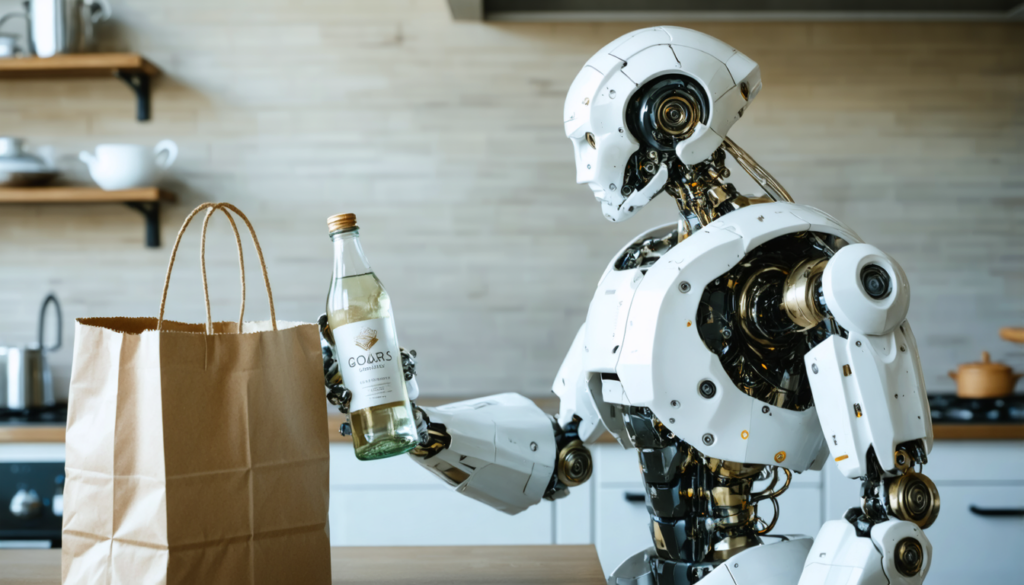
In a world where robotics and artificial intelligence are advancing at a breakneck pace, it may seem paradoxical to watch a video where a robot struggles to slip a simple bottle of olive oil into a paper bag. This moment of hesitation, almost comical at first glance, actually stems from technical challenges of unsuspected complexity. In 2026, spectacular advances mingle with a humbler reality, where patience and precision prevail. This sequence filmed by the British start-up Humanoid offers an unvarnished glimpse into the difficulty for an automaton to handle fragile objects in a domestic environment, without human intervention. Thus, behind every awkward movement, there is an entire engineering where robotics, artificial intelligence, and automation intertwine taking shape. The challenge is no longer simply to design robots capable of performing acrobatics or dancing, but rather to integrate these machines into our daily lives with finesse and safety.
This mundane scenario, that of a robot trying to buy a bottle and place it in a bag, illustrates a major technological challenge: how to prevent the bottle from breaking or the bag from tearing, while performing this ordinary gesture for a human? This video appeals as much for its authentic aspect as for the promise of a new era of innovation in the field of autonomous robots, capable of understanding and interacting with real objects, fluctuating in shape and resistance. The technological feat lies therefore not so much in speed as in mastering the gesture through a precision strategy supported by advanced artificial intelligence. This giant step, presented with humility, redefines our expectations of domestic robotics and prompts deep reflection on the future of automation and human-machine interactions.
- 1 A technological challenge: the underlying complexity of a simple gesture of a robot with a bottle and a bag
- 2 KinetIQ: artificial intelligence at the service of fine and adaptive robotics
- 3 Safety, a fundamental criterion in today’s domestic robotics
- 4 Autonomous robotics facing reality: no more scripted demonstrations
- 5 Domestic automation: what stakes for daily life in 2026?
- 6 A promising future: the expected evolution of robotics in the coming years
- 7 From viral video to concrete reality: understanding the impact of this robotic demonstration
A technological challenge: the underlying complexity of a simple gesture of a robot with a bottle and a bag
At first glance, seeing a robot struggle to slip a bottle of olive oil into a paper bag seems trivial, even unimpressive. But behind this slowness lies a set of colossal technical issues. Handling objects with varied physical characteristics – fragility of glass, flexibility of the paper bag – requires the robot to develop highly sophisticated tactile and kinematic evaluation capabilities. Each action involves a series of real-time calculations, which make it possible to gauge the pressure to apply, the ideal angle, and the trajectory without causing damage.
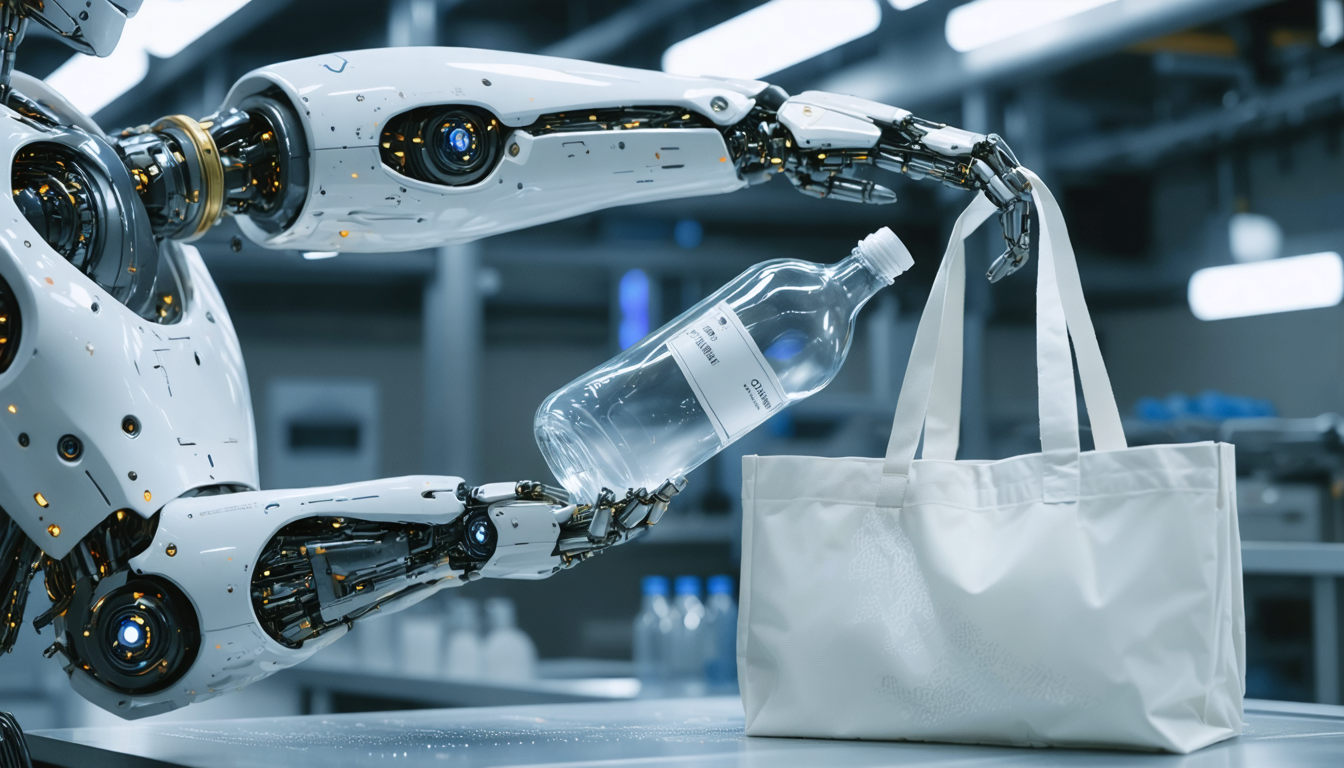
This video sequence is particularly revealing of the efforts deployed by the engineers of the British start-up Humanoid to approach a plausible robot-human interaction. Unlike remote-controlled robots or those piloted by a human via a virtual reality headset, here, each movement is the fruit of an autonomous artificial intelligence, capable of adapting to unforeseen events and material variability. For example, the robot must anticipate the possible deformation of the paper bag under the weight of the bottle. It must calibrate its movement with extreme precision to avoid tearing, a feat that requires more than simple programming of a fixed routine. The artificial intelligence engine called KinetIQ is at the heart of this achievement: it orchestrates the coordination between software and hardware commands, continuously improving the robot’s decision-making.
Moreover, this deliberate slowness shows that every micro-movement is evaluated by a real-time learning loop, where the machine verifies stability, pressure exerted, and material resistance throughout the handling. The challenge goes far beyond what viral videos of robotic acrobatics might suggest, highlighting a crucial innovation for anyone seeking reliable domestic automation. More than a demonstration of power, this is a lesson in precision and dynamic adaptation.
KinetIQ: artificial intelligence at the service of fine and adaptive robotics
The KinetIQ system symbolizes the recent evolution of robotics towards finesse and responsiveness. Designed to combine artificial intelligence software and interconnected robotic hardware, this concept relies on a layered architecture where each level controls and guides the one below it. This cascading structure allows the entire system to adapt to the overall objectives defined by the user, with remarkable sophistication.
In the scene where the robot places a bottle in a bag, KinetIQ manages in real time the information coming from tactile, visual, and kinesthetic sensors. This multiple sensory integration acts as a collective brain capable of anticipating and modifying the manipulation strategy. Like a conductor, the humanoid robot transmits human verbal commands to wheeled robots responsible for physically carrying out the actions in the kitchen. This collaborative approach illustrates a major innovation in coordination between distinct, efficient robots capable of sharing a common mission.
Thanks to KinetIQ, the robot does not apply a simple pre-programmed routine but improvises in the face of a concrete situation, whose parameters are not fixed. Thus, without external intervention, it evaluates the resistance of the bag and the glass bottle, and adjusts its approach accordingly. This complex cognitive approach highlights the scope of an artificial intelligence grounded in the understanding of materials and the environment, an essential step toward credible domestic automation.
| Characteristics | KinetIQ Features | Impact on Manipulation |
|---|---|---|
| Multisensory sensors | Tactile, visual, and kinesthetic analysis | Precise evaluation of materials and deformation |
| Layered architecture | Command hierarchy and feedback | Real-time movement optimization |
| Multi-robot coordination | Communication between humanoid and mobile robots | Smooth and distributed task execution |
| Adaptive learning | Strategy reevaluation according to conditions | Error reduction and increased safety |
Safety, a fundamental criterion in today’s domestic robotics
One of the most impressive aspects of the video is the absence of any specific protection for humans near the robot. Indeed, an operator is filmed very close to the machines, without helmet or physical barriers, a sign of strong confidence in the embedded safety. The deployed technology guarantees intelligent collision management, thus avoiding any risk of injury.
This advance is not trivial. For years, domestic robotics has faced legitimate concerns about coexistence between humans and machines. The risks associated with sudden or unexpected movements sometimes hinder the wider adoption of these systems. Yet, Humanoid and its engineers have here proven that artificial intelligence is not limited to computing or adapting capacity but also includes the ability to preserve users’ physical integrity.
Certification and approval by legal and technical experts underline the excellence of the integrated control system. The robot instantly detects the proximity of a human and modulates its actions accordingly, applying strict standards. This level of safety marks a crucial step for domestic robotics to conquer the mass market, where trust remains an important psychological barrier.
Autonomous robotics facing reality: no more scripted demonstrations
In the media, many videos show robots moving with disconcerting fluidity, performing spectacular gestures seemingly effortlessly. Yet, reality proves much more complex. These often spectacular demonstrations frequently rely on human teleoperation thanks to VR headsets or remote controls. In 2026, a significant portion of these presentations, even in reputable companies, still hides a human part behind the precise maneuvers.
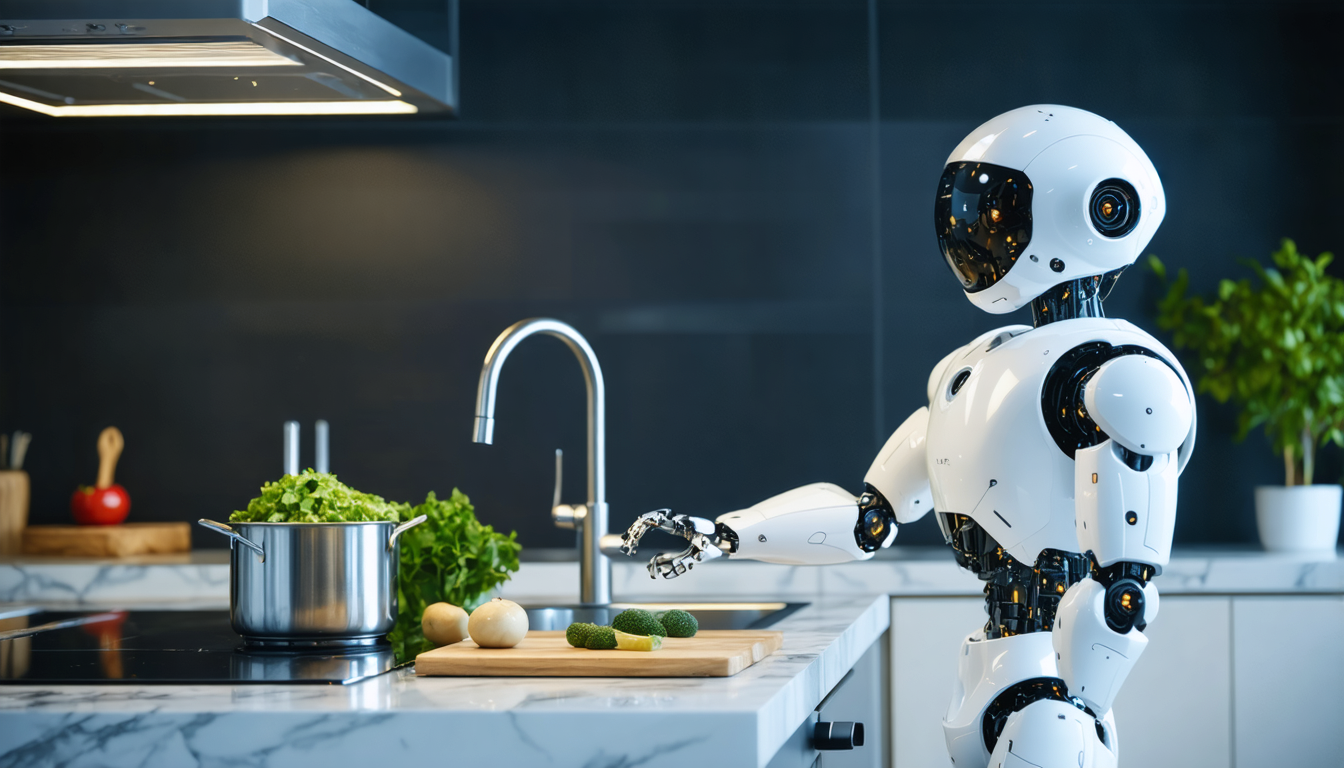
The video published by Humanoid breaks with these clichés. Here, the machine does not follow a prerecorded script but acts autonomously. Every movement is thought out, calculated, and redone if necessary. The robot must “improvise” in light of the tangible reality of the world around it, which represents a true technological innovation challenge. This shift is all the more visible when observing the hesitations and incessant adjustments, tangible signs of an artificial intelligence in a learning phase, which seeks to master domestic gestures in real time.
This approach reflects a profound change in the way robotics is perceived: automation no longer consists of mechanically repeating actions but adapting to an infinity of daily variations. The ability of a robot to manage unprecedented situations is now taken as a criterion of excellence.
Domestic automation: what stakes for daily life in 2026?
The progressive integration of robots into our kitchens or living rooms raises a series of major questions for domestic automation. A robot’s ability to handle objects delicately is one of the pillars for successful adoption. This implies not only extreme precision but also constant adaptation to varying materials and environmental constraints, such as the fragility of bags and glass bottles.
This meticulous interaction opens the door to a variety of applications ranging from aid for elderly or disabled people to support in meal preparation. However, the slowness observed in the video underlines that reliability takes precedence over speed. Indeed, a rushed movement can lead to accidents or material losses, which would be counterproductive in a domestic setting. Thus, autonomous robotics in 2026 primarily aims to reconcile safety, efficiency, and comfort.
The uses in daily life are multiplying and can be classified into several categories:
- Domestic assistance: tidying objects, storing, transporting fragile items.
- Mobility and grasping aid for people with loss of autonomy.
- Surveillance and emergency intervention in households.
- Support for learning and educational activities with robotic interaction.
Intelligent automation, embodied here by Humanoid, opens new perspectives where technology becomes a daily partner, but on the condition of a progressive integration adapted to current limits.
A promising future: the expected evolution of robotics in the coming years
The apparent slowing of the robot in the video actually hides a phase of learning and continuous improvement. As the KinetIQ algorithms grow in sophistication, machines will become faster, safer, and above all more intuitive. The future of domestic robotics will pass through improved sensors, better understanding of complex contexts, and harmonious integration of different robots within the same environment.
The outlook also includes stronger collaboration between humans and robots, where tasks are shared smoothly. This symbiosis will free up time, reduce domestic incidents, and improve quality of life. Moreover, the ethical and safety dimension will take center stage, ensuring broad and peaceful adoption among users.
The most promising research areas include:
- Development of advanced tactile sensors for better perception of texture and resistance.
- Deep learning techniques to anticipate and adapt to changing environments.
- Increased interoperability between robots and connected objects for intelligent home management.
- Advances in miniaturization and power of components for more maneuverable robots.
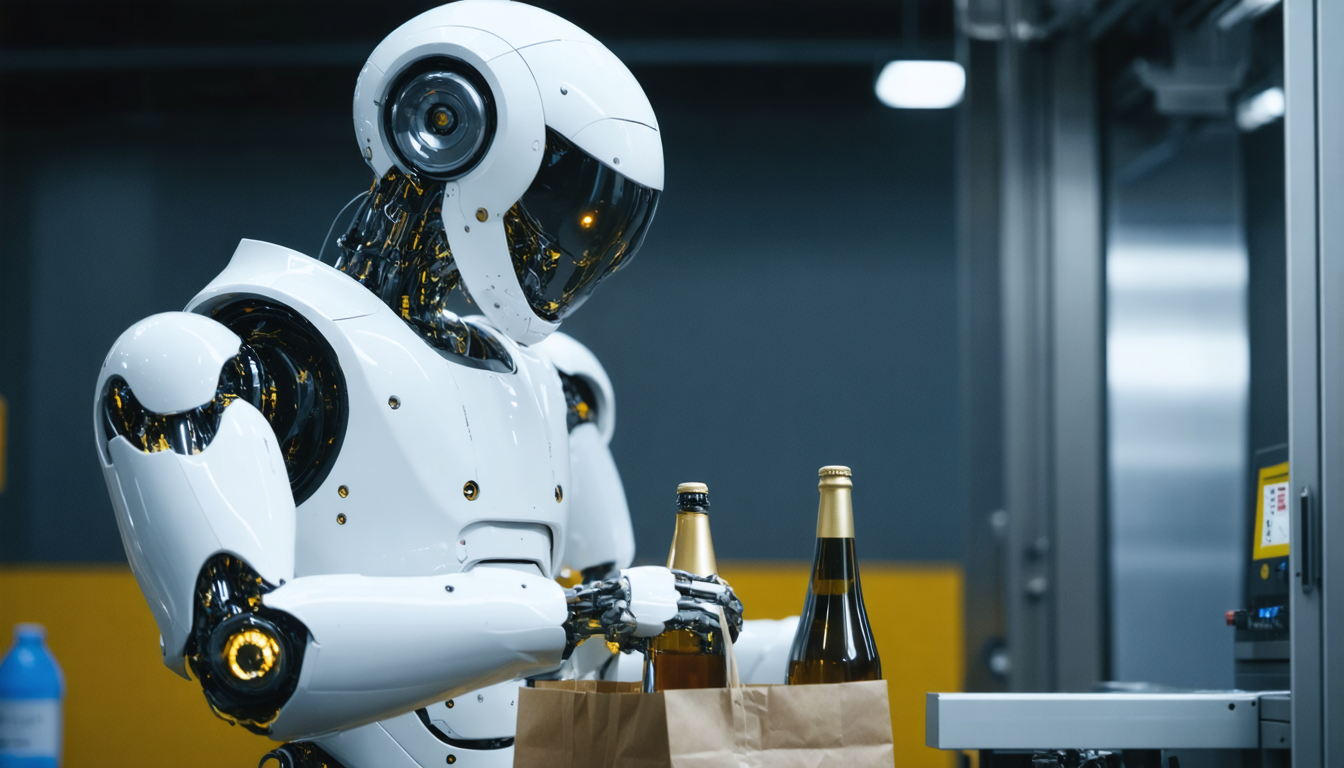
While we are used to images of spectacular robots, this video, at first glance devoid of intense action, is a true lesson. It highlights the difficulty of taming a domestic environment with multiple physical constraints, thus emphasizing the value of each progress. The hesitations, adjustments, and recalibrations of the automaton reveal a system in full evolution, capable of performing a complex task with autonomy never seen before.
In the current debate between marketing promises and tangible reality, Humanoid chooses transparency. This demonstration, controlled but without artifices, allows reestablishing a healthy dialogue on expectations in robotics. The challenge of sustainably installing robots in our homes passes through this recognition of limits, but also through enthusiasm for constant innovations. It is this subtle balance between patience and ambition that shapes the contours of a future where technology truly becomes a partner in daily life.